
MacKenzie Realty's Strategic Restructuring and the Road to Profitability
MacKenzie Realty Capital’s creation of MacKenzie Apartment Communities and advisory amendments mark a pivot addressing persistent losses.
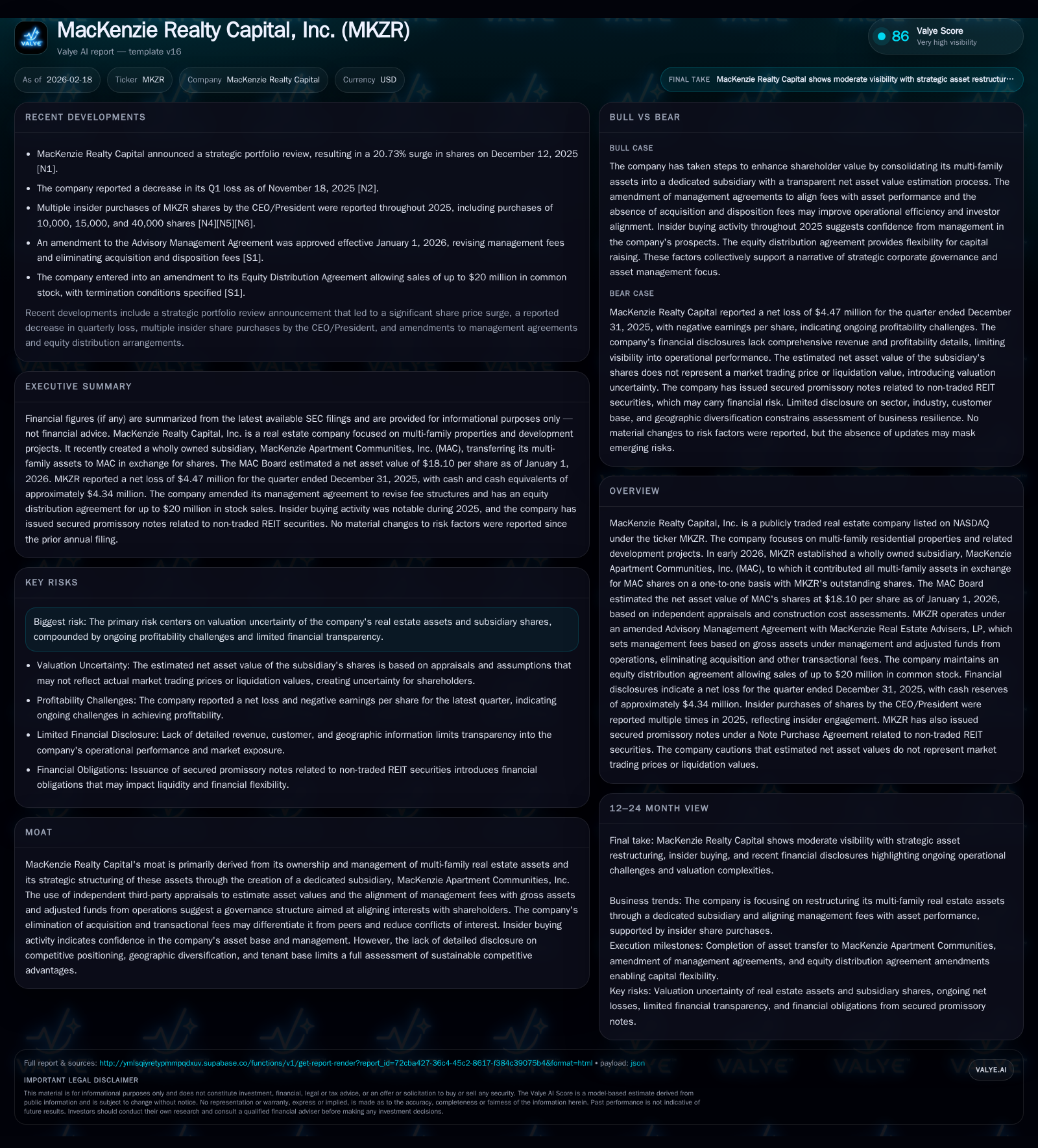
MacKenzie Realty Capital, Inc. has confronted ongoing operating deficits by reorganizing its multi-family real estate holdings into a newly formed subsidiary, MacKenzie Apartment Communities (MAC), capped by an $18.10 per share NAV valuation. Alongside this structural move, the company amended its advisory management agreement to align fees with assets under management and AFFO, eliminating transactional fees to reduce conflicts of interest. Despite these strategic initiatives, MacKenzie Realty continues to wrestle with steep negative operating income and net losses coupled with weak cash flows, with capital allocation reflecting limited dividend returns and measured buyback activity. Key future indicators include MAC’s NAV tracking, potential profitability inflection via operational cash flow improvements, and prudent debt servicing amid the company’s evolving capital structure.
Recurring Operational Losses Define Past Performance
MacKenzie Realty Capital has experienced sustained financial headwinds highlighted by sharply negative operating income and net losses over recent fiscal years. Its operating income deteriorated from a loss of approximately $7.5 million in FY2022 to a steep deficit of over $23 million in FY2025 (fiscal years ending June 30) [F1]. This represents a staggering -136.6% year-over-year change between FY2024 and FY2025 alone, signaling intensifying operational challenges.
Net income follows this downward progression; after reporting positive net income in FY2022 (+$4.3 million), the company swung back into deep losses reaching approximately -$24 million by FY2025 [F1]. Cash flows from operations mirror this trend with CFO declining from positive $4.6 million in FY2022 to negative $1.7 million in FY2025 [F1]. Such cash flow inversion underscores liquidity stress typical amid extended development cycles or lease-up phases for multifamily portfolios.
Stockholders' equity concurrently shrank from nearly $99 million in FY2023 to about $59.9 million in FY2025 [F1], reflecting accumulated deficits eroding book value. The approximate annual ROE based on latest figures stands near -40%. These indicators collectively frame an enterprise struggling to gain operational traction amid real estate sector cyclicality or internal inefficiencies.
Historical performance (annual)
| FY | Net ($mm) | CFO ($mm) | OpInc ($mm) | Net YoY |
|---|---|---|---|---|
| 2025 | -24 | -2 | -23 | -113.6% |
| 2024 | -11 | -1 | -10 | -204.0% |
| 2023 | -4 | -7 | -20 | -186.3% |
| 2022 | 4 | 5 | -7 |
Note: Omitted columns lack sufficient annual XBRL coverage in the provided tags (need ≥2 annual points): Rev, Capex, Div, Buybacks, FCF. Source: SEC companyfacts cache [F1].
Capital returns and efficiency (annual)
| FY | ROE% |
|---|---|
| 2025 | -40.0 |
| 2024 | -13.6 |
| 2023 | -3.7 |
| 2022 | 4.4 |
Source: SEC companyfacts cache [F1].
Metrics omitted: Dividends and Buybacks due to insufficient recent data.
Spin-off of MacKenzie Apartment Communities: Logic and Valuation
In early 2026, MKZR strategically transferred all multi-family residential properties into a wholly owned subsidiary, MacKenzie Apartment Communities, Inc. (MAC). MKZR exchanged all such assets for MAC shares on a one-to-one basis equivalent to MKZR's outstanding shares, effectively segregating these core assets under a dedicated entity [S15].
The MAC Board estimated the net asset value per common share at $18.10 as of January 1, 2026 based primarily on an income capitalization approach utilizing discounted cash flow (DCF) models of projected net operating income minus capex and applying market-derived discount and cap rates [S5]. For certain developed projects like Aurora at Green Valley, valuation was conservatively pegged to total construction costs (~$28.63 million), reflecting prudence amid developmental uncertainties [S5]. This NAV estimate explicitly excludes intangible enterprise value or potential trading premiums/discounts if MAC shares were exchange-listed [S6].
This restructuring serves multiple purposes: it isolates the multi-family portfolio’s performance metrics; provides clearer asset-level transparency; and could facilitate future capital raising or monetization events distinct from MKZR’s other holdings.
Governance Alignment through Advisory Agreement Changes
Concurrent with the spin-off, MKZR amended its Advisory Management Agreement with MacKenzie Real Estate Advisers, LP effective January 1, 2026 [S25]. The revised contract pivots compensation fees towards Base Management Fees at 1.25% of Gross Assets Under Management (GAUM), excluding depreciation and amortization, supplemented by a Bonus Fee equaling 5% of adjusted funds from operations (AFFO).
Notably, acquisition fees along with other transactional fees—common revenue streams for property managers—were completely eliminated [S25]. This fee structure adheres closer to REIT industry best practices designed to minimize conflicts of interest that arise when managers profit from transaction volume rather than long-term asset performance.
By tying compensation more directly to tangible asset size and recurring cash flow metrics rather than deal activity, the alignment between manager incentives and shareholder value creation is arguably strengthened.
Capital Structure Evolution and Recent Debt Issuance
To enhance liquidity amidst ongoing operational losses, MKZR entered into secured promissory note agreements totaling up to $3.27 million with Streeterville Capital LLC during mid-2025 through early 2026 [S8][S20]. As of January 15, 2026, two material secured notes were outstanding aggregating approximately $2.18 million principal amount inclusive of original issue discounts [S20].
These notes carry repayment terms due roughly within an eighteen-month horizon post-investment date alongside accrued interest and fees [S8]. While adding leverage increases financial flexibility for working capital or investment needs, it also elevates fixed obligations amid unpredictably negative operational cash flows.
This financing aligns with broader small-to-mid-sized REIT strategies where access to credit supplements equity draws but requires vigilant balance sheet stewardship given profit volatility.
Dividend Policy, Buybacks, and Capital Return Track Record
MacKenzie Realty's history displays minimal dividend payouts with last recorded dividends around $461 thousand during FY2021 [F1]. Since then there are no substantive indications of regular dividend distributions coinciding with mounting net losses.
Stock repurchase activity appears modest yet consistent prior to recent deteriorations—approximately $409 thousand repurchased across FYs 2021-22 [F1]. Nevertheless, given pressing liquidity considerations reflected by weak cash flows and debt increments, this buyback program seems largely dormant post-FY22.
Management has approved quarterly preferred dividends for Series A-C preferred stock ending March 31, 2026 indicating commitment to honor fixed-income obligations albeit without resumption of common dividends at present [S19]. This measured approach evidences prioritization of capital preservation over shareholder yield amid rebound efforts.
Future Growth Drivers and Market Conditions Impacting NAV
MKZR’s primary growth catalyst lies in unlocking value through its reorganized multi-family portfolio via MAC whose assets have been conservatively appraised using market-sensible capitalization rates paired with DCF methodologies [S4][S5].
Any upside depends significantly on the interplay between rental market demand trends—potentially benefiting from demographic shifts favoring rental housing—and capitalization rate compression which would enhance valuations absent new cash flow improvements.
Sector analysis notes that rising interest rates often increase cap rates thus pressuring real estate valuations; however localized supply-demand imbalances could counteract broad macro effects for well-located multifamily assets—a familiar dynamic investors watch closely as it materially affects NAV calculations.
Developments like Aurora at Green Valley may also contribute incremental value upon reaching stabilized occupancy if leasing activity accelerates beyond current conservative assumptions embedded in appraisal models.
Key Risks Rooted in Valuation Uncertainty and Profitability
MKZR discloses key risks concentrated around real estate asset valuation uncertainties given fluctuating market conditions compounded by ongoing unprofitability limiting reinvestment or reserves [S7][N1]. The use of independent third-party appraisals mitigates some bias risks but cannot eliminate variation attributable to model assumptions or evolving economic contexts.
Further opacity remains due to lack of detailed disclosures regarding tenant profiles or geographic diversification limiting ability to assess earnings durability or defensive moats comprehensively [N1]. This hinders confident assertions about sustainable competitive advantages versus regional peers or specialized multifamily operators.
Persistent negative operating results raise concern over execution capabilities until clear structural improvements manifest objectively through positive operating cash flows or narrowing loss trajectories.
Metrics to Watch: Operating Cash Flows, NAV Updates, and Management Guidance
In lieu of explicit forward guidance from MKZR’s disclosures thus far, investors should prioritize tracking quarterly operating cash flows as a barometer for profitability shifts post-restructuring alongside any revision announcements concerning MAC NAV estimates informed by updated appraisals or market developments [N1][S4][S7].
Adjustments or renegotiations related to the amended advisory fee structure may serve as secondary indicators foreshadowing changing cost dynamics impacting net returns.
Debt portfolio refinancings or maturities approaching will warrant scrutiny given implications for liquidity risk management amid lingering losses.
Incremental transparency around lease-up statuses for developmental properties will further clarify medium-term cash generation prospects critical for capital return strategies beyond preferred dividends currently sustained.
Disclaimer: This analysis synthesizes publicly disclosed SEC filings up through February 18, 2026 without projecting specific stock performance nor offering investment advice.
Disclaimer: This is research-only, informational analysis and not investment advice. It may include AI-generated interpretation and general industry context. Always verify important details using primary sources.

Comments