
Panamera Holdings’ Transition from Losses to Licensing-Driven Growth
Panamera Holdings Corp pivots toward commercializing licensed carbon conversion technology and expanding metals recycling amid persistent financial challenges.
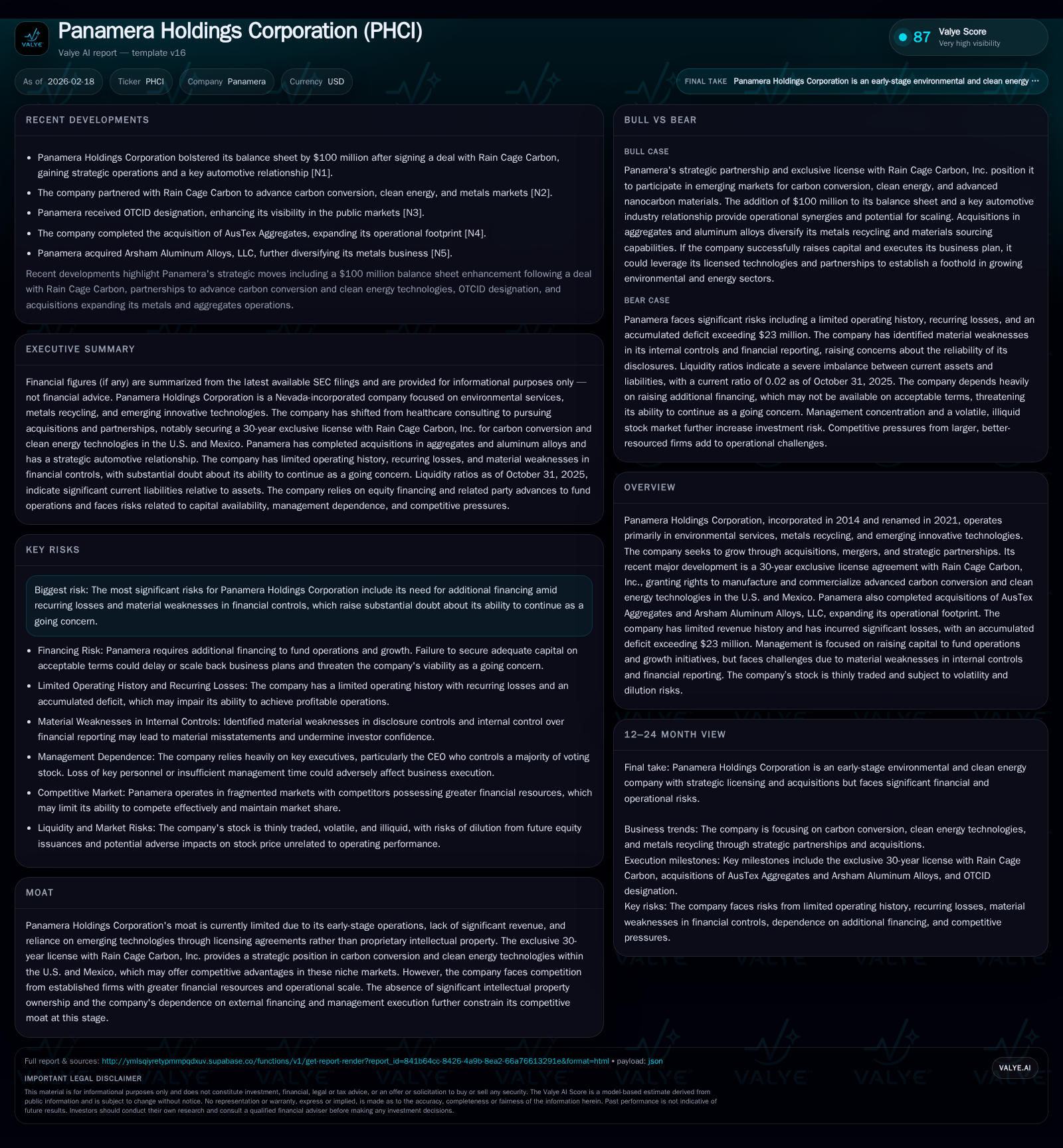
Panamera Holdings Corporation, historically an early-stage operator with limited revenue and substantial losses, is now emphasizing growth through a landmark 30-year exclusive license agreement with Rain Cage Carbon, Inc., alongside recent acquisitions in metals recycling. Despite an over 2000% revenue surge year-over-year through FY2025, the company faces severe liquidity constraints, material weaknesses in internal controls, and significant going concern risks. Management’s controlling equity stake consolidates decision-making power but may limit minority shareholder influence. The path forward hinges on successful capital raises to fund technology commercialization and operational integration, with key milestones tied to advanced carbon capture deployments in the US and Mexico.
Historical Financial Performance and Revenue Trajectory
Since its incorporation in 2014 (initially as Panamera Healthcare Corporation), Panamera Holdings has exhibited limited operational history until its strategic repositioning toward environmental services and emerging technologies post-2021. The fiscal years from 2022 through 2025 demonstrate a sharp but nascent revenue trajectory paired with persistent net losses that highlight the company’s early-stage status.
Historical performance (annual)
| FY | Rev ($) | Net ($mm) | CFO ($) | OpInc ($mm) | Rev YoY | Net YoY |
|---|---|---|---|---|---|---|
| 2025 | 241430 | -1 | -515320 | -1 | +2032.2% | +96.5% |
| 2024 | 11323 | -15 | -99380 | -15 | -88.7% | -114.0% |
| 2023 | 100001 | -7 | -98071 | -7 | +140.0% | -20827.8% |
| 2022 | 41666 | 0 | -29261 | 0 |
Note: Omitted columns lack sufficient annual XBRL coverage in the provided tags (need ≥2 annual points): Capex, Div, Buybacks, FCF. Source: SEC companyfacts cache [F1].
Capital returns and efficiency (annual)
| FY | ROE% |
|---|---|
| 2025 | -85.9 |
| 2024 | 8371.2 |
| 2023 | -14330.1 |
| 2022 | 71.5 |
Source: SEC companyfacts cache [F1].
Note: Operating income and net income YoY % are volatile due to magnitude fluctuations.
While revenues increased sharply by more than twentyfold from FY2024 to FY2025 ([F1]), operating losses shrank significantly though remained substantial relative to revenue base (~-$545K operating loss versus $241K revenue). The company has yet to generate positive operating cash flow or free cash flow; operating cash flow deteriorated markedly in FY2025 to approximately -$515K without any reported capital expenditures ([F1]). Return on equity (ROE) currently approximates negative 86%, reflecting ongoing unprofitability and an accumulated deficit exceeding $23 million ([S1], [F1]).
Strategic Expansion through Acquisitions and Licensing Agreements
Panamera Holdings’ pivot centers on two key strategic growth vectors: acquisitions expanding metals recycling capabilities and an exclusive licensing agreement unlocking proprietary technologies in clean energy.
In August 2025 Panamera executed a pivotal 30-year exclusive license deal with Rain Cage Carbon, Inc., granting rights for manufacturing and commercializing advanced carbon conversion and clean energy technologies across the United States and Mexico ([S1], [S20]). Rain Cage Carbon develops profitable carbon capture capabilities tailored for coal-fired plants and other energy producers — a niche within the broader carbon capture utilization (CCU) industry that addresses escalating regulatory pressure on greenhouse gas emissions.
Complementing this high-tech licensing thrust are the acquisitions of AusTex Aggregates and Arsham Aluminum Alloys completed recently (no news citation available). These expand Panamera’s operational footprint within environmental services focused on critical earth materials recycling sourced from CO₂-derived inputs. This focus aligns with rising market demand for sustainable metals recovery supporting automotive electrification supply chains.
Together these moves illustrate a deliberate shift from prior consulting service models towards integrating tangible physical operations with innovative technology platforms possessing potential multi-decadal commercial lifecycles.
Market Positioning in Environmental Services and Clean Energy Technologies
Panamera's current competitive positioning remains modest due to limited proprietary intellectual property ownership but benefits strategically from its exclusive access to Rain Cage Carbon’s licensed technologies. This provides a unique product offering within the fragmented environmental services sector characterized by numerous small regional players alongside large multinational recyclers.
The company's focus includes metals recycling—specifically domestically sourced critical minerals recycled via CO₂ conversion—and carbon capture solutions pertinent to coal-to-clean energy transitions. These domains leverage industry-specific concepts such as "critical minerals recycling" relevant for renewable energy equipment manufacture and "carbon capture & utilization (CCU) technologies" aimed at reducing greenhouse gas footprints.
However, Panamera faces intense competition from established firms with deeper capital resources and operational scale capable of absorbing compliance costs related to environmental regulation ([S4]). The lack of significant internal R&D spend or patent portfolios emphasizes Panamera’s current dependence on external technology licensors versus owning core IP ([S10]).
Financial Health: Capital Structure, Liquidity, and Going Concern Risks
Panamera Holdings' financial health is precarious with liquidity positioned near crisis levels. The company reports current assets at approximately $55K against current liabilities exceeding $3.4 million as of the latest reporting period ending October 31, 2025 ([F1]). This yields a distressing current ratio near 0.02—far below typical solvency benchmarks—indicating acute working capital shortages.
Recurring operating losses compounded by an accumulated deficit topping $23 million amplify solvency concerns ([S1], [S9]). Included within this deficit are sizable stock-based compensation ($14.5 million) and impairment charges ($7.5 million), primarily non-cash but reflective of past operational setbacks.
Management acknowledges material weaknesses in internal controls over financial reporting due partly to inadequate formal processes around related-party transactions ([S4]), heightening risk of misstatements that could deter investor confidence or restrict access to fresh capital inflows.
Capital raise efforts confront challenges amid volatile market conditions; potential dilution through equity issuance poses risk for current shareholders ([S12], [S11]). Notably CEO T. Benjamin Jennings holds direct control of close to 29% of common stock voting power—enabling decisive influence over corporate matters including financing terms but limiting minority shareholder governance input ([S5]).
Absent successful financing arrangements shortly, Panamera may face forced delay or downsizing of initiatives critical to its survival ([S9]). Auditor notes reflect substantial doubt about ability to operate as a going concern beyond twelve months without new funding support ([S1]).
Returns on Equity / Cash Flows / Dividends / Buybacks Summary:
- Return on Equity (ROE) is approximately -85.9%, indicating deep unprofitability relative to equity base ([F1]).
- Operating cash flows remain negative at roughly -$515K for FY2025; no capital expenditures recorded indicating tight cash management ([F1]).
- No dividends have been paid historically nor are any planned given the company’s financial position ([S3], [F1]).
- No share repurchase or buyback programs exist or have been disclosed; such data is not available in provided tags ([F1]).
Management Control and Governance Implications for Shareholders
Corporate governance dynamics reveal a concentrated equity structure dominated by CEO Benjamin Jennings who commands majority voting power due to shareholdings totaling nearly 29%. This asymmetry effectively curtails minority stockholder influence on matters such as board elections or major corporate transactions including mergers or asset sales ([S5]).
The company's governance framework lacks several standard protections found among more mature public firms — no independent audit or compensation committees exist presently ([S16]), potentially increasing risks related to conflicts of interest or insider decision-making without external oversight.
In addition, the board retains unilateral authority to issue preferred stock with special voting rights without shareholder approval ([S3]), which could further entrench existing management control or dilute existing holders.
This structure can create misalignment between management priorities and minority investor interests particularly during crucial capital raises or strategic shifts.
Outlook: Growth Prospects, Financing Needs, and Operational Milestones
While explicit company guidance remains limited regarding revenue trajectories or milestone timelines beyond licensing highlights ([S20]), future growth prospects hinge notably on:
- Commercial deployment ramp-up of Rain Cage Carbon’s patented carbon capture systems primarily targeting coal-fired plants transitioning under US/Mexico regulatory regimes.
- Successful integration and scaling of metals recycling subsidiaries exploiting critical earth materials derived from recycled CO₂ sources.
- Accessing sufficient equity or debt capital under acceptable terms amid fragile liquidity position.
Capital allocation priorities currently emphasize funding working capital demands rather than discretionary investments; zero capital expenditures recorded in prior fiscal years reflect this constraint ([F1], [S17]).
Investors should monitor progress indicators such as commencement of commercial contracts leveraging the Rain Cage license portfolio alongside operational metrics post-acquisition integrations.
Investing Risks: Regulatory Compliance Burdens, Internal Controls Weaknesses & Litigation Exposure
Several material risks accompany investment consideration:
- Regulatory compliance costs relating to environment-focused activities may escalate as evolving climate legislation imposes stricter standards potentially raising operational expenses ([S13], [S25]).
- Material weaknesses in internal control systems elevate possibilities for inaccurate financial disclosures undermining stakeholder trust ([S4], [S16]).
- Ongoing litigation includes a disputed suit filed by Jeffrey Kilgore claiming owed shares compensation which while deemed meritless by Panamera may entail legal expenses or distraction until resolved ([S6]).
- Absence of comprehensive insurance coverage entails substantial self-insurance risks for catastrophic operational events possibly resulting in unexpected financial strain ([S19]).
- Volatile trading market with low liquidity may exacerbate share price swings unrelated to fundamentals ([S14]).
Disclaimer
This report is prepared solely for informational purposes based on publicly available filings up to February 18, 2026. It does not constitute investment advice or recommendations regarding securities of Panamera Holdings Corporation or any other entity. Readers should conduct their own due diligence when considering exposure to the company's securities.
Disclaimer: This is research-only, informational analysis and not investment advice. It may include AI-generated interpretation and general industry context. Always verify important details using primary sources.

Comments