
Sprouts Farmers Market Balances Supply Chain Transition with Strategic Store Expansion and Innovation
Sprouts leverages its specialty grocery format and supply chain overhaul to fuel growth amid competitive pressures and operational risks.
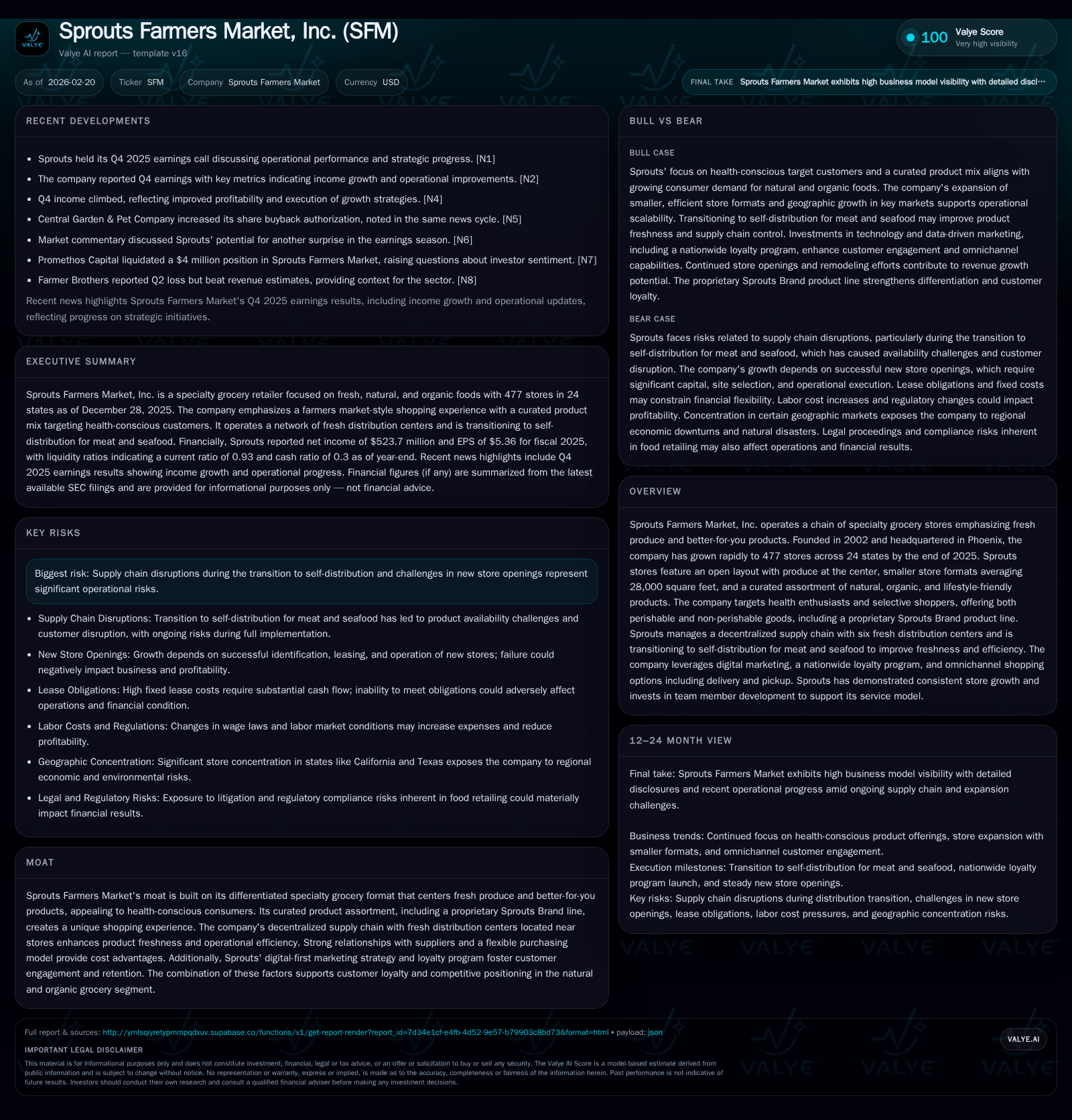
Sprouts Farmers Market, Inc. has evolved rapidly since its founding, expanding to 477 stores by the end of 2025. Its differentiated model centers fresh produce and wellness-oriented products in smaller stores designed for quick service. The company focuses on target customer segments through omnichannel engagement, innovative product offerings, and a decentralized distribution network expanding self-distribution for meat and seafood. Operationally, Sprouts faces risks from supply chain transitions and intensified competition. Financially, it delivered robust operating income growth to $686 million in 2025 with strong cash flow generation and aggressive share repurchases, highlighting effective capital allocation despite current margin compression risks.
Company Overview and Historical Performance
Sprouts Farmers Market, Inc. has carved a distinctive niche within the specialty grocery segment by centering its store design and merchandising around fresh produce. Founded in 2002 in Phoenix, Arizona, Sprouts has accelerated its expansion efforts significantly over the past half-decade, growing to operate 477 stores across 24 states as of December 28, 2025 [S1]. The company’s smaller store footprints—averaging approximately 28,000 square feet but evolving towards even smaller formats between 21,000 and 25,000 square feet—support quick trip shopping with an open floor plan that places produce at the heart of every location [S22].
Financially, Sprouts demonstrated strong growth trajectories over fiscal years 2022 through 2025. Operating income increased substantially from $358 million in FY2022 to $686 million in FY2025—a compound annual growth reflective of both store count expansion and operational improvements [F1]. Net income exhibited parallel gains rising from $261 million to $524 million during the same period. Operating cash flows scaled commensurately to $716 million by FY2025 despite increased capital spending aimed at new store openings, remodeling initiatives, and technology investments.
Historical performance (annual)
| FY | Net ($mm) | CFO ($mm) | OpInc ($mm) | Capex ($mm) | Net YoY |
|---|---|---|---|---|---|
| 2025 | 524 | 716 | 686 | 248 | +37.6% |
| 2024 | 381 | 645 | 504 | 230 | +47.0% |
| 2023 | 259 | 465 | 350 | 225 | -0.9% |
| 2022 | 261 | 371 | 358 | 124 |
Note: Omitted columns lack sufficient annual XBRL coverage in the provided tags (need ≥2 annual points): Rev, Div. Source: SEC companyfacts cache [F1].
Capital returns and efficiency (annual)
| FY | Buybacks ($mm) | FCF ($mm) | ROE% |
|---|---|---|---|
| 2025 | 472 | 468 | 37.3 |
| 2024 | 228 | 415 | 28.8 |
| 2023 | 203 | 240 | 22.5 |
| 2022 | 200 | 247 | 25.0 |
Source: SEC companyfacts cache [F1].
Note: Revenue data not available in provided tags.
Growth Strategy and Future Prospects
Sprouts’ management is executing a multi-pronged long-term strategy focusing on winning target customer segments defined as "health enthusiasts" and "selective shoppers" through curated product assortments emphasizing organic, plant-based, gluten-free, and other lifestyle-friendly items [S1]. The company believes these segments offer ample opportunity for market share gains via better product breadth and an enhanced omnichannel presence including digital ordering with delivery or pickup through its website and app.
The geographic footprint continues to expand with unit growth near a targeted ~10% annual rate projected from current positioning designed to intersect where these customers reside while sustaining supply chain efficiencies [S1]. Store remodels alongside new smaller-format openings aim to deliver stronger returns by maintaining the farmer’s market heritage while scaling innovation.
A critical operational pivot is the transition to self-distribution for meat and seafood categories through their network of six fresh distribution centers located strategically in California (two centers), Arizona, Texas, Colorado, Florida, plus a third-party partnership serving Mid-Atlantic markets [S6]. As of December 28, 2025, this transition serviced approximately 70% of stores with improved delivery frequency enhancing product freshness although initial rollout incurred supply challenges causing lost sales [S6]. Management expects near completion covering ~95% of stores through these efforts during calendar year 2026.
Customer engagement intensifies via data-driven marketing initiatives highlighted by the nationwide launch of the Sprouts Rewards loyalty program in 2025 designed to aggregate insights enabling personalization at scale across digital channels [S1]. Such programs combine precision geographic targeting with social media engagement favoring higher-value shopper segments.
Investment continues in technology platforms supporting inventory management automation and decision-making enhancements on product assortment selection—efforts expected to streamline operations further while enhancing scalability for growth phases [S1]. Notably absent are explicit management financial guidance metrics beyond milestone targets; key performance drivers will hinge on execution momentum pertaining to store expansions, supply chain stabilization post-self-distribution conversion, and digital membership program adoption rates (analysis).
Capital Allocation and Returns
Sprouts exhibits disciplined capital deployment balancing growth investment against shareholder return priorities. Capital expenditures increased modestly from $124 million in FY2022 to $248 million in FY2025 reflecting store openings/remodels plus technological systems enhancements [F1]. Concurrently free cash flow approached an estimated $468 million last fiscal year after capex which underpinned significantly ramped buyback activity totaling nearly half a billion dollars (approximate doubling compared to prior year levels) [F1].
The company does not disclose dividend payments within provided data; however, buybacks represent a material component of shareholder returns. Return on equity stands robust near an approximate level of ~37%, illustrating substantial profitability relative to equity base enhancement over recent years [F1]. Such high ROE despite ongoing investment signals efficient leveraging of operational improvements alongside scale economics.
Industry Context and Competitive Positioning
Sprouts operates within a fiercely competitive retail grocery ecosystem encompassing broadline supermarkets, warehouse clubs (e.g., Costco), discount retailers (e.g., Dollar General), natural food supermarkets (e.g., Whole Foods), direct-to-consumer meal solutions providers, online grocers including Instacart-supported platforms plus burgeoning entrants such as Uber Eats that increasingly challenge traditional distribution paradigms [S18,N13].
The specialty grocery format focusing predominantly on freshness distinctions combined with niche organic/lifestyle availability underpins Sprouts' moat alongside proprietary branded products ensuring differentiated consumer appeal . Key enablers include decentralized purchasing supplemented by regional produce procurement teams who negotiate flexible sourcing agreements that confer cost advantages with strategic local farmer partnerships [S21,S22]. This structure facilitates treasure hunt experiences offering innovative varietals appealing particularly to health-conscious demographics.
Notwithstanding strengths several risk vectors loom large including potential supply chain instability particularly during ongoing self-distribution shifts possibly leading to inventory shortfalls affecting store sales adversely; intensified competition raising pressure on pricing power especially when rivals expand their fresh/natural offerings; regulatory scrutiny centered on labeling accuracy for natural/organic claims; litigation exposure given product liability contexts; plus concentrated exposure due to significant California market store concentration representing one-third of total units heightening vulnerability to regional economic or climate disruptions [S4,S12,S18,S19,S20].
Rising energy costs also factor into margin compression risk given significant logistics dependencies with transportation costs exposed to gasoline/diesel price volatility impacting freight expenses [S12]. Emerging sustainability reporting mandates coupled with evolving federal/state regulations impose additional compliance burden potentially elevating operational costs or constraining product assortments [S24].
Operational Execution Highlights
The flipped store model demarcates Sprouts visually against competitors by positioning produce centrally occupying approximately equal or greater than ~20% selling space share—a notable industry differentiation fostering high customer freshness perception—while smaller box sizes prioritize convenience combined with tailored merchandising that responds agilely to local preferences [S22].
Decentralized supply chains are buttressed by six fresh distribution centers targeted within a tight radius (~250 miles) optimizing freshness logistics; seasonal & local suppliers enhance assortment uniqueness critical for draw among health-focused clientele.
Omnichannel evolution supported by e-commerce strategies facilitating click-and-collect or delivery options allows Sprouts participation in growing consumer preference for hybrid shopping formats without sacrificing personalized in-store experiences underscored by knowledgeable staff aimed at educating customers about wellness-oriented products—a recognized loyalty driver uncommon among mass-market grocers [S22,N1].
Personnel management emphasizes culture-building investments attracting talent aligned with brand values underpinning differentiated service delivery reinforcing competitive barriers beyond solely price or product assortment.
Monitoring Points Going Forward
Key metrics warranting continuous observation include: pace of new store openings relative to the targeted ~10% annual unit growth runway; progress completing full meat/seafood self-distribution rollout by end-2026; performance fidelity of Sprouts Rewards program adoption tied closely with sales conversion uplift; margin trends reflective of cost absorption plus competitive pricing dynamics; and handling regulatory developments impacting labeling or sustainability disclosures.
Additionally potential impact from legal proceedings related to employment or product claims remains intrinsically uncertain though manageable within current frameworks provided insurance protections persist without significant erosion [S10]. Competitive reactions particularly around pricing aggression or health/wellness assortment expansions could influence sales velocity thus profitability.
Conclusion
Sprouts Farmers Market stands firmly positioned as a specialty grocer leveraging its foundational focus on fresh produce complemented by lifestyle-centric product innovation paired with rigorous supply chain reengineering aiming at amplified efficiency and responsiveness. The company’s strategy blends operational investments with aggressive shareholder return programs signaling confidence amid sector headwinds. Persistent risks relate primarily to integration challenges accompanying self-distribution transitions plus shifting competitive landscapes requiring continued agility both operationally and strategically. Given reported fiscal results exhibiting pronounced earnings growth paired with robust cash flow generation despite ongoing reinvestment cycles reflects successful execution so far. Stakeholders should watch execution progress closely against expansion milestones while considering external economic conditions influencing discretionary spending patterns within specialty food retailing.
This analysis is based exclusively on publicly available information including company SEC filings ([S1]–[S29]), news reports ([N1]–[N13]), and structured financial data ([F1]). It does not constitute investment advice or recommendations.
Disclaimer: This is research-only, informational analysis and not investment advice. It may include AI-generated interpretation and general industry context. Always verify important details using primary sources.

Comments