
Expro Group's Strategic Revenue Recovery and Capital Efficiency in 2025
Expro Group achieved significant revenue growth in 2025, balancing operational challenges with prudent capital management and innovation.
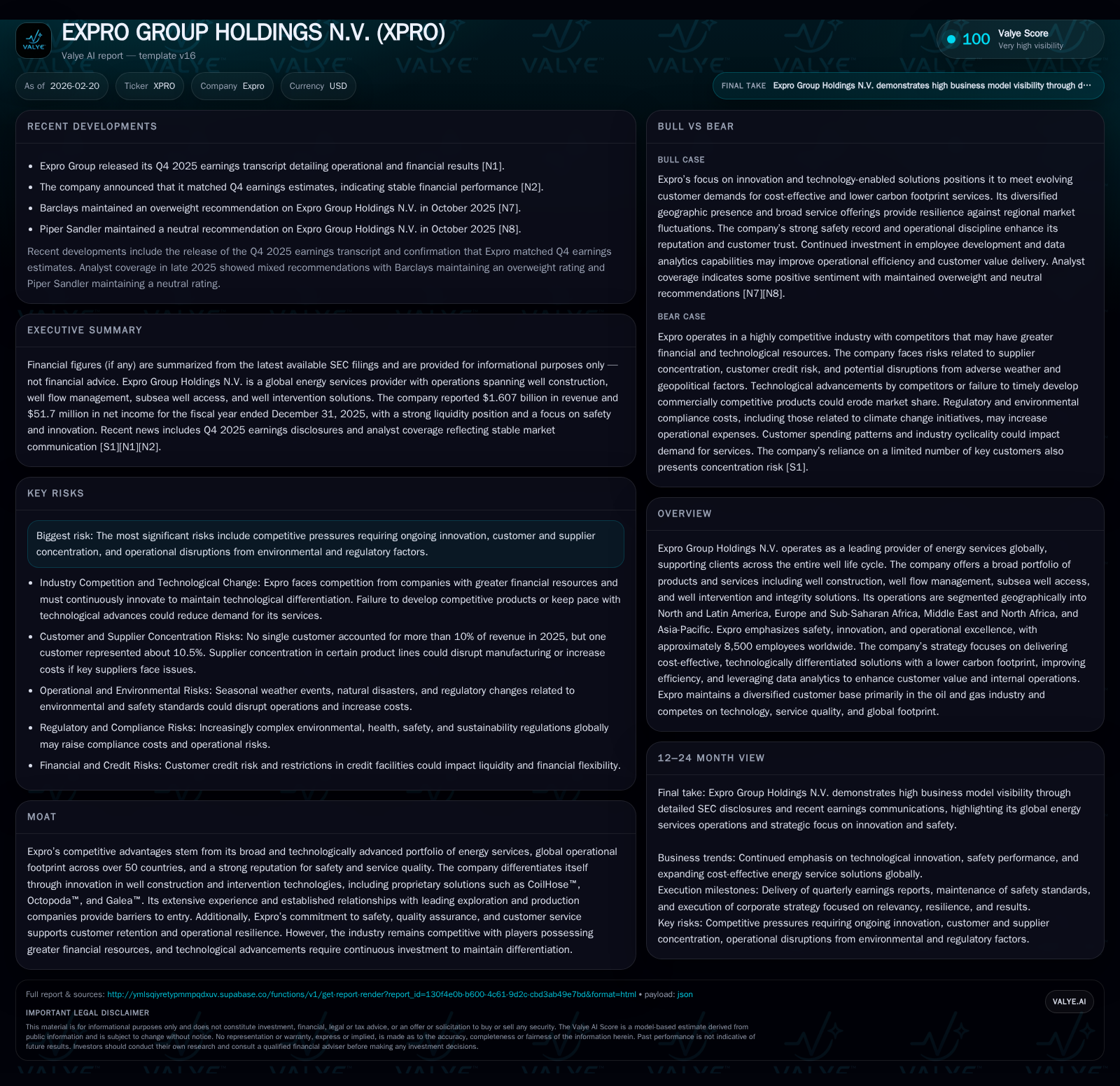
Expro Group Holdings N.V. demonstrated a robust revenue rebound in 2025, recovering from prior years' losses to deliver stable net income amidst volatile energy markets. While operating income declined year-over-year, strong operating cash flow generation and reduced capital expenditures improved free cash flow significantly. The company’s global footprint across four geographic segments, particularly growth in the Middle East and North Africa, underpinned its recovery. Proprietary technologies such as CoilHose™ and Galea™ continue to support differentiation despite intensifying competitive and regulatory pressures. Going forward, sustained innovation and monitoring of geopolitical and environmental dynamics will be critical to maintaining momentum.
Historic Performance: Revenue Surge vs. Earnings Volatility
Expro Group Holdings N.V. has displayed a remarkable financial recovery trajectory over recent years. After experiencing net losses in both 2022 (–$20.1 million) and 2023 (–$23.4 million), the company turned profitable with net income stabilizing near $51.9 million in 2024 and $51.7 million in 2025 [F1]. Revenue reached approximately $1.61 billion in 2025, marking a solid increase of about 6.2% compared to $1.51 billion in 2023, although there was a slight decline from $1.71 billion seen in the prior year.
However, operating income presented a more nuanced picture; it declined by roughly 13.8% from $94.2 million in 2024 to $81.1 million in 2025 [F1]. This divergence between rising revenue and falling operating profit suggests margin erosion possibly due to higher input costs or pricing pressures—common challenges within energy services amid sector volatility.
Operating cash flow expanded strongly, rising by nearly a quarter year-over-year to $210.2 million while capital expenditures contracted by more than one-fifth to about $112.4 million [F1]. This dynamic boosted free cash flow (defined here as CFO less capex) to nearly $98 million, enhancing liquidity for strategic initiatives.
Historical performance (annual)
| FY | Net ($mm) | CFO ($mm) | OpInc ($mm) | Capex ($mm) | Net YoY |
|---|---|---|---|---|---|
| 2025 | 52 | 210 | 81 | 112 | -0.4% |
| 2024 | 52 | 169 | 94 | 144 | +322.3% |
| 2023 | -23 | 138 | 11 | 122 | -16.0% |
| 2022 | -20 | 80 | 2 | 82 |
Note: Omitted columns lack sufficient annual XBRL coverage in the provided tags (need ≥2 annual points): Rev, Div. Source: SEC companyfacts cache [F1].
Capital returns and efficiency (annual)
| FY | Buybacks ($mm) | FCF ($mm) | ROE% |
|---|---|---|---|
| 2025 | 40 | 98 | 3.4 |
| 2024 | 14 | 26 | 3.5 |
| 2023 | 20 | 16 | -1.8 |
| 2022 | 13 | -2 | -1.6 |
Source: SEC companyfacts cache [F1].
Note: Data for FY2018-22 omitted due to reporting inconsistencies or incompleteness.
Analyst takeaway: Expro's return from two consecutive years of reported net losses to profitability underscores robust resilience and operational adaptability amid an unpredictable oilfield services landscape.
Segment Dynamics: Geographic Contributions and Shifting Revenue Mix
Expro's revenue is geographically segmented into four major regions: North and Latin America (NLA), Europe and Sub-Saharan Africa (ESSA), Middle East and North Africa (MENA), and Asia-Pacific (APAC) [S4][S5]. In the latest fiscal year ended December 31, 2025:
- NLA contributed approximately $558 million (34.7%), roughly flat compared with prior periods.
- ESSA revenues decreased slightly to around $487 million representing about a third of total sales.
- MENA exhibited notable growth with revenues reaching approximately $364 million (22.6%), increasing its share significantly from prior years ($233 million in FY23).
- APAC showed declines with revenues at about $199 million (12.4%).
This geographic mix shift highlights MENA’s rising strategic importance driven by increasing offshore activity levels and capital investments aligned with regional oilfield development priorities [S4][S5]. The company’s comprehensive presence across over fifty countries supports capturing well life cycle service demands tailored across these disparate markets.
The seasonality inherent to offshore operations is evident through reported impacts from North Sea winters and monsoon cycles affecting production schedules mainly in ESSA and APAC segments [S6]. These factors contribute to variation quarter-to-quarter but reinforce the operational complexity intrinsic to multi-region service providers dealing with subsea well access and intervention workscopes.
Technology-Driven Innovation as a Competitive Differentiator
Expro’s portfolio centers on specialized offerings that extend across well construction phases through flow management and intervention technologies [valye_report_excerpt.overview]. Proprietary solutions such as CoilHose™ enable efficient wellbore lifting and cleaning operations via lightweight modules that reduce rig time and carbon emissions simultaneously [valye_report_excerpt.moat]. Similarly, Octopoda™ addresses fluid treatments within wellbore annuli supporting integrity maintenance without intrusive conventional methods.
The Galea™ system represents an autonomous well intervention technology that leverages real-time data analytics for optimizing reservoir performance while minimizing safety risks—critical given the offshore environment’s challenging conditions [valye_report_excerpt.moat]. Additionally, expandable casing patches facilitate remedial operations addressing damaged production casing segments—a growing need as mature fields require cost-effective rejuvenation methods.
Integration of fiber-optic sensing for reservoir monitoring coupled with wireless telemetry further differentiates Expro’s offering suite delivering enhanced subsurface data fidelity [S14]. These capabilities embody the company's commitment to operational excellence paired with environmental stewardship amid increasing sector attention on GHG reduction strategies.
Navigating Market Challenges: Commodity Price and Geopolitical Impacts
As detailed within risk disclosures [S1], Expro’s business is intricately tied to oil and gas market dynamics driven by price fluctuations influenced by OPEC+ production policies alongside geopolitical events such as the Russia-Ukraine conflict.
Volatile commodity prices translate into irregular customer capital spending patterns—with higher prices not necessarily yielding proportional increases in drilling activity due to forward-looking pricing expectations influencing project sanctioning decisions [S1]. Moreover, disruptions induced by weather events like hurricanes affecting the Gulf of Mexico operations pose material risks including equipment damage or operational suspensions [S4].
Seasonality influences aggregate demand notably; North Sea winter conditions impede efficiency while monsoon seasons restrict Asia-Pacific marine activities causing temporal reductions in revenue streams [S6]. Additionally pertinent are supply chain concentration risks stemming from reliance on limited key suppliers whose disruptions can cascade into operational delays or margin compression [S4].
Capital Allocation Review: Cash Flow Strength and Shareholder Returns
Liquidity metrics as of year-end reflect sound financial footing with current assets surpassing current liabilities by over twice ($960M vs $444M), yielding a current ratio near 2.16 — indicative of strong short-term coverage capacity [F1]. The annualized return on equity stands at approximately 3.4%, signaling moderate profitability against shareholder equity base [$51.7M net income / $1.53B equity] [F1].
Expro has demonstrated disciplined capital allocation balancing investment with shareholder value enhancement:
- Op cash flow grew substantially to ~$210M (+24%) benefiting from operational efficiencies.
- Capital expenditure fell by nearly a quarter (~22%), hinting at optimized asset utilization or deferment strategies amid market uncertainty.
- Free cash flow consequently approached an estimated $98M level providing flexibility for buybacks or debt servicing.
- The firm undertook about $40M worth of share repurchases during FY25 reflecting confidence in valuation without paying dividends—the last dividend payout recorded was prior to FY19 [F1][S28].
Debt covenant terms embedded within revolving credit facilities impose operational constraints particularly around leverage levels restricting aggressive payout expansions but allowing measured buybacks aligned with cash generation profiles [S23][S28].
Future Outlook: Growth Catalysts and Operational Constraints
Forward guidance is not explicitly provided; however, commentary during recent earnings calls points toward strategic themes emphasizing relevancy through innovative product enhancements alongside improving resilience via cost controls and asset productivity gains [N1][N2][valye_report_excerpt.overview].
Expected drivers for revenue growth include increased offshore exploration activity principally within MENA markets where capital programs exhibit upward trajectories post-pandemic recovery phases [N1][N2]. The sustained adoption of Expro’s differentiated technology suite—specifically embodiments facilitating lower carbon footprints—is anticipated to garner incremental contracts within ESG-conscious operator portfolios.
Operational constraints stem largely from ongoing geopolitical uncertainties impacting customer budgeting processes plus regulatory frameworks increasingly limiting certain drilling practices or imposing stringent environmental compliance costs which can moderate spending pace [S10][valye_report_excerpt.risks]. Monitoring adoption rates for emerging autonomous intervention technologies also represents an indicator for future commercial wins.
What To Watch (Analysis):
- Quarterly updates on offshore rig counts per region reflecting exploration momentum.
- Pipeline of technology deployments aiming at reducing client well construction cycle times.
- Regulatory developments particularly related to hydraulic fracturing restrictions or offshore drilling moratoria.
- Capital expenditure trends among key customers signaling upstream investment health.
Risks on the Horizon: Customer Concentration and Regulatory Landscape
Significant risk factors documented include concentration of revenue among top customers—with one customer contributing just over ten percent of total sales recently—posing collection timing or credit exposure considerations especially during industry downturns [S4][S23][S24]. Supply chains exhibit vulnerabilities due to limited third-party supplier diversification risking throughput interruptions or inflated component costs under market stress scenarios.
Stringent regulatory environments spanning occupational health & safety mandates alongside complex international environmental laws necessitate sizeable compliance expenditures potentially impacting margins or limiting operations where permits become contested or revoked [S9][S15][S18][S26]. Pending climate change legislation aimed at curbing GHG emissions further threatens fossil fuel sector CAPEX budgets thereby indirectly affecting demand for many service providers including Expro [S19].
Additional hazards encompass data privacy breaches linked to AI enhancement initiatives which may expose the company not only to fines but also reputational damage if not proactively managed amid evolving global legal regimes [S13][S25][S26]. Offshore weather-related operational risks remain material due to natural disasters causing downtime or equipment write-offs despite insurance coverage limitations typical within the sector [S27]. Anti-corruption laws enforcement globally increases complexities accompanying cross-border contract executions given Expro’s footprint encompassing politically volatile jurisdictions where local laws impose personal liabilities on management personnel [S16][S21].
Disclaimer: This report provides an analytical overview based on publicly available filings as of February 20, 2026, relating solely to historical performance metrics and disclosed company information without investment advice or recommendations.
Disclaimer: This is research-only, informational analysis and not investment advice. It may include AI-generated interpretation and general industry context. Always verify important details using primary sources.

Comments