
WORKIVA’s Growth Accelerated by Unified AI Platform and Expanding Sustainability Solutions
Strong revenue growth driven by AI-enabled SaaS platform innovation and expanded market reach, despite ongoing net losses.
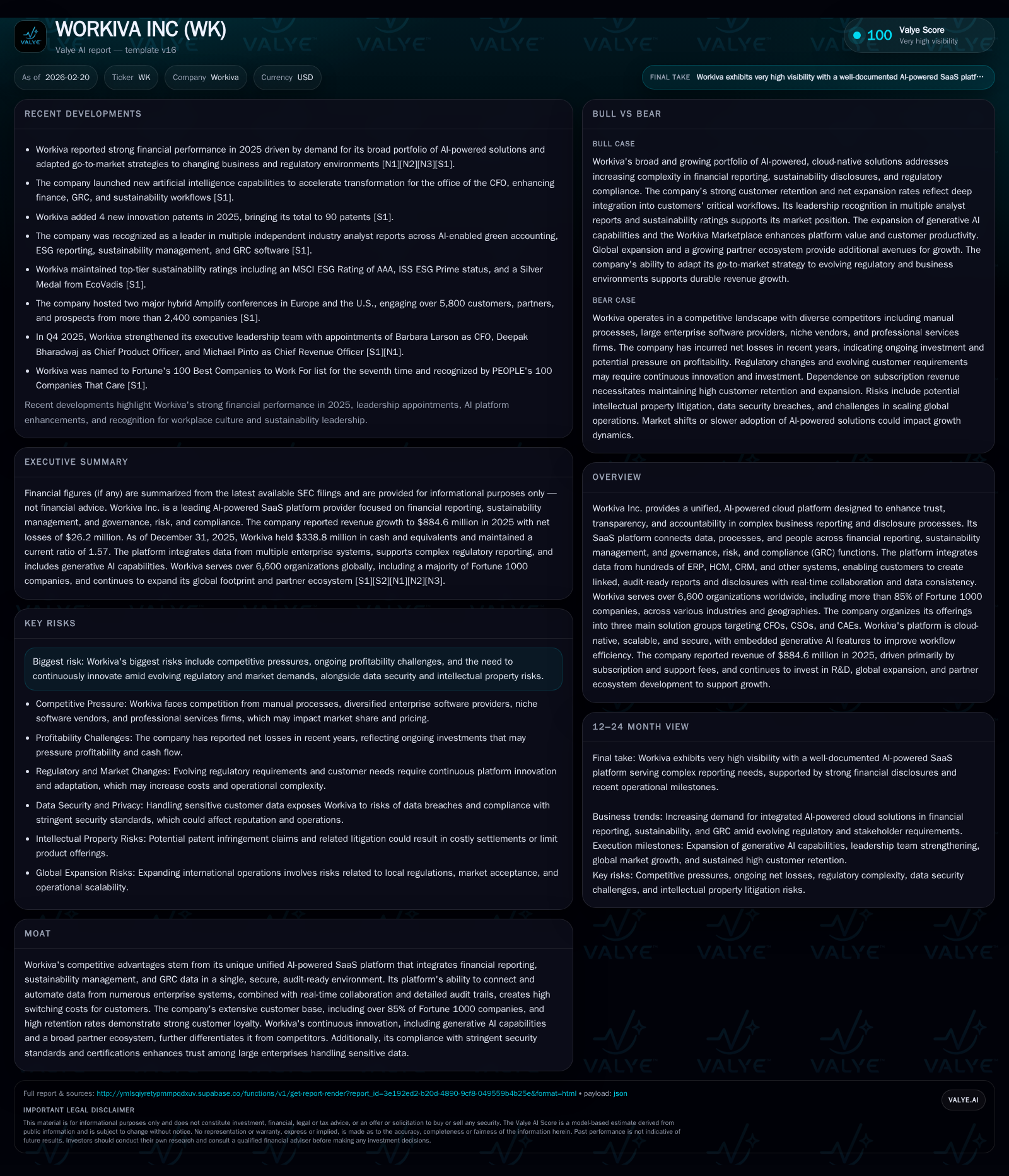
Workiva Inc. has grown revenues robustly with an 18% CAGR from 2023 to 2025, fueled by its unique AI-powered cloud platform that integrates financial reporting, sustainability management, and governance, risk and compliance (GRC). The company's customer base covers over 6,600 organizations worldwide, including a majority of Fortune 1000 firms. While operating and net losses remain a challenge, improving margins and strong operating cash flows underscore operational progress. Looking ahead, growth drivers include expansion in sustainability reporting linked to evolving regulations and continued platform innovation embedded with generative AI capabilities. Key milestones include leadership hires focused on global scale and product innovation, as well as recognition for sustainability performance. Risks primarily relate to competitive pressures and cybersecurity.
Company Overview and Historical Performance
Workiva Inc. operates a differentiated unified AI-powered SaaS platform aimed at enhancing trust, transparency, and accountability for complex business reporting needs spanning financial disclosure, sustainability metrics, and governance/risk/compliance (GRC). Since the launch of its first solution in March 2010, Workiva has exhibited significant top-line growth—revenue increased from $630 million in fiscal year (FY) 2023 to $884.6 million in FY2025—a compound annual growth rate (CAGR) of around 18% [S1][F1].
The company serves more than 6,600 organizations globally, including over 85% of Fortune 1000 companies across various industries, exemplifying broad market penetration and client stickiness demonstrated by a high gross retention rate of 97.2% as of year-end 2025 and a net retention rate exceeding 112%, indicative of successful cross-selling and expansion within existing accounts [S5].
Historical performance (annual)
| FY | Net ($mm) | CFO ($mm) | OpInc ($mm) | Capex ($mm) | Net YoY |
|---|---|---|---|---|---|
| 2025 | -26 | 140 | -42 | 2 | +52.5% |
| 2024 | -55 | 88 | -77 | 1 | +56.8% |
| 2023 | -128 | 71 | -95 | 2 | -40.2% |
| 2022 | -91 | 11 | -89 | 3 |
Note: Omitted columns lack sufficient annual XBRL coverage in the provided tags (need ≥2 annual points): Rev, Div, Buybacks. Source: SEC companyfacts cache [F1].
Capital returns and efficiency (annual)
| FY | FCF ($mm) | ROE% |
|---|---|---|
| 2025 | 138 | 481.4 |
| 2024 | 86 | 132.0 |
| 2023 | 69 | 142.7 |
| 2022 | 8 | -1520.1 |
Source: SEC companyfacts cache [F1].
Note: Buybacks data only available for FY2025; dividends data not available from provided tags; revenue details are from SEC narrative.
Despite remaining unprofitable at the net income level (-$26 million in FY2025), Workiva has substantially reduced losses compared to prior years (-$127 million loss in FY2023). The company demonstrates strong cash generation capacity with operating cash flows rising by nearly 60% year-over-year to $140 million in FY2025 while maintaining modest capital expenditures (~$2 million annually). In addition to operational improvements, Workiva returned $71.6 million to shareholders through stock repurchases during the year [F1]. Equity was slightly negative at approximately -$5 million at the end of FY2025 but improved notably from previous years reflecting balance sheet stabilization alongside earnings improvement trends.
Business Model Differentiation and Competitive Moat
Workiva’s proprietary cloud-native platform is built primarily on AWS infrastructure enabling scalability to support millions of end users concurrently while securing sensitive enterprise data under stringent standards such as FedRAMP and ISO27001 certifications [S17][S19].
The platform integrates data from hundreds of disparate core enterprise systems—including ERP (e.g., SAP/Oracle), HCM platforms (e.g., Workday), CRM systems—facilitating connected workflows that ensure data consistency through linked documents across spreadsheets, presentations, reports, and regulatory filings [S17][S20]. This capability minimizes manual reconciliation errors common in siloed legacy solutions.
Generative AI capabilities augment critical workflows within CFO offices by automating complex content creation tasks such as report drafting, editing assistance, idea generation, data analysis support, and risk alerting mechanisms—all while ensuring human oversight essential for regulated environments [S12][S19].
Workiva’s extensive marketplace offers over two hundred ready-made templates and no-code connectors developed via its partner ecosystem comprising global consulting firms and niche specialists—accelerating adoption by embedding Workiva’s platform into broader digital transformation initiatives [S10][S19].
This creates high switching costs given deep embedding into financial close processes, SOX compliance workflows, ESG disclosures mandated under evolving regulations such as EU’s CSRD or California climate laws—as well as audit management—areas difficult for competitors focusing on narrow or legacy products to replicate cohesively [S14][S21].
Industry Context & Macro Drivers
The broader enterprise software market is shifting decisively toward cloud-first architectures optimized for remote collaboration amid increasingly distributed workforces—a trend accelerated by recent global disruptions.
Regulatory complexity drives demand especially around integrated reporting that combines financial results with comprehensive sustainability disclosures aligned with frameworks like TCFD and SASB/VRF standards requiring precise XBRL tagging enforced globally via SEC inline XBRL filings or EU Single Electronic Format mandates—which Workiva supports effectively [S14][S18].
Proliferation of AI technologies intensifies competitive pressure pushing vendors to embed automated insights into workflows; Workiva leverages substantial prior investments (~$1.2 billion R&D over last decade) underpinning this transition while maintaining openness to third-party integrations strengthening its competitive position versus legacy ERP incumbents slower to innovate [S13][S25].
Recent Developments & Strategic Initiatives
In its FY2025 Q4 earnings call (February 19), Workiva announced enhancements to its generative AI capabilities targeting finance domains supporting CFOs—streamlining disclosures while proactively managing risk; these are viewed as key differentiators given the complex nature of mission-critical financial processes demanding speed without compromising accuracy [N1][N3].
Leadership additions focused on product innovation (chief product officer), global revenue scaling (chief revenue officer), alongside an experienced CFO overseeing financial operations reflect organizational maturity aligned with margin improvement goals [S25].
The company hosted hybrid Amplify conferences in Europe and the US engaging thousands of customers—these events emphasize community building essential for sustaining enterprise SaaS adoption cycles where unlocking additional use cases within existing clients drives incremental revenues organically.
Recognition included repeated endorsements from independent research firms naming Workiva “Best-of-Breed” among GRC providers; analyst accolades around ESG/sustainability reporting software leadership; plus external ESG ratings such as MSCI AAA reflecting both internal commitments and market confidence in corporate governance—all important branding assets supporting sales efforts among institutional accounts increasingly focused on sustainability diligence post-pandemic [S12][S25].
Growth Outlook & Forward Considerations
While explicit guidance is unavailable from provided sources, key watch points include:
- Expansion within sustainability management fueled by regulatory disclosure mandates accelerating demand for integrated dashboards linking non-financial metrics alongside traditional finance KPIs.
- Increased penetration beyond large enterprises into upper mid-market segments enabled by adaptable cloud architecture allowing faster implementations versus competitors.
- Continued rollout of generative AI features enhancing process automation reducing manual workloads while strengthening compliance controls—a critical edge versus legacy spreadsheet-based or narrowly focused point solutions.
- Growth outside the U.S., currently representing ~27% of revenue with further increases expected due to converging global compliance frameworks coupled with partner ecosystem expansion prioritizing localized go-to-market efforts.
- Cross-selling opportunities leveraging footprints across CFOs (financial reporting), CSOs (sustainability), CAEs (audit/remediation) deepening account penetration.
Risks remain centered on the need for relentless innovation lest competitive pressures increase from large enterprise software vendors aggressively expanding cloud portfolios; cybersecurity remains an ongoing concern given sensitivity of customer data handled by Workiva. The board has established rigorous oversight involving certified cybersecurity leadership who regularly brief committees ensuring risk mitigation keeps pace with evolving threats [S28][S29]. Intellectual property protection also remains critical amid frequent patent litigation trends imposing legal burdens even if resolved favorably eventually.
Capital Allocation & Financial Health
Workiva maintains solid liquidity evidenced by cash & equivalents exceeding $338 million against current liabilities near $742 million yielding a current ratio around 1.57—indicative of manageable short-term obligations supporting operational runway without refinancing pressure [F1]. Capital expenditures remain modest relative to operating cash flows underscoring asset-light SaaS economics. Free cash flow approximates $138 million (operating cash flow minus capex), demonstrating robust internal capital generation enabling continued R&D investment alongside strategic share repurchases executed judiciously ($71 million repurchased during FY2025) likely offsetting dilution from employee stock compensation programs common among growth-stage tech companies. Equity was slightly negative at end-2025 (-$5 million) impacted historically by accumulated net losses but trending positively compared to -$89 million three years prior illustrating balance sheet stabilizing effects aligned with earnings improvements [F1]. Approximate return on equity appears elevated due largely to small equity base but reflects improving operational returns consistent with reinvestment phases typical for enterprise SaaS innovators.
Summary Statement
Workiva exemplifies a modern cloud SaaS leader innovating at the intersection of finance transformation and sustainability disclosure amid rapidly shifting regulatory landscapes demanding greater transparency backed by technology-enabled trust mechanisms. Its highly differentiated AI-powered platform integrating multi-dimensional business data fosters substantial client loyalty evidenced through stellar retention metrics bolstered via continuous feature enhancement including generative AI functionality tailored explicitly for complex CFO office workflows. While profitability hurdles persist reflecting significant ongoing investments required to deepen capabilities globally and sustain innovation leadership against intensified competition – particularly from entrenched incumbents transitioning their portfolios – strong free cash flow generation combined with strategic capital allocation provides flexibility for growth-oriented resource deployment. Future potential hinges critically on accelerating global sustainability management adoption spurred by evolving mandates plus seamless integration expansion leveraging extensive ecosystems providing both technical extensibility and trusted implementation channels. Simultaneously vigilant cybersecurity governance backed by experienced leadership forms a crucial safeguard mitigating operational disruption risks intrinsic to handling sensitive client information. As such, WORKIVA represents a compelling case study in how combining domain expertise with advanced technology infrastructure addresses complex real-world challenges facing modern enterprises’ reporting imperatives without sacrificing scalability or security.
Disclaimer: This analysis is informational only and does not constitute investment advice or recommendations.
Disclaimer: This is research-only, informational analysis and not investment advice. It may include AI-generated interpretation and general industry context. Always verify important details using primary sources.

Comments