
Universal Display’s Patent Fortress Drives Stable Licensing Revenue and Strategic Growth
Universal Display leverages its extensive OLED patent portfolio to sustain steady licensing revenues while navigating ongoing legal challenges and targeted capital deployment.
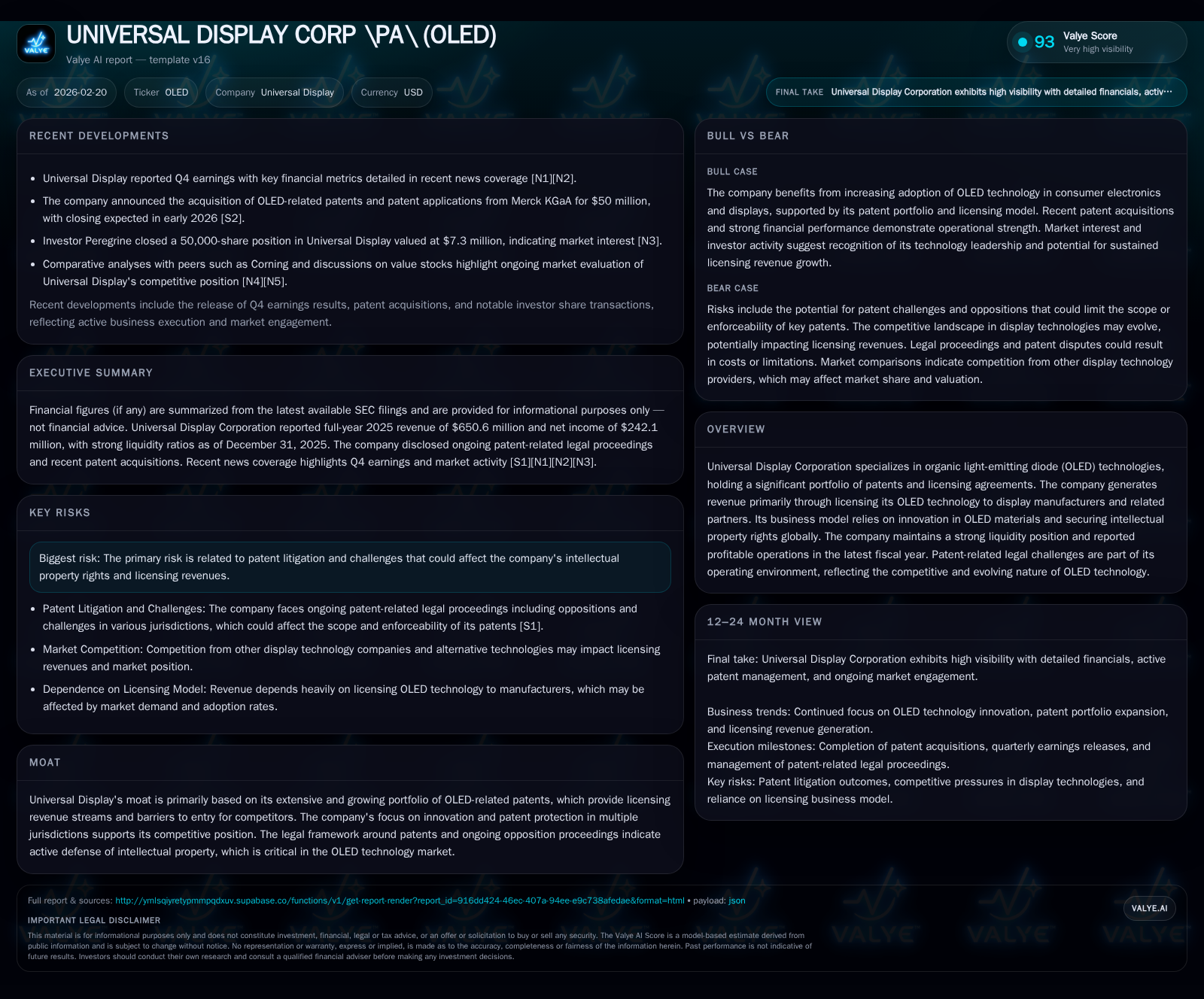
Universal Display Corporation (OLED) has maintained stable revenue growth through its robust licensing business model anchored in a prolific and expanding OLED patent portfolio. Despite the specialized nature of its technology, the company improved operating income and net income in FY2025, reflecting operational efficiencies amid a maturing market. The strategic acquisition of Merck KGaA’s OLED-related patents in early 2026 underscores Universal Display’s commitment to fortify its intellectual property moat, while measured capital allocation balances dividend increases with moderate buybacks and continued investment in innovation infrastructure. Legal opposition proceedings remain a routine risk as the company defends its patents globally, integral to sustaining long-term licensing monetization as the OLED industry evolves.
Historical Revenue and Profitability Anchored in Licensing Innovation
Universal Display Corporation's core business rests on the licensing of its OLED technological patents, a model that has delivered steady financial results even as the OLED sector matures into a more commoditized phase. Annual revenues showed modest overall growth from $616.6 million in FY2022 to $650.6 million in FY2025 (+5.5% cumulative), with only a slight 0.5% increase from FY2024 to FY2025 indicating market maturity [F1]. Operating income softened from an elevated base of $267.1 million in FY2022 down to $248.6 million in FY2025 but regained upward momentum within recent years, advancing 4.1% between FY2024 and FY2025.
Net income performed robustly, rising from $210 million in FY2022 to $242 million by FY2025 (+15% over three years), driven largely by operational efficiencies amid flat revenue growth trends [F1]. These profitability dynamics highlight the firm’s ability to manage costs effectively in a specialized high-innovation environment while maintaining stable royalty streams.
Operating cash flows demonstrated strong growth earlier (nearly doubling from $126.8 million in FY2022 to $253.7 million in FY2024) before dipping by nearly 17% to $210.8 million in FY2025 [F1]. This decrease corresponded with an uptick in capital expenditures reaching $56.5 million (+32% YoY), reflecting increased investment into innovation infrastructure critical for sustaining long-term IP development.
Historical performance (annual)
| FY | Rev ($mm) | Net ($mm) | CFO ($mm) | OpInc ($mm) | Rev YoY | Net YoY |
|---|---|---|---|---|---|---|
| 2025 | 651 | 242 | 211 | 249 | +0.5% | +9.0% |
| 2024 | 648 | 222 | 254 | 239 | +12.4% | +9.4% |
| 2023 | 576 | 203 | 155 | 217 | -6.5% | -3.4% |
| 2022 | 617 | 210 | 127 | 267 |
Note: Omitted columns lack sufficient annual XBRL coverage in the provided tags (need ≥2 annual points): Capex, Buybacks. Source: SEC companyfacts cache [F1].
Capital returns and efficiency (annual)
| FY | Div ($mm) | FCF ($mm) | ROE% |
|---|---|---|---|
| 2025 | 86 | 154 | 13.7 |
| 2024 | 76 | 211 | 13.7 |
| 2023 | 67 | 95 | 14.0 |
| 2022 | 57 | 84 | 16.5 |
Source: SEC companyfacts cache [F1].
Note: Buybacks and dividends excluded for table clarity; see Capital Deployment section.
Patent Portfolio Expansion and Legal Challenges: Maintaining the Moat
At the heart of Universal Display’s enduring competitive advantage lies its extensive patent fortress encapsulating key OLED materials science innovations — notably phosphorescent emitter compounds critical for energy-efficient displays [S1], [S4]. The company’s strategy actively reinforces this moat through continuous patent filings and strategic acquisitions such as the recent purchase from Merck KGaA, which involves acquiring exclusive rights over several OLED-related patents and applications for $50 million (transaction expected close Q1/26) [S15], [N14].
The company's patent portfolio breadth enables broad jurisdictional coverage crucial for licensing monetization cadence, allowing it to enforce royalties against tier-one OEMs involved in premium display manufacturing worldwide.
However, as the OLED industry evolves past early adoption phases toward volume maturity, Universal Display faces increased incidence of patent opposition proceedings commonly initiated by third parties challenging specific claims on technical or legal grounds [S4]. Such oppositions typically do not involve monetary damages but may lead to claim modifications or partial invalidations at administrative review levels [S4]. While these challenges pose ongoing operational risk factors, they also signify robust global enforcement efforts integral to sustaining long-term licensing streams.
2026 Outlook: Market Potential and Integration of New Patents
Explicit forward guidance is limited but recent quarterly earnings outperformance over analyst estimates indicates resilience at current market conditions [N1], [N2], [N4]. The recently acquired Merck KGaA patents serve as tangible catalysts for refreshing Universal Display's IP arsenal at a pivotal moment where next-generation materials innovation could unlock additional license revenue tiers [N14]. Analysts highlight that maintaining leadership through continued expansion of patented compounds aligned with evolving display technologies remains essential to future top-line growth.
Investors should monitor:
- The successful close of the Merck acquisition and subsequent seamless integration into licensing agreements,
- The trajectory of opposition proceedings outcomes across key jurisdictions,
- Potential shifts in contract structures with major display manufacturers tied to new technology adoption cycles.
Capital Deployment: Balancing Dividend Growth, Buybacks, and Investment
Universal Display exhibits prudent capital allocation balancing shareholder returns with reinvestment into innovation assets foundational to its business model [F1], [S14], [S19]. Dividends paid have risen consistently from approximately $57 million in FY2022 to $85 million by FY2025, reflecting management confidence in sustained free cash flow generation.
Share repurchases remain modest with about $32.9 million spent on buybacks during FY2025 versus negligible levels prior years signifying a conservative approach amid evolving market conditions [F1]. Increased capital expenditures correspond mainly with R&D facility improvements and patent acquisition activities rather than scaling manufacturing capacity or discretionary infrastructure spend.
Financial Health Metrics: Liquidity, Cash Flow, and Return on Equity
Strong liquidity characterized by a current ratio exceeding ten (current assets roughly tenfold current liabilities) signals excellent short-term solvency and supports operational agility during intellectual property transactions or contingencies [F1], [S10], [S13]. Cash and equivalents total approximately $138 million at year-end FY2025.
Free cash flow—a key metric for licensors reliant on cash-generative royalties—remains high at ~$154 million after accounting for capex fluctuations [F1]. Return on equity hovers near a healthy ~13.7%, demonstrating effective equity utilization consistent with companies operating predominantly intellectual property licensing models rather than asset-heavy manufacturing [F1].
Strategic Acquisitions Fueling Intellectual Property Strength
The November 2025 announcement regarding acquiring certain OLED-related patents from Merck KGaA illustrates Universal Display's proactive reinforcement of its IP moat amid intensifying competitive patent landscapes [S15], [N14]. This strategic injection broadens technology coverage specifically around organic electroluminescent materials foundational for next-gen display panels.
The transaction value of $50 million reflects both the scarcity and value of OLED patent rights within this niche semiconductor materials sub-sector carrying high barriers due to substantial R&D lead times and regulators’ stringent patentability criteria.
Closing expected during Q1/26 will afford Universal Display additional leverage negotiating terms with licensees given enhanced jurisdictional reach across critical markets.
Intellectual Property Litigation: Risks Versus Opportunity for Expansion
While opposition proceedings across multiple jurisdictions represent ongoing legal headwinds, these challenges largely function as part of Universal Display's strategy—intended defense mechanisms ensuring their patent claims withstand scrutiny while potentially refining claim scope toward enforceable breadth without outright invalidation [S4]–[S8].
Most proceedings emphasize administrative review rather than adjudicated financial penalties or infringement suits; thus opposition activity is less an existential threat than an operational risk consistent with lifecycle management of complex technology portfolios.
Successful navigation not only preserves existing revenues but frequently leads to incremental expansions enabling further licensing monetization cycles embedded within crystalline organic layers' proprietary compositions—a specialized technical term distinguishing OLED’s organic semiconductors’ delicate layer interplays influencing emission efficiency.
Sector-Specific Dynamics: The Impact of OLED Technology Maturation
Organic light-emitting diode technology represents a materials innovation cycle featuring repeated rounds of emitter molecule enhancements that improve color purity, efficiency (measured as external quantum efficiency or EQE), and longevity — parameters crucial for displays’ commercial viability across smartphones, TVs, wearables, and automotive HUDs.
With ecosystem maturation including broad OEM adoption shifting many devices to flexible or foldable formats demanding new organic layers compositions, Universal Display orchestrates jurisdiction-specific patent breadth positioning itself advantageously over rivals aiming for cross-market penetration through forced licensing agreements or alternative tech routes such as microLEDs.
Continual refinement of licensing monetization cadence—carefully timing claim renewals combined with defensive oppositions—aligns closely with sector adoption curves reflecting broader semiconductor materials lifecycle considerations uniquely accentuated within organic chemistry realms relative to traditional silicon-based device patents.
This analysis is informational only based on publicly available SEC filings ([S#]), Nasdaq news articles ([N#]), and XBRL companyfacts data ([F1]). It does not constitute investment advice or recommendation.
Disclaimer: This is research-only, informational analysis and not investment advice. It may include AI-generated interpretation and general industry context. Always verify important details using primary sources.

Comments