
Willow Lane Acquisition Corp. Charts Path to Growth Through AI Infrastructure Merger
Examining Willow Lane’s financial trajectory and strategic merger with Boost Run, spotlighting growth catalysts and risks within a SPAC framework.
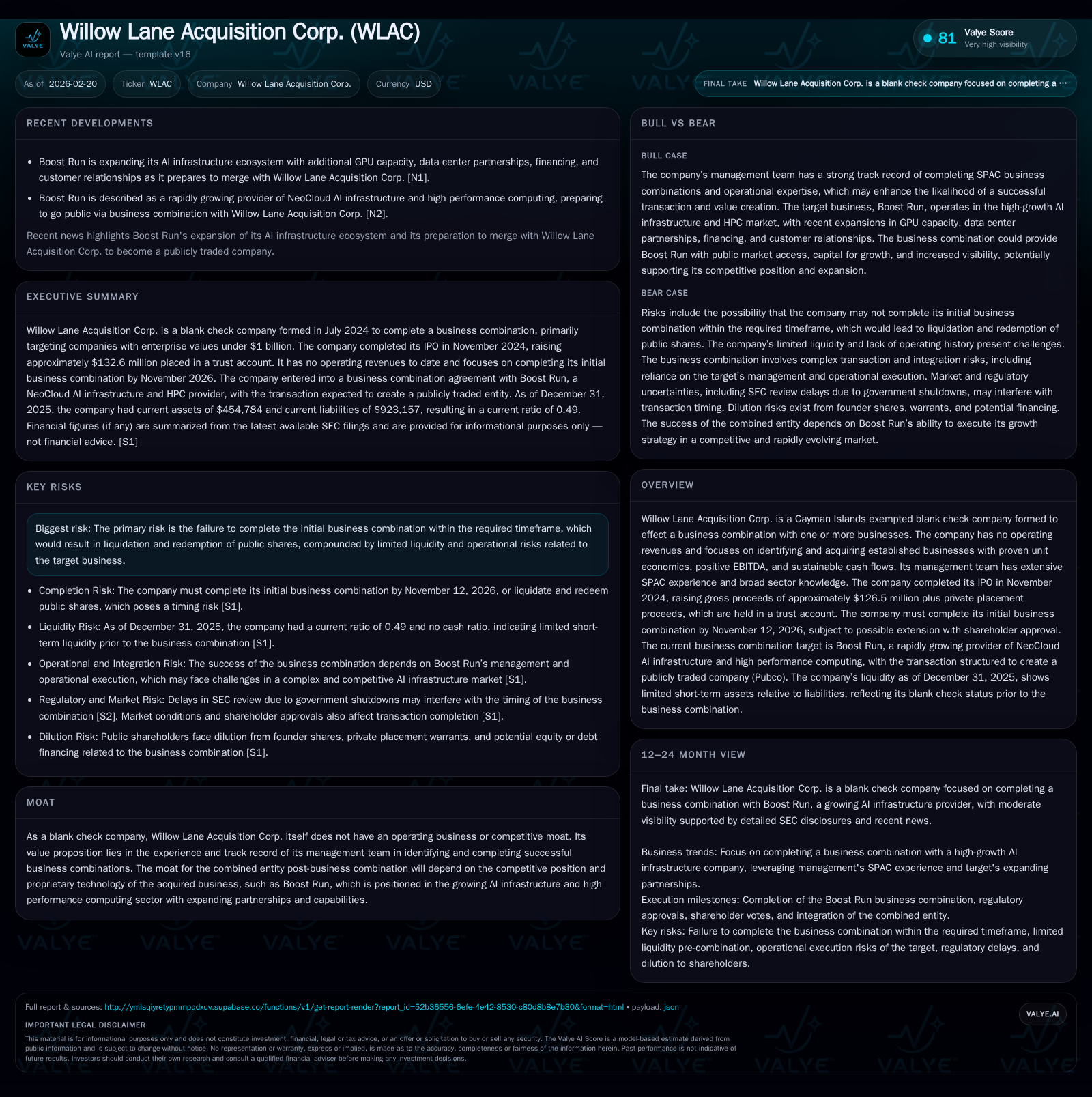
Willow Lane Acquisition Corp. (WLAC), a Cayman Islands-based blank check company, launched its IPO in late 2024, raising $126.5 million to pursue business combinations focused on established profitable enterprises. Its management’s deep SPAC experience underpins its strategy, currently centered on merging with Boost Run, a rising player in NeoCloud AI infrastructure and high-performance computing. Despite no operational revenues prior to combination, WLAC's financials reveal widening operating losses but improved net income reflecting non-operating gains typical for a pre-merger SPAC. The successful closure of the Boost Run transaction promises access to fast-growing tech markets, though execution timing, liquidity management, and sector competition remain pivotal.
Willow Lane’s Foundation: From IPO to Target Identification
Willow Lane Acquisition Corp., incorporated as a Cayman Islands exempted company on July 3, 2024, represents a classical blank check vehicle intent on acquiring mid-sized businesses with solid unit economics and positive EBITDA [S1]. Its initial public offering in November 2024 generated gross proceeds amounting to approximately $126.5 million plus proceeds from private placement warrants; these funds are held securely in a trust account pending business combination execution—a typical SPAC trust account structure allowing investor protection against deployment risk [F1][S1][S23].
The management team's pedigree is notable: it includes professionals who have successfully closed five prior SPAC business combinations, bringing broad sector expertise and cross-border capital markets insight—assets that strengthen WLAC's acquisition thesis [S23]. This deep experience informs careful target screening aligned with established revenue streams and sustainable cash flow generation.
Currently, WLAC has identified Boost Run—a company specializing in NeoCloud AI infrastructure and high-performance computing—as its initial business combination target [S1]. Boost Run’s niche positioning leverages proprietary technology stacks capable of scaling AI compute clusters efficiently across cloud environments [S1]. This focus signals WLAC’s strategic pivot toward capturing growth in the burgeoning AI infrastructure sector.
Historical Financial Snapshot: Operating and Net Income Trends Pre-Merger
Operating history prior to any business combination understandably reflects minimal activity given WLAC's status as a shell entity. Nonetheless, examining recent financials uncovers trends crucial for interpreting upcoming milestones.
Historical performance (annual)
| FY | Net ($mm) | CFO ($) | OpInc ($mm) | Net YoY |
|---|---|---|---|---|
| 2025 | 3 | -1045778 | -2 | +2841.6% |
| 2024 | 0 | -457167 | 0 |
Note: Omitted columns lack sufficient annual XBRL coverage in the provided tags (need ≥2 annual points): Rev, Capex, Div, Buybacks, FCF. Source: SEC companyfacts cache [F1].
Capital returns and efficiency (annual)
| FY | ROE% |
|---|---|
| 2025 | -70.2 |
| 2024 | -4.0 |
Source: SEC companyfacts cache [F1].
Table: Historical Operating Income Loss, Net Income, Operating Cash Flow & Equity (FY24–FY25)
Data sourced from company XBRL filings exhibits pronounced widening of operating losses in FY2025 compared to FY2024 driven by administrative expenses linked to expanded due diligence activities on target companies such as Boost Run—a manifestation of negative operating leverage seen frequently in pre-merger SPACs [F1]. Meanwhile, net income surged positively due to non-operating gains including mark-to-market adjustments or interest income from the trust funds—all standard accounting phenomena harmonized with cash inflows secured at IPO [F1].
The operating cash flow deterioration corresponds with these same trends: increased operational outlays without yet generating revenue streams. Stockholders' equity declines accordingly reflect accumulated losses netted against sponsor contributions but do not indicate fundamental distress given the blank check nature of WLAC [F1]. The current ratio stands low at approximately 0.49 representing minimal working capital outside trust-protected monies [F1], consistent with expectations for an SPAC awaiting business combination completion.
Boost Run Business Combination: Strategic Rationale and Market Position
Boost Run fits WLAC’s criteria of an emerging enterprise embedding proprietary capability within high-growth AI infrastructure markets [S1][S8]. By focusing on NeoCloud architecture—a next-gen distributed cloud-based AI platform offering heightened computational efficiencies—Boost Run confronts an evolving competitive landscape demanding unique technology stacks that improve scalability of AI workloads without commensurate costs escalation [S1].
Boost Run's competitive moat derives from synergistic partnerships enabling it to customize solutions tailored for specific high-performance computing needs while sustaining positive EBITDA margins through operational efficiencies [S1][S8]. Given accelerating demand across sectors including data analytics, machine learning model training, and AI inference at scale—industries predicted by independent analysts to sustain double-digit throughput growth annually—Boost Run occupies a compelling niche . The merger aligns WLAC’s sponsorship expertise with Boost Run’s proprietary assets providing mutual growth enablers.
Growth Prospects and Operational Constraints Post-Combination
Post-closing prospects should incorporate WLAC's access to public markets which can catalyze Boost Run's capital raising efforts crucial for growth acceleration through research & development investment and capacity expansion [S6]. Achieving scale economics by deploying larger AI compute clusters could materially improve margins over time if executed efficiently.
Nevertheless, certain constraints could temper near-term performance: integration complexity within disparate organizational cultures may delay synergy realization; intensified competition within both SPAC sponsors vying for fewer high-quality targets raises acquisition premiums thus compressing return profiles; regulatory scrutiny amplified by government shutdown-related SEC review delays may push back closing timelines adversely impacting momentum [S2][S4]. Furthermore, macroeconomic volatility—namely fluctuations in inflation rates affecting cost structure assumptions—and geopolitical tensions influencing cross-border technology deployment add layers of uncertainty pertinent to investor due diligence assessments .
Capital Structure, Liquidity, and Financing Flexibility
Liquidity remains robust due primarily to the $132.6 million held within the trust account at December 31, 2025 (excluding working capital held outside) which forms the financial bedrock for consummation of the Boost Run deal or alternative transactions should they arise [F1][S6]. The absence of outstanding debt ensures cleaner capitalization going into the transaction.
WLAC retains strategic flexibility in structuring consideration via various blends of cash from trust accounts combined with issuance of equity or debt instruments tailored to meet Boost Run’s funding ambitions balanced against dilution impacts for existing shareholders [S6]. This includes leveraging forward purchase agreements or backstop commitments if required to fulfill minimum cash covenants stipulated under merger agreements.
Trust account release mechanics protect public investors’ principal while offering operational agility post-combination—a hallmark mechanism enabling rapid capitalization yet safeguarding liquidity buffers during transition phases .
Risk Environment Surrounding Business Combination Completion
Failure to complete the business combination by November 12, 2026 would trigger mandatory liquidation resulting in distribution of the Trust Account balance less expenses—the downside scenario deterring speculative holding absent sufficient confidence in closing prospects [S1]. Shareholder redemption rights introduce further complexities particularly if significant holders elect out thus reducing available transaction capital requiring supplemental financings potentially dilute economic interests further [S22][S26].
Regulatory risk factors are accentuated by continuing government shutdown episodes obstructing timely SEC reviews which historically have delayed proxy filings or tender offer documentation needed ahead of shareholder votes [S2]. Market sentiment towards SPACs remains mixed; increased skepticism towards post-IPO valuations pressures pricing dynamics complicating deal negotiations while elevating counterparty risks related to prospective targets’ operational stability or transparency of financial disclosures—as underscored by limited operating histories among many technology-focused entities like Boost Run itself [S16].
Management conflicts inherent within founder shares participation might raise governance scrutiny despite prior track records reducing perceived execution risk; any material litigation or reputational issues among management teams could cascade into deal impediments though none are currently reported [S7][S16]. The evolving regulatory landscape governing disclosures around SPAC mergers imposes incremental cost burdens potentially affecting deal economics.
Forecasting Milestones and Value Creation Triggers to Watch
While explicit timing guidance beyond the statutory November 12 deadline is unavailable from disclosures currently [N/A], key monitoring points include:
- Progression through SEC registration statement reviews enabling formal solicitation of shareholder votes;
- Announcement of shareholder vote schedule or initiation of tender offer process;
- Magnitude and profile of redemption elections signalling confidence levels;
- Execution of supplementary financings supporting transaction funding gaps;
- Initial trading performance post-business combination indicating market reception;
- Operational metrics emerging from combined company relevant to earnings power realization including revenue ramp rates around AI infrastructure deployments.
These gatekeeper events will determine liquidity inflection points critical in managing valuation trajectories and informing secondary market participation decisions .
Capital Allocation Policies: Shareholder Returns and Cash Management
To date WLAC has paid no dividends nor undertaken share repurchases consistent with standard blank check company practices limiting distributions until generation of steady free cash flow post-merger operations commence as no data on dividends or buybacks is available from company filings [F1][S5]. Redemption rights embedded within governance structures safeguard public shareholders by permitting exit ahead of transaction closure if they oppose terms maintaining alignment with fiduciary duties.
Post-combination capital allocation is likely oriented toward reinvestment earmarked for organic growth initiatives or servicing any incurred debt financing facilitating acquisition structuring flexibility rather than immediate shareholder returns via dividends or buybacks—though future policies remain subject to board discretion reflecting underlying cash flow visibility established over time [S5].
Approximate return on equity calculations remain negative at around –70%, owing principally to pre-combination accumulated operating losses offsetting sponsor funding not yet yielding operating revenues; meaningful ROE analysis will materialize only after combined entity transitions into fully operational status delivering positive EBITDA generation [F1].
Disclaimer: This analysis is prepared solely for informational purposes integrating publicly filed documents with professional interpretation specific to Willow Lane Acquisition Corp.'s historical data and merger plans as disclosed up to February 20th, 2026. It does not constitute investment advice or recommendations regarding security transactions. Readers should conduct their own due diligence including consultation with qualified advisors before making any investment decisions.
Disclaimer: This is research-only, informational analysis and not investment advice. It may include AI-generated interpretation and general industry context. Always verify important details using primary sources.

Comments