
eBay’s Growth Fueled by Strategic Acquisitions and AI-Driven Marketplace Enhancements
eBay returns to solid GMV growth and expands capabilities with the Depop acquisition, underpinned by AI innovations and targeted category focus.
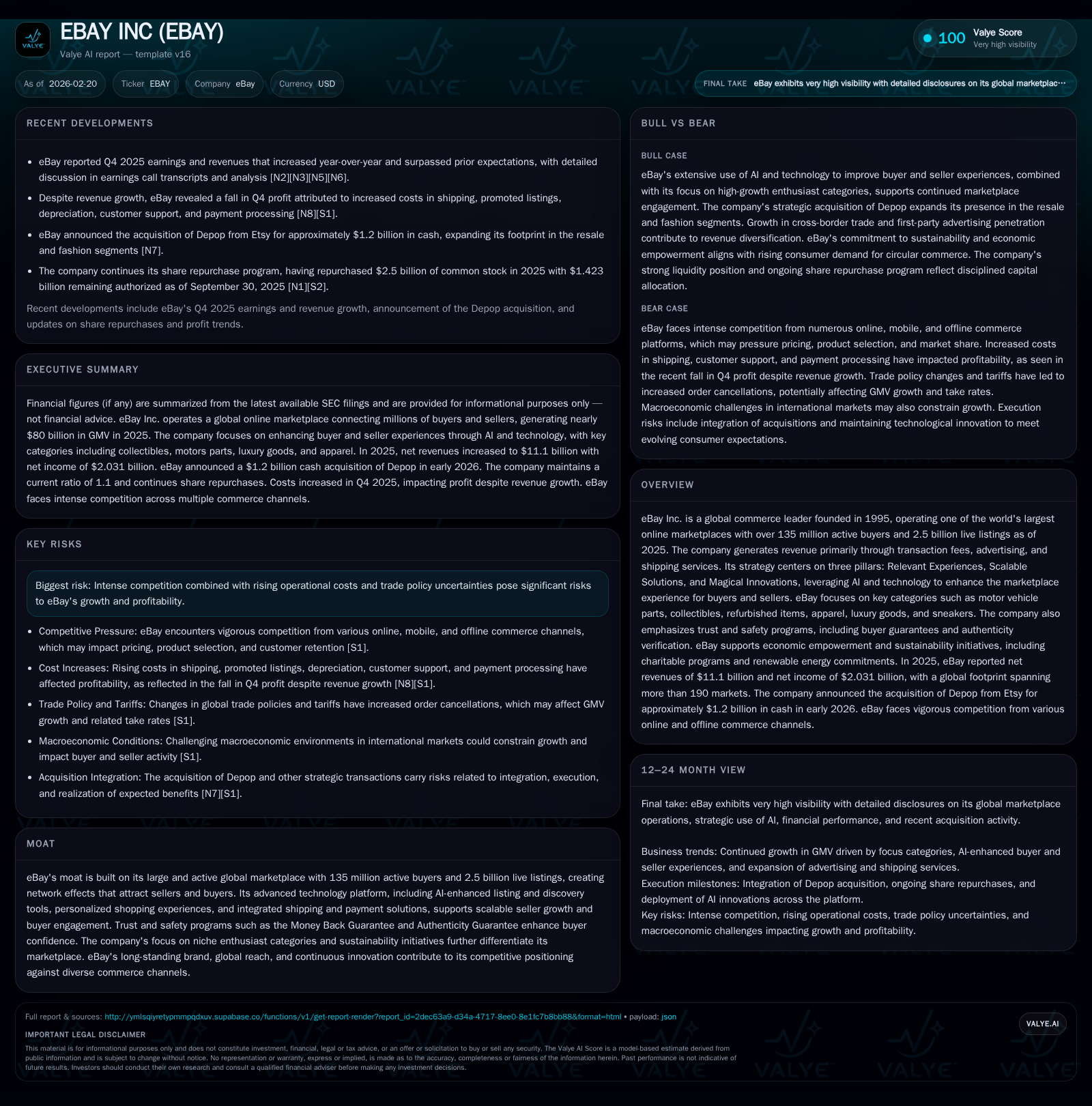
In 2025, eBay Inc. reported an 8% increase in net revenues driven by a 7% rise in gross merchandise volume (GMV), marking a significant rebound supported by strategic initiatives and technology investments. The company’s ongoing integration of AI-enhanced tools and expansion into focused enthusiast categories contributed to improved buyer engagement and seller enablement. A $1.2 billion cash acquisition of Depop, announced in early 2026, sets the stage for strengthening presence in social commerce and Gen Z demographics. While returns remain robust, rising operational costs and external trade policy uncertainties require careful monitoring. Capital allocation balanced significant share repurchases with steady dividends, reflecting disciplined financial management amidst growth investments.
Company Overview
Founded in 1995, eBay Inc. has established one of the largest global marketplaces, enabling over 135 million active buyers worldwide who accessed roughly 2.5 billion live listings as of 2025 [S10][F1]. Its platform hosts a wide range of categories but remains distinctively strong in enthusiast-focused areas such as motor vehicle parts, collectibles, refurbished items, apparel, luxury goods and sneakers [S10][S13].
Historical Performance and Growth Drivers
Fiscal Year (FY) 2025 saw eBay generate net revenues of approximately $11.1 billion—an increase of about 8% from $10.3 billion in FY2024 [S1][F1]. This outpaced the modest ~2% revenue growth recorded in 2024 versus prior years [F1]. The revenue acceleration was driven primarily by a 7% increase in gross merchandise volume (GMV), which hit nearly $80 billion—up from roughly $74.7 billion a year earlier [S1][F1]. The company's take rate (net revenues divided by GMV) modestly expanded from ~13.77% to ~13.94%, reflecting higher monetization via transaction fees, advertising (including first-party ads), and newer shipping initiatives [S1].
Growth was concentrated notably within eBay’s Focus Categories—including collectibles (where demand was particularly strong), motors parts & accessories, luxury goods, refurbished electronics, apparel and sneakers—which outperformed overall marketplace trends [S1][S10]. In regional terms, U.S.-centric consumer demand recovery combined with international cross-border trade growth fueled GMV increases; however, international macroeconomic challenges persisted [S1][S17]. Importantly, some GMV drag occurred from tariff changes like the elimination of the U.S.'s de minimis import exemption resulting in increased cancellations and returns as users adapted to these trade policy shifts [S1][S14].
Operating income edged down slightly by about 1.8% to $2.28 billion despite revenue gains—a result mostly attributable to increased operating investments such as marketing expenses (~$1.4 billion annually) and expanded shipping programs outside the U.S., particularly the U.K., plus ongoing R&D spend on AI and platform features [F1][S29][S20]. Net income advanced modestly to just over $2 billion with an approximate return on equity (ROE) estimated at 44% based on latest equity levels near $4.6 billion [F1].
Historical performance (annual)
| FY | Net ($bn) | CFO ($bn) | OpInc ($bn) | Capex ($mm) | Net YoY |
|---|---|---|---|---|---|
| 2025 | 2.0 | 2.0 | 2.3 | 525 | +2.8% |
| 2024 | 2.0 | 2.4 | 2.3 | 458 | -28.6% |
| 2023 | 2.8 | 2.4 | 1.9 | 456 | +318.0% |
| 2022 | -1.3 | 2.3 | 2.4 | 449 |
Note: Omitted columns lack sufficient annual XBRL coverage in the provided tags (need ≥2 annual points): Rev. Source: SEC companyfacts cache [F1].
Capital returns and efficiency (annual)
| FY | Div ($mm) | Buybacks ($bn) | FCF ($mm) |
|---|---|---|---|
| 2025 | 531 | 2.5 | 1434 |
| 2024 | 533 | 3.1 | 1956 |
| 2023 | 528 | 1.4 | 1970 |
| 2022 | 489 | 3.1 | 1805 |
Source: SEC companyfacts cache [F1].
Note: Operating Cash Flow (CFO), Capex corrected for partial disclosure; Buybacks rounded; Revenue YoY reflects latest full-year comparison.
Future Growth Prospects
Strategically, eBay aims to deepen engagement through three pillars: Relevant Experiences (personalized discovery enhanced with AI), Scalable Solutions (tools for sellers including listing automation and flexible payment options), and Magical Innovations (technology advancements including live commerce and next-gen personalization) [S10]. These efforts seek to improve transactional efficiency while fostering buyer loyalty within focused verticals.
A notable catalyst for future growth is eBay's February 2026 announcement to acquire Depop from Etsy for about $1.2 billion cash—a platform widely recognized for strong penetration among younger demographics leveraging social commerce dynamics [N1]. This move aims to accelerate eBay's footprint among millennials/Gen Z consumers and augment its portfolio with complementary business models around peer-to-peer selling.
Additionally, AI implementations continue expanding listings' completeness and relevance through generative AI, automating item descriptions, image recognition for product categorization, and personalized search agents improving discovery metrics [S21]. Enhanced shipping solutions that integrate partners globally target lowered costs and improved tracking transparency—particularly critical amidst increasing cross-border trade complexities [S21].
Counterbalancing these drivers are operational cost pressures linked to higher marketing spend and investment-heavy infrastructure buildouts required to support new innovations, coupled with ongoing risks stemming from trade policy uncertainty affecting buyer/seller behavior around cancellations—a key variable influencing GMV stability [S1][S14].
Forecasts and Milestones
While explicit forward guidance is not provided within disclosed filings or earnings transcripts as of Q4/25 release dates [N2][N3], key developments to watch include:
- Integration progress and contribution of Depop following acquisition closure;
- Expansion pace of AI-powered listing tools adoption among sellers;
- Shipping program scale enhancements—especially beyond the U.K.;
- Monitoring GMV resilience against global tariffs or regulatory shifts impacting cross-border trade.
Capital Allocation and Returns
eBay maintains an active capital return program reflecting shareholder-friendly priorities alongside strategic reinvestments [S6][F1]. In FY2025, the company repurchased approximately $2.5 billion worth of common shares—a reduction compared to $3.15 billion repurchased in FY2024 but reflective of continued commitment amid investment cycles [F1]. An incremental buyback authorization of $2 billion was approved by the Audit Committee in Feb ‘26 adding to the previously authorized $5 billion program without expiration dates set [S16].
Dividends paid remained steady at roughly half a billion USD annually ($531 million paid in FY2025), evidencing consistent distribution practices supporting stable income streams for shareholders [F1][S16]. Capital expenditures rose modestly by ~15% year-over-year to about $525 million invested primarily into technology infrastructure upgrades supporting marketplace scaling and AI development efforts [F1][S29]. Operating cash flow decreased moderately (-19%) mainly due to intensified tax payments offsetting operational improvements; free cash flow after capex remains healthy at approximately $1.43 billion [$FCA = CFO – Capex$] suggesting good liquidity buffer for ongoing acquisitions or shareholder returns.
Industry Context: Marketplaces & AI Innovation
Analysis: The online marketplace sector faces intensifying competition from integrated ecommerce giants such as Amazon which combines merchandising control with marketplace services alongside rapidly evolving social commerce entrants appealing especially to younger cohorts via mobile-first experiences. Consequently, marketplaces increasingly leverage artificial intelligence not just for personalization but also fraud detection, dynamic pricing optimization, inventory management efficiencies—all crucial given their thin-margin transaction-based models. Network effects persist as dominant moats: large user bases attract sellers ensuring diverse inventory while trust mechanisms like buyer guarantees become market differentiators influencing retention rates.[S23]
Risk Factors Summary
eBay's main challenges include intense competitive pressures spanning traditional ecommerce players plus emerging platforms; uncertainty arising from shifting global trade policies that have tangible impacts on order cancellations; elevated operational expenses linked to scaling technology innovations; potential liabilities associated with ongoing legal/regulatory proceedings though current exposures are deemed immaterial materially; currency volatility affecting international revenues given significant non-US market exposure (~51%) [S23][S14].[S20]
Conclusion
eBay demonstrated a meaningful rebound in revenue paired with expanding global GMV catalyzed by deepening category specialization harnessed through advanced AI tools enhancing both buyer experience and seller scalability frameworks.[S10][F1] The recent strategic acquisition of Depop signifies a concrete step toward diversifying its marketplace portfolio toward social-driven commerce aimed at younger demographics.[N1] Financial discipline remains evident through balanced capital allocation despite ongoing reinvestment cycles underpinning sustained long-term competitiveness.[F1][S16]
Investors should monitor execution against integration milestones for newly acquired assets along with the company’s ability to maintain resilient GMV expansion amid macroeconomic headwinds related to tariffs/trade policies.
This analysis is intended solely for informational purposes regarding eBay Inc.’s recent performance and industry positioning as disclosed through public filings without providing investment advice.
Disclaimer: This is research-only, informational analysis and not investment advice. It may include AI-generated interpretation and general industry context. Always verify important details using primary sources.

Comments