
Wayfair Inc. Leverages Omni-Channel Execution to Improve Operating Income in 2025
Wayfair’s strategic shift from expansion to operational efficiency in 2025 centers on omni-channel growth, logistics integration, and tighter capital management.
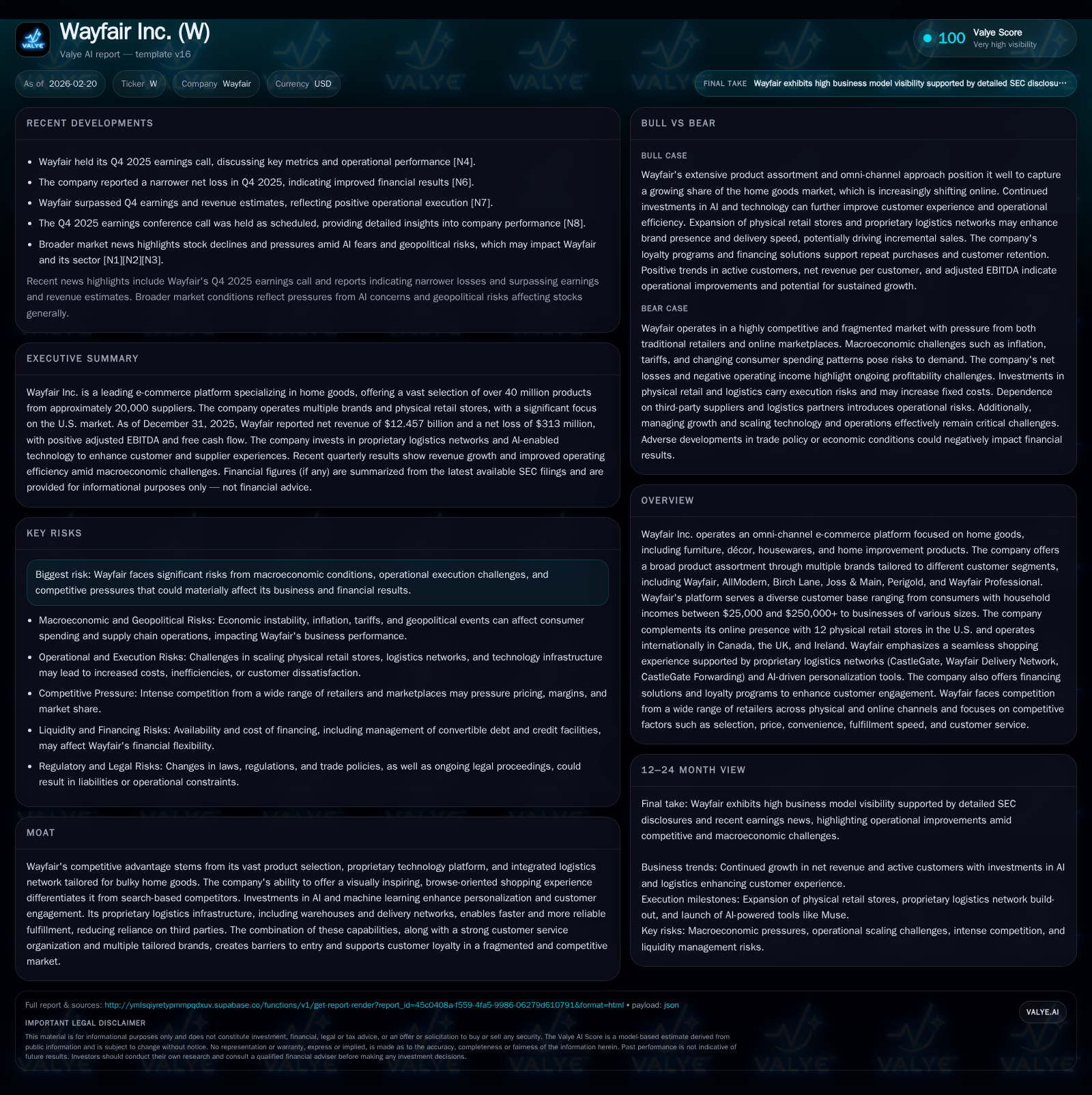
Wayfair Inc. transitioned in 2025 from aggressive top-line expansion with deep operating losses toward a model emphasizing profitability and cash flow generation. The company’s exit from the German market and macroeconomic headwinds tempered revenue growth to a modest 5.1%, while repeat buyer orders remained robust at over 80%. Investments in proprietary logistics networks combined with AI-driven personalization enhanced customer engagement and fulfillment reliability, underpinning improved contribution margins and positive operating income. Despite persistent net losses and negative equity, free cash flow grew markedly to $464 million, reflecting disciplined capital allocation amid a challenging global trade environment.
Wayfair’s Historical Growth: Scale Gains Amid Operational Complexity
Wayfair's revenue trajectory since its IPO reflects rapid scale driven by expanding product assortments from approximately 20,000 suppliers offering over 40 million SKUs across furniture, décor, housewares, and home improvement categories [F1][S8]. Revenue surged from $1.32 billion in FY2014 to $4.72 billion by FY2017 — an increase of nearly 3.6x over three years.
This expansion introduced complex logistics challenges intrinsic to bulky goods e-commerce, requiring investments in proprietary infrastructure such as CastleGate warehouses for forward-positioning inventory closer to consumers and the Wayfair Delivery Network (WDN) for last-mile delivery control [S8][S9]. While gross margins have remained stable near low-30%s, operating losses peaked at -$1.38 billion in FY2022 before narrowing substantially to a positive operating income of $17 million in FY2025 — evidencing improved operating leverage [F1].
Historical performance (annual)
| FY | Net ($mm) | CFO ($mm) | OpInc ($mm) | Capex ($mm) | Net YoY |
|---|---|---|---|---|---|
| 2025 | -313 | 534 | 17 | 70 | +36.4% |
| 2024 | -492 | 317 | -461 | 73 | +33.3% |
| 2023 | -738 | 349 | -813 | 148 | +44.6% |
| 2022 | -1331 | -674 | -1384 | 186 |
Note: Omitted columns lack sufficient annual XBRL coverage in the provided tags (need ≥2 annual points): Rev, Div. Source: SEC companyfacts cache [F1].
Capital returns and efficiency (annual)
| FY | Buybacks ($mm) | FCF ($mm) | ROE% |
|---|---|---|---|
| 2025 | 464 | 11.3 | |
| 2024 | 0 | 244 | 17.9 |
| 2023 | 0 | 201 | 27.3 |
| 2022 | 75 | -860 | 52.2 |
Source: SEC companyfacts cache [F1].
Note: Revenue beyond FY2017 is not available in provided tags; operating income shows marked improvement; net income remains negative but less so.
Market Exits & Macroeconomic Headwinds Impacting Growth
In early 2025, Wayfair announced its exit from the German market as part of restructuring efforts aimed at streamlining international operations amid soft consumer demand compounded by inflationary pressures across Europe [S1][N1]. This move trimmed overhead but constrained international revenue contributions.
Simultaneously, U.S.-imposed tariffs on imported goods raised input costs for Wayfair’s significant Asian-sourced product base [S1], while elevated interest rates pressured consumer discretionary spending on non-essential home furnishings.
Despite these headwinds, active customers stabilized at roughly 21 million with repeat buyers generating over 80% of orders — underscoring customer loyalty under economic uncertainty [S1][N13]. Advertising spend remained tightly managed with ROI-focused strategies optimizing cost-effective customer acquisition.
Omni-Channel Strategy & Brand Portfolio
Wayfair operates six distinct brands—Wayfair, AllModern, Birch Lane, Joss & Main, Perigold, and Wayfair Professional—catering to diverse demographics ranging from modest-income households (~$25K annual) up to affluent consumers exceeding $250K per annum [S8]. This segmentation enables tailored merchandising and marketing approaches.
Physical retail presence complements e-commerce through twelve stores across four U.S states as of end-2025 providing experiential shopping touchpoints that reinforce brand engagement offline [S8][S29]. The B2B channel via Wayfair Professional leverages dedicated technology solutions for streamlined bulk ordering.
Mobile commerce accounts for over half site traffic with integrated augmented reality features facilitating product visualization pre-purchase — enhancing conversion among younger demographics [S20].
Proprietary Logistics & AI Enhance Customer Experience
Wayfair’s vertically integrated logistics infrastructure includes CastleGate warehouses enabling forward inventory positioning closer to key markets — accelerating delivery times especially for bulky items requiring specialized handling [S8]. The Wayfair Delivery Network (WDN) manages last-mile delivery through consolidation centers, cross-docks, and owned or contracted carriers reducing damage rates and improving delivery predictability [N1].
CastleGate Forwarding optimizes inbound freight flows from Asia directly into distribution hubs cutting transit times versus traditional port routes.
AI-powered personalization tools dynamically curate product recommendations based on browsing behavior correlated with purchase history improving discovery efficiency online and via mobile platforms; AI also supports customer service automation reducing merchant fees [S8][N1].
These capabilities form barriers against marketplace-only competitors lacking logistic control or curated assortments critical for the visual-centric home goods sector.
Capital Allocation & Financial Positioning Amid Negative Equity
Wayfair’s balance sheet reflects accumulated losses resulting in stockholders’ equity of approximately negative $2.78 billion at FY2025 end [F1]. No dividends have been paid recently nor share buybacks conducted since early years due to focus on deleveraging and liquidity preservation amid significant upcoming debt maturities [F1][S18].
Operational cash flow improved significantly — net CFO rose nearly +69% year-over-year reaching $534 million despite modest revenue growth reflecting enhanced working capital management supported by logistics investments [F1]. Capital expenditures moderated slightly (-4%) year-over-year signaling disciplined investment focused on maintenance rather than expansion phases.
Free cash flow (CFO minus capex) approximated $464 million highlighting improved capital efficiency which strengthens liquidity buffers for refinancing or strategic opportunities if net loss trends improve further towards breakeven.
The company carries complex debt including convertible notes maturing between 2026-28 plus senior secured bonds due through early next decade imposing covenant constraints limiting operational flexibility; liquidity stood around $1.54 billion as of late-2025 providing immediate cushion albeit refinancing risk persists given macroeconomic volatility [S5][S7][S12].
Profitability Milestones & Margin Trends
After successive years of steep operating losses driven by scaling investments (e.g., >$800 million loss in FY2023), Wayfair achieved positive operating income of about $17 million in FY2025 marking a key milestone despite ongoing net losses of $313 million reflecting accrued interest expenses related to high debt levels and convertible note amortization impacting GAAP results heavily [F1].
Gross margins remained steady near low-thirties percentage supported by cost efficiencies from proprietary logistics reducing reliance on third-party carriers prone to damage claims; contribution margins improved through leaner advertising spend yielding better order economics per marketing dollar invested amidst inflationary supply chain pressures [S9][N13].
Challenges Ahead: Macroeconomic & Competitive Pressures
Ongoing global economic volatility—including tariff uncertainties between U.S.-China trade relations—inflationary wage pressures on logistics providers plus recession fears weigh on discretionary home furnishing demand sensitive to economic cycles more than essentials [S10][N1].
Competition remains fragmented yet intense with large e-commerce platforms like Amazon exerting pricing power alongside physical retailers offering integrated omnichannel experiences backed by scale fulfillment networks limiting margin upside potential for Wayfair [S19].
Regulatory risks related to evolving privacy laws constrain digital marketing effectiveness critical for customer acquisition/retention models reliant on repeat purchases; supply chain disruptions add execution risks threatening customer satisfaction gains [S10][S21][N13].
What To Watch: Key Performance Indicators & Strategic Triggers
Analysts will monitor omni-channel sales mix shifts favoring higher-margin physical stores; international market developments post-Germany exit; AI-driven personalization impacts on average order value; advertising ROI trends driving scalable new customer acquisition; repeat purchase rate stability signaling consumer confidence; plus debt refinancing outcomes critical given restrictive covenants starting late-2026 maturities [N6][N7][S2][S16].
Disclaimer: This analysis is based solely on information available as of February 20, 2026 with no speculative assumptions beyond documented sources cited within brackets. It does not constitute investment advice or recommendation.
Disclaimer: This is research-only, informational analysis and not investment advice. It may include AI-generated interpretation and general industry context. Always verify important details using primary sources.

Comments