
Pulse Biosciences Advances Cardiac Ablation Focus Despite Persistent Losses and Capital Needs
Pulse Biosciences is progressing its innovative Nano-pulse Stimulation platform while grappling with operating deficits and financial sustainability challenges.
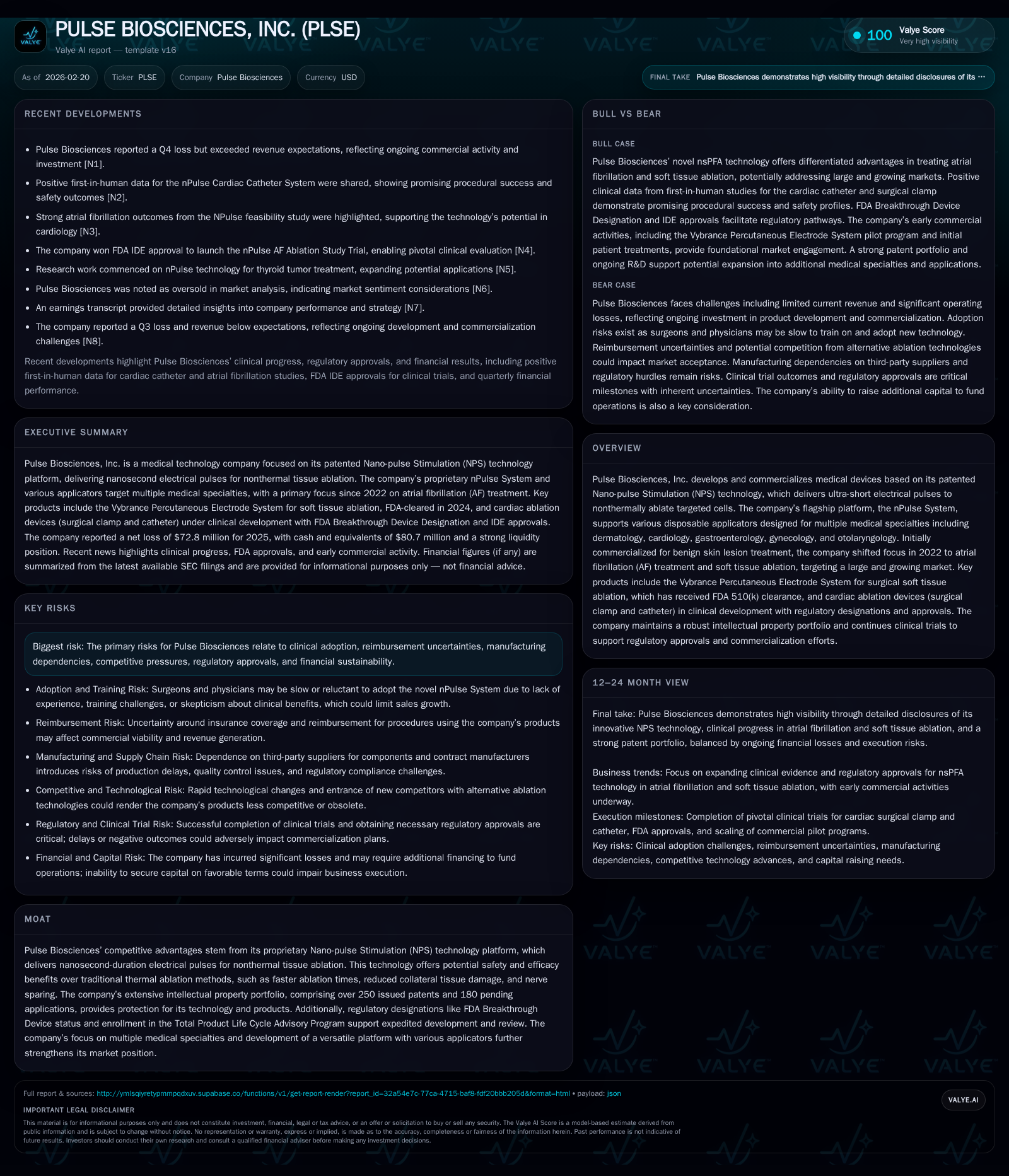
Pulse Biosciences, Inc. has transitioned from dermatology to cardiology for its proprietary Nano-pulse Stimulation (NPS) technology, targeting a multi-billion-dollar atrial fibrillation treatment market. Despite receiving FDA clearance for its Vybrance Percutaneous Electrode System and advancing promising clinical data for cardiac ablation devices, the company continues to incur significant operating losses and negative cash flows. Its substantial patent portfolio and regulatory designations support the platform’s competitive moat, yet clinical adoption, reimbursement, and funding remain key risks. Pulse relies heavily on capital raises, with recent equity financings underpinning ongoing R&D and commercialization efforts.
Company Overview and Historical Development
Pulse Biosciences markets itself as an innovator in medical device ablation technologies through its patented Nano-pulse Stimulation (NPS) platform delivering ultra-short electrical pulses to nonthermally ablate targeted cells [S1]. Initially directed at benign skin lesions with the CellFX system, the company recalibrated its strategic focus by 2022 predominantly toward treating atrial fibrillation (AF), a large-scale indication with roughly 1.9 million US annual diagnoses representing an estimated $3 billion addressable market within electrophysiology alone [S1]. This pivot reflects Pulse’s aspiration to capture long-term double-digit growth within AF coupled with other soft tissue ablation opportunities through surgical and minimally invasive applications.
The company's flagship commercially available product is the nPulse Vybrance Percutaneous Electrode System—a disposable needle electrode paired with the nPulse Console—which achieved FDA 510(k) clearance in late 2023 [S1]. After years of preclinical optimization and a first-in-human feasibility study involving thyroid nodules demonstrating safety without fibrosis or scarring, limited market release began in Q3 2025 [S1][S27]. Early anecdotal outcomes indicated favorable tolerability but wider clinical adoption hurdles remain unproven.
Parallel efforts include developing cardiac ablation applicators such as surgical clamps and catheters—leveraging NPS energy’s promise for precise myocardial tissue ablation while sparing nerve structures. These investigational devices have earned FDA Breakthrough Device designations designed to accelerate regulatory evaluation [N2][N3][S1]. Positive initial human catheter data was reported recently indicating compelling safety and efficacy signals for AF outcomes [N2][N3]. Collectively, this breadth of applicators spanning dermatology, cardiology, gastroenterology, gynecology, and otolaryngology underlines Pulse’s platform versatility.
Financial Performance: Past Growth and Operating Metrics
While technology investment has been robust, revenue has remained nascent with only approximately $0.57 million recorded through September 30, 2021—the last reported figure prior to broader commercialization attempts [F1]. Operating income has deteriorated annually given steep expense growth amid clinical trials and commercialization support:
Historical performance (annual)
| FY | Net ($mm) | CFO ($mm) | OpInc ($mm) | Capex ($) | Net YoY |
|---|---|---|---|---|---|
| 2025 | -73 | -54 | -77 | 315000 | -35.8% |
| 2024 | -54 | -36 | -56 | 125000 | -26.9% |
| 2023 | -42 | -33 | -44 | 121000 | +27.9% |
| 2022 | -59 | -47 | -58 | 401000 |
Note: Omitted columns lack sufficient annual XBRL coverage in the provided tags (need ≥2 annual points): Rev, Div, Buybacks. Source: SEC companyfacts cache [F1].
Capital returns and efficiency (annual)
| FY | FCF ($mm) | ROE% |
|---|---|---|
| 2025 | -54 | -90.2 |
| 2024 | -36 | -46.7 |
| 2023 | -33 | -95.2 |
| 2022 | -47 | 2602.5 |
Source: SEC companyfacts cache [F1].
Note: Revenues reflect limited early commercial sales; detailed YoY revenue unavailable due to sparse data.
Net income losses have deepened alongside increasing operating expenses driven by heightened research activities (+$12M increase in R&D expenses in FY25 vs FY24), stock-based compensation increments ($4.5M SG&A), and expanding clinical programs [S27]. The company remains unprofitable with a calculated return on equity near -90%, highlighting continuing resource burn against shareholder capital [F1].
Operating cash flow is persistently negative (-$54M in FY25), accompanied by modest capital expenditures reflective of light asset intensity typical for device developers in early commercial stage [F1][S16][S27]. Pulse ended FY25 with cash reserves above $80 million—supported substantially by a mid-2024 Rights Offering that grossed $60M—and a strong current ratio exceeding 10x due to low current liabilities against liquid assets [F1][S6][S10][S26].
Future Growth Drivers and Catalysts
The primary growth avenue lies in broadening adoption of the nPulse Vybrance system beyond initial limited release into established medical practices for soft tissue ablation surgeries [S1][N1]. Acceptance by physicians will hinge on patient outcomes comparing favorably versus incumbent thermal ablation methods—especially regarding reduced collateral damage risks such as nerve preservation—a distinctive value proposition of NPS technology [S1]. Pricing strategies must also navigate complex reimbursement landscapes where Medicare and commercial insurers have growing scrutiny over novel device coverage criteria [S22]. Successful establishment of sustainable reimbursement codes would materially improve commercial viability.
More transformative is progression in AF treatment: development-stage cardiac ablation catheters with encouraging first-in-human data offer strategic runway into a multi-billion dollar electrophysiology sector currently dominated by thermal modalities like radiofrequency or cryoablation [N2][N3]. Regulatory Breakthrough Device status affords accelerated timelines but real-world outcomes data is pending to drive acceptance among cardiologists.
Additionally, leveraging their extensive patent portfolio (over 250 issued patents plus ~180 pending) across multiple procedural formats provides protection against competitive encroachment and supports potential pipeline expansion into other specialties such as gastroenterology or gynecology where localized nonthermal ablation could be disruptive [S1][N2]. Clinical trials targeting these areas will be important milestones.
Risks and Constraints on Growth Prospects
Key uncertainties include:
- Clinical adoption: Convincing surgical and electrophysiology communities to switch from established thermal tools requires robust long-term safety/efficacy demonstrations amid entrenched practices [S4][S9].
- Reimbursement dynamics: Absence or delays in securing payer approvals complicate physician uptake; cost-effectiveness analyses will influence coverage decisions [S22].
- Manufacturing dependencies: Supply chain disruptions could impact production scale-up; alternative supplier arrangements are limited [S22].
- Regulatory hurdles: Despite Breakthrough Device recognition, emergent FDA policies or EU MDR standards could add delays or costs [S5][S21].
- Financial sustainability: Continuing net losses and negative cash flows necessitate further capital raises; dilution risk exists alongside potential financing availability challenges amid volatile macroeconomic conditions [S6][S10][S17].
Capital Allocation & Financial Strategy
The company invests heavily in research & development—which rose to approximately $44.7 million in FY25 from about $32.3 million the prior year—reflecting increased external trial costs and internal compensation pressures including stock-based awards [S16][F1]. Selling, general & administrative expenses similarly escalated by roughly $8 million driven by personnel additions supporting sales force expansion ahead of broader commercialization campaigns.
Capital expenditures remain minimal (<$400K per annum), consistent with an asset-light model focused on product development rather than manufacturing plants [F1]. There are no reported dividend payments or stock repurchase programs executed; available equity plans provide room for future grants to incentivize employees but also pose potential dilution risks for existing shareholders [S24][F1].
Liquidity remains adequate at present due to the sizeable cash balance post-Rights Offering completed mid-2024 ($60M gross proceeds), supplemented by warrant exercises totaling over $14 million since issuance. The company projects sufficient funding resources for at least twelve months following the February 2026 filing date but explicitly acknowledges likely needs for additional capital later depending on commercialization progress [F1][S6][S10][S26].
Industry Context Analysis
Nonthermal irreversible electroporation technologies like NPS differ fundamentally from thermal ablation via radiofrequency or microwave modalities widely used across cardiology and soft tissue oncology fields. Advantages include reduced procedure duration owing to rapid nanosecond pulses combined with minimization of heat-induced tissue damage that commonly causes collateral injury during conventional ablations. Emerging clinical evidence supports potential nerve sparing benefits particularly relevant in cardiac procedures near critical conduction pathways.
However, market penetration depends heavily on regulatory clearances worldwide—where increasingly stringent Quality System Regulations (QSR) enforcement under FDA’s CDRH division and new European MDR frameworks demand extensive clinical documentation—and payer acceptance which varies significantly across geographies.
Moreover, medical device innovation cycles from concept to full market penetration average multiple years due to required investigator training programs plus demonstrated improvements versus gold standard therapies necessary for guideline incorporation.
What to Watch Near Term (Analysis)
- Enrollment progress and early outcomes reports from ongoing cardiac catheter clinical trials will be critical indicators of therapeutic viability.
- Expansion or initiation of additional indication studies beyond AF that may broaden total addressable market assumptions.
- Reimbursement code development status updates affecting commercial pricing strategies.
- Cash runway developments relative to expenditure pace including any announcements of planned capital raises or partnerships.
- Competitive landscape moves especially any rival nanoelectroporation tech entrants or emerging thermal alternatives with improved safety profiles.
- Regulatory milestones such as supplemental clearances or PMA submissions evidencing advancement toward sustained U.S./international market access.
Summary Table: Key Financial Metrics (Annual)
| FY | Revenue ($K) | OpInc ($K) | Net ($K) | CFO ($K) | Capex ($K) |
|---|---|---|---|---|---|
| 2025 | NA | -76,939 | -72,781 | -54,122 | 315 |
| 2024 | NA | -56,257 | -53,585 | -36,343 | 125 |
| 2023 | NA | -43,574 | -42,210 | -33,041 | 121 |
| 2022 | NA | -58,057 | -58,505 | -47,013 | 401 |
NA indicates insufficient annual revenue data available.
Disclaimer
This report provides an independent analysis of Pulse Biosciences’ business situation based on publicly available information as of February 20, 2026. It does not constitute investment advice or recommendations to purchase or sell securities. Readers should consider consulting professional financial advisors before making any investment decisions.
Disclaimer: This is research-only, informational analysis and not investment advice. It may include AI-generated interpretation and general industry context. Always verify important details using primary sources.

Comments