
Huntsman Corp's Struggle with Margin Compression Despite Global Scale and Integration
Huntsman faces raw material cost swings and pricing pressure affecting profitability amid stable revenue.
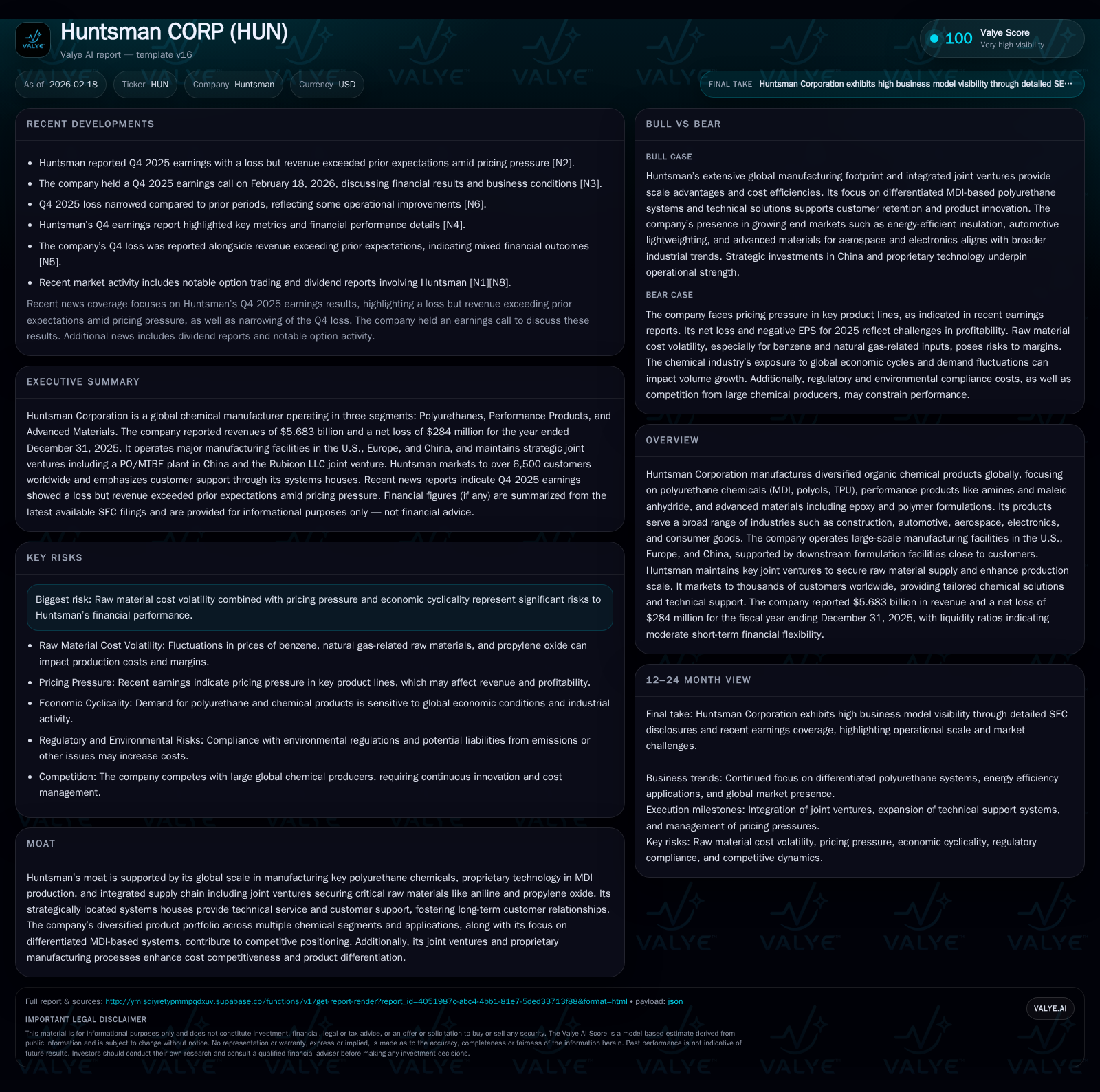
Over the last several years, Huntsman Corporation has seen declining revenue and profitability due to volatile raw material inputs and pricing pressures despite its broad product portfolio and global manufacturing footprint. The company’s integrated supply chain, including key joint ventures, supports scale and competitiveness but has not insulated it from macroeconomic headwinds. Looking forward, growth is tied to innovation in differentiated MDI-based systems and expanding market penetration in construction and automotive sectors, especially in Asia. However, margins remain constrained by input cost volatility and economic cyclicality. Capital allocation focuses on maintaining liquidity with cautious share repurchases and modest dividend increases.
Company Overview
Huntsman Corporation is a global manufacturer specializing in diverse organic chemical products, notably focusing on polyurethane chemicals including MDI (methylene diphenyl diisocyanate), polyols, thermoplastic polyurethane (TPU), performance chemicals such as amines and maleic anhydride, as well as advanced materials like epoxy-based formulations [S1][S4]. Its extensive product range serves industries ranging from construction and automotive to aerospace and electronics.
The company operates three main business segments: Polyurethanes, Performance Products, and Advanced Materials. Huntsman possesses major MDI production facilities located in the U.S. (Geismar), Europe (Rotterdam), and China (Caojing) employing proprietary technology designed for scale efficiency [S16]. Complementing manufacturing scale is an integrated supply chain that includes key joint ventures securing crucial upstream raw materials such as aniline (through Rubicon LLC with Lanxess AG) and propylene oxide (via a joint venture with Sinopec in China) [S16][S15]. This integration enhances competitiveness by controlling costs in a volatile commodities environment.
Historical Financial Performance
Over recent fiscal years up to 2025, Huntsman has experienced pressure on top-line growth coupled with deteriorating profitability amid cyclical end-market softness and raw material cost volatility. The annual financial highlights illustrate this trend:
Historical performance (annual)
| FY | Rev ($bn) | Net ($mm) | CFO ($mm) | OpInc ($mm) | Rev YoY | Net YoY |
|---|---|---|---|---|---|---|
| 2024 | 5.7 | -284 | 289 | -131 | -7.0% | -381.2% |
| 2023 | 6.1 | 101 | 209 | 84 | -23.8% | -78.0% |
| 2022 | 8.0 | 460 | 914 | 672 | -5.1% | -56.0% |
| 2021 | 8.5 | 1045 | 952 | 795 |
Note: Omitted columns lack sufficient annual XBRL coverage in the provided tags (need ≥2 annual points): Capex. Source: SEC companyfacts cache [F1].
Capital returns and efficiency (annual)
| FY | Div ($mm) | Buybacks ($mm) | FCF ($mm) |
|---|---|---|---|
| 2024 | 146 | 0 | 116 |
| 2023 | 41 | 349 | -21 |
| 2022 | 40 | 1005 | 642 |
| 2021 | 40 | 200 | 610 |
Source: SEC companyfacts cache [F1].
Note: Some YoY figures omitted when calculation not possible due to lack of full data.
Revenue peaked around $8B in FY22 but fell sharply thereafter largely due to weakening demand in key end markets such as construction and automotive sectors alongside pricing pressure [F1]. Operating income followed a similar trajectory from a strong $795M profit in FY21 down to losses by FY25.
Margins suffered primarily from elevated input costs—particularly benzene, chlorine derivatives, natural gas-related raw materials—combined with challenging pricing environments that limited pass-through ability [S10][N1]. Despite the downturn in operating results, operating cash flow remained positive at $289M for FY25 as working capital management improved.
Capital expenditures have declined consistent with lower revenue base but continue supporting maintenance of capacity especially within integrated polyurethane production sites [F1]. Dividend payments rose substantially in FY25 though absolute amounts remain moderate relative to cash flow generation; no share buybacks occurred during FY25 reflecting credit facility constraints [F1][S6].
Business Segments and Competitive Positioning
Polyurethanes
The largest segment by revenue exposure focuses on the manufacture of MDI-based polyurethane chemicals that form rigid/flexible foams plus coatings, adhesives, sealants and elastomers [S4][S22]. Major end markets include building insulation, footwear, furniture, automotive (including electric vehicles), cold chain packaging, and specialized engineering applications.
Huntsman’s proprietary manufacturing technologies at large-scale facilities enable production of approximately 2.9 billion pounds of combined MDI/polyols annually [S16]. The company’s downstream "systems houses" enhance customer intimacy by tailoring formulated MDI/polyol solutions close to end-users worldwide.
This segment benefits from substitution trends where MDI-based products displace conventional materials like fiberglass or phenolics due to better energy efficiency or durability—a key driver aligned with global megatrends around energy management and lightweight transportation [S14][S22].
Performance Products
This segment includes amines—used broadly as reactive agents across multiple end uses including fuel/lubricant additives—and maleic anhydride for unsaturated polyester resins utilized primarily in fiberglass reinforced plastics for automotive & construction products [S26]. These products provide diversification away from polyurethane cyclicality.
Advanced Materials
Here Huntsman supplies high performance epoxy resins and related polymers targeted at adhesives/composites used in aerospace, automotive electronics, electrical transmission equipment and sports infrastructure [S20]. This segment relies on technologically advanced chemistries offering premium application performance.
Growth Prospects & Catalysts
Huntsman's future growth hinges critically on expanding its differentiated product offerings within MDI formulations—leveraging proprietary blends that address specific customer needs for insulation efficiency or lightweight cushioning solutions [N2][S14]. Growth drivers include:
- Increasing adoption of spray polyurethane foam insulation stimulated by tightening energy-efficiency regulations worldwide.
- Expansion of coated TPU applications for automotive electrification & footwear manufacturing benefiting from tailored polymer properties.
- Geographic expansion especially within the Chinese market supported by localized upstream feedstock via Sinopec PO/MTBE joint venture.
- Development of sustainable product lines such as foam systems incorporating recycled PET plastic converting processes (via Huntsman Building Solutions).
However, growth may be capped by:
- Raw material price volatility which could erode margins if pricing actions lag cost inflation.
- Economic cyclicality impacting core customer industries like residential construction or automotive manufacturing.
- Competitive pressures from large chemical peers also scaling MDI/polyol production globally.
- Regulatory compliance costs including environmental controls inherent to chemical manufacturing [S10].
Forecasts & Milestones to Monitor
While explicit forward-looking guidance is not provided publicly beyond recent earnings disclosures [N1][N2], investors should monitor:
- Developments in raw material procurement costs versus pricing adjustments.
- Volume trends within North American SPF insulation markets where Huntsman holds significant position.
- Expansion progress of Chinese formulation capability and joint venture output levels.
- Innovations announced related to low-emission or recycled-content polyurethane products aligning with ESG trends.
- Quarterly earnings relative to analyst expectations reflecting ongoing margin recovery or further challenges.
Returns & Capital Allocation Analysis
Return on equity for FY25 was negative approximately -10%, reflecting net losses offsetting shareholder equity of roughly $2.75B at year-end [F1]. This compares unfavorably to profitable years range of mid-single-digit ROE earlier but highlights operational stress under current industry conditions.
Cash flow generation remains positive albeit below peak levels with free cash flow estimated near $116 million after capex spending [F1]. Dividend payouts have risen more than threefold recently signaling confidence in underlying cash flows while buyback activities ceased likely due to leverage covenant limits under the latest credit facility arrangement effective February 2026 [$800 million revolving credit facility] [S7][S18].
The balance sheet reflects manageable liquidity supported by $429 million cash equivalents and current assets exceeding liabilities by a ratio near 1.3 times providing sufficient short-term funding cushion [F1]. Total debt terms impose customary covenants restricting excessive shareholder returns without lender consent but support operational flexibility via covenant-light arrangement incentives [S7][S17].
Industry Context & Domain-Specific Insights (Analysis)
The polyurethane chemicals industry is characterized by high capital intensity enabled only through large-scale assets requiring continuous investment for technological upgrades—a factor underpinning Huntsman's competitive positioning through its substantial MDI plants and integrated supply partnerships. Importantly, the company's "systems houses" approach elucidates value-add differentiation enabling tailored formulations vs commoditized commodity chemicals typical at other players.
Given U.S., European, and Chinese operations spanning major demand centers combined with strategic feedstock joint ventures targeting critical intermediates like aniline or PO/MTBE supply chains generates defensible cost leadership against spot market fluctuations absent long-term contracts common among competitors.
Seasonality plays a role particularly since construction-related segment sales peak during northern hemisphere spring/summer months; hence sequential quarterly results often reflect volume swings beyond underlying demand strength signals [S22]. Raw material input prices—especially benzene tied closely to crude oil derivatives—remain pivotal influencers necessitating robust risk management strategies embedded within procurement planning frameworks.
Conclusion
Huntsman Corporation's recent financial trajectory evidences considerable challenges wrought by raw material cost volatility compounded by pricing constraints across diversified yet cyclically exposed end markets. Its global footprint anchored by proprietary technology platforms combined with integrated feedstock ventures affords competitive advantages; however operational leverage exposes susceptibility during demand troughs.
Future growth depends heavily on the successful scaling of higher-margin differentiated polyurethane solutions—especially within evolving sustainability-driven product lines—and further geographic penetration notably within Asian markets buoyed by joint venture assets. Maintenance of disciplined capital allocation balancing moderate dividends against cautious absence of buybacks aligns prudently given ongoing sector uncertainties.
Stakeholders should weigh continuing macroeconomic headwinds alongside the firm's historical resilience facilitated through technical expertise and scale advantages shaping Huntsman's medium- to long-term value proposition within specialty chemical manufacturing.
This analysis does not constitute investment advice or recommendations. Readers should conduct their own due diligence before entering any financial position regarding Huntsman Corporation or related securities.
Disclaimer: This is research-only, informational analysis and not investment advice. It may include AI-generated interpretation and general industry context. Always verify important details using primary sources.

Comments