
Alarm.com's Record Scale Illuminates Prospects and Challenges for Connected Properties
Alarm.com’s expansive IoT platform and partner network underpin robust SaaS growth amid competition and regulatory complexities.
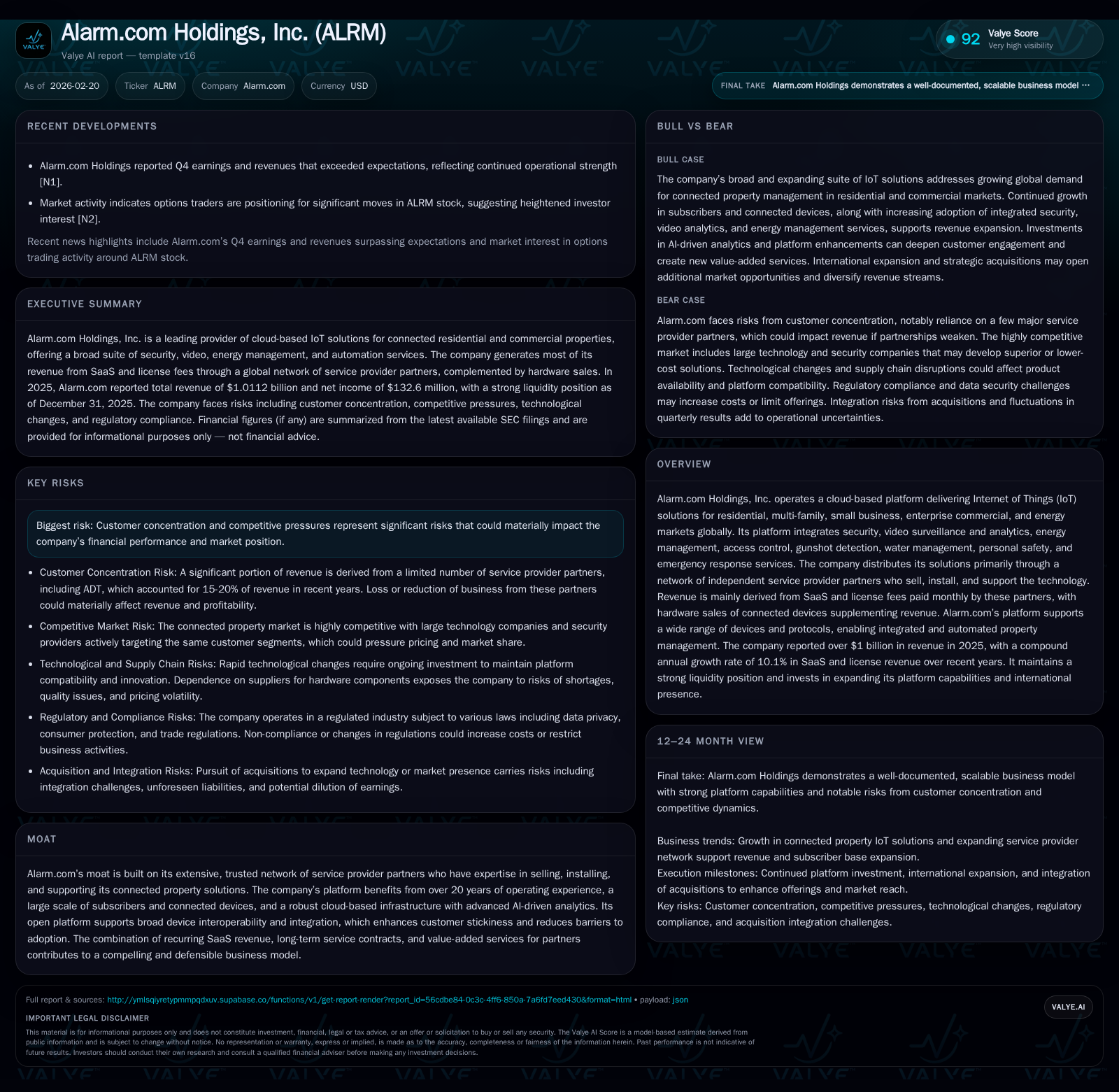
Alarm.com Holdings, Inc. surpassed $1 billion in total revenue by 2025, driven by its cloud-based IoT platform serving residential and commercial markets globally. The company’s scale—evidenced by over 170 million connected devices and a trusted service provider ecosystem—supports recurring SaaS revenue growth at a CAGR of approximately 10% from 2023 to 2025. Operating income grew strongly (+23.1% YoY in 2025), though net income declined slightly (-3.1%), with operating cash flow moderating amid rising capital expenditures. A robust balance sheet with nearly $961 million in cash and equivalents supports ongoing investments and share repurchases, which totaled $41.6 million in 2025. Risks include concentration among large service providers like ADT (~15–20% of revenue), ongoing patent litigation, competitive pressures from major technology firms, and evolving regulatory environments affecting IoT security solutions. Investors should consider the variability of management guidance and legal outcomes when assessing near-term outlook.
Historic Growth Fueled by Subscription Scale and Diversified IoT Solutions
Alarm.com Holdings, Inc. has demonstrated strong historical growth driven primarily by recurring SaaS and license revenues channeled through an extensive network of independent service provider partners [S1][F1]. Since its founding in 2000, the company has established leadership in connected properties by integrating diverse IoT solutions—including security, video analytics, energy management, access control, gunshot detection, water management, personal safety, and emergency response—into a unified cloud-based platform [S6][S9].
In fiscal year (FY) 2025, Alarm.com reported total revenues exceeding $1 billion—a significant milestone reflecting expansion beyond traditional security services into comprehensive property automation solutions [N1][S1]. SaaS and license revenues formed the core growth engine: rising from $569.2 million in FY2023 to $689.4 million in FY2025, representing a compound annual growth rate (CAGR) of approximately 10.1% [F1][S16]. Hardware sales complement but remain secondary to the durable software subscription model.
Operating income showed consistent improvement aligned with scalable cloud infrastructure efficiencies; FY2025 operating income reached $133.6 million, up 23.1% year-over-year from $108.5 million in FY2024 [F1]. This gain reflects effective cost management alongside expanding top-line revenue.
| Fiscal Year | Operating Income ($M) | YoY Change (%) |
|---|---|---|
| 2022 | 51.0 | — |
| 2023 | 66.8 | +31.0 |
| 2024 | 108.5 | +62.3 |
| 2025 | 133.6 | +23.1 |
Note: Total revenue exact figures are not available from provided tags.
Key Growth Drivers: Trusted Partner Networks & Platform Interoperability
Alarm.com's business model centers on an open-platform approach combined with an established network of independent service provider partners who sell, install, and support its solutions [S6][S9][S22]. These partners range from local specialists to national operators such as ADT—which contributes approximately 15–20% of Alarm.com's revenues—and extend into new verticals including HVAC providers, property managers, utility companies, insurers, and network operators seeking diversification [S11][S25].
Contracts with these partners typically involve monthly SaaS fees; partners often maintain multiyear agreements (three to five years) with end customers [S1], ensuring customer stickiness and predictable renewal patterns that drive long-term average revenue per user (ARPU) growth.
The platform supports broad device interoperability across protocols like Z-Wave, Wi-Fi, and cellular communications [S9], enabling flexible hardware integration that meets diverse consumer needs while lowering switching costs.
AI-driven analytics embedded within the platform enhance value for service providers through features such as alarm event prioritization using Person On-Site Likelihood indicators—an important differentiation given the high cost of false alarms in security systems [S6].
Emerging Constraints: Competition, Regulatory Complexities & Concentration Risks
Despite solid fundamentals, Alarm.com faces headwinds that could constrain near-term margin expansion or growth acceleration [S4][S5]. Increasing regulatory complexity encompasses telemarketing restrictions under TCPA, evolving U.S. state privacy laws (e.g., CCPA), export controls limiting international expansion opportunities, and emerging scrutiny over AI use—all potentially raising compliance costs or limiting solution scope [S18][S20].
Customer concentration remains notable; major partners like ADT account for up to one-fifth of revenues while other large providers collectively hold significant shares [S11][S24]. Contract renegotiations or partner attrition could materially impact financial results.
Ongoing patent litigation—particularly initiated by EcoFactor since January 2022 involving multiple patents—is a material risk factor exposing Alarm.com to potential injunctions or royalty obligations if rulings are unfavorable [S4][S19]. The company is actively defending these claims but outcomes remain uncertain.
Competitive pressure intensifies as large technology firms expand smart home offerings and broadband providers bundle security services leveraging brand recognition and capital resources; these dynamics may compress pricing power despite Alarm.com's technical openness [S22].
Quarterly results have exhibited volatility due to these factors alongside macroeconomic influences affecting consumer discretionary spending on home automation upgrades [S1][N1].
Financial Health Snapshot: Operating Income Strength Amid Net Income Variability
Financial data reveals divergence between operating income growth (+23.1% YoY in FY2025) and net income trends which declined slightly (-3.1%) as of FY2024 [F1], suggesting impacts from non-operating expenses or tax-related adjustments on bottom-line profitability.
Liquidity remains robust: a current ratio near 1.92 supported by cash & equivalents around $961 million underscores ample short-term financial flexibility for operations or strategic initiatives without liquidity stress [F1][S13].
Operating cash flow (CFO) declined by approximately -25.7% YoY to $153 million in FY2025 from $206 million the prior year—likely influenced by working capital changes or timing differences related to collections from service providers [F1]. Despite this moderation, free cash flow remained strong at about $137 million after subtracting capital expenditures.
Historical performance (annual)
| FY | Net ($mm) | CFO ($mm) | OpInc ($mm) | Capex ($mm) | Net YoY |
|---|---|---|---|---|---|
| 2025 | 153 | 134 | 16 | ||
| 2024 | 30 | 206 | 109 | 10 | -3.1% |
| 2023 | 31 | 136 | 67 | 8 | +73.1% |
| 2022 | 18 | 57 | 51 | 29 | +97.7% |
Note: Omitted columns lack sufficient annual XBRL coverage in the provided tags (need ≥2 annual points): Rev, Div. Source: SEC companyfacts cache [F1].
Capital returns and efficiency (annual)
| FY | Buybacks ($mm) | FCF ($mm) | ROE% |
|---|---|---|---|
| 2025 | 42 | 137 | |
| 2024 | 75 | 196 | 4.2 |
| 2023 | 27 | 128 | 4.5 |
| 2022 | 79 | 28 | 3.0 |
Source: SEC companyfacts cache [F1].
Note: Latest net income data only available through FY2024.
Capital Deployment: Share Repurchases & Infrastructure Investment
Capital allocation remains disciplined with shareholder returns via common stock repurchases totaling approximately $41.6 million in FY2025—a decrease compared to $75 million executed during FY2024 [F1]. No recent dividend payments have been reported.
Capital expenditures increased meaningfully (+60%) in FY2025 versus prior years reflecting investments focused on maintaining and upgrading cloud infrastructure critical to processing billions of daily data points across platform operations [F1][N1]. Such capex aligns with industry norms balancing innovation demands against cost efficiency.
Free cash flow generation after capex absorption supports capacity for strategic M&A or R&D consistent with management’s emphasis on maintaining technology leadership [N1][S13].
Forward-Looking Considerations: Guidance Variability & Legal Developments
Management emphasizes significant uncertainty inherent in financial guidance due to volatile macroeconomic conditions combined with industry-specific risks including partner behavior variability—urging investors to interpret forecasts cautiously [S1]. Sensitivity analyses rather than fixed outlooks characterize forward-looking disclosures.
Legal proceedings related to patent claims filed by EcoFactor present material uncertainty; unfavorable outcomes could impose substantial damages or restrict product offerings via injunctions or licensing requirements [S4][S19]. Monitoring court rulings and appeals timelines is advised.
Additional considerations include competitive pricing pressures impacting margins alongside evolving privacy/data security regulations necessitating ongoing compliance investment [S18][N7]. Transparency around AI adoption within platforms is increasingly important given regulatory scrutiny risks openly acknowledged by the company [S8].
Strategic Positioning: Ecosystem Scale & Technology Moat
Alarm.com's advantage extends beyond subscriber counts to include a broad interoperable device ecosystem developed over two decades complemented by a deep multi-channel partner network enabling rapid scaling without the direct customer acquisition costs typical of retail models [S6][S22][S25].
The integrated offering—interactive security combined with video analytics, energy optimization tools, personal safety features powered by AI-driven insights—creates a ‘sticky’ system difficult for competitors lacking an open protocol approach or similar installed base to replicate swiftly.
Continued innovation investments are essential amid intensifying competition; machine learning enhancements for predictive alarm verification alongside expanded automation workflows position Alarm.com favorably relative to peers reliant on closed systems or legacy infrastructure constraints.
This ecosystem addresses diverse customer segments—from homeowners and multifamily complexes to small businesses—and is gradually extending into enterprise commercial markets reflecting both velocity and resilience amidst shifting technology appetites worldwide.
Disclaimer: This analysis is based solely on publicly available filings and news reports as of February 20, 2026; it is not investment advice nor a recommendation regarding securities of Alarm.com Holdings Inc.

Comments