
Floor & Decor's Profit Retreat Highlights Growth-Capital Allocation Tradeoffs in Hard Surface Flooring Retail
After steady growth, Floor & Decor faces profitability pressures and liquidity constraints while pursuing store expansion and operational scale.
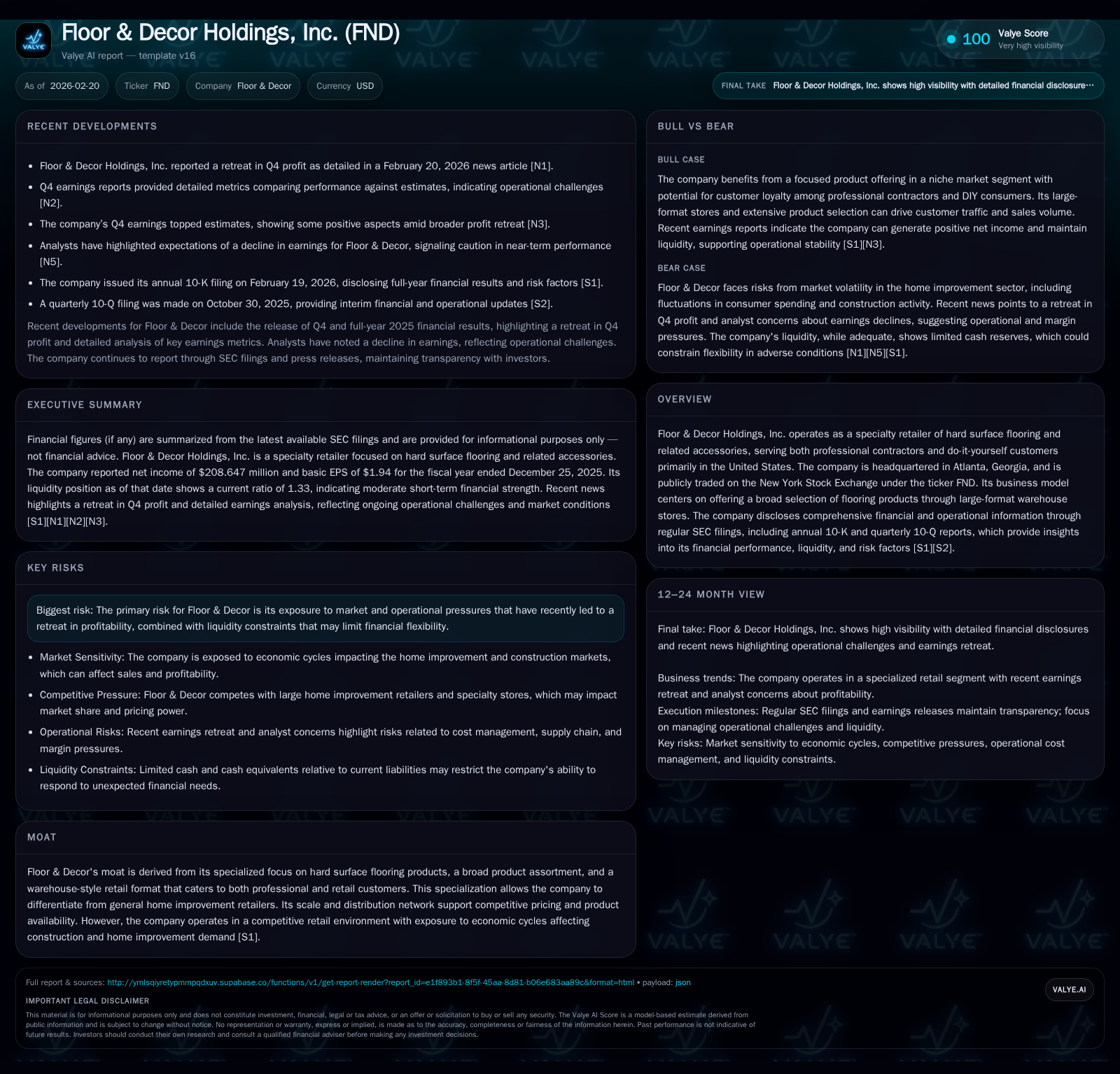
Floor & Decor Holdings, Inc. (FND) has delivered consistent operating income growth from 2022 through 2025 but recent quarters reveal a symbolic retreat in profitability linked to its aggressive expansion strategy and capital expenditures. The company’s focus on broad product assortment and large-format warehouse stores underpins its moat, serving contractors and DIY consumers alike. However, liquidity and financial flexibility are currently constrained by elevated capex and slower cash flow conversion. New leadership and capital discipline will be key to navigating margin pressure and ensuring sustained growth amid a competitive retail environment dependent on construction cycles.
Business Overview and Market Position
Floor & Decor Holdings, Inc. operates as a specialized hard surface flooring retailer focused primarily on large-format warehouse stores across the U.S., catering both to professional contractors and DIY customers [S1]. This focused niche differentiates Floor & Decor from broader home improvement chains by offering a comprehensive selection of flooring products—including tile, wood, laminate—and related accessories under one roof. The company’s business model leverages its scale to secure competitive pricing and drive product availability advantages critical for contractor customers requiring reliable inventory on project timelines.
The moat thus rests on product specialization combined with warehouse-style retailing efficiency allowing Floor & Decor to maintain relevance against generalist competitors such as Home Depot or Lowe’s. The retail format also supports an extensive geographic footprint enabling regional penetration while controlling costs [S1][S4]. As the flooring market is closely tied to residential construction cycles—both new builds and refurbishment projects—the company faces sensitivity to macroeconomic conditions affecting construction activity.
Historical Financial Performance
Floor & Decor has displayed consistent operating income growth over the past four fiscal years albeit with some notable inflections in recent periods indicating emerging profitability pressures [F1].
Historical performance (annual)
| FY | Net ($mm) | CFO ($mm) | OpInc ($mm) | Capex ($mm) | Net YoY |
|---|---|---|---|---|---|
| 2025 | 209 | 382 | 270 | 318 | +1.3% |
| 2024 | 206 | 603 | 256 | 447 | +455.2% |
| 2023 | 37 | 804 | 321 | 548 | -46.4% |
| 2022 | 69 | 112 | 397 | 457 |
Note: Omitted columns lack sufficient annual XBRL coverage in the provided tags (need ≥2 annual points): Rev, Div, Buybacks. Source: SEC companyfacts cache [F1].
Capital returns and efficiency (annual)
| FY | FCF ($mm) | ROE% |
|---|---|---|
| 2025 | 64 | 8.7 |
| 2024 | 156 | 9.5 |
| 2023 | 256 | 1.9 |
| 2022 | -344 | 4.2 |
Source: SEC companyfacts cache [F1].
Note: Revenue data is not available in provided tags.
Operating income declined notably from a peak of $397 million in FY22 to $270 million by FY25 reflecting growing cost pressures or margin compression despite top-line growth (not shown). Net income shows a strong rebound in FY24 driven largely by lower impairment or non-operational hits but leveled off into FY25 at $209 million, showing only marginal incremental profit gains.
Operating cash flow exhibited spikes especially in FY23 driven by working capital fluctuations but dipped steeply by nearly 37% in FY25 owing partly to increased inventory build or receivables tied to sales growth strategies [F1]. Capital expenditure has been substantial given the chain’s asset-heavy strategy focused on opening new stores and building distribution capacity—a requirement for maintaining service levels across wide geographies.
Equity increased steadily reflecting retained earnings accumulation which supports reinvestment needs yet caps upward ROE leverage given sizeable capital employed; at ~8.7%, ROE signals modest return levels relative to pure retail peers due to inherent capital intensity.
Growth Drivers and Constraints
Floor & Decor’s future growth prospects hinge primarily on expanding store count and geographical penetration continuing its proven warehouse format coupled with product assortment enhancements.
The company targets both professional tradespeople who demand broad product availability and competitive pricing as well as DIY consumers benefiting from showroom-style experiences supported by digital sales channels [N11][S1]. Service differentiation through design tools, installation advice, or loyalty programs may deepen customer engagement.
However, these avenues face several constraints:
- Profitability Pressure: Recent earnings releases reveal retreating margin profiles possibly due to inflationary input costs, promotional activities needed to maintain volume share, or operational inefficiencies during rapid scale-up phases impacting SG&A leverage [N5][N4].
- Liquidity Constraints: Elevated capex spending restricts free cash flow generation limiting flexibility for share repurchases or dividends; working capital requirements also absorb cash unexpectedly affecting CFO trends [F1][S19].
- Economic Cyclicality: Demand is tightly coupled with housing market health, renovation cycles, and overall construction activity which are subject to macro headwinds including interest rate rises that dampen new homebuilding or discretionary remodeling spend [S4][S6].
- Competition: Intense rivalry from large home improvement chains expanding pro customer networks presents both pricing and service challenges; Floor & Decor needs continuous innovation and operational excellence to defend moat status [N10][N8].
Forecasts, Milestones, and What To Watch
No explicit forward-looking guidance is provided within the filings cited; thus stakeholders should focus on key operational indicators as proxy signals:
- Margin Trajectory: Improvement or stabilization of operating margin metrics would signal resolution of current cost pressures.
- Cash Flow Conversion: Sequential improvements suggesting better working capital management or moderated capex reflecting disciplined store rollout pace.
- Store Expansion Rates: Ability to open profitable new locations without detrimental impact on mature store performance.
- Leadership Execution: Monitoring actions by newly appointed CEO Bradley S. Paulsen who commenced duties at start of FY26 with increased incentive alignment could provide clarity on strategic pivots or operational tightening measures [S22][S25].
- Competitive Positioning: Market share trends vis-à-vis competitors (Home Depot especially) in contractor-focused segments as Home Depot intensifies its pro network strategy can inform competitive risk profile dynamics [N10][N11].
Returns and Capital Allocation
The company does not pay dividends per recent data points nor reported buyback activity within the latest filing period noted here; instead it appears focused heavily on reinvesting cash flows into capex projects aimed at expanding physical footprint.
Free cash flow (CFO minus Capex) was approximately $64 million for FY25—down markedly versus prior years illustrating near break-even cash generation after funding growth initiatives which could constrain other shareholder-friendly actions short term [F1].
ROE remains modest around 8.7%, reflective of heavy asset base deployment relative to equity size restricting rapid earnings accretion capacity; this aligns with typical retail models where fixed asset investments skew returns lower until scale efficiencies manifest more fully.
Capital structure data shows current liabilities nearing ~$1.15 billion against current assets near ~$1.53 billion yielding a current ratio of about 1.33 which is adequate but indicates tight short-term liquidity largely attributable to inventory financing inherent in retail hard surfaces sector operations [F1][S19].
Ongoing debt management will be crucial as Floor & Decor navigates between funding growth opportunities whilst shoring up financial flexibility amid potentially volatile consumer spending landscapes.
Leadership Transition and Governance Updates
Noteworthy changes occurred late in calendar year 2025 when longtime CEO Thomas V. Taylor transitioned to Executive Chairman role concurrently advancing Bradley S. Paulsen as new CEO effective December 26, 2025 [S22][S23]. This move suggests strategic intent for fresh operational leadership focusing on delivering profit stabilization alongside continued strategic investments.
Paulsen’s employment agreement includes robust severance protections aligning his incentives toward achieving sustainable performance improvements rather than short-term gambits—a governance signal acknowledging existing margin challenges requiring disciplined management focus [S25].
Industry Context Analysis
The hard surface flooring retail niche operates within broader home improvement market cycles heavily affected by housing permits issuance trends, renovation rates stimulated by aging housing stock replacement, material supply chain dynamics, and labor availability for installations (pro contractor workforce intensity) — all core factors influencing demand elasticity here.
Given Floor & Decor’s warehouse-format model targeting pro users specifically—who historically represent higher average order values but demand faster delivery times—the company must balance inventory depth against carrying costs meticulously while leveraging scale logistics infrastructure efficiently.
Recently reported industry commentary highlights Home Depot’s growing professional contractor network emphasizing multi-category bundling which may raise Floor & Decor’s acquisition cost of trade accounts unless it accelerates complementary service offerings or price competitiveness effectively keeping pace with this evolution [N8][N10].
Risks Summary
Key risks articulated formally include:
- Economic sensitivities leading to downturns in construction demand adversely affecting sales volumes.
- Increased competition exerting downward price pressure squeezing margin sustainability.
- Execution risks associated with rapid expansion including store productivity dilution or supply chain disruptions.
- Financial risks highlighted by liquidity constraints limiting maneuvering room amid simultaneously high capex cycles.
- Litigation or regulatory matters embedded within risk disclosures common for large retailers though no material issues currently dominating narrative [S4][S6].[F1]
Conclusion
Floor & Decor enters fiscal year 2026 facing a nuanced interplay between sustaining top-line momentum via network expansion while managing profitability pressures exacerbated by macroeconomic uncertainty surrounding residential construction spending patterns. The company’s distinctive specialization confers competitive advantages but demands exceptional operational execution paired with prudent capital deployment decisions amidst constrained liquidity.
The recent CEO succession signals readiness for renewed strategic focus addressing these dual imperatives—holding investor attention toward upcoming quarterly milestones tracking margin recovery progress alongside free cash flow improvements critical for establishing long-term value creation pathways.
This analysis is based solely on publicly available SEC filings and market news sources cited herein without any projection beyond stated facts or proprietary insights into future results. It does not constitute investment advice or recommendations regarding securities mentioned.
Disclaimer: This is research-only, informational analysis and not investment advice. It may include AI-generated interpretation and general industry context. Always verify important details using primary sources.

Comments