
CarGurus' Strategic Pivot: From CarOffer Wind-Down to Tech-Driven Growth
CarGurus delivered a remarkable financial turnaround in 2025 by exiting its CarOffer Transactions Business and focusing on AI-powered marketplace analytics.
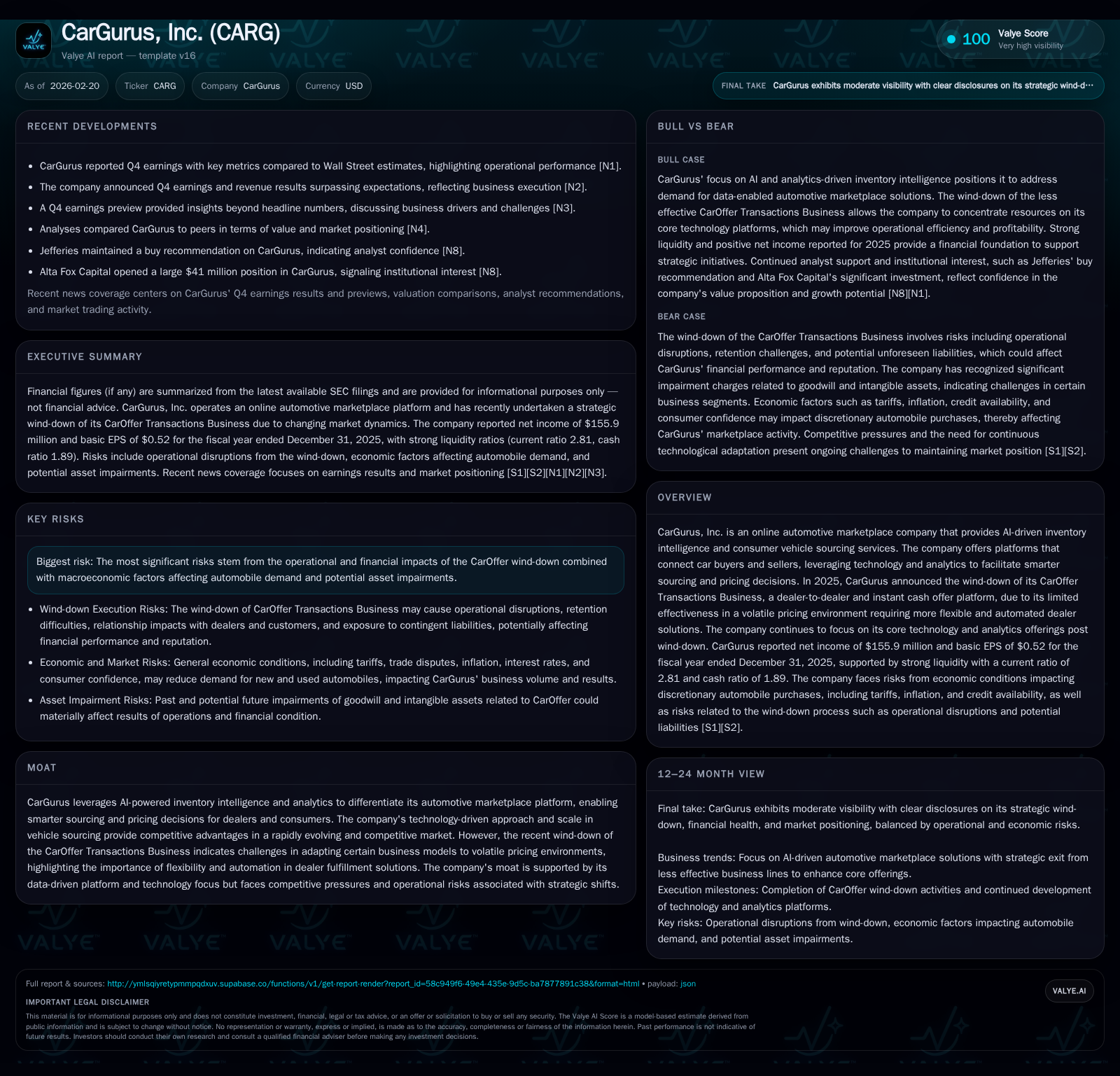
CarGurus navigated a volatile auto market by decisively winding down its less flexible CarOffer dealer-to-dealer platform in 2025, resulting in a dramatic surge in operating income and net profitability. The company sharpened its focus on scalable AI-driven inventory intelligence and vehicle sourcing services, leveraging data analytics to enhance dealer pricing and sourcing decisions. With disciplined capital allocation including robust share repurchases and sharply reduced capital expenditures, CarGurus strengthened liquidity and posted a roughly 42% return on equity. Key risks remain around economic sensitivity, integration of ongoing wind-down impacts, and the scalability of AI platform adoption.
From CarOffer Exit to Core Focus: Historical Growth Path and Transition in 2025
CarGurus witnessed a striking inflection in financial performance during fiscal year 2025, catalyzed primarily by its strategic decision to wind down the CarOffer Transactions Business—a dealer-to-dealer wholesale platform offering instant cash deals that proved less tenable in an increasingly volatile pricing environment [S2][S6]. This pivot away from transaction facilitation toward a technology and analytics-centric model marks the company’s refocus on scalable AI-driven marketplace solutions.
Over the past several years, CarGurus steadily grew revenues while profitability fluctuated given investments in various segments. However, in 2025 operating income catapulted to $244.4 million from just $13.4 million the prior year—a staggering increase of approximately 1723%—while net income expanded from $21.0 million to $155.9 million (+643%) [F1]. These dramatic improvements underscore the operational leverage achieved by shedding lower-margin transactional businesses such as CarOffer.
The wind-down rationale was rooted in dealer demands for more flexible, automated fulfillment processes beyond what the CarOffer model could supply amidst unpredictable wholesale pricing swings [S2]. Consequently, management prioritized concentration on its AI-powered inventory intelligence platforms which provide dealers with advanced market insights for smarter sourcing and pricing decisions .
Technology Backbone: AI-Powered Inventory Intelligence Driving Competitive Advantage
At its core, CarGurus leverages sophisticated machine learning-based pricing algorithms fused with vast historical data sets to deliver inventory yield optimization—a process that enhances dealer funnel conversion rates by accurately forecasting buyer behavior and pricing sensitivities [S8]. This AI-centric approach forms the foundation of its competitive moat by enabling superior vehicle sourcing intelligence for both consumers and dealers.
Unlike many traditional automotive marketplaces that rely heavily on manual inputs or static listings, CarGurus’ platform applies continuous real-time analytics to dynamically adjust pricing guidance and inventory recommendations [S1]. This continuous recalibration supports dealers’ need for flexible decision-making tools amid rapid market fluctuations.
The scale of CarGurus’ data footprint—accumulated across millions of transactions—confers an important network effect that entrenches its technological lead versus peers attempting similar automation . The company’s focus on technology-enabled SaaS dealer fulfillment solutions is well-aligned with industry trends emphasizing digital transformation across automotive retail.
Finishing the Wind-Down: Operational Impacts and Financial Costs Evaluated
Announced in August 2025, the CarOffer wind-down was projected to incur total costs between $13 million and $15 million, including restructuring severance, contract termination fees, and other operational expenses related to exiting this business line [S2][S6][S17]. By September 30, an estimated $7 million to $9 million remained payable, with most cash outflows expected before year-end and residuals extending into early 2026.
Despite reducing earlier estimates (initially between $14 million–$19 million), uncertainties persist regarding final timing and total charges due to negotiations with counterparties and potential unforeseen liabilities [S10]. Possible risk factors include retention challenges for key personnel involved in wind-down efforts and potential adverse effects on relationships with dealers or vendors critical to other operating units [S10][S11].
Management cautions that unsuccessful or delayed execution could impair realization of expected benefits or impose additional costs that might weigh on near-term results and reputation [S6]. Nevertheless, no significant ongoing legal claims linked directly to these activities exist as of the latest filing [S4].
2025 Financial Highlights: Revenue, Profitability, and Cash Flow Breakthroughs
The pivot away from lower-margin transactional services catalyzed a sharp improvement in profitability metrics. Revenue's trajectory is more muted relative to earnings gains yet remains stable as core marketplace offerings mature. Operating cash flow also increased moderately while capital expenditures collapsed reflecting curtailed investment needs post-CarOffer.
Historical performance (annual)
| FY | Net ($mm) | CFO ($mm) | OpInc ($mm) | Capex ($mm) | Net YoY |
|---|---|---|---|---|---|
| 2025 | 156 | 295 | 244 | 6 | +643.4% |
| 2024 | 21 | 255 | 13 | 75 | -43.2% |
| 2023 | 37 | 125 | 33 | 25 | -56.2% |
| 2022 | 84 | 256 | 108 | 6 |
Note: Omitted columns lack sufficient annual XBRL coverage in the provided tags (need ≥2 annual points): Rev, Div. Source: SEC companyfacts cache [F1].
Capital returns and efficiency (annual)
| FY | Buybacks ($mm) | FCF ($mm) | ROE% |
|---|---|---|---|
| 2025 | 352 | 289 | 41.7 |
| 2024 | 146 | 180 | 3.9 |
| 2023 | 209 | 100 | 6.0 |
| 2022 | 14 | 250 | 11.5 |
Source: SEC companyfacts cache [F1].
Note: Annual revenue figures after FY2018 are not available in provided tags.
This massive operating leverage partly stems from fixed cost absorption once CarOffer-related expenses were eliminated along with tighter expense control [N1][N2]. Robust free cash flow generation approximates $289 million (operating cash flow minus capex) reinforcing financial flexibility [F1].
Assessing Risks: Economic Sensitivities and Integration Challenges Post-Wind-Down
CarGurus operates within inherently cyclical automotive markets where consumer discretionary spending fluctuates with macroeconomic conditions including interest rates, credit availability, inflationary pressures, tariffs affecting vehicle prices, and consumer confidence [S4][S9][S15]. Prolonged downturns could dampen new/used car demand affecting dealer advertising budgets integral to CarGurus’ revenue.
Operationally, the company faces transition risks tied to successfully concluding its CarOffer exit without impairing ongoing platform innovation or alienating key partners [S10][S11]. There is also potential exposure to contingent liabilities beyond current projections as contractual terminations unfold.
Personnel retention during wind-down phases poses additional challenges since specialized talent managing both legacy transaction systems and emerging AI capabilities is critical for seamless integration [S6]. Litigation risk remains low presently but contingent claims may arise requiring careful monitoring [S4].
Capital Allocation Strategies: Robust Buybacks, Capex Reduction, and Liquidity Profile
Capital deployment shifted decisively towards shareholder returns in FY25 as buybacks surged sharply to approximately $352 million—more than doubling prior year levels—offsetting shrinking equity bases from repurchased stock [F1][S23][S27]. This aggressive repurchase program underscores management’s confidence in returning capital amid steadier core earnings streams.
Simultaneously, capital expenditures declined over ninety percent year-over-year signaling judicious prioritization away from heavy investments associated with discontinued operations toward scalable software development focused on analytics tools [F1].
Liquidity metrics suggest a strong buffer with current assets nearly threefold current liabilities (ratio =2.81) complemented by a healthy cash ratio (~1.89), positioning CarGurus well to navigate residual uncertainties related to wind-down costs or economic volatility [F1].
Approximate return on equity based on latest net income relative to equity stands at an impressive ~42%, reflecting effective earnings generation against a smaller equity base after buybacks [F1]. Dividends remain absent per disclosed filings indicating reinvestment or repurchase preference currently.
Future Outlook: Growth Drivers and Key Metrics to Monitor
Looking forward—which remains speculative absent explicit guidance—the sustainability of growth hinges on deepening penetration of AI-driven inventory intelligence among dealerships alongside scaling consumer-facing vehicle sourcing offerings such as “Sell My Car” through Top Dealer Offers platforms [N3][N6]. Enhancements in automated dealer fulfillment processes will be critical given previously cited limitations causing the CarOffer shutdown.
Continuous cost management without sacrificing innovation velocity will behoove management amid evolving competitive landscapes featuring incumbents accelerating digital retail capabilities . Observers should monitor incremental disclosures around platform adoption rates, monetization expansions beyond core search/lead generation models, reimbursement structures under changing dealer automation demands, plus any updates on residual wind-down costs or contingent liabilities impacting near-term results.
Macroeconomic conditions—particularly credit market health influencing consumer car purchases—and regulatory developments around international trade tariffs remain pivotal external variables shaping outlook trajectories.
This analysis reflects publicly available information as of early 2026 without providing investment recommendations. It synthesizes regulatory filings alongside recent corporate disclosures into a narrative assessing strategic shifts shaping CarGurus’ prospects.
Disclaimer: This is research-only, informational analysis and not investment advice. It may include AI-generated interpretation and general industry context. Always verify important details using primary sources.

Comments