
Solstice Advanced Materials Inc. Leverages Innovation and Customer Proximity to Manage Growth Amid High Capital Intensity and Regulatory Complexity
Solstice Advanced Materials operates two distinct segments with strong intellectual property, serving diverse end markets amidst evolving regulatory and supply chain challenges.
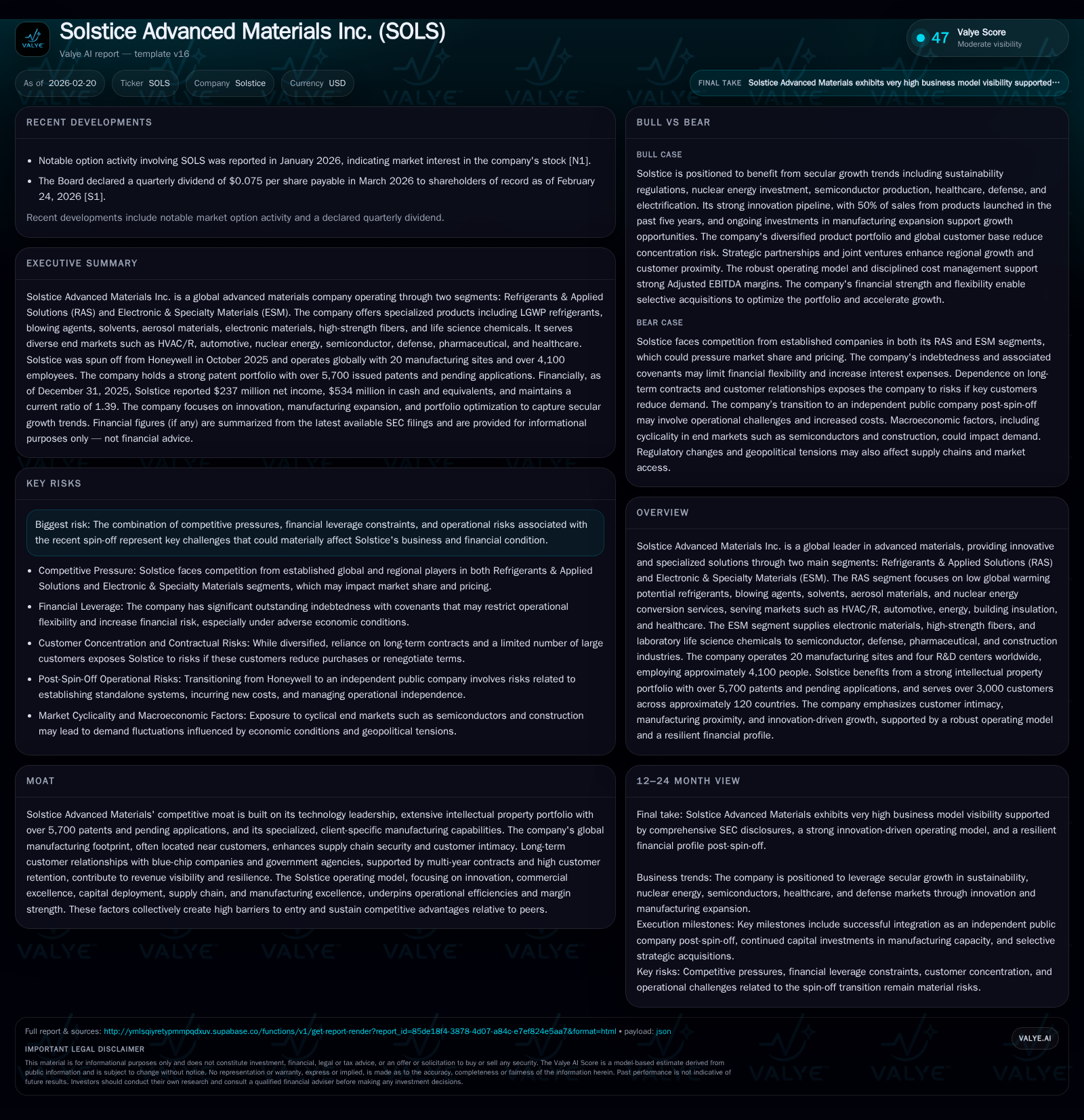
Solstice Advanced Materials Inc., spun off from Honeywell in late 2025, combines Refrigerants & Applied Solutions (RAS) and Electronic & Specialty Materials (ESM) to serve global markets with high-value advanced materials and specialty chemicals. Its growth is supported by a deep patent portfolio exceeding 5,700 patents, proximity manufacturing sites, and multi-year customer contracts, contributing to solid revenue visibility. The company faces constraints from capital-intensive operations, regulatory compliance complexity—especially environmental and nuclear—and financial leverage limitations but shows promising mid-single digit organic sales growth alongside strong adjusted EBITDA margins. Cash flow remains robust, supporting dividend payments despite significant ongoing investments in manufacturing capabilities.
Company Overview and Historical Performance
Solstice Advanced Materials Inc., launched as a stand-alone entity following its spin-off from Honeywell in October 2025 [S25], specializes in innovative advanced materials with a global footprint comprising 20 manufacturing sites and four dedicated R&D centers. The company employs approximately 4,100 personnel worldwide.
Its business structure divides into Refrigerants & Applied Solutions (RAS) and Electronic & Specialty Materials (ESM). RAS produces low-global warming potential refrigerants and blowing agents critical for HVAC/R applications while also offering nuclear energy conversion services for uranium hexafluoride—a unique niche reinforced by multi-year contracts providing considerable revenue stability.
ESM supplies high-purity electronic materials including sputtering targets utilized in semiconductor fabrication nodes advancing toward smaller technology nodes; this sector is notably cyclical reflecting semiconductor capex cycles but benefits from long-term industry investment trends [S4,S8].
Financial data for FY2025 indicates net income reached $237 million (noting limited historical comparability due to recent spin-off status) supported by robust operating cash flow of $455 million against capital expenditures of $336 million [F1]. The firm achieved an approximate ROE of 16.8%, bolstered by long product lifecycles and client-specific innovation. Absence of detailed segment revenue data limits granular YoY growth calculations; however, over half the revenue derived from products introduced within five years underscores strong innovation-led traction [S12].
Historical performance (annual)
| FY |
|---|
| 2025 |
Note: Omitted columns lack sufficient annual XBRL coverage in the provided tags (need ≥2 annual points): Rev, Net, CFO, OpInc, Capex, Div, Buybacks, FCF, ROE%. Source: SEC companyfacts cache [F1].
Note: Revenue and Operating Income omitted due to unavailability; Buybacks not reported.
Growth Prospects and Operational Dynamics
Solstice’s forward-looking strategy hinges on several pillars:
Innovation Tie-ins: Approximately half the sales in 2025 originated from products less than five years old—a direct outcome of its substantial patent portfolio exceeding 5,700 filings—coupled with deep technical collaboration integrating customer roadmaps into R&D pipelines [S8,S12]. This approach enhances forecastability amid dynamic end markets.
Market Expansion: Adjacent market growth plays a role as Solstice extends LGWP blowing agent products across automotive electrification segments beyond stationary HVAC/R applications and penetrates niche semiconductor materials such as copper manganese sputtering targets critical for advanced-node fabs [S12,S25].
Manufacturing Footprint: The company emphasizes proximity manufacturing to customers globally (including increasing presence in India/Asia), enhancing supply security amid supply chain volatility—crucial given the chemical complexity and regulatory scrutiny these products entail [S11,S15]. For instance, its AES nuclear conversion business operates under highly regulated conditions yet benefits from long-term pricing agreements mitigating cyclicality risks.
Commercial Excellence: Dedicated sales teams segmented by geography and product lines allow tailored customer engagement supporting contract durations commonly ranging from one to five years (and longer for healthcare packaging), which boosts revenue visibility [S6]. Notable client concentration remains moderate with top ten customers accounting for less than 20% of total sales.
Portfolio Optimization: Solstice actively explores inorganic growth avenues via acquisitions targeting differentiated technologies that enhance exposure to high-growth markets aligned with their value-based pricing model [S12].
Financial Structure and Capital Allocation Considerations
The company's capital structure features approximately $2 billion in senior secured debt comprising term loans and revolving credit facilities complemented by $1 billion senior notes due 2033 [S24,S10]. Credit agreements impose covenants such as leverage caps (Consolidated First Lien Leverage Ratio not exceeding ~3.50x except temporary relief on acquisitions) alongside interest coverage thresholds that restrict excessive indebtedness potentially constraining growth finance flexibility.
Liquidity remains adequate with a current ratio of roughly 1.39 supported by cash and equivalents of $534 million at year-end [F1]. Operating cash flow coverage over capex yields a positive free cash flow estimate around $119 million facilitating dividends—recently declared at $0.075 per share quarterly—with no public indication of buyback activity yet [S3,F1].
Given the relatively short operational history as an independent entity since the spin-off event, management continues evolving standalone financial disciplines independent of former parent Honeywell's balance sheet supports [S25,S18].
Risks: Regulatory Complexity and Operational Challenges
Several risk vectors loom prominently:
Regulatory Landscape: Chemical manufacturing is subject to intensive federal (e.g., TSCA), state-level (RCRA), EU regulations (REACH), and emerging sustainability mandates requiring continuous monitoring for compliance costs or potential product reformulations impacting margins . Moreover, nuclear sector operations mandate strict decommissioning responsibilities including letters of credit sureties that could inflate future liabilities or liquidity needs [S21].
Environmental Liabilities: Legacy contamination or newly discovered pollutants at manufacturing or disposal sites expose Solstice to potentially material remediation costs despite insurance protections; adverse outcomes could affect cash flows significantly [S26,S20].
Debt Servicing Burden: The approximately $2 billion senior secured tranche plus notes introduces fixed obligations that could limit strategic nimbleness should economic conditions deteriorate or interest rates rise sharply impacting refinancing costs [S24,S23].
Competitive Landscape: Both RAS and ESM segments face established players like Arkema, Chemours, Daikin among others along with smaller regional firms creating pricing pressure although Solstice’s specialized client-focused solutions help defend pricing power [S4,S6].
Supply Chain & Talent: Potential disruptions through raw material volatility or failure to attract highly skilled personnel necessary for specialized chemical processes pose ongoing operational risks—the company applies planning tools but uncertainty persists especially amid geopolitical tensions affecting global trade flows [S17,S19].
Outlook: Metrics to Watch Going Forward
Absent explicit forward guidance published yet beyond stated strategic themes as of February 2026 earnings release [S3], relevant milestones include:
- Trajectory of organic sales growth particularly from new product lines in electric vehicles and semiconductor sectors.
- Evolution of Adjusted EBITDA margin profile reflecting implementation success of Solstice operating model pillars.
- Capital expenditure pacing relative to production scale-up or greenfield expansions targeting proximity advantages.
- Management’s ability to optimize capital returns balanced against necessary reinvestment amid legacy environmental cost uncertainties.
- Monitoring debt covenant compliance amid macroeconomic fluctuations influencing leverage ratios.
- Progress on acquisitions or divestitures sharpening portfolio focus on higher margin specialties.
Conclusion
Solstice Advanced Materials stands at an inflection point leveraging proprietary innovation coupled with a geographically proximate manufacturing model supporting resilient demand across sustainability-driven verticals ranging from HVAC refrigerants to semiconductors. While the recent spin-off confines historical trend analysis and parts of financial disclosure remain incomplete (notably revenue detail), existing data depict a company generating solid operating cash flows supporting capital-intensive investments alongside shareholder returns via dividends.
Nonetheless, heavyweight challenges emanate from regulatory stringency around chemical use and nuclear operations plus elevated financial leverage necessitating vigilant execution on cost controls and portfolio shaping initiatives. Success will depend on maintaining technology leadership through sustained R&D productivity, preserving customer intimacy via specialized solutions integration, judicious capital deployment focused on high-growth adjacencies, while navigating mounting environmental oversight mandates.
Disclaimer: This analysis does not constitute investment advice or recommendations regarding securities of Solstice Advanced Materials Inc. It is intended solely for informational purposes based on public filings and reports as cited. Readers should perform their own due diligence before making any investment decisions.
Disclaimer: This is research-only, informational analysis and not investment advice. It may include AI-generated interpretation and general industry context. Always verify important details using primary sources.

Comments