
Lakeside Holding’s Cross-Border Growth Faces Profitability and Regulatory Hurdles
LSH’s robust Asian-focused supply chain expansion is tempered by rising losses and fragmented competition.
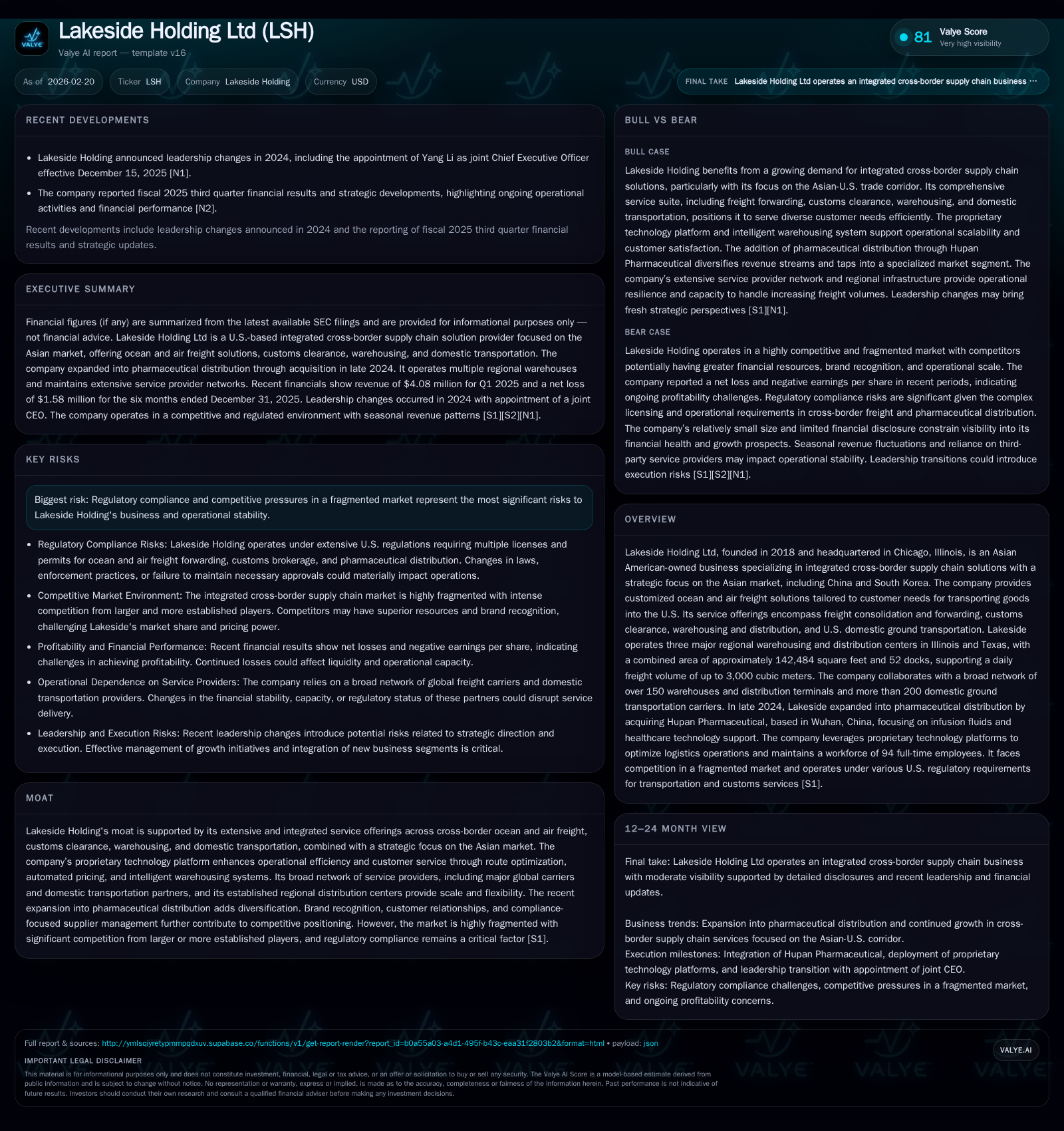
Lakeside Holding Ltd has demonstrated fast revenue growth since its 2018 inception, driven by integrated cross-border freight services tailored to U.S.-Asia trade flows and recent pharmaceutical distribution ventures. However, profitability remains elusive as operating losses widened significantly in FY2025 amid increased scale and initial pharma segment costs. The company leverages proprietary technology and extensive logistics networks but operates within a highly fragmented market with notable regulatory compliance risks. Capital allocation includes modest buybacks but no dividends, with liquidity supported by a solid current ratio. Key milestones to monitor include scaling pharmaceutical operations and potential margin improvement under competitive pressures.
Company Overview
Lakeside Holding Ltd (LSH), founded in 2018 and headquartered in Chicago, is an Asian American-owned provider of integrated cross-border supply chain solutions focused primarily on the U.S.-Asian trade corridor with emphasis on China and South Korea [S1][S5]. The company offers customized ocean and air freight forwarding alongside ancillary value-added services like customs clearance, warehousing & distribution, and comprehensive U.S. domestic ground transportation.
Its three major regional distribution hubs located strategically near O’Hare International Airport (Illinois) and Dallas Fort Worth International Airport (Texas) provide approximately 142,484 square feet of warehousing space with 52 docks—capable of handling up to 3,000 cubic meters of daily freight volume [S4][S6]. This infrastructure supports multi-customer utilization enabling economies of scale from shared facilities and labor.
Complementing traditional logistics offerings is Lakeside’s recent strategic expansion into pharmaceutical distribution via its wholly owned subsidiary Hupan Pharmaceutical based in Wuhan, China [S5]. The pharma segment focuses on infusion fluids supply chains with regulated licensing appropriate for this sector [S10][S18].
Historical Financial Performance
Since inception, the company has experienced rapid revenue growth driven largely by increasing trade volume inbound from Asia to the U.S., enabled through its integrated service portfolio that provides end-to-end solutions for customers including e-commerce platforms and manufacturers [S7].
However, profitability has lagged significantly due to high scaling costs and investments in new business lines such as pharmaceuticals.
Historical performance (annual)
| FY | Net ($mm) | CFO ($mm) | OpInc ($mm) | Capex ($) | Net YoY |
|---|---|---|---|---|---|
| 2025 | -5 | -3 | -5 | 49816 | -2229.0% |
| 2024 | 0 | 0 | -1 | 18288 |
Note: Omitted columns lack sufficient annual XBRL coverage in the provided tags (need ≥2 annual points): Rev, Div. Source: SEC companyfacts cache [F1].
Capital returns and efficiency (annual)
| FY | Buybacks ($) | FCF ($mm) | ROE% |
|---|---|---|---|
| 2025 | 805345 | -3 | -184.4 |
| 2024 | 47536 | 0 | -35.2 |
Source: SEC companyfacts cache [F1].
Note: Revenue for FY2025 is not explicitly available; latest quarterly revenue was approximately $4.08M as of Q3 FY2025 ending Sept 30 [F1].
Losses expanded markedly between FY2024 and FY2025 reflecting aggressive investment phases particularly related to the pharma segment integration costs and broader operational expenses [F1]. Operating income deteriorated from approximately -$0.5 million to nearly -$5 million year-over-year signifying an over eightfold margin contraction.
The net loss exceeded $5.2 million for FY2025 with an implied return on equity near -184%, indicating substantial negative profitability relative to shareholder capital employed [F1]. Operating cash flow similarly turned deeply negative (-$2.65 million), exacerbated by investment-related outlays albeit on relatively low capex spend (~$50K) reflecting limited capital intensity [F1].
Free cash flow after capex remains negative at approximately -$2.7 million highlighting ongoing cash burn concerns amid scale-up [F1]. Notably the company undertook share repurchases exceeding $800K during this period despite mounting losses [F1]. There is no available information on dividends paid from provided tags.
Growth Catalysts and Constraints
Growth Drivers:
- Expansion of cross-border freight forwarding volumes connecting Asia-Pacific manufacturing hubs with U.S. markets fueled by burgeoning e-commerce demand.
- Increasing penetration into pharmaceutical distribution via Hupan Pharmaceutical including healthcare technology verticals promises diversification beyond general logistics [S5].
- Proprietary technology platform delivering route optimization, real-time automated pricing quotes for ocean/air freight solutions along with intelligent warehouse management designed to improve operational efficiency [S6][S12].
- Extensive service provider network collaborating with over 150 warehouses/domestic terminals and more than 200 ground transportation carriers offering scale flexibility [S6][S7].
Constraints:
- Persistent unprofitability pressures stemming from scale-up costs especially in newly acquired pharmaceutical segment where early stage investment weighs on margins.
- Highly fragmented third-party logistics marketplace intensifies competitive dynamics where rivals may deploy superior financial or operational resources [S8].
- Regulatory compliance complexity across multiple jurisdictions including FMC licensing requirements for NVOCC operations, TSA mandates for air freight carriers as indirect air carrier status holders, Customs oversight for warehousing & container freight stations as well as Chinese pharmaceutical distribution licensing creates potential operational risks if improperly managed [S10][S15][S16][S18].
- Dependence on service provider network stability which may face capacity constraints or financial stress influencing delivery reliability.
- Seasonal fourth-quarter concentration where revenues typically rise due to holiday demand could distort short-term earnings visibility though historic seasonality patterns are not guaranteed to persist [S14].
Capital Allocation & Financial Health
Lakeside maintains a solid liquidity profile evidenced by a current ratio approximating 2.03 at the end of calendar year 2025 supported by nearly $1.64 million in cash equivalents against current liabilities surpassing $10 million [F1]. This indicates sufficient near-term working capital coverage despite ongoing free cash flow deficits.
Capital expenditures remain modest relative to revenues consistent with asset-light third-party logistics model concentrated on leased or managed warehouse spaces rather than heavy asset ownership [F1].
The company has returned capital through stock buybacks totaling $805K during FY2025 compared with only $48K the prior year suggesting an opportunistic approach despite lack of earnings power so far; there have been no dividends declared or paid per available disclosures [F1][S26][S27]. This may reflect management prioritizing shareholder returns via buybacks while stabilizing operations.
ROE stands significantly negative due to net losses reducing shareholder equity gains – this metric will require dramatic earnings turnaround or scale efficiencies for improvement given the base effect of low equity capitalization ($2.85M at FY25 midpoint) [F1]. Monitoring improvements here will be vital for capital efficiency analysis.
Industry Context & Competitive Positioning
Within the integrated cross-border supply chain ecosystem targeting Asia-U.S trade flows, differentiation hinges on technological innovation, breadth/depth of service offering consistency, customer relationships grounded in responsiveness/reliability, and regulatory compliance discipline . Lakeside’s investment into a proprietary cloud-based logistics platform featuring automatic contract management tools coupled with intelligent warehouse inventory replenishment systems signals competitive tech enablement uncommon among many fragmented small-to-mid tier peers [S6][S12].
Nonetheless fierce competition exists from both larger logistics providers commanding strong brand recognition and capital resources alongside smaller specialized players focusing on niche cargo categories or routes. Lakeside’s niche leveraging Asian American ownership roots aids cultural-linguistic connectivity enhancing customer trust within targeted e-commerce vendor bases but competitors with longer track records may react swiftly as well [S8].
Regulatory complexity forms a substantial moat barrier but also hazard: Licensing required from FMC for ocean forwarding status as licensed NVOCC plus TSA certification adherence as indirect air carrier introduces workflow rigidity but also security alignment [S15][S16]. Similarly Chinese pharma wholesale licensing entails operational compliance attention critical for successful supply chain execution given strict state inspections noted recently passed by Hubei provincial authorities overseeing these practices [S18].
Future Forecast / Milestones To Watch
Although no explicit forward financial guidance is documented as of the latest filings up to early 2026 [N1][S2], key areas investors should monitor include:
- The operational ramp-up trajectory for the pharmaceutical business segment including expansion beyond infusion fluids into other therapeutic categories if feasible.
- Technology platform enhancements enabling improved customer retention through faster pricing responsiveness and error reduction.
- Margin improvement plans addressing fixed cost absorption effects related to warehousing scale gains or optimized route planning.
- Potential geographic expansion in fulfillment centers given current reliance on two regional hubs providing opportunity for multi-nodal network synergies.
- Regulatory approvals maintenance across all segments ensuring no interruptions due to litigation or non-compliance infractions noted as risk factors [S10][S13].
Summary
Lakeside Holding Ltd occupies an intriguing position within the burgeoning U.S.-Asia cross-border logistics domain marked by rapid revenue growth yet challenged by sustained operating deficits largely driven by investments into diversification initiatives such as pharmaceuticals alongside continued development of proprietary digital platforms supporting complex supply chain orchestration.
The company’s strengths include substantial warehousing assets proximate to major transport hubs enabling economies of shared usage; broad collaborative provider networks facilitating flexible last-mile delivery; and well-defined technology assets enhancing process efficiency — combining into a credible moat within a fragmented competitive landscape.
Meanwhile the sizable net losses borne over recent fiscal periods underscore material profitability constraints requiring effective execution on scaling operations while managing regulatory complexities inherent across multiple jurisdictions involved.
Cash flow profiles suggest adequate near-term liquidity but persistent negative free cash flow warrants close observation amid capital allocation choices favoring modest share repurchases versus reinvestment or dividends.
Going forward stakeholders should focus on clarified growth milestones particularly related to pharmaceutical segment progressions along with measured enhancement in operational margins driven presumably through software-enabled efficiencies that could convert top-line momentum into sustainable bottom-line returns.
This report synthesizes publicly available SEC filings including annual (10-K) and quarterly (10-Q) reports alongside contemporaneous company news from Nasdaq without providing investment advice.
Disclaimer: This is research-only, informational analysis and not investment advice. It may include AI-generated interpretation and general industry context. Always verify important details using primary sources.

Comments