
Capital One's 2025 Revenue Surge and Profit Compression Amid Integration Challenges
Capital One Financial Corp experienced strong revenue growth in 2025 driven by portfolio expansion and acquisitions, but net income declined significantly due to elevated credit costs and expenses.
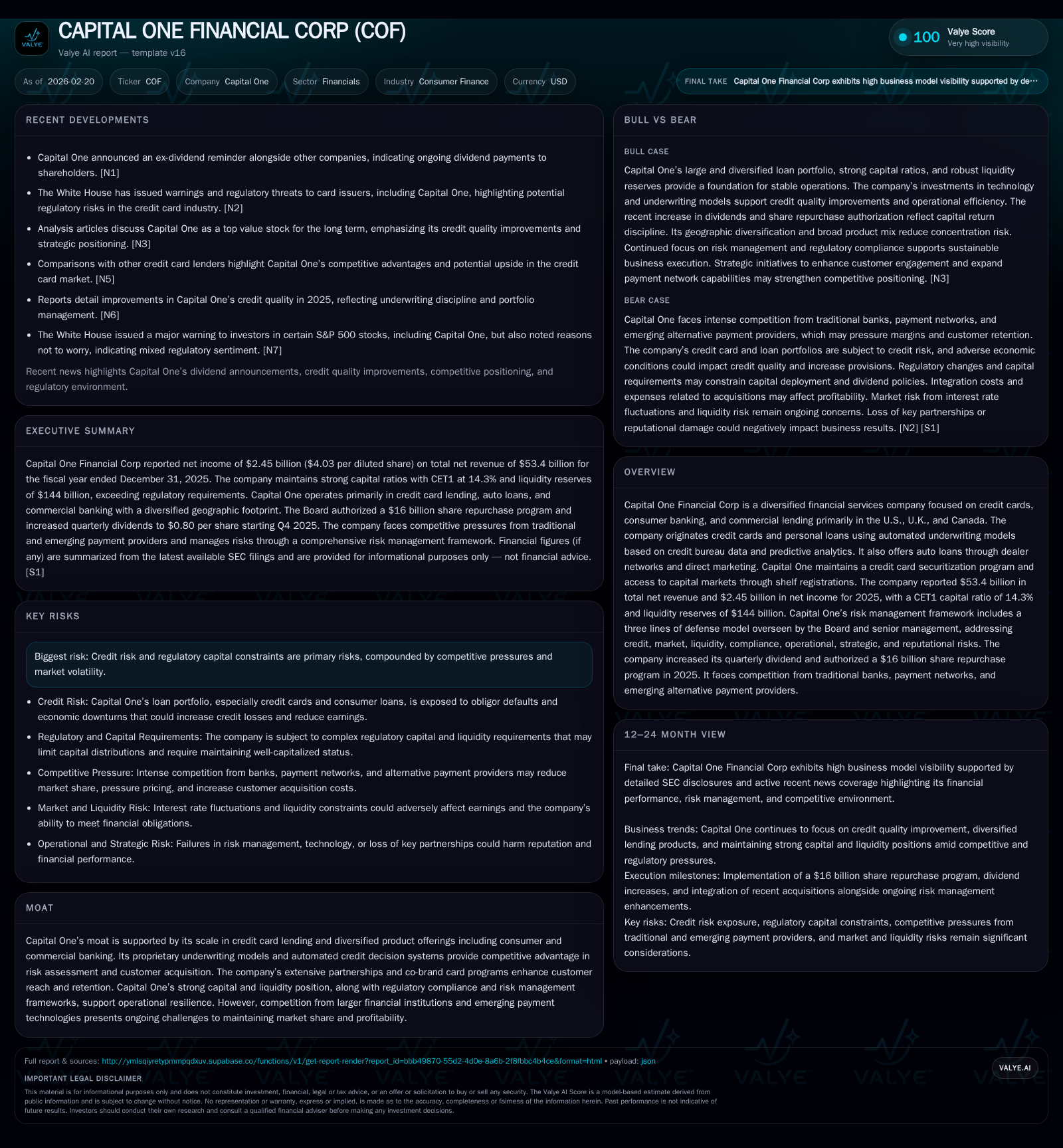
In 2025, Capital One Financial Corporation saw a 37% increase in net revenue to $53.4 billion, fueled largely by the integration of Discover’s portfolios and broader lending activities. Despite top-line growth, net income halved to $2.45 billion, reflecting a sharp rise in credit loss provisions and operating expenses related to acquisition integration and evolving risk management challenges. Capital One maintains a robust capital position with a CET1 ratio of 14.3% and liquidity reserves of $144 billion, enabled sizable share repurchases totaling $3.8 billion in 2025 and increased dividends slightly. Future performance depends on effective risk mitigation, loan portfolio quality stabilization, regulatory environment navigation, and successful technology integration.
Historical Performance
Capital One Financial Corp delivered robust top-line expansion in 2025 yet faced profit compression largely attributable to rising credit costs. Total net revenue reached $53.4 billion for the full year, up by an impressive 36.6% compared to $39.1 billion in 2024 and $36.8 billion in 2023 [F1][S1]. This sharp leap primarily reflects organic growth across its credit card, personal loan, auto lending segments combined with the acquisition of Discover’s portfolios completed during 2025.
However, bottom-line results were pressured as net income dropped nearly half from $4.75 billion in 2024 to $2.45 billion in 2025 [F1]. The main earnings headwinds were the provision for credit losses jumping by over three-quarters to $20.7 billion due to increasing consumer delinquencies and seasoning of newly acquired loans [F1][S15]. Concurrently, operating expenses rose materially by about 42%, reaching $30.5 billion as Capital One absorbed higher marketing outlays, compliance investments, and integration costs related to its recent transactions [F1][S15]. Despite the earnings decline, operating cash flow improved substantially by more than half to approximately $27.7 billion supported by strong core business cash generation [F1].
Historical performance (annual)
| FY | Rev ($bn) | Net ($bn) | CFO ($bn) | Capex ($mm) | Rev YoY | Net YoY |
|---|---|---|---|---|---|---|
| 2025 | 53.4 | 2.5 | 27.7 | 1578 | +36.6% | -48.4% |
| 2024 | 39.1 | 4.8 | 18.2 | 1204 | +6.3% | -2.8% |
| 2023 | 36.8 | 4.9 | 20.6 | 961 | +7.4% | -33.6% |
| 2022 | 34.3 | 7.4 | 13.8 | 934 |
Note: Omitted columns lack sufficient annual XBRL coverage in the provided tags (need ≥2 annual points): OpInc. Source: SEC companyfacts cache [F1].
Capital returns and efficiency (annual)
| FY | Div ($mm) | Buybacks ($bn) | FCF ($bn) |
|---|---|---|---|
| 2025 | 1516 | 4.1 | 26.1 |
| 2024 | 932 | 0.7 | 17.0 |
| 2023 | 931 | 0.7 | 19.6 |
| 2022 | 950 | 4.9 | 12.9 |
Source: SEC companyfacts cache [F1].
Note: Operating income not available; Dividend payout ratio calculations suggest increased shareholder distributions.
Business Overview & Moat
Capital One is a broadly diversified financial services player focused on U.S., U.K., and Canadian markets with leading positions in credit cards, consumer auto loans, personal lending, and commercial banking lines . A critical asset underpinning its moat is its proprietary underwriting technology leveraging extensive credit bureau data integrated via automated decisioning platforms.
The firm's extensive partnerships through co-brand card programs diversify customer acquisition channels; these include key retail relationships enhancing penetration.
Risk management credentialed through a rigorous three lines of defense model overseen by management and Board adds resilience against volatility inherent in consumer finance sectors.
Nonetheless, industry competition notably from megabanks with scale advantages and nimble fintech challengers inexorably pressures margins and requires continuous innovation.
Growth Prospects & Constraints
The discover acquisition expands Capital One’s product suite into new borrower segments enhancing cross-selling potential [N1]. Additionally, secular tailwinds in credit spending rebounding post-pandemic support underlying origination activity.
However, significant downside risks remain tied to elevated macroeconomic uncertainty affecting borrower repayment capacity amidst inflationary pressures and labor market adjustments influencing delinquencies [S15][N9]. Regulatory tightening especially around consumer protection laws may raise compliance costs further constraining profitability [S6].
Technology investments aimed at integrating Discover’s systems while aligning risk controls pose execution complexity that could delay anticipated synergy realization timelines.
Capital Position & Liquidity
Capital One sustains solid capitalization metrics with Common Equity Tier-1 ratio at a healthy 14.3%, comfortably above Basel III minimum requirements ensuring shock absorption capacity under stress scenarios [S1][S28].
Liquidity reserves ascended sharply from about $124 billion in December ’24 to approximately $144 billion at year-end ’25 encompassing cash assets plus investment securities readily monetizable or pledged for secured borrowing lines such as FHLB advances [S10].
The firm holds ample issuance capacity under multiple shelf registrations aggregating nearly $40 billion predominantly supporting securitized debt issuance programs targeting credit card receivables and auto loans . Contingent liquidity lines exceeding $100 billion enable rapid response during periods of market dislocation.
Returns & Capital Allocation
Despite the decline in net income impacting return on equity (~2.2% for FY25 derived from net income/equity), Capital One preserved disciplined capital allocation with total common stock repurchases summing around $3.8 billion — more than fivefold increase YoY — indicating opportunistic buyback strategy aligned with excess capital buffer deployment [F1][S20].
Dividend payments increased moderately by about eight percent compared with prior year levels supporting shareholder income continuity amid earnings volatility.
Risk Management & Regulatory Environment
Comprehensive risk governance anchored around established policies covers credit underwriting rigorously tested against stress scenarios using predictive analytics models continuously refined incorporating AI techniques . Still inheriting legacy exposures from Discover acquisition necessitates careful oversight as reported control gaps are addressed incrementally with expectations of phased remediation.
Regulatory scrutiny has intensified on matters such as anti-money laundering adherence, consumer fairness initiatives including recent OCC monitoring for debanking biases related investigations — any adverse findings could lead to enforcement actions or costly reputational damage [S6][N6].
Market interest rate fluctuations remain a persistent earnings sensitivity factor given Capital One’s large variable rate loan portfolio mix.
What To Watch Going Forward (Analysis)
- Credit quality trends emerging from recently acquired personal loan segments will be crucial considering the elevated provision levels suffered in ’25.
- Progress reporting on full integration completion timelines for Discover transaction impacts cost efficiency realization estimates.
- Updates on regulatory developments impacting allowable lending practices or capital return constraints under prudential frameworks.
- Competitive positioning against fintech disruptors incorporating novel payment ecosystems could affect market share dynamics particularly among younger demographics.
- Capital deployment strategies: size/frequency of future buybacks or dividend amendments reflective of earnings recovery pace or strategic investment priorities.
This analysis relies on historical data through fiscal year ended December 31, 2025 as disclosed by Capital One Financial Corporation (COF) via SEC filings dated February 19, 2026 ([F1],[S#]) alongside contemporaneous news articles for sector context ([N#]). All forward-looking considerations reflect management discussions within public filings without speculative forecasts beyond reported guidance or explicit company statements. This is not investment advice or recommendation but an informational company and industry perspective authored for internal analytical use.

Comments