
Fiserv’s Earnings and Strategic Moves Shape Its Financial Technology Future
An in-depth review of Fiserv’s recent financial results, capital structure, and AI-driven initiatives reveals the interplay shaping its fintech growth and risk profile.
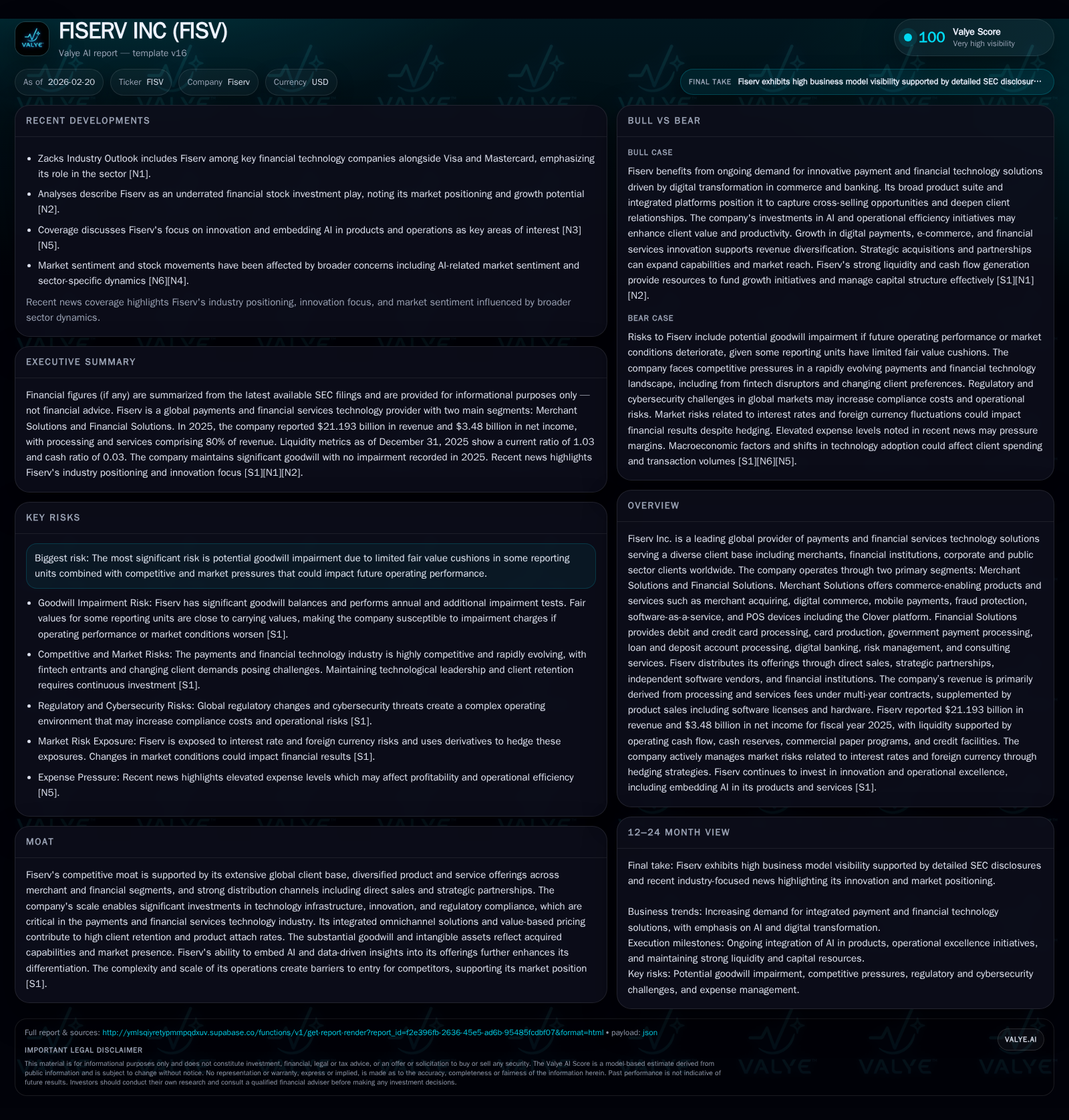
Fiserv maintains a diversified fintech portfolio through its Merchant and Financial Solutions segments, demonstrating steady revenue growth over recent years though facing a Q4 2025 revenue decline. The company is aggressively embedding AI into its offerings, particularly within Clover POS and fraud protection software, to drive client retention and product attachment. Capital allocation reflects solid free cash flow generation with ongoing share repurchases amid no recent buybacks. Goodwill impairment risk remains elevated due to tight fair value cushions post-stock price declines. Investors should focus on segment-specific adoption metrics, regulatory impacts, and debt covenant compliance as near-term catalysts unfold.
Historical Revenue and Profit Evolution: Tandem Segment Contributions
Fiserv’s historical performance underscores a steady expansion balanced by operational challenges within its dual-segment model comprising Merchant Solutions and Financial Solutions [S1][S23][F1]. From FY2022 through FY2025, revenue climbed from approximately $17.74 billion to $21.19 billion, reflecting about 3.6% year-over-year growth in the latest fiscal year [F1]. Operating income showed more volatility: rising sharply from $3.74 billion in FY2022 to $5.01 billion in FY2023 before marginally declining by 1% to $5.82 billion in FY2025 [F1]. This divergence suggests margin pressures despite top-line gains.
Net income exhibited resiliency with an 11.1% increase in FY2025 compared to FY2024, reaching $3.48 billion [F1]. The company's operating cash flow (CFO) decreased by ~8.6% in FY2025 yet remained strong at just over $6 billion annually [F1]. Capital expenditures grew by about 12%, indicative of continued investments in technology infrastructure critical for supporting SaaS platforms like Clover POS and digital payment processing [F1][S9].
Historical performance (annual)
| FY | Rev ($bn) | Net ($bn) | CFO ($bn) | OpInc ($bn) | Rev YoY | Net YoY |
|---|---|---|---|---|---|---|
| 2025 | 21.2 | 3.5 | 6.1 | 5.8 | +3.6% | +11.1% |
| 2024 | 20.5 | 3.1 | 6.6 | 5.9 | +7.1% | +2.1% |
| 2023 | 19.1 | 3.1 | 5.2 | 5.0 | +7.6% | +21.3% |
| 2022 | 17.7 | 2.5 | 4.6 | 3.7 |
Note: Omitted columns lack sufficient annual XBRL coverage in the provided tags (need ≥2 annual points): Capex, Div, Buybacks. Source: SEC companyfacts cache [F1].
Capital returns and efficiency (annual)
| FY | FCF ($bn) | ROE% |
|---|---|---|
| 2025 | 4.3 | 13.5 |
| 2024 | 5.1 | 11.6 |
| 2023 | 3.8 | 10.3 |
| 2022 | 3.1 | 8.2 |
Source: SEC companyfacts cache [F1].
Certain metrics such as dividends paid or buybacks during fiscal years subsequent to FY2018 are unavailable from XBRL data.
Drivers Behind Q4-2025 Financial Performance: Revenue Decline Amid Earnings Beat
While full-year revenues increased modestly, Fiserv's Q4 calendar year results showed a contrasting approximate seven percent year-over-year revenue decline [N2][N3]. This quarter-level contraction was partly driven by softer merchant acquiring volumes amid changing client dynamics and competition within payment acceptance solutions [S3]. Despite this softness, earnings surpassed analyst expectations due to disciplined cost management and benefits from restructuring initiatives aimed at improving operational efficiency.
Management noted elevated expenses linked to technology investments and transformation efforts intended to position the company for longer-term growth [N2][S3]. Pressure points within the Merchant segment's small business clientele reflect macroeconomic factors influencing payment volumes.
The juxtaposition of Q4 revenue softness with EPS beats indicates that tactical pricing strategies combined with enhanced automation likely improved contribution margins despite volume headwinds.
Integration of AI and Technology Investments: Modernizing Payment Solutions
Technology modernization is central to Fiserv's strategy as it seeks competitive differentiation through AI-enhanced products [S1][S9][S13]. Particularly within the Merchant segment, Clover POS devices incorporate embedded AI capabilities that streamline transactions and enhance fraud detection—an increasingly critical area given cybersecurity threats.
AI-powered fraud algorithms reduce false positives while expediting legitimate approvals, delivering both operational savings and improved client experience [S9][S13]. Furthermore, AI-driven insights enable personalized merchant offerings such as pay-by-bank solutions and tailored financing options.
The SaaS-centric model supports continuous feature updates without hardware disruptions, lowering total cost of ownership for clients while increasing switching costs—a strategic moat for fintech platforms.
Segment-Specific Growth Opportunities and Market Positioning
Growth drivers within Merchant Solutions notably include the Small Business sub-segment through expanding ISV partnerships integrating merchant acquiring into their software offerings [S9][S23]. The Enterprise sub-segment targets large clients seeking unified omnichannel ecosystems across physical stores, e-commerce, mobile payments, and commerce analytics.
Financial Solutions emphasize Digital Payments—covering debit card processing and person-to-person transfers—and Issuing services including credit card processing and prepaid cards [S13][S19]. Banking operations complement these via digital account processing coupled with risk management consulting.
Strategic partnerships remain key distribution channels spanning direct sales teams to joint ventures with financial institutions that facilitate cross-selling opportunities across segments [S9][N6]. Emerging interest around stablecoins and cryptocurrencies may offer future product expansion amid evolving regulatory frameworks affecting digital currency acceptance [S20].
Capital Structure, Debt Management, and Liquidity Profile
In August 2025, Fiserv entered into a new senior unsecured multicurrency revolving credit facility totaling $8 billion maturing in August 2030, replacing prior arrangements with the same lender syndicate [S4][S10]. Outstanding borrowings under this revolver were approximately $188 million at year-end against commercial paper borrowings exceeding $1 billion [S14][S16].
The company remains compliant with financial covenants limiting consolidated indebtedness to no more than roughly 3.75 times trailing EBITDA adjusted for certain items [S4][S10]. Senior fixed-rate notes aggregate nearly $25 billion with staggered maturities extending into the mid-2030s; managing refinancing risk amid interest rate volatility is an ongoing treasury focus [S14].
Foreign credit lines primarily denominated in Latin American currencies carry elevated local borrowing costs—for instance Argentina's nominal average interest rate exceeds fifty percent—necessitating vigilant foreign currency risk monitoring [S16].
Overall liquidity includes roughly $798 million cash equivalents plus revolver availability post-commitments providing operational runway including planned ~$1.76 billion capital expenditures annually [F1][S24].
Shareholder Returns: Cash Flow Generation and Buyback Activity
Free cash flow (operating cash flow minus capital expenditures) approximated $4.3 billion for FY2025—modestly down from prior year but robust given increased capex reflecting technology investments [F1][S24]. Return on equity is estimated near mid-teens (~13.5%), demonstrating effective capital utilization relative to net income against shareholders' equity base exceeding $25 billion [F1].
While meaningful share repurchases occurred historically (peaking near ~$2 billion annually around FY2018), no material buybacks were executed during FY2025 per available XBRL data [F1][S15]. Dividends paid are not available from provided tags; investor communications should be referenced for payout details.
Recent large share repurchase authorizations indicate board confidence but actual execution appears measured amid ongoing litigation risks and goodwill valuation concerns [S15].
Goodwill Valuation and Impairment Risk Assessment
Fiserv reported goodwill totaling approximately $37.7 billion at December-end ‘25 following acquisitions expanding payments technology capabilities globally [S1]. Annual impairment testing combines discounted cash flow analyses with market-based approaches supported by independent valuation experts.
Eight reporting units representing roughly half the goodwill balance had fair value cushions below fifteen percent compared to carrying values—with some as low as ~3-4%—indicating heightened sensitivity to market or operational shifts that could trigger impairments [S1]. Late-2025 triggered tests due to stock price declines confirmed no impairment charge was necessary but underscored vulnerability.
Investors should monitor goodwill quality closely given its scale relative to total assets and potential earnings impact if impairments occur.
What Investors Should Monitor Next: Catalysts and Risks Ahead
Key indicators warranting attention include:
- Quarterly earnings execution focusing on revenue trajectory reversal especially early in fiscal quarters,
- Merchant Solutions’ client acquisition momentum particularly among SME SaaS partners leveraging Clover platform,
- Adoption rates of AI-enabled features enhancing transaction automation or fraud mitigation,
- Regulatory developments impacting data privacy/security potentially affecting compliance costs or solution demand,
- Leverage ratios relative to macroeconomic impacts on EBITDA generation,
- Outcomes of ongoing securities litigation matters given reputational implications influencing investor sentiment.[N7][N14][N5]
Maintaining technological leadership while managing financial risks will be crucial for Fiserv’s ability to capitalize on expanding global digital payments markets fueled by evolving consumer demands.
Disclaimer: This report is prepared solely for informational purposes based on publicly available data from SEC filings ([F1], [S#]) and news sources ([N#]). It does not constitute investment advice or recommendations.
Disclaimer: This is research-only, informational analysis and not investment advice. It may include AI-generated interpretation and general industry context. Always verify important details using primary sources.

Comments