
LKQ CORP’s Growth Slows as Cost Pressures and Competitive Dynamics Weigh on Margins
After nearly two decades of expansion, LKQ faces headwinds from softer demand and margin compression even as it maintains strong cash flow and liquidity.
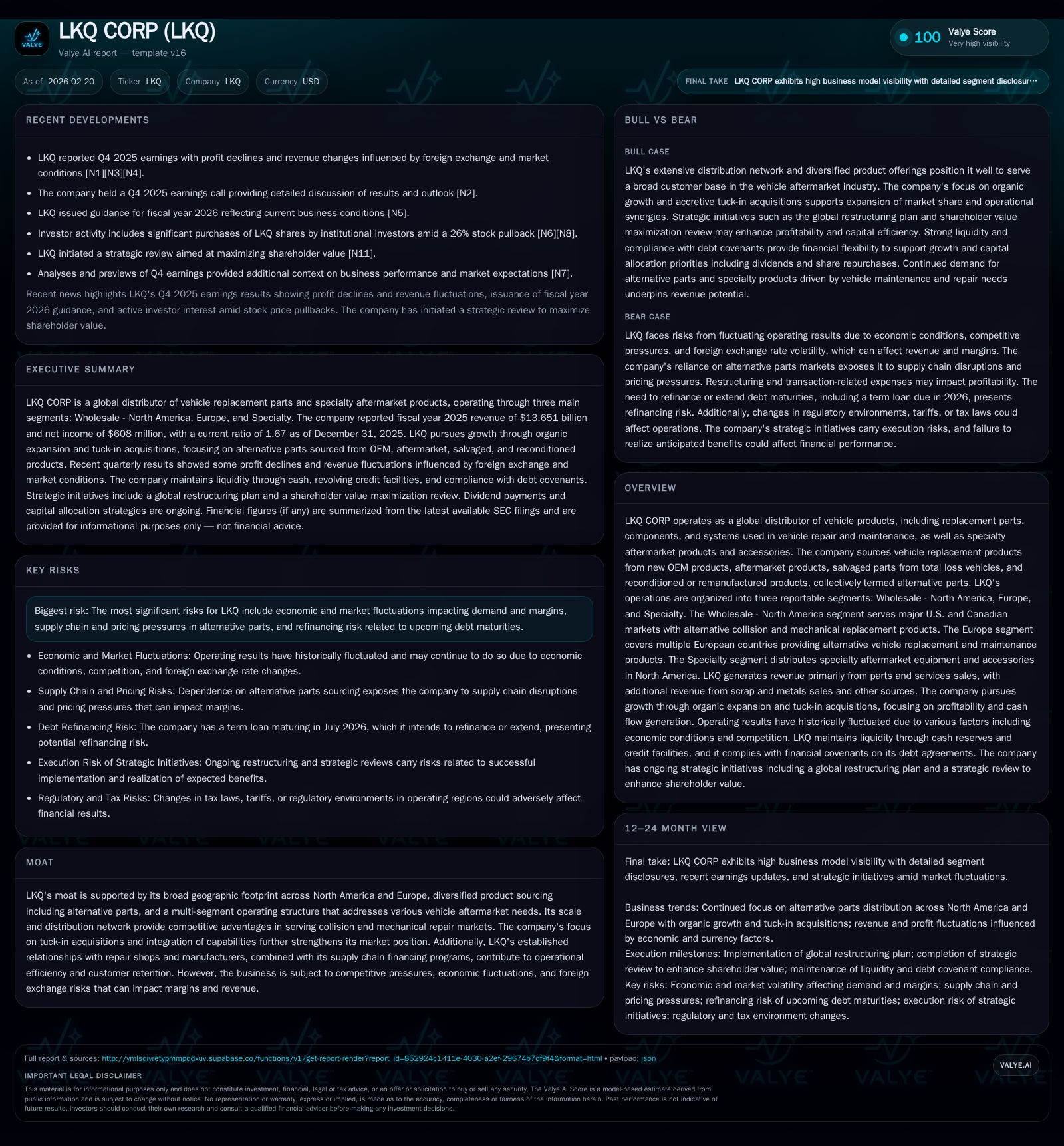
LKQ CORP, a leading global distributor of vehicle replacement parts and specialty aftermarket products, reported revenue decline in 2025 after years of steady growth. Its historical growth was driven by geographic expansion, diversified sourcing including alternative parts, and a multi-segment structure. However, 2025 saw a 4.9% revenue drop and a 17.2% operating income decline due to challenging economic conditions, pricing pressure, and competitive intensity in both North American and European markets. LKQ’s capital allocation remains balanced with disciplined buybacks, dividends, and tuck-in acquisitions supported by solid free cash flow generation and liquidity. Market watchers should focus on upcoming refinancing efforts and margin recovery initiatives as catalysts.
Company Overview
LKQ CORP operates as a global distributor specializing in vehicle replacement products encompassing new OEM goods, aftermarket parts, recycled salvage components, refurbished items, and remanufactured engines or transmissions. It serves primarily collision repair shops along with general mechanical repair businesses through three segments: Wholesale - North America, Europe, and Specialty aftermarket equipment. This segmentation enables LKQ to address diverse vehicle maintenance needs across major markets in the U.S., Canada, and multiple European countries including Germany, U.K., Italy, and France [S1][S2].
The company's extensive sourcing strategy blends OEM-new products with "alternative parts"—those aftermarket or recycled—boosting flexible inventory options while reducing reliance on more expensive OEM suppliers. This approach combined with broad geographic reach forms the crux of LKQ’s competitive advantage offering scale benefits critical in logistics-heavy distribution frameworks .
Historical Performance Drivers
Over the past four years (2022–2025), LKQ demonstrated resilience with mostly growing revenues driven by organic volume gains and strategic tuck-in acquisitions that expanded geographic footprint or enhanced specialty product offerings. However, FY2025 reversed this trajectory with revenue slipping to $13.65 billion from $14.36 billion the prior year—a drop of -4.9%—mainly attributable to demand softness in core collision-related categories amid tough economic conditions especially impacting Europe [F1][S26][S27].
Historical performance (annual)
| FY | Rev ($bn) | Net ($mm) | CFO ($mm) | OpInc ($mm) | Rev YoY | Net YoY |
|---|---|---|---|---|---|---|
| 2025 | 13.7 | 608 | 1063 | 993 | -4.9% | -12.3% |
| 2024 | 14.4 | 693 | 1121 | 1199 | +3.5% | -26.1% |
| 2023 | 13.9 | 938 | 1356 | 1357 | +8.4% | -18.4% |
| 2022 | 12.8 | 1149 | 1250 | 1581 |
Note: Omitted columns lack sufficient annual XBRL coverage in the provided tags (need ≥2 annual points): Capex. Source: SEC companyfacts cache [F1].
Capital returns and efficiency (annual)
| FY | Div ($mm) | Buybacks ($mm) | FCF ($mm) |
|---|---|---|---|
| 2025 | 310 | 159 | 847 |
| 2024 | 318 | 360 | 810 |
| 2023 | 302 | 38 | 998 |
| 2022 | 284 | 1040 | 1028 |
Source: SEC companyfacts cache [F1].
Note: The somewhat irregular net income trend particularly in FY2024 reflects underlying cost pressures and restructuring impacts disclosed but not detailed here [F1].
Gross margin pressure stemmed from higher input costs for alternative parts alongside increased tariff cost pass-throughs which diluted profitability despite price hikes [S15]. Additionally, the Specialty segment offset some softness with steady volume growth driven by automotive and marine aftermarket product lines indicating pockets of resilience.
Segment Analysis
- Wholesale - North America: Largest segment but saw modest revenue decline (-0.5%) in Q3 2025; margin pressures arose from tariff-related pricing and elevated SG&A expenses mainly due to personnel costs increases [S13][S15].
- Europe: Experienced organic sales declines (~4%) amid economic challenges partially offset by FX gains; margins slightly improved due to prior restructuring benefits though SG&A rose due to foreign exchange effects [S16][S23].
- Specialty: Delivered revenue growth (~9%) led by volume increases in automotive and marine product lines with slight margin expansion reflecting favorable mix shifts [S14].
Future Growth Prospects
Growth outlook hinges on economic recovery across Europe affecting collision repair volumes; success of pricing strategies balancing inflation pass-through without eroding market share; continued focus on tuck-in acquisitions targeting geographic density or specialty capabilities; plus expansion into specialty aftermarket products aligned with secular trends toward vehicle customization.
Risks include intensifying competition from OEM suppliers defending parts franchises, supply chain cost escalations outpacing price adjustments, foreign exchange volatility given significant Euro exposure, plus refinancing risk linked to near-term debt maturities [S18][N6].
Guidance & Strategic Initiatives
Following Q4 earnings where profit fell short of estimates due mainly to margin compression and slower volumes [N1][N3], LKQ issued cautiously stable guidance for FY26 focusing on margin recovery efforts alongside operational efficiency programs targeting cost management [N4,N6]. A strategic review initiated early in calendar year aims at portfolio optimization and maximizing shareholder value through potential restructurings or asset monetizations [N6]. Near-term refinancing needs include a $503 million term loan maturing July 2026 which the company plans to extend or refinance proactively [S10][S25].
Returns & Capital Allocation
LKQ maintained disciplined capital deployment with dividends totaling about $310 million annually paid at roughly $0.30 per quarter while share repurchases were curtailed sharply from $360 million in FY24 to $159 million in FY25 amid weaker free cash flow but preserving balance sheet flexibility for acquisitions or debt reduction [F1][S25][S28].
Operating cash flow declined ~5%, totaling $1.06 billion in FY25; capital expenditures cut over 30% year-on-year to $216 million reflecting cautious investment posture given macro uncertainty; resulting free cash flow approximated $847 million supporting dividend coverage plus discretionary financial capacity [F1].
Return on equity stood near a modest ~9%, consistent with mid-cycle auto parts distribution peers where scale offsets cyclicality though below prior peak levels due to recent profit pressures [F1]. The ability to generate meaningful free cash flow amid top-line softness underscores operational leverage inherent in distribution logistics but requires ongoing cost management vigilance.
Industry Context & Domain-Specific Considerations
The automotive aftermarket industry faces shifting dynamics including increasing electric vehicle penetration which reduces mechanical replacement part demand alongside evolving consumer preferences favoring customization services. LKQ’s sourcing strategy emphasizing alternative parts like remanufactured engines must navigate quality perception challenges influencing adoption rates.
Supply chain financing programs support working capital optimization despite generally slower inventory turns driven by vehicle age profiles. Effective procurement payment term negotiation remains key for liquidity management balancing supplier relations against internal cash needs.
Currency fluctuations represent an ongoing risk given significant cross-border operations notably exposed to USD strength impacting European earnings translation.
Risks & Challenges Summary
- Economic downturns or prolonged softening of collision repair claims compress revenue potential.
- Pricing power limited by intense competition particularly from OEMs retaining loyal customer bases.
- Margin erosion from supply chain cost escalation not fully recoverable through selling price adjustments.
- Refinancing risk due to substantial near-term debt maturities requiring favorable credit market access.
- Foreign exchange volatility undermining reported profitability metrics.[S18]
Conclusion & What To Watch Next
LKQ CORP’s long track record of expansion confronts current challenges stemming from subdued demand environments across key geographies coupled with input cost pressures squeezing earnings margins. Despite these headwinds, strong liquidity reserves and positive free cash flow offer financial flexibility supporting capital returns alongside cautious investments.
Key events likely influencing trajectory include:
- Outcomes of ongoing strategic review evaluating portfolio or operational changes.
- Progress on refinancing the term loan maturing mid-2026.
- Ability to stabilize or improve margins via procurement optimization and pricing mix actions.
- Macro-economic developments impacting end-market vehicle maintenance activity.
Investors should monitor quarterly updates clarifying margin recovery efforts combined with any strategic shifts emerging from corporate reviews that may redefine future growth pathways.
This report is intended solely for informational purposes based on available SEC filings and credible market sources as of early 2026 without providing investment advice or price targets.
Disclaimer: This is research-only, informational analysis and not investment advice. It may include AI-generated interpretation and general industry context. Always verify important details using primary sources.

Comments