
NeuroOne Medical Technologies’ Surge in Neurological Device Revenue Amid Ongoing Operating Losses
The company reports robust revenue growth powered by its OneRF system, while managing losses and capital strategy ahead of key clinical milestones.
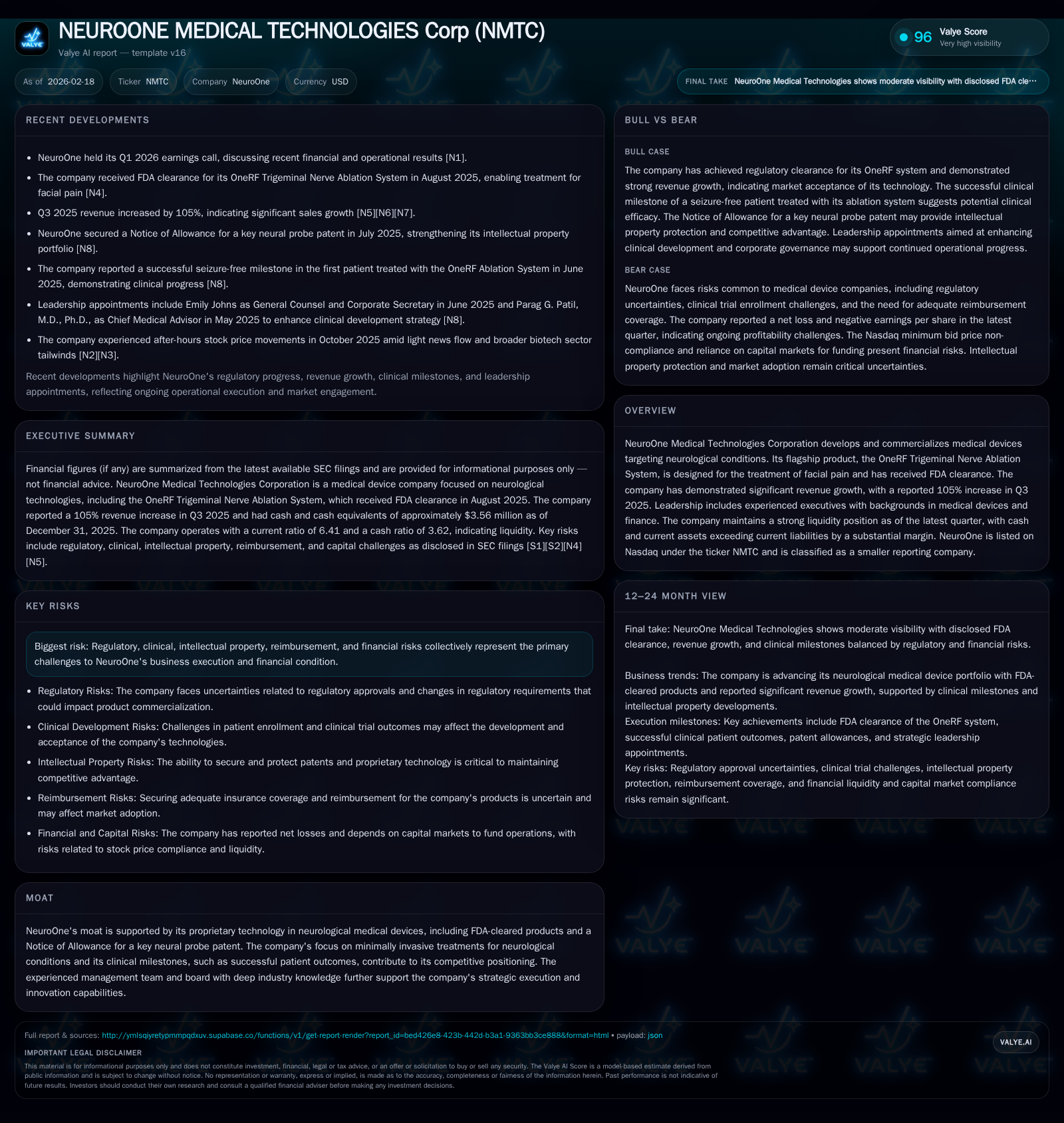
NeuroOne Medical Technologies posted a significant revenue increase of 163.5% in fiscal 2025 compared to 2024, driven by adoption of its FDA-cleared OneRF Trigeminal Nerve Ablation System. Despite continued operating losses, the company’s loss margins narrowed substantially year-over-year, reflecting improved operating leverage as commercialization scales. The balance sheet remains strong with $3.56 million in cash and a current ratio above 6x, supporting ongoing R&D and operational expenses. Intellectual property protection is bolstered by a Notice of Allowance on a key neural probe patent, underscoring competitive positioning. While explicit management guidance on growth outlook is not provided in the filings, upcoming clinical data releases, regulatory approvals, and reimbursement progress are expected to influence future expansion. Capital allocation prioritizes reinvestment with modest share repurchases (~$125K in FY2025) and no dividends declared. Key risks include regulatory hurdles, reimbursement variability, intellectual property enforcement challenges, and financing needs as the company advances commercialization [F1][N1][S1][S4][S6].
Rapid Revenue Expansion Driven by OneRF System Adoption
NeuroOne's recent fiscal years demonstrate an extraordinary revenue ramp tied closely to the commercial rollout of its OneRF Trigeminal Nerve Ablation System—an FDA-cleared device targeting facial pain syndromes such as trigeminal neuralgia. Revenue grew from $171K in FY2022 to $1.95M in FY2023 (+1042%), then $3.45M in FY2024 (+76.9%), culminating in an outsized jump to $9.10M in FY2025 (+163.5%) [F1]. This trajectory signals accelerating market acceptance within the niche neuromodulation segment focused on minimally invasive nerve ablation therapies.
The device's proprietary neural probe technology underpins differentiation despite competition from established neuromodulation methods like radiofrequency ablation or non-invasive approaches [N1][S1]. Growing procedural adoption among neurologists and pain specialists supports this momentum.
Narrowing Operating Losses Reflect Improving Leverage
While NeuroOne remains unprofitable on an operating basis, losses have contracted significantly alongside revenue gains. Operating loss improved from -$11.89M in FY2024 to -$4.23M in FY2025 (a 64.4% reduction) [F1], indicating effective absorption of fixed costs during expanding sales activities.
Net income loss also improved substantially by 70.7%, narrowing from -$12.32M to -$3.61M over the same period [F1]. This trend aligns with typical medtech early commercialization dynamics where investments continue but efficiencies emerge.
Operating cash flow remains negative at approximately -$2.84M for FY2025 but improved 74% year-over-year [F1], reflecting ongoing outlays for marketing, clinical trials support, and inventory buildup necessary for growth. Capital expenditures decreased sequentially to about $82K (down 32% YoY), consistent with asset-light manufacturing strategies [F1].
Proprietary Technology and Intellectual Property Strength
The company’s value proposition centers on its FDA-cleared OneRF system utilizing proprietary neural probe technology enabling precise nerve ablation [S1]. A recent Notice of Allowance on a key neural probe patent further fortifies its IP moat against competition [S1].
This intellectual property underpins strategic barriers critical for clinician preference formation and reimbursement negotiations within a market characterized by slow adoption due to entrenched therapeutic practices [N1][S1]. Early clinical data highlight favorable safety and efficacy profiles.
Catalysts and Growth Outlook
Although explicit forward-looking financial guidance is not available from the provided sources, several milestones are anticipated to drive future growth:
- Release of additional pivotal clinical trial results expanding patient populations treated;
- Potential FDA clearance extensions or supplemental indications broadening market opportunity;
- Progress toward securing third-party reimbursement coverage from insurers impacting procedure economics [N1][S4].
Investors should monitor quarterly updates for incremental disclosures regarding these developments.
Financial Position Supports Ongoing Investment
As of December 31, 2025, NeuroOne held $3.56 million in cash with current assets exceeding current liabilities by over sixfold (current ratio ~6.41x), indicating robust liquidity supportive of operational needs and R&D investments [F1][S5].
Capital expenditures remain modest relative to total expenses (~$81K), aligning with contract manufacturing models typical for emerging medtech firms [F1].
Capital Allocation Strategy
The company prioritizes reinvestment over shareholder returns given its developmental stage; during FY2025 it repurchased approximately $125K in shares—an increase over prior years—but no dividends have been declared or paid historically [F1].
Return metrics such as ROE remain deeply negative (~-51%) reflecting sustained investment losses during scale-up phases; thus capital returns are deferred pending profitability emergence [F1]. Equity compensation programs align management incentives toward long-term value creation rather than immediate payouts.
Risk Factors
NeuroOne faces several material risks detailed extensively in SEC filings:
- Regulatory uncertainties including potential delays or failures obtaining required FDA approvals or expanded indications limiting growth scope;
- Reimbursement challenges due to variable insurer coverage affecting procedure economics and adoption rates;
- Intellectual property risks including potential litigation or inability to defend core proprietary technologies impacting competitive advantage;
- Financial risks related to capital requirements during scaling without positive cash flow generation posing refinancing or dilution threats [S4][S22].
Additionally, clinician adoption depends on sustained evidence generation demonstrating safety and efficacy relative to incumbent treatments before widespread acceptance can be expected.
Historical performance (annual)
| FY | Rev ($mm) | Net ($mm) | CFO ($mm) | OpInc ($mm) | Rev YoY | Net YoY |
|---|---|---|---|---|---|---|
| 2025 | 9 | -4 | -3 | -4 | +163.5% | +70.7% |
| 2024 | 3 | -12 | -11 | -12 | +76.9% | -3.9% |
| 2023 | 2 | -12 | -13 | -12 | +1040.7% | -18.6% |
| 2022 | 0 | -10 | -8 | -10 |
Note: Omitted columns lack sufficient annual XBRL coverage in the provided tags (need ≥2 annual points): Capex, Div. Source: SEC companyfacts cache [F1].
Capital returns and efficiency (annual)
| FY | Buybacks ($) | FCF ($mm) | ROE% |
|---|---|---|---|
| 2025 | 124617 | -3 | -51.0 |
| 2024 | 81403 | -11 | -1498.5 |
| 2023 | -13 | -189.8 | |
| 2022 | -8 | -104.1 |
Source: SEC companyfacts cache [F1].
Note: Buybacks (~$125K in FY2025) and dividends (none declared) are discussed separately; ROE approximated at -51%. All figures per SEC filings unless otherwise noted.
In conclusion, NeuroOne Medical Technologies exhibits hallmark signs of a disruptive medtech innovator successfully advancing early commercialization of its flagship OneRF platform amid persistent yet shrinking losses typical of investment-intensive neuromodulation startups. Its strong liquidity position combined with an expanding intellectual property portfolio forms a solid foundation for executing on clinical milestones that could reshape treatment paradigms for patients with trigeminal neuralgia.
The company must nevertheless navigate complex reimbursement environments and regulatory pathways while balancing capital deployment between innovation pipelines and scaled market access before achieving sustainable profitability that can underpin shareholder returns.
Disclaimer: This analysis is based solely on public filings available as of February 18th, 2026; it does not constitute investment advice.
Disclaimer: This is research-only, informational analysis and not investment advice. It may include AI-generated interpretation and general industry context. Always verify important details using primary sources.

Comments