
Gentherm Inc’s Strategic Thermal Innovations Shape Automotive Comfort and Growth Trajectory
Gentherm leverages proprietary thermal management technology and a global footprint to underpin automotive and medical segment growth despite sector headwinds.
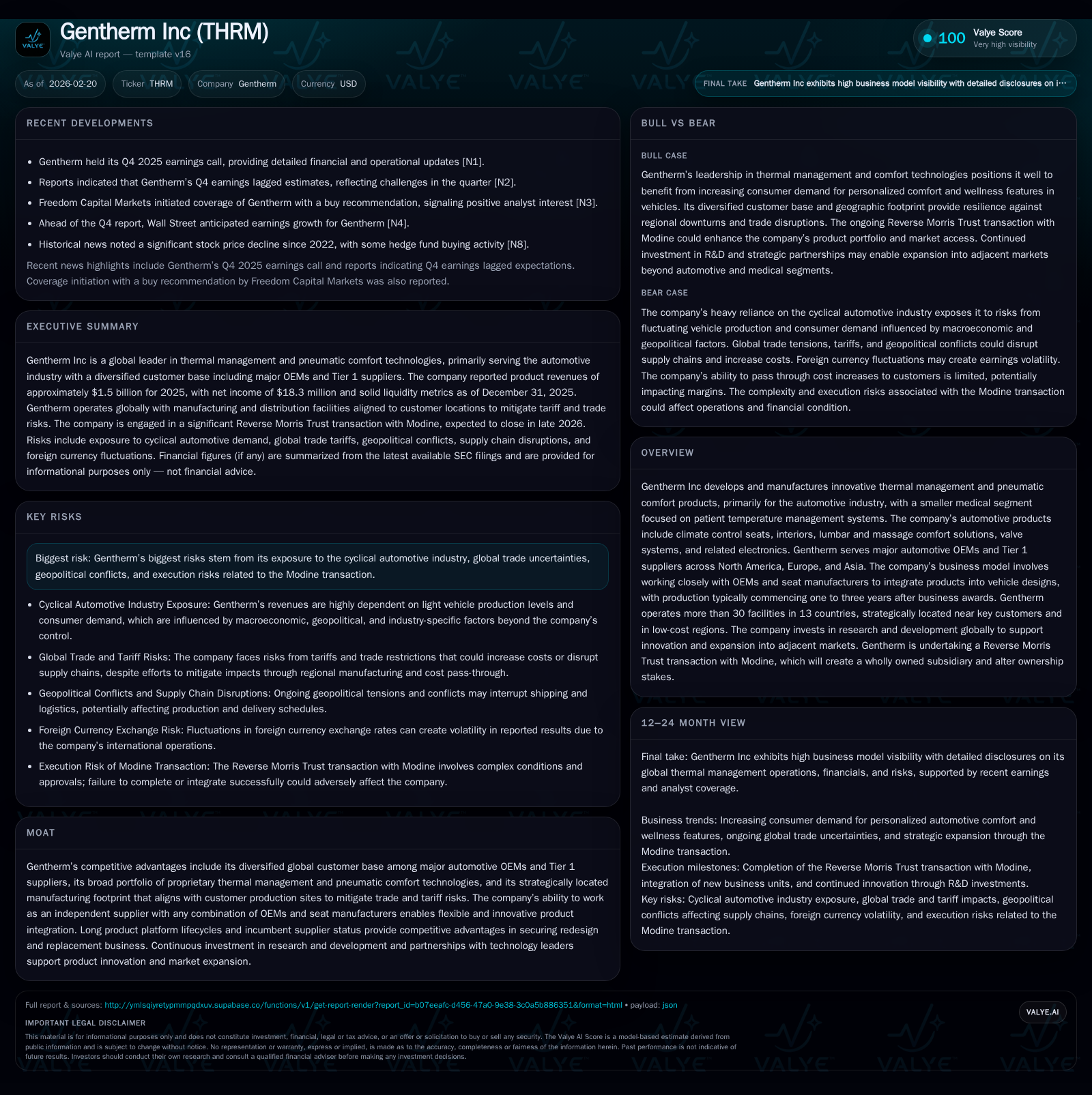
Gentherm Inc has demonstrated a resilient historical performance driven by its leadership in automotive climate control solutions and patient temperature management. While recent operating income declined due to cyclical challenges, operating cash flows strengthened, supported by reduced capital expenditures. The company’s pending Modine acquisition aims to diversify its portfolio, potentially opening new markets though adding integration risks. Long-term growth prospects hinge on sustained R&D investments, strategic manufacturing proximity to OEMs, and capital discipline balancing buybacks with liquidity preservation. Key risks remain tied to automotive cyclicality, geopolitical tensions, and execution risks from M&A integration.
Gentherm’s Historical Growth Path and Operational Drivers
Gentherm Inc has historically underpinned its growth through its comprehensive portfolio of thermal management solutions primarily designed for automotive interiors alongside a smaller but strategically relevant medical segment focused on patient temperature management systems [S1][S6]. From FY2022 through FY2025, the company's operating income exhibited notable volatility aligned with global automotive production cycles and shifting OEM order timing. FY2025 recorded an operating income of $82.7 million—a decline of 22.7% relative to $107 million in the prior fiscal year—reflecting the pressure exerted by automotive industry cyclicality during rollout phases of new vehicle platforms [F1][N1]. Despite this operational margin pressure, Gentherm sustained solid revenue levels driven by its core Climate Control Seats (CCS®), Climate Control Interiors (CCI™), lumbar and massage comfort solutions that generate almost all of the Automotive segment revenue [S6]. This mix emphasized premium thermal comfort modules closely integrated into vehicle seat platforms through collaborative work with OEMs and Tier-1 suppliers.
Meanwhile, operating cash flow improved marginally by 6.5% year-over-year to approximately $116.8 million in 2025 [F1], benefitting from tighter working capital management and a strategic reduction in capital expenditures. Capital spending fell by about 24%, down to $55.7 million as Gentherm optimized its manufacturing footprint investments after prior capacity expansions [F1]. The lag inherent in automotive supplier business models—one to three years from award to mass production—accentuates timing risk for revenue realization but also cements longer-term recurring revenue streams once platforms mature.
Historical performance (annual)
| FY | CFO ($mm) | OpInc ($mm) | Capex ($mm) |
|---|---|---|---|
| 2025 | 117 | 83 | 56 |
| 2024 | 110 | 107 | 73 |
| 2023 | 119 | 77 | 38 |
| 2022 | 15 | 48 | 40 |
Note: Omitted columns lack sufficient annual XBRL coverage in the provided tags (need ≥2 annual points): Rev, Net, Div, ROE%. Source: SEC companyfacts cache [F1].
Capital returns and efficiency (annual)
| FY | Buybacks ($mm) | FCF ($mm) |
|---|---|---|
| 2025 | 10 | 61 |
| 2024 | 52 | 36 |
| 2023 | 91 | 82 |
| 2022 | 20 | -25 |
Source: SEC companyfacts cache [F1].
Note: Annual Revenue and Net Income data is insufficiently available for table inclusion; dividends not disclosed.
Impact of Market Cycles and Automotive Industry Dynamics
Gentherm operates deeply embedded within the automotive supply chain where revenues depend heavily on OEM platform awards issued well before mass production—which typically spans five to ten years—creating inherent volatility [S6]. Its products are supplied indirectly through Tier-1 seat manufacturers making Gentherm reliant on tight coordination across complex multi-tiered product validation processes involving prototypes delivered years ahead of commercial launches. This extended prototype-to-mass production lag leads to uneven revenue recognition patterns.
Industry cyclicality also manifests in margin compression during ramp-up phases when fixed costs precede volume economies [N1]. Additionally, tariff exposure remains an ongoing concern amidst fluctuating global trade policy environments [S10], although Gentherm mitigates direct tariff impacts via its geographically diverse manufacturing base situated near key customers across North America, Europe and Asia—including China, Hungary and Mexico—allowing component compliance or cost pass-through to OEMs [S6][S19]. However, renewed tariffs periodically announced since early-2025 have elevated uncertainty around component sourcing costs requiring vigilant supply chain adjustments.
Modine Transaction: Strategic Rationale and Integration Outlook
In January 2026, Gentherm entered definitive agreements for a Reverse Morris Trust transaction acquiring Modine Manufacturing Company's Performance Technologies segment [S1]. Structured as a tax-efficient merger following Modine's spin-off of SpinCo—which becomes a wholly owned Gentherm subsidiary post-merger—this deal aims to expand Gentherm's addressable market beyond climate control seating into advanced thermal management technologies complementary to existing capabilities.
Closing conditions include shareholder approvals, regulatory clearances including IRS rulings for tax treatment, financing milestones and customary hurdles targeted for completion in Q4-2026 [S1][N1][S19]. While this acquisition is poised to enhance product diversification and deepen technology leadership within adjacent markets—potentially benefiting from cross-selling synergies—the transaction adds significant execution complexity risks regarding operational integration of disparate manufacturing footprints and systems noted explicitly in risk disclosures [S16][S21]. Financing involves bridge loans that will convert into permanent debt post-closing [S19], potentially impacting near-term leverage profiles.
Future Growth Potential Anchored in Technology Leadership and Global Footprint
Gentherm’s commitment to research and development remains robust as it focuses on advancing proprietary thermal management solutions embedded into vehicle interiors via CCS® technologies incorporating heating/cooling channels coupled with electronics for precise local control—a critical differentiator enhancing passenger comfort amidst electrification trends [S1][N6]. The company’s deep collaboration with OEMs and Tier-1 seat suppliers ensures strong incumbent advantages when platforms enter redesign phases due to multi-year expertise embedded during initial awards.
Manufacturing operations exceeding thirty sites across thirteen countries enable logistical proximity advantages reducing lead times while mitigating tariffs [S6][S18], thus preserving operational resiliency amid global trade tensions. These capabilities strengthen platform incumbency advantage—an important competitive moat—as vehicle programs often last multiple model years restricting new entrants’ opportunities once initial designs embed Gentherm components.
Though modest in revenue compared with automotive activities, the Medical segment focusing on patient temperature management systems provides diversification through acute/chronic care devices leveraging core innovation competencies in thermal regulation [S1].
Capital Allocation Strategy: Balancing Investment, Buybacks, and Liquidity
Historically aggressive stock repurchases moderated significantly during FY2025 when buybacks totaled approximately $10 million compared with $51.6 million in FY2024—and even higher prior year levels—reflecting prudence amid rising external uncertainties [F1][S16][S20]. Meanwhile capital expenditures declined substantially year-over-year as recent capacity investments tapered providing positive free cash flow approximating $61 million (operating cash flow minus capex) in FY2025 [F1]. Gentherm ended the year with robust liquidity comprising $160.8 million of cash plus nearly $308 million available on its revolving credit facility—a secured $500 million line maturing mid-2027—providing ample financial flexibility for organic investments or acquisitions such as Modine's Performance Technologies segment [F1][S4][S5][S19].
The company currently does not pay dividends but maintains an active repurchase authorization program up to $150 million extending through June 30, 2027 that remains largely untapped as market conditions evolved recently [S16][S17][S20]. Debt covenant constraints including net leverage ratio limits encourage disciplined capital deployment ensuring resource availability for strategic priorities.
Financial Performance Highlights with Forward-Looking Indicators
Gentherm did not disclose explicit formal guidance for calendar year 2026; however, market participants are advised to monitor order backlog trends from OEM customers along with scheduled vehicle launch timetables embedding Gentherm’s technologies as indicators of future revenue inflections [N3][N6]. Recent equity analyst coverage underscored confidence in Gentherm's technology edge alongside cautious recognition of automotive production cycle sensitivities impacting near-term margins [N6].
Additionally, successful integration progress of the Modine acquisition will be crucial milestone events determining medium-term growth trajectory given expected portfolio synergies yet concomitant execution complexity risk [N1][S16].
Risks From Cyclicality, Geopolitical Tensions, and Integration Execution
Key risk factors continue revolving around exposure to the cyclical nature of the automotive sector where production fluctuations materially affect revenues given just-in-time delivery models without significant firm order backlogs at any time complicating demand forecasting [S7][S21]. Geopolitical trade tensions exacerbate uncertainties with tariff implementations necessitating ongoing supplier realignments possibly increasing costs or disrupting supply continuity despite manufacturing localization strategies [S10][S14].
The recent acquisition introduces integration-related execution risks including system harmonization challenges across international operations which if mishandled could delay synergy realization or strain resources impacting overall financial performance adversely [S16][S25]. Furthermore, warranty claims or potential product recalls linked either directly or indirectly via acquired entities represent contingent liabilities monitored carefully within operating governance frameworks [S12][S22]. Lastly cybersecurity governance overseen by specialized IT Security Committees safeguards information assets reducing vulnerability exposure supporting operational resilience amid digital threats typical across advanced manufacturing supply chains [S14].
This report synthesizes publicly available data from corporate filings and market commentary without making investment recommendations. Readers should consider additional sources prior to forming conclusions or decisions related to Gentherm Inc.
Disclaimer: This is research-only, informational analysis and not investment advice. It may include AI-generated interpretation and general industry context. Always verify important details using primary sources.

Comments