
Bunge Global’s Surge in Sales Contrasted by Profit Retreat: Evaluating 2025’s Mixed Signals
Bunge Global’s exceptional revenue growth in 2025 contrasts sharply with steep profitability declines amid acquisition integration and margin pressures.
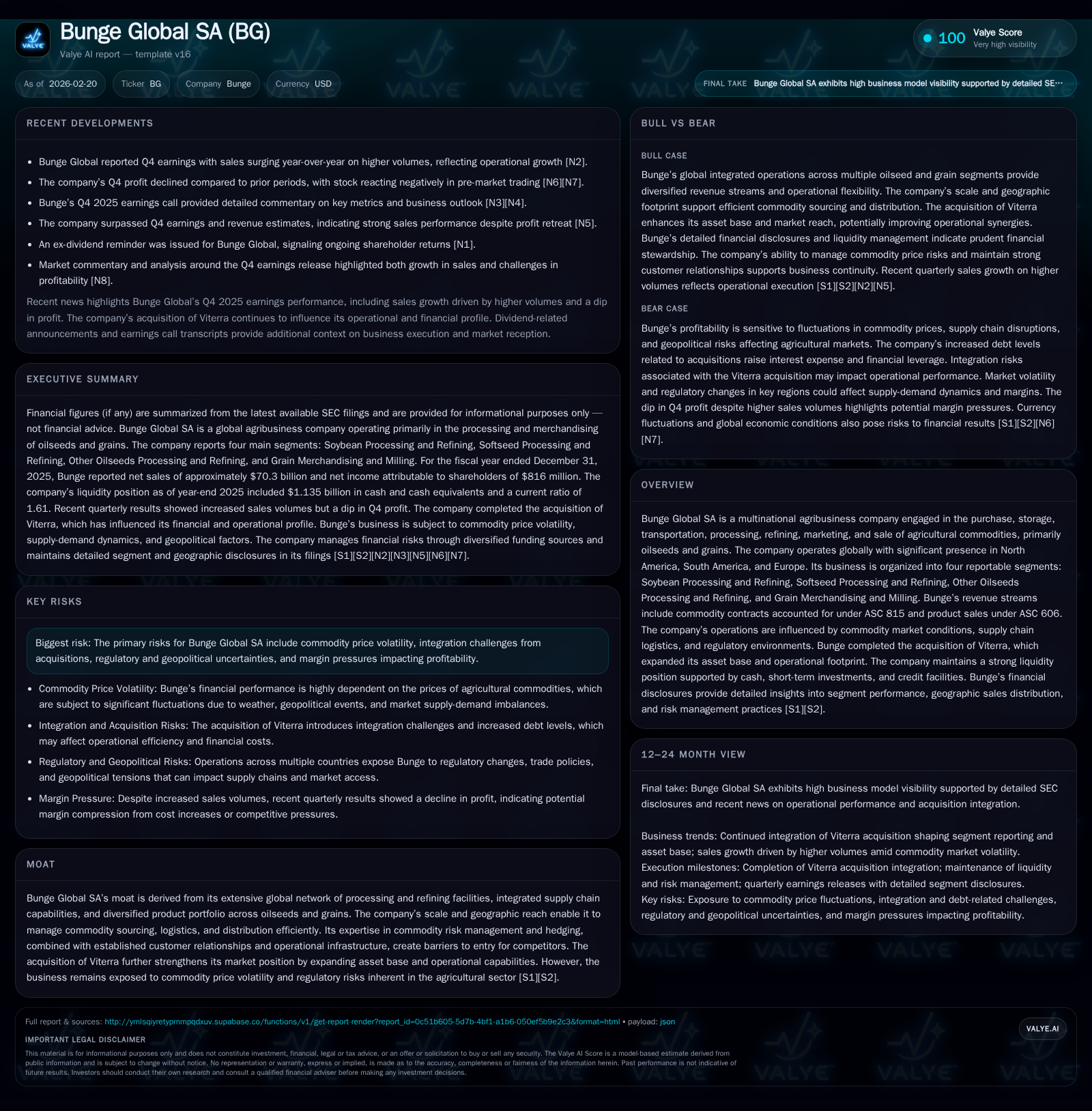
In 2025, Bunge Global SA achieved a remarkable 75.5% year-over-year revenue increase to $23.76 billion, driven primarily by volume gains and the strategic acquisition of Viterra. However, this top-line surge coincided with an 84.2% plunge in net income to just $95 million, reflecting significant margin compression, commodity price volatility, and integration costs. Operating cash flow contracted substantially by 55.6%, resulting in negative free cash flow despite elevated capital expenditures. The company maintains solid liquidity supported by $9 billion unused committed credit lines but faces challenges in recovering margins and optimizing capital allocation amidst ongoing commodity market risks.
Historic Growth Trajectory and Volume Drivers in 2025
Bunge Global SA recorded an extraordinary year in terms of revenue growth for fiscal year 2025, achieving total revenues of approximately $23.76 billion — a sharp increase of 75.5% compared to $13.54 billion in 2024 [F1]. This volume-driven expansion owes much to the successful integration of the Viterra acquisition completed mid-2025 [S1], which augmented Bunge's asset base significantly across its four primary business segments: Soybean Processing and Refining, Softseed Processing and Refining, Other Oilseeds Processing and Refining, and Grain Merchandising and Milling.
The revenue recognition follows ASC 606 for product sales, which captures the expanded sales volume through these segments clearly augmented by Viterra's operational footprint [S18]. Notably, Bunge's soybean processing segment now comprises over 35 oilseed processing plants worldwide with substantial daily production capacity totaling more than 193 thousand metric tons paired with over 11 million metric tons in storage capacity [S1]. Combined with softseed and other oilseed processing assets along with grain merchandising facilities—spanning key regions including North America, South America, Europe, and Asia-Pacific—the enlarged infrastructure supports large-scale commodity throughput facilitated through integrated logistics capabilities.
Supply chain efficiencies remain critical as Bunge manages vast global trade flows underpinned by extensive port terminals and storage strategically located near processing hubs [S1]. This network optimization aligns with agribusiness sector demands where proximity reduces handling time for perishable commodities such as oilseeds.
Overall, the historic performance demonstrates Bunge's aggressive scaling approach leveraging acquisitions plus organic growth within high-volume commodity processing channels.
2025 Profit Decline: Underlying Factors Beyond Revenue Gains
Despite the soaring topline results, Bunge's earnings tell a starkly different story: net income plunged by an alarming 84.2%, crashing from $602 million in 2024 down to a mere $95 million in fiscal year-end 2025 [F1]. Operating cash flows also weakened notably by about 55.6%, landing at $844 million amid increased working capital demands associated with larger operations post-acquisition [F1][N10][S1].
Several factors combined to erode profitability far faster than revenue gains could offset. Cost inflation affecting raw agricultural inputs plus elevated transportation expenses exerted upward pressure on the cost of goods sold (COGS) [S1][N10]. On top of that, hedging strategies governed under ASC 815 for derivatives aimed at mitigating commodity price volatility fell short due to unexpected market swings leading to inefficiencies that squeezed margins further [S1][S13].
Additionally, acquisition-related expenses tied to integrating Viterra's operations—from consolidating systems to harmonizing procurement—added significant one-time charges impacting corporate EBIT negatively [S18]. Margin compression was exacerbated through softseed refining segments facing regional regulatory cost burdens along with volatility in grain merchandising prices linked to geopolitical developments disrupting trade flows [S2][S18].
The combination of these macro- and microeconomic influences presents a challenging earnings environment despite volume expansion—a cautionary tale about the complexity of scaling commoditized agribusiness operations rapidly while maintaining financial discipline.
Commodity Market Risks and Regulatory Challenges Impacting Margins
Bunge’s business is intrinsically exposed to the volatility characteristic of global agricultural commodity markets—a fundamental risk factor documented extensively [S1][S2]. Price fluctuations in oilseeds such as soybeans or softseeds create inherent unpredictability that impacts procurement costs and potential selling prices.
Furthermore, regulatory environments impose complexities ranging from environmental compliance in refining processes (especially regarding emissions standards) to tariffs impacting cross-border grain trade [S18]. These factors result not only in direct cost impacts but also complicate risk management strategies attempting optimized hedging positions according to ASC standards.
Logistics costs intensified following global supply chain disruptions during recent years continue influencing margin pressures given fuel price fluctuations affecting transportation expenses across continents [S18]. Additionally, geopolitical tensions have occasionally impeded access or caused modifications in trade agreements contributing uncertainty.
Altogether, these dynamics demand vigilant enterprise risk management frameworks coupled with agile operational protocols—areas where Bunge invests considerable resources but remains susceptible due to external uncontrollable variables [S13].
Strategic Impact of Viterra Acquisition on Operational Capacity
A keystone event shaping Bunge’s profile in FY2025 was its acquisition of Viterra—a move that expanded both physical capacity and geographic reach substantially [S1][S18]. Post-acquisition asset consolidation introduced upward shifts in daily aggregate production capacities: soybean processing alone counts over 193k metric tons per day globally involving more than thirty-five dedicated plants supported by robust port terminal networks.[S1]
Storage facilities grew multifold as well; grain merchandising segment benefits greatly from nearly 19.5 million metric tons available trough just this asset base increasing flexibility for inventory management during seasonal harvests or market-driven demand waves.[S1]
Nevertheless, integrating disparate operational platforms poses standard M&A challenges encountered widely across agribusiness firms—systems standardization delays or cultural assimilation issues may detract from anticipated synergy realizations initially forecast.[N11][S18] This transitional friction likely contributed toward incremental operating costs weighing on quarterly results post-close.
Management statements underscore ongoing attention toward extracting efficiency improvements while safeguarding supply chain continuity amid amalgamation processes reflecting common yet critical hurdles faced following large scale mergers.[N2]
Capital Allocation Review: Dividends, Buybacks, and Cash Flow Dynamics
In fiscal year ending December 31, 2025, Bunge pursued a cautious capital return strategy balancing shareholder distributions against preservation of liquidity amid profit challenges [F1][S20]. Dividends paid increased moderately by approximately 21% year-over-year reaching $459 million compared to $378 million the prior year reflecting confidence in sustainable payout levels amidst growth investments [F1][N9].
Conversely, share repurchase activity slowed materially—from a full $1.1 billion repurchased in FY2024 down to just $551 million spent on buybacks during FY2025 indicating conservative deployment given strained net income levels alongside negative free cash flow after capital expenditure commitments ($844M CFO less $1.72B capex) resulting roughly in -$879 million free cash flow position [F1].
Return on equity (ROE) tumbled correspondingly from double-digit territory prior years falling visibly below parity around roughly ~0.6% reflecting earnings erosion despite sizable equity base swelling from acquisition-related share issuances expanding book equity upwards from ~$9.9 billion at end-2024 up to ~$15.9 billion at end-2025 [F1].
These trends suggest capital allocation priorities increasingly geared towards liquidity preservation plus deleveraging attempts rather than aggressive share yield enhancement currently.[S20]
Liquidity and Credit Profile Amid Expansion and Integration Costs
Bunge maintains a strong liquidity position notwithstanding balance sheet expansion necessitated by acquisition funding requirements [S4][S6][S8]. At December 31, 2025 excess revolving credit facilities stood at approximately $9.07 billion unutilized committed borrowing capacity complemented by a robust commercial paper program sized at $3 billion providing flexible short-term borrowing sources if needed.[S5][S12]
Total debt ballooned nearly twofold rising from around $6.24 billion at end-2024 up to over $14 billion at end-2025 primarily driven by issuance of new senior notes totaling approximately $1.3 billion plus term loans utilized for partial financing of the Viterra deal alongside customary refinancing activities related thereto[S12][S17]. Despite greater leverage ratios, credit rating agencies retained investment-grade rankings across major firms affirming stable outlooks based on company fundamentals including diverse asset portfolio plus strong operational cash generation prospects balancing inherent cyclicality.[S6][S7]
Financial covenants remain comfortably met evidenced through compliance with minimum current ratio thresholds (recorded current ratio stood at ~1.61x) lending reassurance around short-term solvency amid working capital intensification post-acquisition[S8].[S15]
Trade receivables securitization programs totaling up to $1.5 billion including extension provisions contribute further financial flexibility optimizing working capital solutions consistent with industry norms integrating sustainability targets linked pricing adjustments[S21].[S23]
What to Watch Next: Cash Flow Recovery and Margin Stabilization Scenarios
While explicit formal company guidance is limited publicly for early calendar year periods post-reporting cycle[N2], investors should observe key performance milestones during upcoming quarters:
- Trends in quarterly operating cash flow improvements signaling initial benefits from operational synergies generated through integrated Viterra assets.
- Incremental margin trends within soybean processing segments especially focusing on softseed refining efficiency gains alongside minimization of hedging losses linked derivatives application under ASC 815.
- Management rhetoric surrounding deleveraging strategies aimed at optimizing capital structure possibly reinvigorating opportunistic share repurchase programs contingent on earnings normalization[N12][N13].
- Developments related to regulatory changes impacting multinational commodity operations primarily within Europe & Asia-Pacific jurisdictions bearing on compliance costs.
- Volatility patterns within core agricultural commodity pricing influencing feedstock purchase economics versus product pricing power remaining pivotal for medium-term profitability recovery prospects.
These indicators will collectively shape momentum trajectories validating or challenging the sustainability of Bunge's recent expansive transformation path pending broader macroeconomic conditions shaping food supply chain dynamics globally.
Summary Table: Bunge Global Historical Financials (FY2023–FY2025)
Historical performance (annual)
| FY | Rev ($bn) | Net ($mm) | CFO ($bn) | Capex ($mm) | Rev YoY | Net YoY |
|---|---|---|---|---|---|---|
| 2025 | 23.8 | 95 | 0.8 | 1723 | +75.5% | -84.2% |
| 2024 | 13.5 | 602 | 1.9 | 1376 | -9.3% | -2.3% |
| 2023 | 14.9 | 616 | 3.3 | 1122 |
Note: Omitted columns lack sufficient annual XBRL coverage in the provided tags (need ≥2 annual points): OpInc. Source: SEC companyfacts cache [F1].
Capital returns and efficiency (annual)
| FY | Div ($mm) | Buybacks ($mm) | FCF ($bn) |
|---|---|---|---|
| 2025 | 459 | 551 | -0.9 |
| 2024 | 378 | 1100 | 0.5 |
| 2023 | 383 | 600 | 2.2 |
Source: SEC companyfacts cache [F1].
Note: Operating income not available; ROE approx 0.6% derived from latest net income/stockholders' equity ratio; Free Cash Flow calculated as CFO minus Capex (-$879M in FY2025).
This analysis synthesizes publicly available financial data alongside SEC filings and relevant sector insights without providing investment recommendations or forecasts beyond observed disclosures or company commentary.
Disclaimer: This is research-only, informational analysis and not investment advice. It may include AI-generated interpretation and general industry context. Always verify important details using primary sources.

Comments