
Otter Tail Corp’s Growth Moderation and Capital Strategy in Regulated Utilities and Manufacturing
Otter Tail Corp balances stable regulated utility investments with manufacturing diversification amid legal and market challenges.
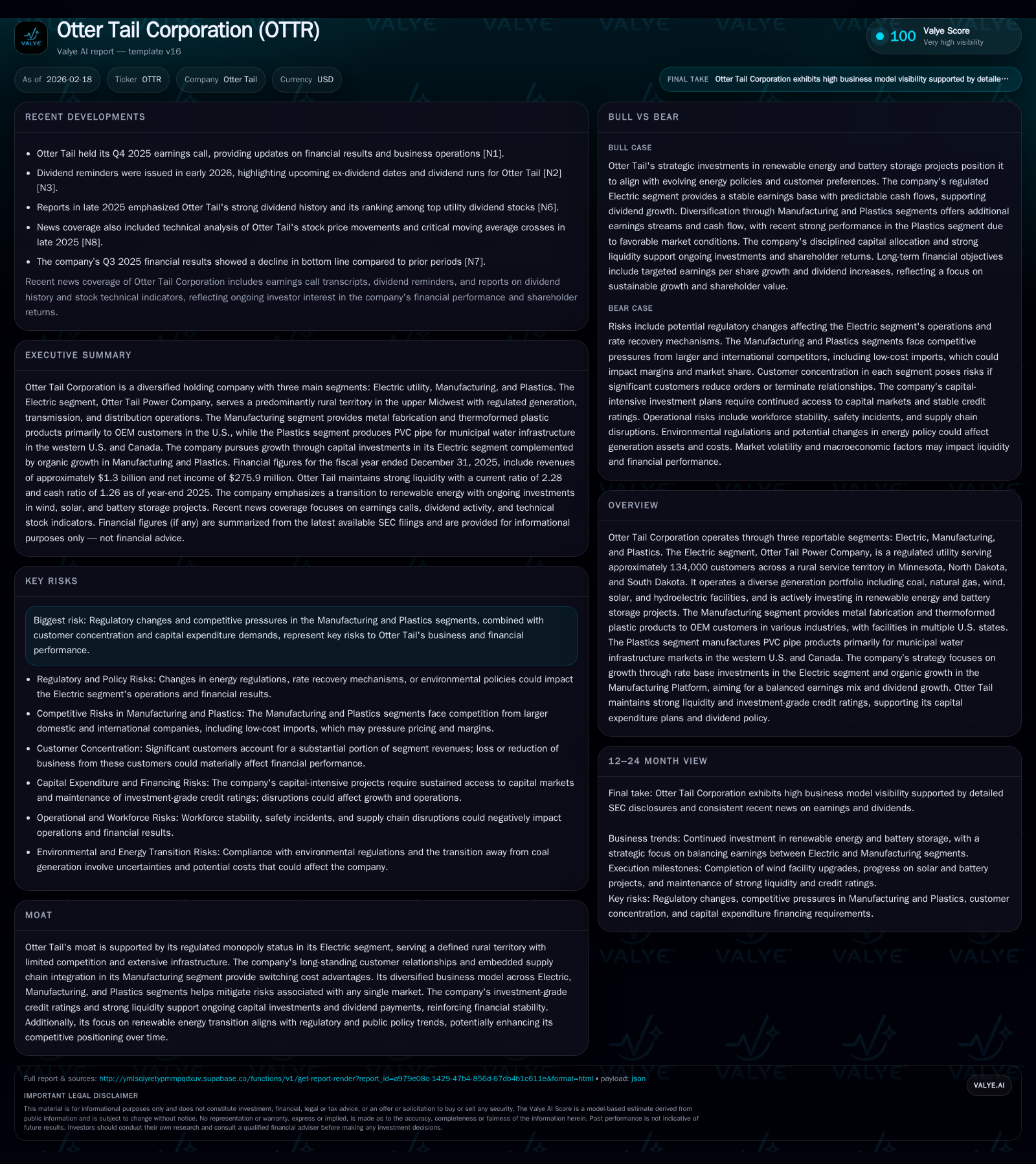
Otter Tail Corp operates a regulated rural electric utility alongside manufacturing and plastics businesses, providing a diversified income base. While revenue and earnings have declined modestly over recent years due to lower product sales and regulatory pressures, the company remains focused on strategic capital allocation targeted at utility rate base growth. Risks from regulatory scrutiny and ongoing antitrust litigation in plastics pose potential challenges. Financially, Otter Tail maintains strong liquidity and investment-grade ratings, enabling steady dividend payments and moderate return on equity.
Company Overview
Otter Tail Corporation amalgamates regulated electric utility operations with manufacturing and plastics segments to provide customers with power and industrial products across multiple U.S. geographies. Its Electric segment, primarily Otter Tail Power Company (OTP), serves approximately 134,000 customers scattered predominantly across rural Minnesota, North Dakota, and South Dakota. This segment operates with a vertically integrated model including coal, natural gas, wind, solar, and hydroelectric assets, aligning with evolving renewable energy goals through ongoing investments in battery storage and green generation projects [S1][N1].
The Manufacturing segment delivers metal fabrication solutions as well as thermoformed plastic products largely to OEMs in sectors including powersports, agricultural equipment, construction machinery, and industrial appliances. It boasts facilities spanning Georgia to Illinois and Minnesota [S1][S10]. Meanwhile, the Plastics segment focuses on producing polyvinyl chloride (PVC) piping essential for municipal water infrastructure primarily in western U.S. regions and Canada [S1][S10].
This tripartite structure balances Otter Tail’s risk profile by offsetting cyclical pressures faced in manufacturing with stabilizing rate base growth in its regulated electric utility.
Historical Financial Performance
Otter Tail has seen a modest downward trend in revenues over the last several years mainly due to softness in its Manufacturing segment combined with environmental regulatory impacts and seasonal demand fluctuations affecting the Plastics business [F1][S2]. The following table encapsulates key annual financial data from FY2022 through FY2025:
Historical performance (annual)
| FY | Rev ($mm) | Net ($mm) | CFO ($mm) | OpInc ($mm) | Rev YoY | Net YoY |
|---|---|---|---|---|---|---|
| 2025 | 1300 | 276 | 386 | 346 | -2.3% | -8.5% |
| 2024 | 1330 | 302 | 453 | 380 | -1.7% | +2.5% |
| 2023 | 1353 | 294 | 404 | 378 | -7.9% | +3.5% |
| 2022 | 1469 | 284 | 389 | 390 |
Note: Omitted columns lack sufficient annual XBRL coverage in the provided tags (need ≥2 annual points): Capex, Buybacks. Source: SEC companyfacts cache [F1].
Capital returns and efficiency (annual)
| FY | Div ($mm) | FCF ($mm) | ROE% |
|---|---|---|---|
| 2025 | 88 | 98 | 14.8 |
| 2024 | 78 | 94 | 18.1 |
| 2023 | 73 | 117 | 20.4 |
| 2022 | 69 | 218 | 23.3 |
Source: SEC companyfacts cache [F1].
Note: Buybacks data is unavailable for recent years.
Revenues contracted by approximately 2.3% year-over-year into FY2025 after more pronounced declines between FY2022-23 attributable to manufacturing sales weakness amidst tariff-driven cost pressures on steel inputs and subdued end-market demand [S2][S10]. Operating income declined by nearly a tenth from frothy pre-pandemic levels reflecting margin compression especially outside the utility segment.
Capital expenditures surged notably entering the mid-decade period driven by expansions but moderated sharply (-19.7%) in FY2025 as certain manufacturing expansions completed late-2024 plus the company paced down its electric grid investments somewhat [F1][S16]. Operating cash flow fell alongside earnings yet remained healthy enough to generate roughly $98 million free cash flow after capex.[F1]
Dividends have shown consistent yearly growth commensurate with earnings through this period but no material share repurchase activity has been disclosed recently [F1][S11]. These factors underscore a strategy balancing investment intensity with shareholder yield.
Future Growth Prospects
Electric Segment growth hinges critically on regulatory approvals that enable expansion of rate base assets including renewable energy installations and transmission system upgrades—components central to Illinois Power Markets Independent System Operator (MISO) dynamics where OTP participates [S6]. Investments in battery storage technologies also represent an incremental catalyst aligned with state decarbonization mandates.
The Manufacturing segment’s prospects are linked to securing sustained volume across diverse OEM end markets like powersports and agriculture amid macroeconomic uncertainties tied to tariffs and inflation that could pressure input costs or dampen customer capex budgets [S10][S2]. Automation initiatives intend to improve throughput while labor availability challenges persist.
In Plastics, geographic focus on western U.S./Canada municipal infrastructure aligns with long-term water system modernization trends benefiting PVC pipe demand; however litigation uncertainty stemming from ongoing domestic and Canadian antitrust lawsuits alleging industry-wide price-fixing practices injects risk [S4][S6]. Resolution outcomes could materially sway earnings or operating practices.
Long-term company guidance targets compounded annual EPS growth between roughly 7-9%, principally driven by rate base expansion complemented by organic growth advances in Manufacturing Platform businesses [N1][S1]. Monitoring regulatory decisions towards self-funding transmission projects within MISO will be critical to validating top-line momentum.
Forecasts / Milestones / Expectations
While explicit guidance figures are limited beyond general EPS CAGR objectives shared recently [N1], attention should be directed toward quarterly regulatory filings documenting progress on capital projects, rate case approvals, renewable asset commissioning timelines, and legal case developments especially concerning Plastics litigation.
Industry-specific catalysts include: FERC rulings on transmission project funding policies impacting OTP’s self-funded investments; municipal infrastructure funding changes influencing PVC pipe volume; shifts in trade policy affecting metal fabrication input costs; utility load demand variations shaped by increasingly common distributed energy resources adoption [S6][N1].
Absent concrete consensus forecasts issued by Otter Tail itself, vigilant reading of SEC quarterly reports for updated operational metrics will be essential.
Returns / Capital Allocation
Otter Tail’s approximate return on equity stands at ~14.8% for FY2025 (net income of $276M divided by equity ~$1.86B), reflecting a balance between steady regulated electric earnings and more variable returns from its competitive manufacturing segments [F1].
Cash flow generation supports ongoing capital expenditures—around $288 million invested last fiscal year—and shareholder dividends which totaled $88 million paid during FY2025 ([F1]; dividends per share rose from $1.49 previously). Despite vigorous capex prompting elevated financing needs (including private placements of senior unsecured notes totaling $100 million maturing over medium-long terms), liquidity remains robust thanks to substantial cash reserves (~$386 million) plus available revolving credit facilities near $380 million combined under flexible terms [S5][S12][S18].
Debt ratios adhere comfortably within covenant limits (interest-bearing debt to capitalization between low-to-mid forties percent), preserving investment grade ratings affirmed stable outlooks from Moody’s, S&P and Fitch rating agencies [S9][S12]. Otter Tail employs a conservative capital structure philosophy emphasizing financial stability that enables reliable dividend continuity even amid episodic earnings volatility related to regulatory delays or litigation outcomes.
No recent share repurchases have been reported indicating prioritization of reinvestment into operations or dividend distribution over buybacks under current conditions [F1][S11].
Strategic Risks & Industry Challenges
Key business risks include potential adverse rulings related to multiple class action antitrust lawsuits filed against its Plastics subsidiaries alleging price-fixing behavior since early-2017 via coordinated industry conduct facilitated through an information service OPIS—a situation complicated further by DOJ investigations spanning U.S and Canada jurisdictions [S4][S13][S20].
These legal matters introduce uncertainties regarding possible damages liabilities or operational restrictions that may impact financial results substantially depending on resolution timing or severity.
On the regulatory front, delays or unfavorable decisions regarding capital expenditure recovery through rate cases could constrain Electric segment growth plans given slower cost pass-through rates or partial disallowances affecting earnings quality [S6][N1]. Weather volatility impacting rural electricity demand seasonally adds another operational layer of unpredictability.
Supply chain disruptions notably related to raw material availability such as steel pricing spikes due to tariffs affect manufacturing costs despite contractual price pass-through mechanisms mitigating some margin pressures [S10][S2]. Moreover, climate change's physical impacts pose long term operational threats to infrastructure resilience.
Cybersecurity remains an ongoing concern as digital asset dependence intensifies prompting continuous investments into defense-in-depth measures while facing ever-evolving threat landscapes including AI-enhanced attacks [S20].
Competitive Positioning & Market Context Analysis
Within the rural utility sector, Otter Tail benefits from monopolistic service territory protections limiting direct competition though it faces indirect contestation from distributed energy alternatives like rooftop solar plus regional municipally owned utilities competing within overlapping footprints—a factor increasing customer choice gradually albeit slowly due to infrastructure dependencies [S21].
Its Manufacturing unit competes within a highly fragmented metal fabrication market where differentiation arises through technological automation investments that improve repeatability/product quality amid skilled labor constraints prevalent industrywide; geographical reach from Midwest southeast U.S aids resilience against localized economic shifts [S10][S15].
Plastics operations compete against both domestic plants and low-cost Southeast Asia imports particularly within horticultural product channels adding pricing pressure while wrapping up allegations around anti-competitive conduct continues distracting management resources [S10][S19].
However, Otter Tail’s embedded customer relationships spanning decades provide switching cost advantages assisting retention even amid cyclicality inherent in industrial end-markets.
Conclusion & Monitoring Points
Otter Tail presents a multifaceted enterprise blending stable cash flows from a regulated energy platform with growth-oriented yet cyclical manufacturing activities susceptible to market, regulatory and legal uncertainties. Recent performance shows careful moderation of capital deployment aligned with these realities while maintaining financial discipline underscored by solid liquidity buffers and investment-grade credit access.
Investor focus should remain on:
- Regulatory approvals advancing OTP’s green energy transition investments,
- Developments around antitrust litigation exposures within Plastics,
- Durable recovery signals within Manufacturing order books,
- Quarterly cash flow health relative to capex requirements,
- Dividend policy consistency amid shifting external cost dynamics.
This balanced but nuanced profile underscores Otter Tail’s effort to sustain moderate growth mixed with conservative capital stewardship navigating sectoral headwinds without compromising core franchise vitality.
This report synthesizes publicly filed information without offering any investment advice or recommendations.
Disclaimer: This is research-only, informational analysis and not investment advice. It may include AI-generated interpretation and general industry context. Always verify important details using primary sources.

Comments