
Zoomcar's Growth Hindered by Liquidity Constraints and Debt Defaults Despite Platform Expansion
Zoomcar Holdings has pivoted sharply to a peer-to-peer car sharing model but faces operational challenges from strained liquidity and debt burdens.
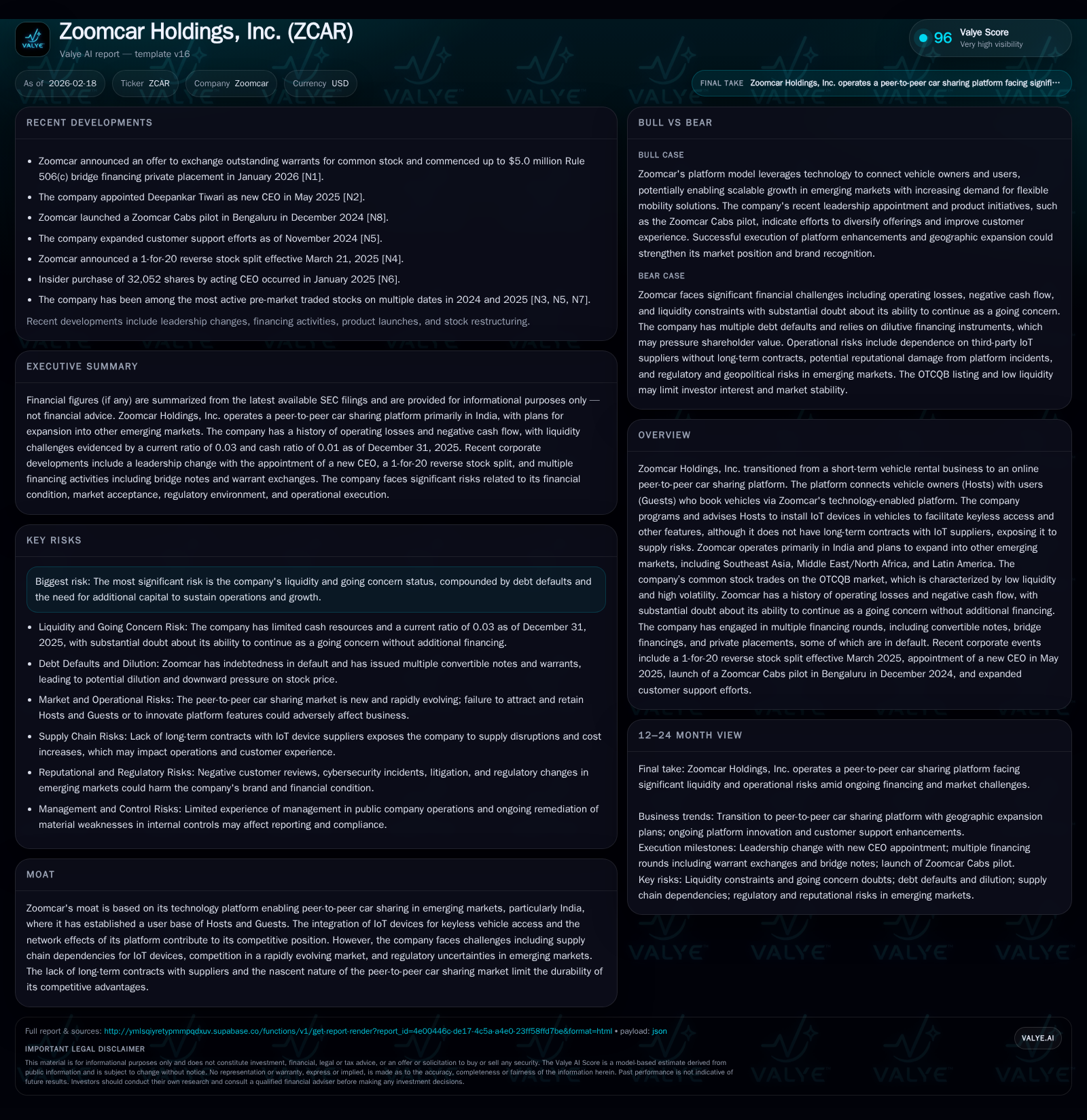
Zoomcar Holdings, Inc. has transitioned from operating short-term vehicle rentals to a technology-driven peer-to-peer car sharing platform, primarily in India with ambitions in emerging markets. Historically, the company has experienced significant operating losses and negative cash flow, with revenues declining slightly in recent periods. While platform growth could be fueled by expanded host networks and geographic expansion, ongoing liquidity constraints, substantial debt defaults exceeding $25 million, and supplier risks pose major obstacles. The company’s capital structure is highly leveraged with multiple high-interest convertible notes and promissory notes, leading to substantial doubts about its ability to continue as a going concern without immediate additional financing. Key near-term milestones include managing upcoming debt maturities and executing equity or debt raises to fund operations beyond March 2026.
Company Overview
Zoomcar Holdings, Inc. has evolved significantly since its inception as a short-term vehicle rental operator into a technology-driven peer-to-peer (P2P) car sharing platform serving primarily India with plans to expand into other emerging markets including Southeast Asia, the Middle East/North Africa (MENA) region, and Latin America . The platform connects vehicle owners—termed "Hosts"—with users or renters known as "Guests", utilizing IoT devices installed on vehicles to enable features such as keyless entry. This digital model aims to leverage network effects by growing both sides of the marketplace.
However, Zoomcar does not secure long-term supply contracts for its IoT devices, which introduces dependency risks on third-party technology providers with an uncertain cost structure. These vulnerabilities compound operational challenges in a dynamic regulatory landscape across emerging economies where the company targets growth. The stock currently trades on the OTCQB market, reflective of relatively low liquidity and high volatility in its shares.
Historical Performance and Growth Drivers
Revenue Trends
Zoomcar's reported revenue for fiscal year (FY) 2025 stood at approximately $9.11 million compared with $9.90 million in FY2024 representing an estimated decline of roughly 8% year over year (YoY) [F1]. This moderate decrease reflects the company's ongoing transformation impact excluding legacy rental revenues which have largely been shed.
Historical performance (annual)
| FY | Rev ($mm) | Net ($mm) | CFO ($mm) | OpInc ($mm) | Rev YoY | Net YoY |
|---|---|---|---|---|---|---|
| 2026 | ||||||
| 2025 | 9 | -26 | -9 | -10 | -8.0% | +25.2% |
| 2024 | 10 | -34 | -22 | -32 | ||
| 2023 |
Note: Omitted columns lack sufficient annual XBRL coverage in the provided tags (need ≥2 annual points): Capex, Div, Buybacks, FCF. Source: SEC companyfacts cache [F1].
Capital returns and efficiency (annual)
| FY | ROE% |
|---|---|
| 2026 | |
| 2025 | 101.1 |
| 2024 | 101.7 |
| 2023 |
Source: SEC companyfacts cache [F1].
OpInc = Operating Income Loss; CFO = Cash Flow from Operations
Profitability Metrics
Operating losses have narrowed markedly—from a steep loss of $31.7 million in FY2024 to a still sizable but reduced loss of around $10.4 million FY2025 [F1]. Net losses also improved from about $34.3 million to $25.6 million during the same timeframe. Despite this improvement trajectory in profitability metrics reflecting cost rationalization post-business model shift toward P2P sharing technology infrastructure investment remains significant.
Cash Flow and Capital Expenditure
Consistent with operating losses Zoomcar's cash flows from operations remain negative but exhibit improvement: operating cash outflows shrank from about -$22.2 million in FY2024 to close to -$9.1 million FY2025 [F1]. Capital expenditures have become marginal (~$4K versus ~$86K prior), signaling a pivot away from asset-heavy rental investments towards platform development and maintenance.
Balance Sheet Overview
At December 31, 2025 Zoomcar reported just over $208K in cash and equivalents against current liabilities totaling nearly $29.2 million yielding an alarmingly low current ratio of approximately 0.03 [F1]. Stockholders' equity remains deeply negative at around -$25.3 million reflecting accumulated losses and high leverage [F1].
This imbalance highlights critical liquidity stresses especially given the looming maturity profiles of existing debt tranches.
Capital Structure and Liquidity Challenges
Zoomcar's capital structure is heavily laden with convertible redeemable notes and promissory notes obtained through private placements throughout 2024-2025 totaling over $25 million principal amounts largely in default or at risk thereof . These instruments bear coupon rates ranging from 6% up to 12%, some subject to default penalty interest escalating rates up to 22% per annum.
The company has repeatedly entered into securities purchase agreements with various institutional investors including AES Capital Management LLC ($112.5K), CFI CAPITAL LLC ($150K), Labrys Fund ($180K), FirstFire Global Opportunities Fund ($220K), AUCTUS Fund LLC ($125K), DLL/Boot Capital (> $200K combined) across second halves of 2024 into early 2026 .
Despite numerous bridge financings totaling several millions (including a recent remarketed offer dated January 23, 2026 for warrant exchanges coupled with up to $5 million Rule506(c) private placement bridge financing) these inflows pale relative to liabilities faced near term [N1][S3].
The company discloses explicit substantial doubt about continuing as a going concern without additional financing imminently needed by March 31, 2026 under current burn assumptions assuming no payments on outstanding debt except operational accruals [S4][S5][S29]. Absent successful capital raises offering or restructuring defaults may crystallize higher penalty costs further straining cash flow.
Strategic Outlook & Future Growth Prospects
Platform Expansion Opportunity
Zoomcar aims to capitalize on the burgeoning mobility-as-a-service trend across emerging markets leveraging its technology-enabled P2P car sharing platform that offers hosts flexibility while unlocking urban mobility access for guests at scale without owning vehicles outright . Expansion beyond India into Southeast Asia corridors, MENA countries where informal vehicle rental economies are prevalent represents untapped addressable market potential pending regulatory clarity.
The company's competitive advantage derives from multi-sided network effects connecting thousands of hosts who install IoT hardware enabling keyless access—a differentiator supplemented by the technological platform facilitating discovery and booking.
Supply Chain Exposure & Regulatory Risks
However supply chain exposure remains acute due to absence of long-term contractual arrangements for IoT device sourcing exposing Zoomcar to pricing volatility or shortages amidst geopolitical tensions impacting semiconductor supply chains globally—an endemic risk for technology-reliant mobility startups.
Moreover nascent regulations governing shared vehicle usage rights across jurisdictions inject policy uncertainty that could constrain unit economics or impede geographic rollout speed.
Financial Risk Factors Capping Growth Potential
Zoomcar's leverage profile significantly curtails organic reinvestment capability given sizeable interest accruals plus principal repayment obligations. The high coupon convertible notes’ embedded equity conversion features also risk dilution on future recapitalizations worsening shareholder value composition.
Legal contingencies related to past vendor litigation elevate potential off-balance sheet drains diverting management focus as referenced in recent SEC risk disclosures [S27].
What To Watch / Forecasts & Milestones (Analysis)
No explicit forward-looking revenue or profitability guidance is provided by management within public filings or news releases presently. Monitoring focus should center on:
- Success or failure of ongoing capital raise efforts under private placements or warrant exchange offers currently underway through early Q2 calendar 2026;
- Ability to manage imminent debt maturities expiring as soon as March through August 2026 amidst installment payment schedules stipulated;
- Progress towards expanding user-host base within India and initial traction reports if available from pilot overseas expansions;
- Reinforcement or dilution of OTCQB listing status impacting investor accessibility;
- Resolution status on legal appeal processes related to vendor claims which may influence contingent liability exposure;
- Operational KPI disclosures if forthcoming relating utilization rates of assets onboarded through Hosts linked via IoT tech simplifying vehicle turnover times.
While Zoomcar's P2P platform growth harbors latent market opportunity within mobility sharing ecosystems undergoing rapid digital disruption worldwide (analysis), lack of clarity tied directly to funding runway places execution risk front-and-center.
Return Profile & Capital Allocation History (XBRL Evidence)
Return metrics such as ROE are distorted given the negative equity base (-$25M) alongside persistent net losses; approximate ROE calculation yields an inversion >100% reflecting accounting artifacts rather than economic profitability [F1]. Dividends are not reported in available filings indicating absence typical for growth-stage tech companies undergoing restructuring; buybacks last recorded were sporadic prior transition period highlighting cash preservation priority more recently [F1].
Capital expenditures have been minimal lately ($4K per Q3 ended Dec’25) indicating operational focus skewed away from tangible asset acquisition towards software platform R&D internally capitalized rather than capex-expensed investment highlighting shift dynamics [F1].
Cash flow trends demonstrate persistent negative operational cash burn limiting free cash flow generation currently in negative ~$9M ballpark annualized terms—a structural headwind until scaled monetization evidences material improvements [F1].
Sector Context (Analysis)
Peer-to-peer car sharing platforms face unique asset-light scalability advantages yet confront multifaceted regulatory regimes varying substantially across emerging markets needing tailored compliance strategies potentially increasing overhead relative to developed market analogues. Additionally IoT-based vehicle telemetry systems rely on secure encrypted communications underpinned by telecom infrastructure stability—a notable industry hurdle especially outside major metropolitan zones complicating host onboarding consistency. Liquidity squeeze symptoms typified by excessive reliance on short-term bridge funds paired with convertible securities bearing punitive default interest rates signal difficulties often preceding restructuring cycles seen in comparable tech-centric mobility ventures attempting rapid geographic scaling under capital intensity pressures.
Conclusion
Zoomcar Holdings stands at a crossroads balancing promising technological innovation driving an online peer-to-peer car sharing ecosystem against serious near-term financial viability challenges rooted primarily in its stressed liquidity profile compounded by high-cost debt load defaults affecting operational continuity prospects absent swift capital infusions. The company’s moat—anchored around network effects facilitated by integrated IoT components enabling seamless user experiences—faces durability tests posed by supply chain fragility and uncertain regulatory environments prevalent throughout targeted emerging regions. Investors monitoring Zoomcar should focus firmly on upcoming liquidity events slated through early-mid CY2026 alongside operational KPIs validating scalable client adoption trajectories ahead of meaningful profitability transitions available only if solvency issues can be resolved adequately before critical deadlines.
Disclaimer: This is research-only, informational analysis and not investment advice. It may include AI-generated interpretation and general industry context. Always verify important details using primary sources.

Comments