
Financial and Operational Dynamics Shaping Gaming & Leisure Properties’ 2025 Performance
GLPI leverages its specialized gaming property portfolio and tenant relationships to deliver steady growth while balancing regulatory risks and capital discipline.
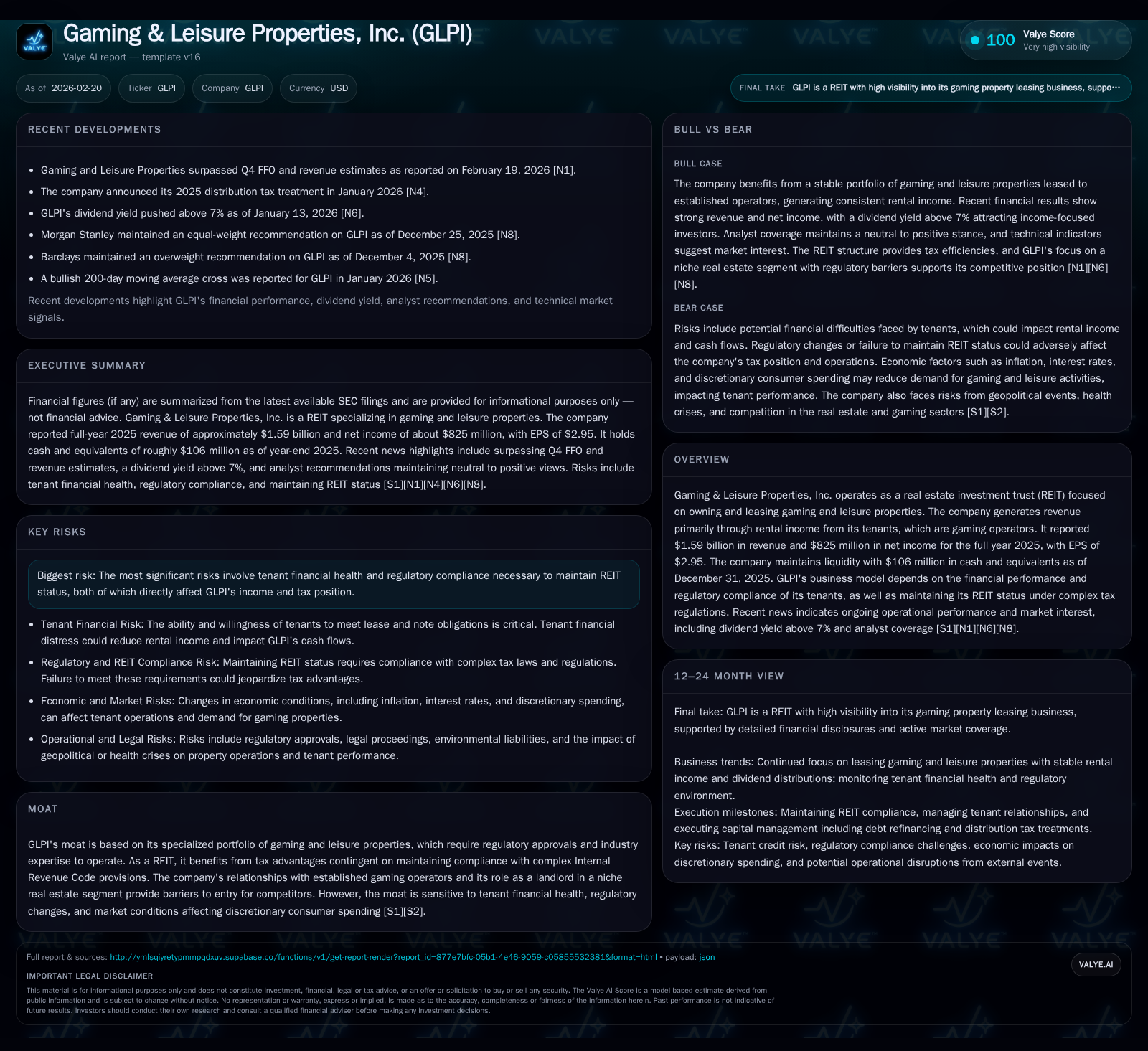
Gaming & Leisure Properties, Inc. (GLPI) reported solid revenue and net income growth in 2025, powered by its uniquely regulated gaming property portfolio and the creditworthiness of its tenant operators. The company’s ability to maintain REIT tax code compliance alongside stable lease covenant performance supports robust cash flow generation and a dividend yield above 7%. However, shareholder returns are constrained by tenant financial health and regulatory risks, with capital allocation focused primarily on dividends and debt management rather than buybacks. The absence of explicit forward guidance shifts focus onto portfolio rebalancing, lease renewals, and macroeconomic factors affecting discretionary gaming spend as critical near-term catalysts.
Specialized Portfolio Powers Revenue Momentum
Gaming & Leisure Properties operates as a specialized REIT owning a niche portfolio of gaming and leisure properties leased to established gaming operators subject to rigorous regulatory oversight [S1][S8]. This specialization creates high barriers for new entrants due to the necessity of maintaining extensive regulatory approvals alongside tenant operational expertise.
Financially, this has translated into consistent growth over recent years. From FY2022 through FY2025, GLPI’s revenues advanced from $1.31 billion to $1.59 billion, representing an approximate CAGR of 4.1% (see Table below) [F1]. Operating income rose more sharply by about 6.3% year-over-year in FY2025 to $1.20 billion, indicating improving operating efficiencies or lease escalations within its portfolio.
The company's focus on regulated gaming properties means that the quality — or gaming operator tenant creditworthiness — directly influences revenue momentum given it underpins stable rent collections tied to tenant financial health [S8].
Table: GLPI Historical Financial Performance (FY2022-FY2025)
Historical performance (annual)
| FY | Rev ($mm) | Net ($mm) | CFO ($mm) | OpInc ($mm) | Rev YoY | Net YoY |
|---|---|---|---|---|---|---|
| 2025 | 1595 | 825 | 1129 | 1201 | +4.1% | +5.2% |
| 2024 | 1532 | 785 | 1073 | 1131 | +6.3% | +6.9% |
| 2023 | 1440 | 734 | 1009 | 1069 | +9.8% | +7.2% |
| 2022 | 1312 | 685 | 920 | 1030 |
Note: Omitted columns lack sufficient annual XBRL coverage in the provided tags (need ≥2 annual points): Capex, Buybacks, FCF. Source: SEC companyfacts cache [F1].
Capital returns and efficiency (annual)
| FY | Div ($mm) | ROE% |
|---|---|---|
| 2025 | 872 | 17.8 |
| 2024 | 831 | 18.4 |
| 2023 | 834 | 17.7 |
| 2022 | 771 | 18.1 |
Source: SEC companyfacts cache [F1].
Note: Capex data limited; only sparse historical figures available [F1][S9]
Tenant Performance and Regulatory Landscape: Balancing Risks and Opportunities
GLPI’s model is deeply intertwined with the operational success and compliance of its tenants — primarily gaming operators whose business outcomes affect lease covenant performance and consequently GLPI's rent receipts [S4][S5][S6]. The regulatory environment compounds this relationship because both the landlord's REIT status and tenants' licenses depend on stringent adherence to complex U.S tax laws and gaming regulations — known collectively as REIT tax code compliance.
Any deterioration in tenant creditworthiness or breach of lease covenants could impair cash flow and threaten GLPI's ability to maintain continuous qualifying income streams essential for REIT tax treatment [S11]. This complexity requires active monitoring since even inadvertent tenant missteps raise potential qualification risks for GLPI itself.
Recent operational performance trended positively with Q4 exceeding Funds From Operations (FFO) estimates due to strong rent collections linked to improved tenant operating metrics [N1]. Despite this strength, the sensitivity to discretionary gaming spending cycles remains a notable risk variable.
Assessing Capital Allocation: Dividend Yield, Leverage, and Shareholder Returns
GLPI prioritizes returning capital via dividends consistent with its REIT structure; dividend payouts totaled approximately $872 million in FY2025 supporting a yield north of 7%, appealing for income-focused shareholders [F1][N6][S21]. This payout ratio ties closely to generated FCF, reinforced by minimal reinvestment requirements given the asset-light leasing model.
On leverage management, GLPI issued $1.3 billion in senior unsecured notes during mid-2025 splitting between tranches maturing in 2033 (coupon: ~5.25%) and 2037 (coupon: ~5.75%), enabling refinancing of nearer-term maturities at favorable rates while extending duration [S10][S14][S15]. This illustrates continued access to debt markets at sustainable costs enhancing capital structure optimization.
Returns metrics reflect these dynamics; estimated ROE stands at a robust ~17.8%, indicative of disciplined equity utilization amid steady net income gains [F1]. However, repurchase activity is not evident from available filings suggesting capital prioritization toward dividend stability and debt management rather than buybacks.
Recent Results Beat Expectations: Implications for Near-Term Outlook
In Q4-2025 results reported February '26, GLPI topped FFO and revenue expectations fueled by higher rent collections versus market estimates [N1][N2]. Analyst commentary highlighted this performance as affirming the firm’s resilient fundamental position despite macro headwinds affecting gaming sectors broadly.
Further detail remains sparse since explicit forward guidance was not disclosed; thus near-term outlook depends heavily on maintaining current tenant operating leverage alongside navigating competitive leasing renewal negotiations — both vital watch points given lack of formal projections [N2].
Cash Flow Generation and Free Cash Flow Efficiency
Quality cash flows underpin GLPI’s financial strength with operating cash flow increasing steadily by approximately +5.3% year-over-year in FY2025 reaching roughly $1.13 billion [F1]. The REIT’s capex footprint remains minimal (roughly $14 million last reported), reflective of an asset-lite landlord profile requiring limited maintenance or development outlays compared to typical real estate peers [S9].
This produces free cash flow approximating $1.12 billion annually—highly efficient converting earnings into distributable cash supporting the attractive dividend yield while maintaining liquidity buffers around $106 million as of end-2025 [F1][S10].
Key Risks from Tenant Stability and REIT Compliance
Among primary disclosed risks are those related directly to tenant financial condition which can impact timely rent payments or necessitate restructuring efforts disrupting income streams critical for GLPI's fixed obligations [S4][S5][S6][S7]. Additionally, failure by either tenants or GLPI itself to satisfy asset composition, income source diversification, distribution amount requirements or shareholder ownership thresholds jeopardizes REIT status carrying significant tax consequences.
Given sector-specific constraints including complex Internal Revenue Code provisions surrounding real estate investment trusts paired with gaming licensing laws, GLPI operates within a finely balanced framework requiring active diligence—factors emphasized repeatedly within risk disclosures reflecting inherent model vulnerabilities.[S11]
Growth Catalysts and Constraints: What Investors Should Monitor
Looking ahead from an analytical lens absent explicit company forecasts or milestone disclosures, key growth drivers lie in GLPI’s ability to pursue accretive acquisitions complemented by successfully negotiating lease renewals on favorable terms reflecting improved property valuations or rent escalations [N6]. Additionally, improvements in tenant operational efficiency can translate into expanded rental base via additional funded construction projects where GLPI provides development financing support.
Conversely macroeconomic constraints including fluctuations in discretionary consumer spending critically influence casino operations underlying rental incomes [N6][S4]. Regulatory changes impacting tenants’ ability to operate profitably or obtain necessary approvals remain latent threats potentially curbing leasing momentum or triggering credit deterioration.
Watch lists should prioritize updates on portfolio rebalancing initiatives favoring low-risk properties with strong operator partners plus any shifts in incremental funding commitments tied to construction projects within the existing property base.
Disclaimer: This analysis is based solely on publicly available information including SEC filings and news reports as cited; it does not constitute investment advice or recommendations.
Disclaimer: This is research-only, informational analysis and not investment advice. It may include AI-generated interpretation and general industry context. Always verify important details using primary sources.

Comments