
Waystar's 2025 Transformation: Acquisition Impact and Financial Leverage Tradeoffs
Waystar Holding Corp. solidified its growth trajectory through the Iodine acquisition, balancing gains against rising competitive and leverage challenges.
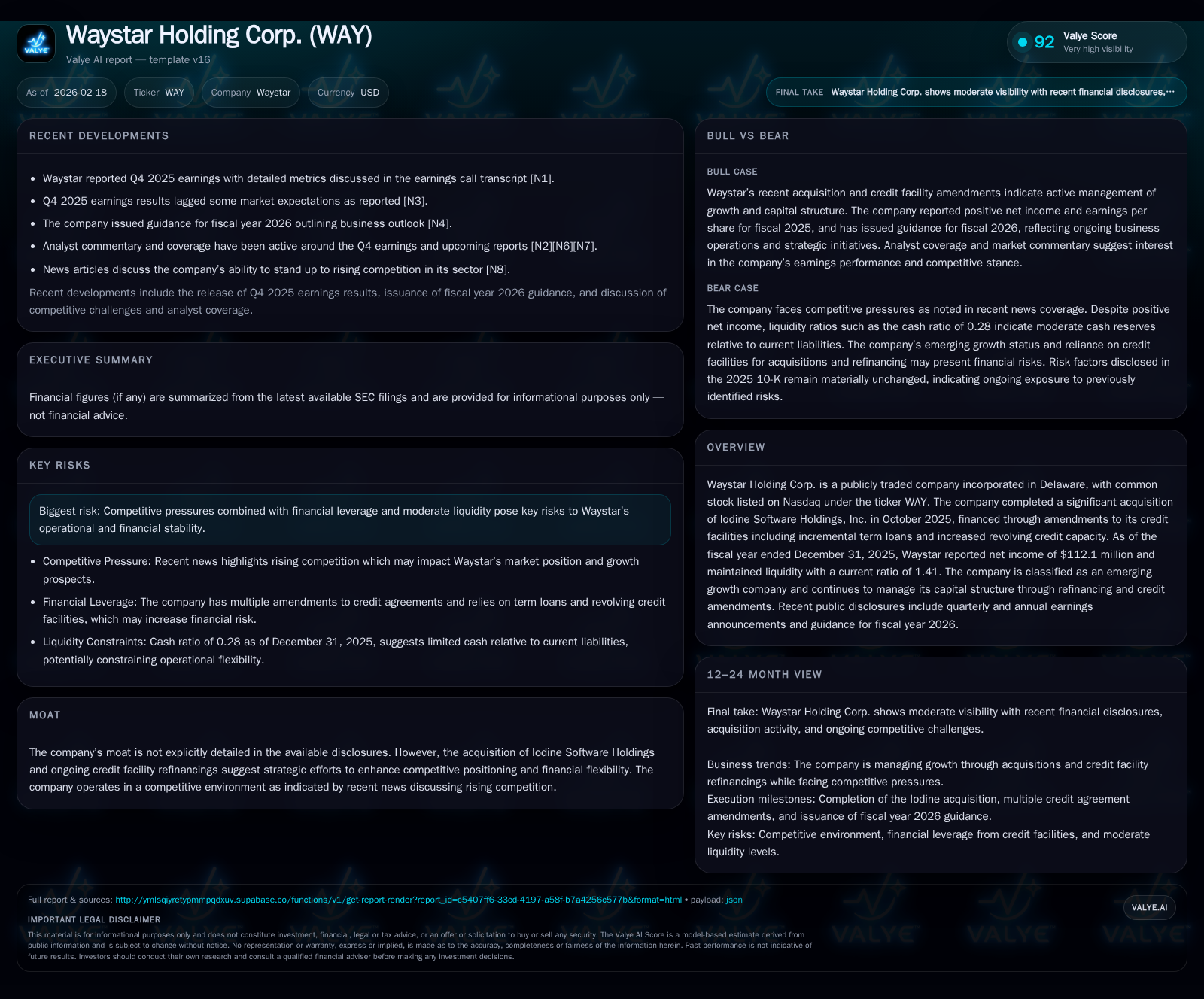
In 2025, Waystar Holding Corp. doubled its operating income and swung to positive net income following the strategic acquisition of Iodine Software Holdings. This growth was supported by amendments to credit facilities that increased financial flexibility but also heightened leverage risks. Looking ahead to 2026, the company faces an evolving competitive environment while managing liquidity and capital structure amid moderate returns on equity. Key indicators include strong cash flow generation but cautious capital allocation decisions with no share buybacks in 2025.
Historical Performance and Growth Drivers
Waystar Holding Corp.'s fiscal year ending December 31, 2025 marked a pivot point thanks primarily to its October acquisition of Iodine Software Holdings. Operating income more than doubled from approximately $124 million in FY2024 to about $249 million in FY2025, representing a breathtaking 101.5% increase [F1]. The turnaround in net income from a loss of $19 million to a positive $112 million (+686%) further underscores this transformation [F1]. These earnings gains are attributable not only to revenue growth associated with Iodine’s integration but also to operational synergies and cost efficiencies realized during the year.
Cash flow metrics reveal strengthening business fundamentals; operating cash flow improved by over 80%, reaching nearly $310 million, fueling free cash flow around $283 million after capital expenditures remained flat near $26 million [F1]. Maintaining capex levels steady amid expansion suggests disciplined investment prioritization.
Annual Financial Summary
Historical performance (annual)
| FY | Net ($mm) | CFO ($mm) | OpInc ($mm) | Capex ($mm) | Net YoY |
|---|---|---|---|---|---|
| 2025 | 112 | 310 | 249 | 26 | +686.1% |
| 2024 | -19 | 170 | 124 | 27 |
Note: Omitted columns lack sufficient annual XBRL coverage in the provided tags (need ≥2 annual points): Rev, Div. Source: SEC companyfacts cache [F1].
Capital returns and efficiency (annual)
| FY | Buybacks ($) | FCF ($mm) | ROE% |
|---|---|---|---|
| 2025 | 0 | 283 | 2.9 |
| 2024 | 844000 | 143 | -0.6 |
Source: SEC companyfacts cache [F1].
Note: Revenue data unavailable; Buyback figures reflect payments for repurchase of common stock.
Capital Structure and Liquidity Position
To finance the Iodine acquisition costing approximately $459 million in cash plus stock consideration (nearly 16.6 million shares issued), Waystar amended its First Lien Credit Agreement twice within five months. The August amendment refinanced existing term loans with lower interest rates while maintaining covenants [S7][S9]. Then, on October 1, coinciding with acquisition completion, incremental term loans of $250 million were added alongside an increased revolving credit facility ceiling rising from $400 million to $500 million [S11][S18]. These moves reduced borrowing costs modestly on SOFR-based pricing but introduced greater debt levels.
Despite increased leverage reflected in higher total borrowings, Waystar maintained liquidity strength with a current ratio of approximately 1.41 as of December-end [F1], signifying reasonable short-term asset coverage over liabilities.
Future Growth Prospects and Risks
While explicit revenue forecasts are absent from disclosures [N3], guidance issued concurrently with Q4 fiscal announcements indicates expectations for continued earnings growth supported by Iodine’s contributions and cross-selling opportunities across Waystar’s platform [N3][N1]. However, rising competition highlighted in industry commentaries may pressure pricing and margin compression moving forward [N9]. The company's moat is indirectly fortified via strategic acquisitions and financial flexibility rather than through explicit technological or regulatory barriers .
Operational execution post-merger will be critical amid moderate ROE around 2.9% historically calculated using net income over equity (~$3.9 billion end-2025), reflecting sizable goodwill and intangibles that dilute returns [F1]. Sustaining double-digit operating income growth while managing integration costs will test management skill.
Capital Allocation and Returns
Waystar has refrained from share repurchases since late-2024 after minimal buyback activity totaling less than $1 million [F1]. No dividends are indicated given absence of disclosures. This preference suggests focus on deleveraging or reinvesting internally rather than returning capital externally at this juncture.
Strong operating cash flows provide ample funding capacity for working capital needs and strategic investments; free cash flow exceeded $280 million even after stable capex spending consistent with software sector norms for R&D and infrastructure maintenance [F1].
Management Stability and Outlook Considerations
Management reshuffling events surfaced recently with the announced March departure of Chief Business Officer Ric Sinclair III without episode-linked disputes [S26]. This could imply shifts toward refreshed growth strategies or organizational adjustments as the post-acquisition roadmap unfolds.
Analysts have begun recognizing turnaround momentum as evidenced by coverage initiations and rating upgrades early in February 2026 despite some quarterly earnings lagging estimates [N8][N4][N6][N7]. Key milestones to monitor will include revenue traction from combined operations, margin trends amidst competitive pressures, further refinancing opportunities at favorable rates, and execution on cross-platform integrations.
Industry Context (Analysis)
In software-enabled healthcare revenue cycle management—the inferred primary domain given Waystar's profile—the industry commonly contends with rapid technological evolution, shifting payer regulations, and client retention demands, which challenge companies like Waystar to innovate continually while controlling costs. The loan amortization schedules typical for leveraged deals like Waystar’s leverage amendments necessitate stable cash flows for covenant compliance.
Conclusion
Waystar’s strategic actions culminating in the Iodine acquisition have materially lifted operating results while adding complexity through enhanced leverage. The firm exhibits promising operational cash generation and bolstered liquidity yet confronts modest profitability metrics compounded by competitive threats. Governance transitions suggest ongoing recalibration aimed at sustaining growth trajectory into calendar year 2026.
Investors should observe forthcoming revenue disclosures, margin developments, debt service capacity under evolving interest rate conditions, and management’s capital deployment choices including potential resumption of shareholder returns agenda as indicators shaping longer-term valuation narratives.
This analysis is based exclusively on publicly available information without offering investment advice or price targets. Readers should consider consulting professional advisors before making investment decisions.
Disclaimer: This is research-only, informational analysis and not investment advice. It may include AI-generated interpretation and general industry context. Always verify important details using primary sources.

Comments