
Nano Nuclear Energy’s Capital-Intensive Path to Commercial Microreactors Faces Regulatory and Technological Bottlenecks
Nano Nuclear Energy Inc. develops advanced mobile nuclear microreactors with a vertically integrated business model but remains pre-revenue and loss-making amid regulatory and technical challenges.
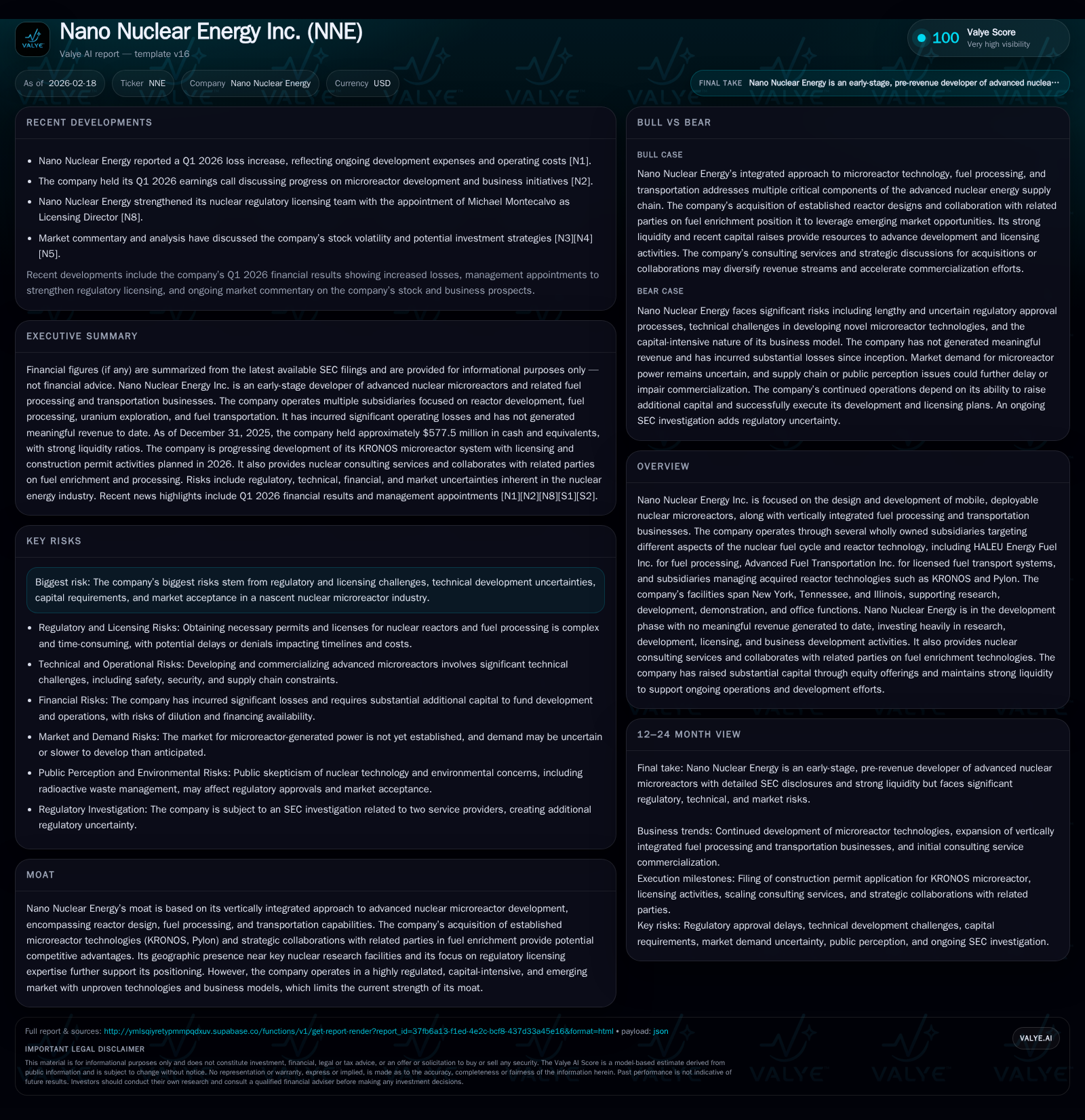
Founded in 2022, Nano Nuclear Energy (NNE) focuses on the design, development, and commercialization of nuclear microreactors alongside vertically integrated fuel processing and transport capabilities. The company has rapidly expanded its workforce and infrastructure, acquiring key technologies like KRONOS and Pylon, yet remains at a pre-revenue stage, incurring deep losses driven by R&D and licensing efforts. Significant capital expenditures and the highly regulated nature of the nuclear industry pose ongoing risks. While Nano Nuclear’s integrated approach along with recent licensing expertise hires potentially bolster its moat, uncertain regulatory outcomes, legal challenges, and the nascent market environment constrain near-term growth visibility.
Company Overview
Nano Nuclear Energy Inc. (NNE), established in February 2022, targets an ambitious role in the nascent advanced nuclear energy sector by developing modular mobile nuclear microreactors alongside a vertically integrated suite of fuel cycle services. The firm operates multiple subsidiaries specializing respectively in fuel processing (HALEU Energy Fuel Inc.), licensed fuel transportation (Advanced Fuel Transportation Inc.), and reactor technology acquisitions such as KRONOS and Pylon. Its facilities span New York City headquarters to research hubs near Oak Ridge National Laboratory in Tennessee — a strategic placement for leveraging existing government nuclear expertise [S1].
Though technologically promising, NNE remains development-stage with no commercial revenue to date. The company is investing heavily in R&D, licensing efforts, regulatory engagement, and business development aimed at eventual commercialization of its products [S1].
Historical Financial Performance
Since inception, Nano Nuclear has accumulated substantial operating losses attributable primarily to product development costs, technical testing, intellectual property acquisition, quality assurance procedures, and internal corporate infrastructure building.
Historical performance (annual)
| FY | Net ($mm) | CFO ($mm) | Capex ($mm) | Net YoY |
|---|---|---|---|---|
| 2025 | -40 | -20 | 8 | -294.7% |
| 2024 | -10 | -8 | 2 |
Note: Omitted columns lack sufficient annual XBRL coverage in the provided tags (need ≥2 annual points): Rev, OpInc, Div, Buybacks. Source: SEC companyfacts cache [F1].
Capital returns and efficiency (annual)
| FY | FCF ($mm) | ROE% |
|---|---|---|
| 2025 | -28 | -18.0 |
| 2024 | -10 | -32.1 |
Source: SEC companyfacts cache [F1].
Note: Revenue data not available; no reported dividends or buybacks.
Losses sharply increased nearly threefold from fiscal year 2024 to 2025 reflecting expansion of R&D activities and operational scale-up ([F1]). Cash flows from operations remain negative with a worsening trend indicative of substantial spending ahead of commercialization milestones. Capital expenditure quadrupled driven by facility acquisition/expansion including a $1.7 million land purchase at Oak Ridge for its Nuclear Technology Branch — located proximate to national labs — enhancing development capacity [S1],[F1].
Equity grew impressively from $31.6 million to $222.6 million largely due to significant equity financing activity supporting strategic ambitions [F1]. Current ratio of approximately 134 evidences strong liquidity vs current liabilities at year-end but masks the underlying cash burn rate.
Future Growth Prospects
NNE’s growth prospects hinge strongly on securing regulatory approvals while advancing demonstration projects for its microreactors underpinned by complementary developments in high-assay low-enriched uranium (HALEU) fuel processing capacity facilitated through partnerships with LIS Technologies Inc., a related party specializing in uranium enrichment [S1],[N8].
Planned expenditures around $65 million next year focus intensively on:
- Reactor R&D: ~$43 million targeting design validation, testing phases, licensing activities,[S1]
- Fuel processing facilities: ~$12 million joint ventures advancing proprietary processes alongside LIS Technologies,[S1]
- Additional operational expenses: ~$10 million sustaining corporate functions essential for project momentum[S1]
The vertically integrated strategy covering reactor hardware through fuel manufacturing to licensed transportation intends to minimize external dependencies that typically slow deployment schedules in nuclear sectors .
However, this complex integration also introduces notable operational risk and capital intensity compared with single-focus peers.
Forecasts / Milestones / What to Watch For
Explicit guidance on commercialization timelines remains limited in disclosed materials as NNE prioritizes technology maturation and regulatory alignment before revenues commence[S1]. Key developments to monitor include:
- Progress toward NRC (Nuclear Regulatory Commission) licensing milestones including initial design certifications[N8]
- Demonstration reactor performance results from subsidiary KRONOS or Pylon technologies
- Strategic partnerships or off-take agreements signaling market acceptance or financing support
- Outcomes related to exploration grants or governmental funding applications potentially subsidizing capital needs[S26]
- Regulatory investigations outcomes especially regarding recent SEC subpoenas relating to service providers that could affect governance perceptions[S9]
Given the complexity of licensing new nuclear technologies internationally alongside typical multi-year approval cycles impacting vendors' project lifecycles in this industry context (analysis), investors should view progress updates critically for tangible advancement toward commercialization.
Returns / Capital Allocation
With no revenue generation so far, return metrics such as ROE remain negative; calculated ROE approximates –18% based on last annual net income relative to equity at September 2025[F1]. Cash flow analysis reveals ongoing negative free cash flow approaching -$28 million annually once capital expenditures are considered[F1], underpinning the extensive investment phase.
Nano Nuclear has not declared dividends nor initiated share repurchase programs since inception[S23],[F1], consistent with early-stage growth companies prioritizing innovation expenditures.
Equity financing has been aggressively employed throughout FY2025 elevating shareholder’s equity primarily through stock issuances in public markets strategically timed with private placements[S26],[F1]. These fundraises reflect both capitalization needs due to operational burn rates and judiciously building financial runway amid challenging macroeconomic conditions.
Strategic Positioning & Moat Analysis
Nano Nuclear’s core moat is grounded in its extensive vertical integration across critical segments—microreactor core design/engineering coupled with proprietary fuel cycle capabilities such as HALEU processing plus licensable transport infrastructure—rendering it less exposed to supply chain bottlenecks common in conventional nuclear sectors[S1].
Its geographic presence adjacent to major federal nuclear research hubs imparts direct access to top-tier scientific talent pools enhancing innovation velocity[S1]. Recent strategic hires strengthening regulatory licensing expertise exemplify management’s focus on institutionalizing compliance proficiency needed to navigate intricate governmental approval pathways[N8].
Conversely, dependence on unproven technologies paired with industry complexities—regulation stringency combined with lengthy certification—constitutes sizeable impediments diluting moat defensibility until commercial operations scale adequately.
Risks & Challenges
Nano Nuclear operates under material risk conditions typical for innovative advanced nuclear firms:
- Prolonged regulatory delays or failure obtaining requisite licenses could stall progress indefinitely[S4],[S7][N8]
- Ongoing litigation envelops company management stemming from shareholder derivative suits and class action claims tied to disclosures about developmental progress generating financial uncertainties[S15],[S16],[S10]
- Uncertainties surrounding government investigations including SEC subpoena actions introduce governance risk flags[S9]
- Market acceptance hurdles persist given volatility inherent in nascent nuclear microreactor demand environments coupled with potential competing technologies[S4]
- Execution risks related to integration of acquired technology platforms (KRONOS/Pylon) may impact timely product delivery[S25]
- Funding risk remains significant despite healthy cash reserves given forecasted multi-year negative cash flow until scalable commercial operations materialize[F1],[S18]
- Intellectual property enforcement globally poses challenges given international variance in patent protection mechanisms potentially weakening competitive positioning[S16],[S17]
Industry Context (Analysis)
The advanced nuclear sector is galvanized by increasing global emphasis on carbon-neutral energy solutions offering stable baseload power complementary to renewables. Microreactors promise enhanced deployment flexibility through compact modularity enabling applications ranging from remote industrial sites to military installations. However regulatory frameworks remain fragmented internationally slowing universal adoption while technical hurdles around safety standards continue evolving.
Moreover, specialized supply chains for HALEU fuel — considerably higher enriched than traditional LWR fuels — are just becoming established with limited capacity creating bottlenecks. The vertically integrated approach attempts preemptive supply control mitigating these constraints but executes high capital burdens unlike conventional utilities.
Conclusion
Nano Nuclear Energy Inc.’s vision for ushering mobile nuclear microreactors into commercial viability is compelling strategically yet fraught with developmental complexity inherent in early-stage innovative nuclear firms. Its considerable investments into research capabilities, technology stacking via acquisitions, fuel infrastructure integration, and bolstered regulatory know-how collectively position it uniquely in the unfolding advanced nuclear ecosystem.
However substantial hurdles remain: extended negative earnings track record underscored by escalating R&D spend demands patient investor capital; regulatory compliance risks necessitate deft navigation; ongoing litigations could distract resources; and market acceptance timelines remain uncertain amidst competing energy vectors.
Tracking progress against key technical milestones coupled with clarity around definitive NRC certification will provide critical signals regarding Nano Nuclear’s ability ultimately to transition from pre-revenue innovator into a commercial-scale energy provider.
This analysis is based solely on publicly available information as of February 18, 2026. It intends solely to inform about company fundamentals and sector context without offering investment advice or recommendations.
Disclaimer: This is research-only, informational analysis and not investment advice. It may include AI-generated interpretation and general industry context. Always verify important details using primary sources.

Comments