
West Pharmaceutical’s Steady Innovation Amid Regulatory and Supply Challenges
West Pharmaceutical Services advances integrated injectable drug delivery systems, balancing steady growth with complex regulatory and supply chain hurdles.
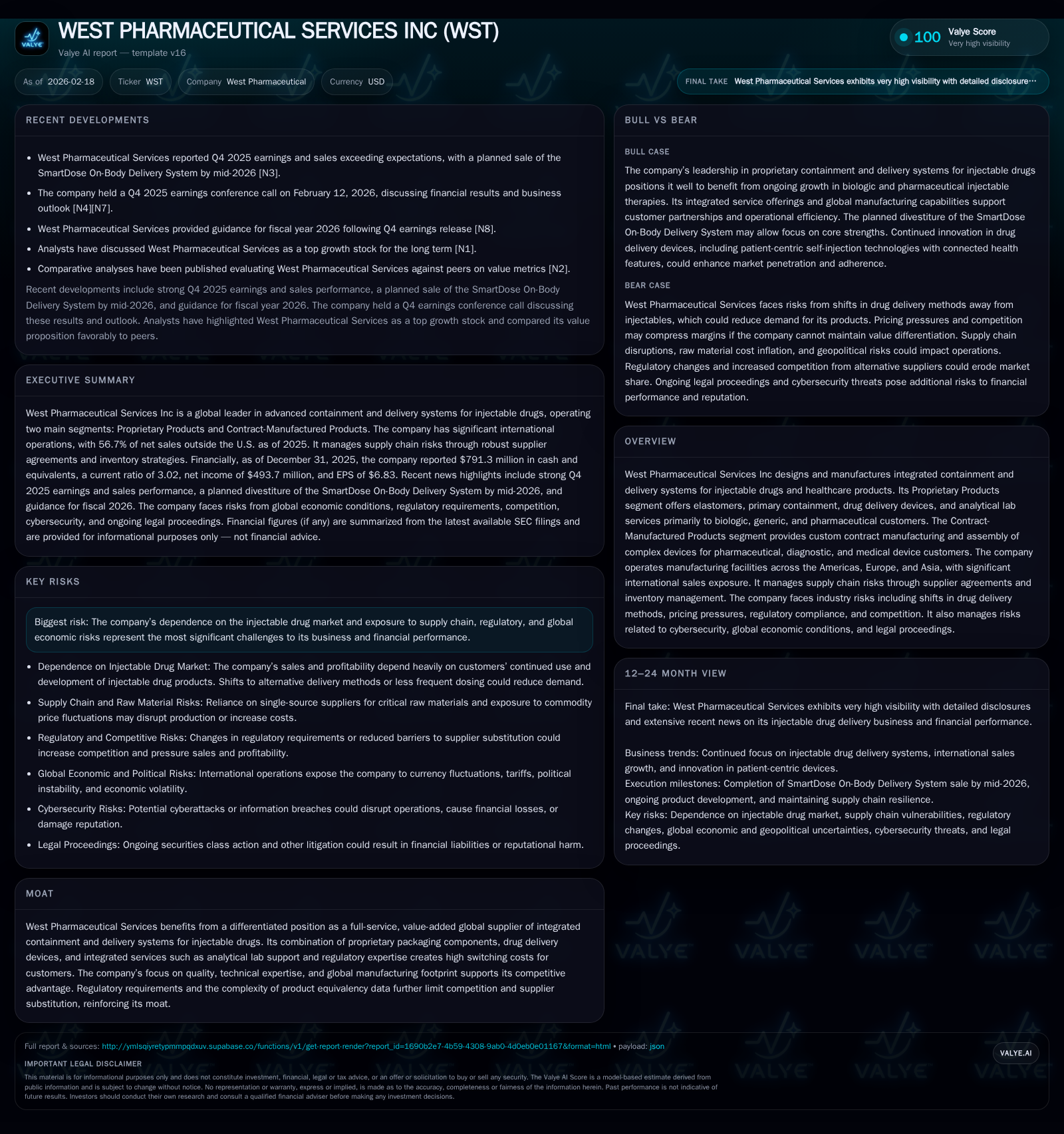
West Pharmaceutical Services Inc. (WST) has demonstrated resilient, moderate revenue and earnings growth over recent years, supported by its proprietary products and contract manufacturing segments focused on injectable drug delivery. The company leverages a differentiated integrated containment and delivery platform that benefits from high switching costs driven by regulatory complexity and strong technical expertise. However, challenges include inflationary raw material costs, regulatory approval timelines, and competitive pressures. Capital allocation reflects a cautious approach with steady dividends, reduced share buybacks, and moderated capital expenditures. Key upcoming milestones such as the mid-2026 SmartDose divestiture and evolving regulatory landscapes warrant close observation for their impact on operational focus and growth trajectories.
Growth Snapshot: Revenue and Profit Trends Over Recent Years
West Pharmaceutical Services experienced robust revenue growth from FY2019 ($1.84 billion) through FY2022 ($2.89 billion) [F1]. Growth moderated thereafter with approximately 2% revenue increase year-over-year into 2024-25. Operating income peaked at $734 million in FY2022 but declined before rebounding slightly to $585 million in FY2025 (+2.6% YoY). Net income stabilized around $494 million in FY2025 (+0.2%) [F1].
Strong operating cash flow generation—$755 million in FY2025 representing a 15.5% increase YoY—supports internal funding for capital needs alongside shareholder returns [F1]. Capital expenditures decreased sharply by over 24% in FY2025 compared to prior year levels, indicating a phase focusing on efficiency or consolidation [F1].
Historical performance (annual)
| FY | Net ($mm) | CFO ($mm) | OpInc ($mm) | Capex ($mm) | Net YoY |
|---|---|---|---|---|---|
| 2025 | 494 | 755 | 585 | 286 | +0.2% |
| 2024 | 493 | 653 | 570 | 377 | -17.0% |
| 2023 | 593 | 777 | 676 | 362 | +1.3% |
| 2022 | 586 | 724 | 734 | 285 |
Note: Omitted columns lack sufficient annual XBRL coverage in the provided tags (need ≥2 annual points): Rev. Source: SEC companyfacts cache [F1].
Capital returns and efficiency (annual)
| FY | Div ($mm) | Buybacks ($mm) | FCF ($mm) |
|---|---|---|---|
| 2025 | 61 | 134 | 469 |
| 2024 | 59 | 561 | 276 |
| 2023 | 57 | 438 | 415 |
| 2022 | 54 | 203 | 439 |
Source: SEC companyfacts cache [F1].
*Note: Latest specific quarterly revenue available for Q1-2024 only at $695M [F1]. **YoY estimated based on latest trends.
Drivers Behind Recent Performance
West’s Proprietary Products segment is the core growth driver, offering elastomers, containment systems, injection device components, self-injection technologies, and integrated lab services primarily serving biologic and generic pharmaceutical companies [S4][S24]. Innovation in synthetic elastomers tailored for drug compatibility alongside connected drug administration devices supports margin expansion via higher-value product mixes (HVP momentum) [N9][N11].
With manufacturing facilities across Americas, Europe, and Asia, international sales constitute approximately 56.7% of net sales as of fiscal year-end 2025 [S4], providing geographic diversification that cushions against region-specific risks.
Collaborations with leading biologics manufacturers deepen customer relationships through integrated pre-market support such as regulatory guidance and stability testing beyond simple supplier roles [N2][S24], raising switching costs and enabling premium pricing despite pricing pressures.
Navigating Regulatory Complexities
West operates under stringent regulation from FDA (U.S.), European Medicines Agency (Europe), and other authorities governing medical device safety and pharmaceutical packaging compliance [S5][S6][S7]. Regulatory approval requires extensive equivalency data validating that alternative components do not compromise drug safety or efficacy.
Multi-year approvals especially via FDA’s PMA or Biologics License Application processes can delay product launches significantly [S6], reinforcing West’s moat by limiting supplier substitution due to costly requalification hurdles.
Changes relaxing equivalency data requirements could alter competitive dynamics by easing entry for lower-cost competitors [S6], making regulatory monitoring critical.
Growth Opportunities Within Integrated Delivery Systems
Increasing patient-centric drug administration drives opportunities for West’s portfolio expansion into self-injection devices combined with connected health platforms improving adherence through digital monitoring [S22][N11].
Smart technologies embedded alongside elastomeric containment create differentiation aligned with convenience trends outside clinical settings—important amid biologic treatments requiring frequent injections like GLP-1 agonists [S24].
West's comprehensive offering—from polymer containers mitigating glass incompatibility to advanced reconstitution systems—positions it well amid formulation innovations emphasizing cold chain stability and safety enhancements [S24]. Analytical lab services further accelerate market entry via rigorous compatibility testing.
Industry Headwinds: Pricing Pressure, Supply Chain Risks & Competition
Raw material inflation affects elastomers, plastics, aluminum critical to manufacturing inputs [S4][S25]. West manages these risks via robust supplier contracts complemented by elevated inventory levels using critical material planning aimed at supply continuity despite single-source dependencies [S4][S19].
Supply chain volatility remains an operational threat exacerbated by geopolitical tensions impacting trade flows despite mitigation efforts including multiple global manufacturing sites [S19][S21].
Pharmaceutical consolidation intensifies pricing pressure; while West’s technical services partially insulate against commoditization risks, regulatory easing could heighten competitive threats by facilitating supplier switching [S18][S25].
Capital Deployment: Dividends, Buybacks & Investment Levels
Capital allocation shows discipline:
- Dividends increased steadily from $54M in FY2022 to ~$61M in FY2025 reflecting stable shareholder returns.
- Share repurchases rose through FY2023 ($438M) but dropped sharply to $134M in FY2025 signaling caution amid uncertainties or strategic shifts.
- Capital expenditures contracted by over 24% to ~$286M in FY2025 after prior heavier investments suggesting focus on optimization rather than expansion [F1].
This yields an estimated free cash flow near $469M (operating cash flow minus capex), supporting reinvestment capacity alongside capital returns without excessive leverage [F1].
Financial Health & Return Metrics
Balance sheet highlights:
- Cash & equivalents stand strong at ~$791 million at fiscal year-end.
- Current assets exceed current liabilities roughly threefold (current ratio ~3.0), indicating liquidity resilience.
- Stockholders’ equity increased moderately reaching ~$3.18 billion by FY2025.
- Approximate return on equity is about 15.5%, demonstrating efficient capital utilization within industry norms [F1].
Consistent operating cash flow funds capex while preserving liquidity buffers—a key advantage given cyclical demand exposure.
Key Upcoming Catalysts & Risks to Monitor
Significant near-term catalysts include the planned divestiture of the SmartDose business projected for mid-2026 announced alongside Q4 earnings release [N1][S3], potentially reshaping portfolio focus towards core containment products.
Ongoing legal exposures include a securities class action lawsuit filed in mid-2025; management disputes claims vigorously but unfavorable outcomes could impose costs or distract leadership [S9].
Regulatory landscape shifts remain pivotal; changes affecting equivalency data requirements could either strengthen moat sustainability or raise competitive pressures depending on enforcement rigor across jurisdictions [S6][S7].
Macroeconomic factors such as persistent inflation impacting raw materials also merit attention alongside geopolitical risks given WST’s sizable international revenues (~57%) exposing it to currency fluctuations and trade policy uncertainty [S4][S17].
Monitoring execution against innovation pipelines—especially patient-focused delivery devices integrating digital health—is critical as WST navigates evolving pharmaceutical formulations including oral alternatives like oral GLP-1s which pose structural demand challenges [S20].
Disclaimer: This analysis is based solely on publicly available SEC filings ([S#]), news releases ([N#]), and company financial facts ([F1]). It does not constitute investment advice or recommendations regarding any securities.
Disclaimer: This is research-only, informational analysis and not investment advice. It may include AI-generated interpretation and general industry context. Always verify important details using primary sources.

Comments