
Bausch + Lomb’s Growth and Profitability Constrained by Debt and Heavy Capital Expenditure
The company shows solid revenue gains but operates under significant financial and operational pressures.
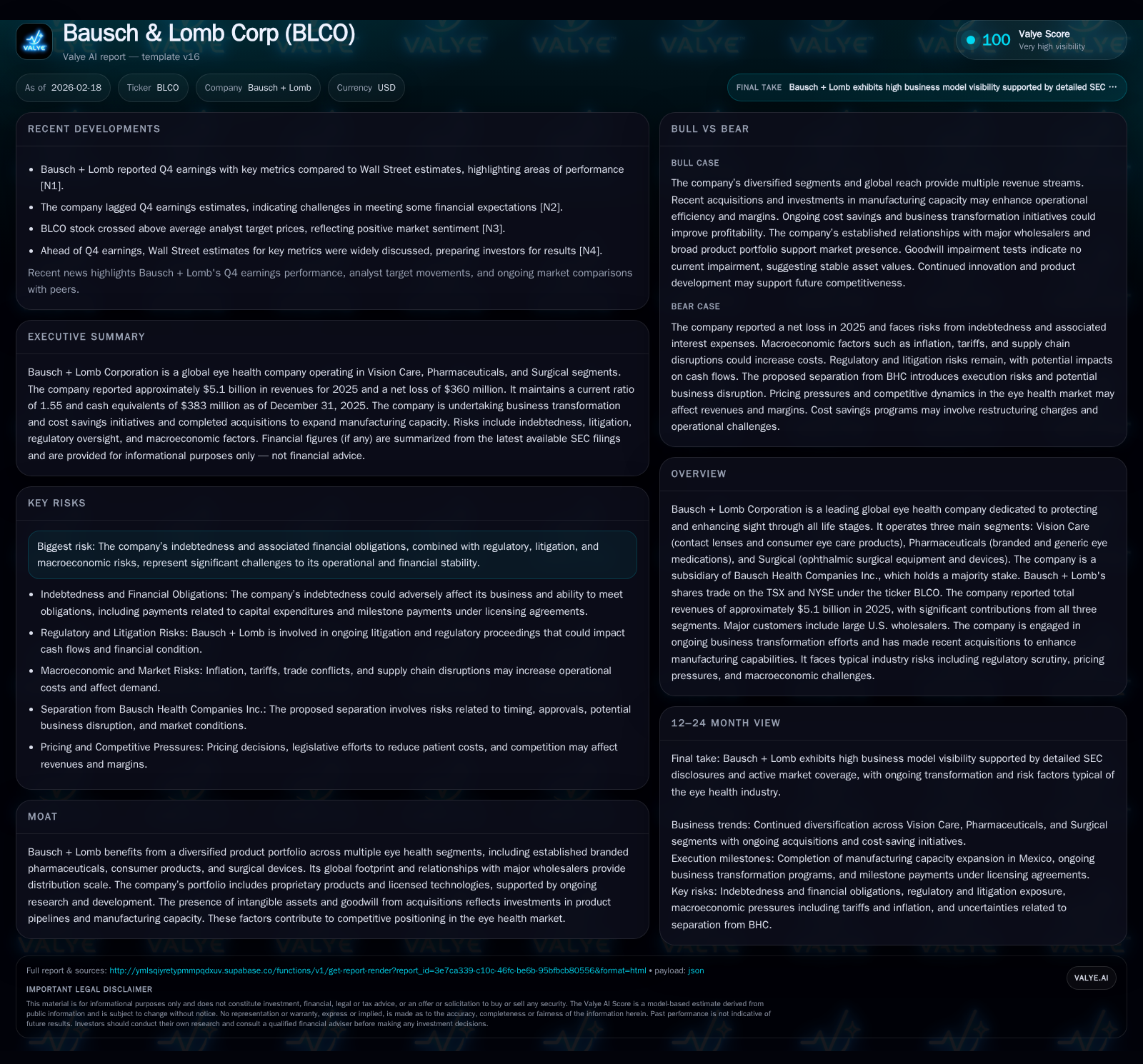
Bausch + Lomb Corp reported steady top-line growth driven by diversified segments of vision care, pharmaceuticals, and surgical products, reaching approximately $5.1 billion in 2025 revenues. However, profitability remains pressured with a net loss of $360 million in 2025 amid rising operating expenses and elevated capital expenditures totaling $349 million. The firm’s substantial indebtedness and ongoing business transformation efforts also weigh on cash flow generation and operational flexibility. Looking ahead, Bausch + Lomb plans targeted investments to boost manufacturing capacity and product innovation but faces risks from regulatory scrutiny, pricing pressures, and litigation.
Overview of Bausch + Lomb’s Business Segments and Market Position
Bausch + Lomb Corporation stands as a prominent global player in eye health, delivering products across three main segments: Vision Care (contact lenses and consumer eye health products), Pharmaceuticals (branded/generic eye medications), and Surgical (ophthalmic surgical instruments/devices). This diversified portfolio is bolstered by strong distributor relationships with major wholesalers like McKesson Corporation and Cardinal Health, which together accounted for about 20% of revenue in the U.S. market in 2025 [S4]. The company operates globally with sizable revenue contributions from North America (~50%), Europe, Asia including China and Japan, as well as emerging markets such as Russia and Poland.
Historical Financial Performance
Bausch + Lomb has demonstrated appreciable revenue growth over recent years—total revenues expanded from approximately $4.15 billion in 2023 to about $5.1 billion in 2025 [S4]. This roughly translates into a compound annual growth rate near the mid-single digits. The growth drivers stem from a combination of new product introductions within their pharmaceutical segment, expansion of contact lens offerings under Vision Care, and solid demand for surgical devices.
Despite expanding top-line metrics, profitability has been challenged. Operating income fell from $207 million in 2022 to $113 million in 2025—a decline of more than 45% over three years [F1]. This deterioration accelerated in fiscal year 2025 alone where operating income dropped nearly 30% year-over-year [F1]. Corporate disclosures identify that business transformation costs including restructuring initiatives raised SG&A expenses materially [S1][S2]. Furthermore, the company's operating environment includes ongoing pricing pressures especially in generic pharmaceuticals.
Net income followed a similar downtrend trajectory moving from a modest $6 million profit in 2022 to losses of $360 million in 2025 [F1]. Nevertheless, operating cash flow showed recovery with a positive trend from negative $17 million in 2023 to $283 million in 2025—reflecting better working capital management [F1]. Concomitantly, capital expenditures increased sharply to $349 million by the end of 2025 as the company invested significantly into expanding production capabilities including commissioning new facilities abroad [S2][F1].
Historical performance (annual)
| FY | Net ($mm) | CFO ($mm) | OpInc ($mm) | Capex ($mm) | Net YoY |
|---|---|---|---|---|---|
| 2025 | -360 | 283 | 113 | 349 | -13.6% |
| 2024 | -317 | 232 | 162 | 291 | -21.9% |
| 2023 | -260 | -17 | 130 | 181 | -4433.3% |
| 2022 | 6 | 345 | 207 | 175 |
Note: Omitted columns lack sufficient annual XBRL coverage in the provided tags (need ≥2 annual points): Rev, Div, Buybacks. Source: SEC companyfacts cache [F1].
Capital returns and efficiency (annual)
| FY | FCF ($mm) | ROE% |
|---|---|---|
| 2025 | -66 | -5.6 |
| 2024 | -59 | -4.9 |
| 2023 | -198 | -3.8 |
| 2022 | 170 | 0.1 |
Source: SEC companyfacts cache [F1].
Note: Revenue data not available from provided tags; Net income YoY % computed for available years.
Capital Structure and Liquidity Position
One critical constraint on Bausch + Lomb's financial flexibility is its elevated indebtedness position—total long-term debt obligations stood at approximately $5 billion with maturities extending predominantly beyond five years post-refinancing efforts [S5][S6][S17]. The weighted average interest rate on outstanding debt was around 7.7% as of December 31, 2025 [S5], reflective of legacy financing arrangements involving term loan facilities maturing mostly between 2028-2031.
In early January 2026 the company announced refinancing transactions that extended term loan maturities through January 2031 while reducing interest margins slightly [S5][S17], signifying proactive management of leverage risk. Nonetheless compliance with financial covenants will remain essential given covenant thresholds linked to leverage ratios defined under their credit agreements [S6]. On the liquidity front, Bausch + Lomb maintained $383 million in cash equivalents alongside ample revolver availability ($664 million) as of end-2025 [F1][S17]. However current liabilities were significant at nearly $2 billion against current assets near $3 billion yielding a current ratio of roughly 1.55 [F1], indicating moderate short-term buffer.
Strategic Investments & Business Transformations
Capital expenditure activity has accelerated notably reflecting aggressive manufacturing capacity expansion efforts including acquisition of new asset leases for production facilities located in Mexico expected to enhance supply chain resilience [S2][S1]. Planned capex through the year is targeted at approximately $285 million mainly directed toward property plant & equipment investments vital for scaling ophthalmic surgical device production capabilities and supporting pipeline product commercializations.
The company also disclosed extensive business transformation initiatives involving organizational restructuring designed to boost operational efficiency via potential headcount reductions, elimination of redundant operations, real estate rationalization programs, and contribution margin improvement drives [S1][S2]. These initiatives generated "Business Transformation Costs" recorded largely within SG&A expenses impacting margins currently but targeting longer-term cost savings.
Notably under a December 2019 license agreement with Novaliq GmbH the company is required to make future sales-based milestone payments related to MIEBO® technology; a milestone payment accrual of $35 million was recognized as of September 30, 2025 expected to be paid during Q1 2026 [S1][S2]. Additionally the company entered an agreement in late September 2025 to acquire manufacturing equipment/assets including lease assumption for a facility in Mexico with closing anticipated between Q4 2025 and Q1 2026 pending regulatory approvals accompanied by an upfront payment around $75 million [S2].
Legal Risks & Regulatory Environment
As customary for multinational pharmaceutical firms operating under heavy regulation Bausch + Lomb faces ongoing litigation risks stemming from product liability claims related predominantly to previously acquired consumer products such as Shower to Shower® powders [S10][S20]. While indemnity agreements with former owners mitigate much direct exposure costs remain possible albeit currently minimal loss contingency accruals are reported (around $8 million) [S13]. Regulatory audits by FDA equivalents globally remain standard operational risk factors impacting approval timelines or incurring compliance costs.
Separately the company exited multinational generic anti-trust litigation consolidation but retains exposure linked indirectly via affiliates within parent Bausch Health Companies Inc.'s ongoing legal landscape [S14], underscoring persistent industry-wide pressures around pricing practices.
Future Growth Prospects & Catalysts
Looking forward Bausch + Lomb’s growth engine is anchored on several key levers:
- Continued expansion of its pharmaceuticals pipeline leveraging proprietary molecules plus licensed technologies particularly for treating ocular conditions.
- Manufacturing capacity scale up through recently acquired Mexico facility assets enabling improved supply reliability amid global disruptions.
- Expected benefit from ongoing cost rationalization measures aimed at improving operating leverage over medium term horizons.
- Product lifecycle extension strategies supplemented by R&D investment targeting formulary exclusivity maintenance.
- Opportunities for additional bolt-on acquisitions supporting niche technologies or geographic penetration are plausible though not explicitly guided upon at this stage [N1][N3].
- Milestone payments associated with licensing agreements will continue as part of commercial arrangements requiring monitoring.
Monitoring milestones like commercial launch success rates for pipeline products along with realization timing on transformation-driven cost synergies will be paramount indicators guiding investor expectations around earnings inflection points.
Return Metrics & Capital Allocation Policy
While detailed dividend or share repurchase data is not provided within available disclosures or filings it is relevant that net negative profitability dynamics (-$360M net loss FY25) constrain free cash flow generation which was negative approx. -$66M after subtracting capex from operating cash flow last year [F1]. The return on equity metric correspondingly was negative approximately -5.6%, signaling net value destruction currently though this metric may improve subject to successful execution of strategic initiatives aimed at margin recovery.
Capital allocation focus during this period emphasizes deleveraging prudently through refinancing efforts combined with investing heavily into operational improvements rather than returning capital via dividends or buybacks while still maintaining sufficient liquidity buffers given an intensive capex program [S28][S6].
Sector-Native Contextual Analysis
The ophthalmic industry landscape reflects several typical structural characteristics influencing Bausch + Lomb’s operating environment:
- Pricing pressure due to increasing generic competition especially within branded pharmaceutical categories necessitates robust product differentiation supported by patent protections.
- Distribution concentration around large wholesale pharmacy chains creates dependency on negotiating terms favorable enough to preserve margin integrity —a factor apparent given two customers account for about one-fifth of revenue [S4].
- Manufacturing complexity related to sterile drug formulations and delicate medical device assembly demands continuous CAPEX investment as these elements drive regulatory compliance plus competitive quality standards.
- Rising emphasis on integrated digital diagnostics driver tools paired with therapeutic devices introduces pressures for technological upgrades affecting surgical segment capital expenditure intensity.
- Regulatory scrutiny continuously increases particularly within major jurisdictions (U.S., EU) influencing launch cadence timelines.
Conclusion: Balancing Growth Ambitions Against Structural Constraints
Bausch + Lomb Corp projects solid top-line momentum built upon its historically broad product lineup enhanced by acquisitions and capacity expansions; however it grapples with substantial headwinds stemming primarily from heavy debt loads coupled with profitability compression driven by elevated SG&A/operating costs tied partly to transformational restructuring efforts. This dynamic produces a delicate tradeoff balancing necessary reinvestment into production footprint expansion against sustaining manageable leverage levels while navigating multifaceted regulatory/legal risks intrinsic to pharmaceutical/medical device markets. Continued monitoring of cash flow trends relative to capital spending commitments plus tangible progress on margin recovery will be essential barometers informing how swiftly Bausch + Lomb can generate shareholder value going forward.
Disclaimer: This analysis is strictly informational based on publicly available documents ([F1], [N#], [S#]) as of February 18th, 2026. It is not investment advice or a recommendation regarding any securities or investment strategy. Investors should conduct their own due diligence before making any investment decisions.

Comments