
Porch Group's Rebound: From Operating Losses to Emerging Profitability in Home Services
Porch Group marks a notable financial turnaround in 2025 with rising operating income amid capital structure challenges.
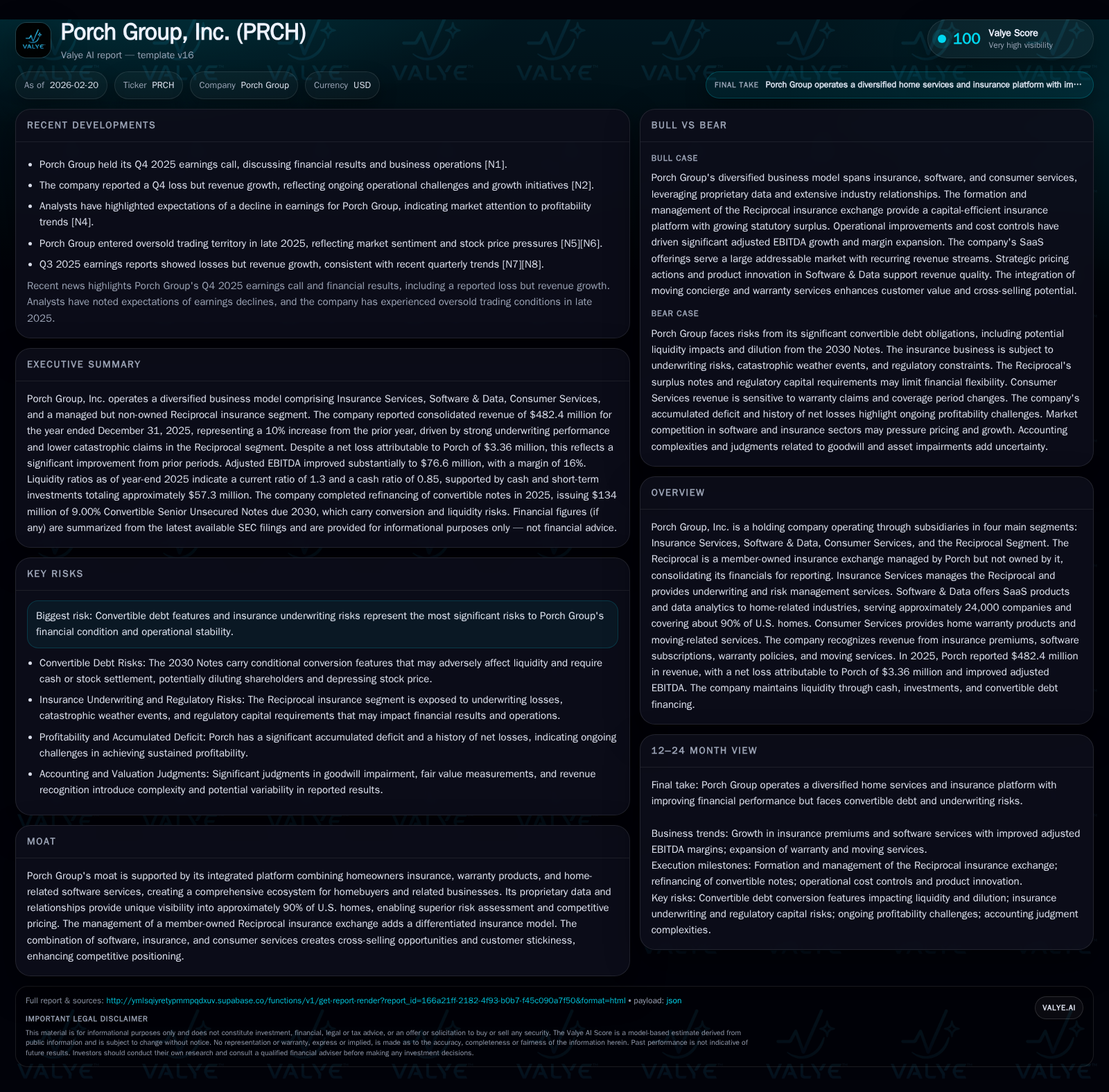
Porch Group, Inc. demonstrated significant improvement in its financial performance in 2025, shifting from heavy operating losses to positive operating income driven by growth in revenue and operational efficiencies across its insurance services, software, and consumer offerings. The company's unique Reciprocal insurance exchange model and its expansive SaaS platform supporting nearly 90% of U.S. homes underpin this progress. However, convertible debt complexities and underwriting risks continue to impose constraints on liquidity and shareholder returns. Operating cash flow surged, providing cushion for strategic investments, while capital allocation remains cautious with no dividend or buyback activity planned amid ongoing debt management.
Historic Growth and Financial Turnaround: Revenue Gains and Margin Expansion
Porch Group experienced a pronounced financial transformation in fiscal year 2025. Total revenues reached $482.4 million, up 10.2% from $437.8 million in 2024 [F1]. This top-line expansion was propelled by organic growth across the Insurance Services, Software & Data, and Consumer Services segments alongside consolidation effects from the newly formed Reciprocal insurance segment [S16]. Operating income saw a remarkable reversal from a loss of $64.6 million in 2024 to a positive operating profit of $36.6 million in 2025 reflecting both scale economies and improved operational efficiencies [F1][N1][S3]. While net income remained negative at -$3.36 million, it marked an almost 90% improvement year-over-year indicating narrowing losses as the operating base strengthens [F1]. These results underscore Porch’s success in leveraging its integrated business model combining insurance underwriting with technology-powered services.
Historical performance (annual)
| FY | Rev ($mm) | Net ($mm) | CFO ($mm) | OpInc ($mm) | Rev YoY | Net YoY |
|---|---|---|---|---|---|---|
| 2025 | 482 | -3 | 66 | 37 | +10.2% | +89.8% |
| 2024 | 438 | -33 | -32 | -65 | +75.5% | |
| 2023 | -134 | 34 | -190 | -277.6% | ||
| 2022 | -35 | -18 | -34 |
Note: Omitted columns lack sufficient annual XBRL coverage in the provided tags (need ≥2 annual points): Capex, Div. Source: SEC companyfacts cache [F1].
Capital returns and efficiency (annual)
| FY | Buybacks ($mm) | FCF ($mm) | ROE% |
|---|---|---|---|
| 2025 | 0 | 66 | 13.7 |
| 2024 | 0 | -32 | 75.9 |
| 2023 | 6 | 33 | 375.3 |
| 2022 | 2 | -20 | -44.7 |
Source: SEC companyfacts cache [F1].
Omitted columns: Buybacks, dividends due to no recent activity or insufficient data.
Insurance Reciprocal Model: A Differentiated Approach Driving Segment Performance
A core pillar in Porch's evolution is its management of the Reciprocal insurance exchange—a member-owned entity treated as a variable interest entity consolidated for reporting purposes [S1][S16]. This structure allows Porch to oversee underwriting, claims payments, risk monitoring, and capital management without direct ownership of the carriers involved [S16]. The Reciprocal holds statutory surplus north of $155 million contributing to regulatory compliance and capitalization adequacy [S23].
Porch derives fees from administrative services provided under this arrangement, segregating underwriting risks while capturing management revenues [S16]. This model contrasts traditional carrier ownership by transferring direct insurance liabilities to policyholders through surplus contributions embedded within revised net written premiums (RWP) metrics [S6]. Such structure provides flexibility in risk sharing while benefiting from policyholder surplus inflows—a critical factor ahead of introducing Porch’s proprietary insurance product [N1][S6]. However, underwriting volatility inherent in this model demands agile risk management and highly accurate actuarial assumptions.
Software & Data Segment: Market Penetration and SaaS Revenue Dynamics
Porch’s Software & Data segment offers a holistic suite of SaaS products coupled with proprietary home-related data analytics that service roughly 24,000 companies representing coverage over approximately 90% of U.S. residential properties [S1][N1]. This extensive data footprint—covering property records, transactions, valuations—and subscription licensing structures form a high-retention revenue base critical for cross-segment integration.
The SaaS adoption within this segment fosters robust recurring revenues insulated from typical cyclicality impacting insurance underwriting or consumer services [N1]. Its data-driven approach enhances risk assessment models used internally for the Reciprocal's underwriting as well as customer-facing offerings such as warranty pricing optimization [S1]. Steady retention rates contribute predictability while incremental new product launches may extend wallet share among home service providers.
Consumer Services: Supporting Cross-Selling in Warranty and Moving Related Offerings
Complementing Porch’s integrated platform is its Consumer Services segment delivering home warranty policies alongside moving-related offerings [S1]. These products bolster customer engagement post-home purchase creating recurring touchpoints augmenting customer lifetime value through ecosystem stickiness [N2][S16]. By bundling warranties with insurance products under one umbrella supported by technology-driven insights from the Software segment, Porch strengthens cross-selling efficiency.
This synergy is evidenced by growing warranty policy volumes contributing meaningfully to total revenue without materially diluting margins given fixed cost allocations already absorbed at scale [N2]. Marketing efficiencies emerging from bundled sales channels further improve overall unit economics supporting sustainable margin improvements.
Capital Structure Conundrum: Managing Convertible Debt and Liquidity Risks
Porch’s capital structure is dominated by three tranches of convertible senior notes totaling approximately $475 million principal amount outstanding at year-end 2025 including $7.8 million due in September 2026, $333 million senior secured notes due 2028, and $134 million unsecured notes due 2030 bearing an above-market coupon rate of 9% introduced via refinancing transactions during mid-2025 [S4][S5][S19].
The recent issuance of the 2030 Notes entailed complex conditional conversion features whereby holders may convert into shares subject to company settlement through cash or stock election options posing dilution potential as well as liquidity strain should conversions be settled partially or fully in cash [S2][N5]. Accounting treatments require potential reclassification of these convertible instruments as current liabilities contingent on market conditions further pressuring working capital metrics [S2].
Certain indenture provisions raise barriers for third-party takeovers through mandatory repurchase premiums triggered by fundamental events increasing acquisition costs beyond nominal par values [S2][S21]. While these measures secure financing continuity for Porch’s growth plan, they constrain flexibility absent refinancing or deleveraging strategies.
Operating Cash Flow and Free Cash Flow Strengthening Financial Flexibility
After years of operating cash flow deficits—including a negative outflow of nearly $31.7 million in fiscal year 2024—Porch achieved a substantial turnaround with net cash provided by operating activities rising sharply to $66.4 million in fiscal year 2025 [F1][S20]. Capital expenditures remained modest at $454 thousand reflecting disciplined spending focused primarily on software development enhancements rather than heavy infrastructure investment [F1].
This combination yielded free cash flow approximating $65.9 million (operating cash flow minus capex), offering meaningful liquidity support for ongoing reciprocal insurance reserves funding alongside convertible debt servicing requirements [F1]. Efficient working capital management alongside improving profitability drivers underpin this positive cash generation phase.
Outlook and Growth Catalysts: New Product Launches and Market Expansion
Looking forward, Porch has positioned itself around ecosystem expansion primarily anchored on launching its proprietary Porch Insurance product designed to align premium revenues more closely with full economic payments including required surplus contributions driving RWP higher per updated metric definitions effective late-2025 [N1][S6][N4]. This initiative could create differentiated underwriting economics amplifying revenue scale while deepening insurer-consumer direct relationships.
Additional growth vectors reside in further penetration within existing Software & Data licenses plus geographic rollout of Consumer Services offerings targeting warranty expansions paired with enhanced digital experiences integrating moving logistics seamlessly through mobile platforms [N1]. Nonetheless, any underwriting adverse loss trends within the Reciprocal could temper margin improvements while macroeconomic variables impacting housing activity modulate demand levels.
Key Metrics to Monitor: Conversion Features, Regulatory Risks, and Capital Allocation Plans
Investors should keenly monitor potential triggers activating conversion rights on the sizeable outstanding convertible notes set due mostly beyond five years yet with conditional pre-maturity conversion mechanics that influence equity dilution probabilities versus balance sheet leverage ratios soon after fiscal year-end closing dates [S2][S24]. Regulatory constraints notably limit dividend distributions from subsidiaries controlling insurers requiring Porch Group’s parent entity to rely heavily on intercompany dividends subject to state approval constraining free cash deployment externally including dividend or share repurchase programs which remain dormant through recent periods [F1][S24].
ROE measured approximately at +13.7% improving substantively but tempered by accounting adjustments related to legacy accumulated deficits nearing $648 million reflects ongoing efforts toward earnings normalization absent large impairment risks currently monitored closely via qualitative goodwill assessments conducted annually or upon triggering events per ASC guidance [F1][S10][S16][N5]. Cybersecurity governance led by specifically credentialed senior IT security leadership reflects organizational focus on mitigating non-financial operational risks increasingly relevant given the company’s reliance on digital infrastructure supporting both SaaS platforms and reciprocal insurance data integrity frameworks [S1].
This report synthesizes publicly available financial disclosures filed with the SEC alongside recent earnings call commentary without providing investment advice or price targets. The analyses herein reflect company-specific facts up to February 20, 2026; subsequent developments are beyond scope.
Disclaimer: This is research-only, informational analysis and not investment advice. It may include AI-generated interpretation and general industry context. Always verify important details using primary sources.

Comments