
How BBVA Balanced Geographic Diversity and Digital Transformation for Profit Gains
Analyzing BBVA’s 2025 earnings growth driven by multi-region loan expansion and digital client onboarding amid regulatory pressures.
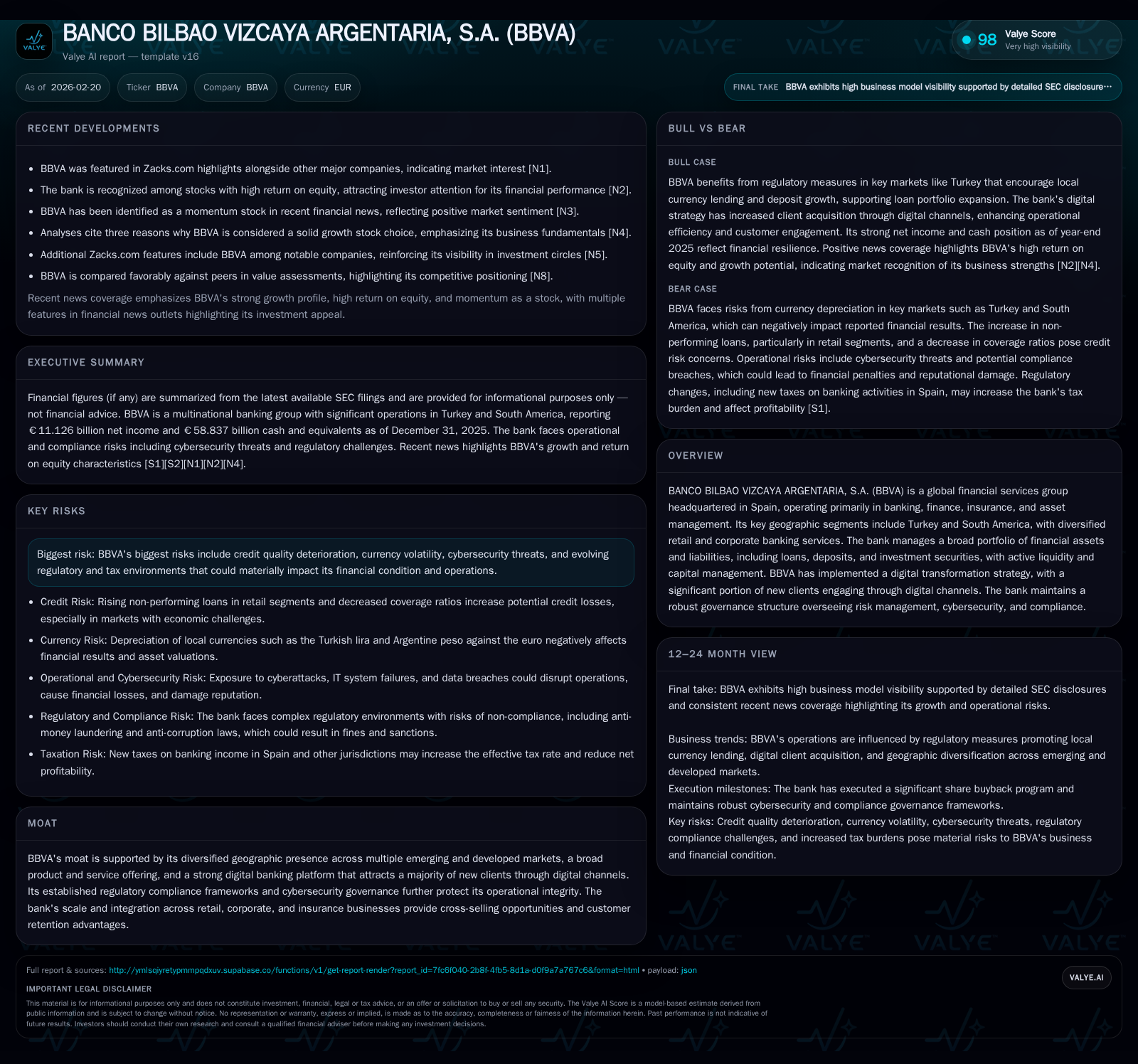
BBVA achieved steady net income growth in 2025, supported by strategic geographic diversification primarily in Turkey and South America. The bank’s accelerated digital transformation enabled a majority of new clients to engage through digital channels, enhancing operational efficiencies and cross-selling opportunities. Despite challenges from currency depreciation—particularly the Turkish lira—and regulatory headwinds including newly introduced Spain-specific financial transaction taxes, BBVA maintained robust capital allocation via dividends and progressive share buybacks, sustaining an approximate 18% return on equity. Future growth remains sensitive to credit quality trends and evolving tax frameworks.
Historical Growth Trajectory and Key Performance Drivers
BBVA's net income exhibited consistent upward momentum over the past four years. From €6.83 billion in FY2022, net income rose to €8.42 billion in FY2023 (+23%), followed by an increase to €10.58 billion in FY2024 (+25.6%), culminating in €11.13 billion in FY2025 (+5.2%) [F1]. This deceleration in growth rate during 2025 reflects a maturation phase post-pandemic recovery combined with macroeconomic headwinds.
The earnings gains were underpinned notably by strong loan portfolio expansion, particularly within its Turkish segment where consumer and wholesale loans denominated in Turkish lira increased by double digits [S5][S7]. This was encouraged by regulatory easing such as the reduction of loan reserve requirements by Turkish authorities aiming to stimulate domestic currency lending. However, efforts to grow the loan book had to balance deteriorating asset quality metrics amid rising interest rates outpacing inflation in Turkey, which pressured retail customer repayment capacity [S5].
Currency depreciation—primarily the Turkish lira weakening against the euro—tempered some translation gains outside local reporting currency results but was partially offset through strategic foreign currency exposure management including increased holdings in local currency debt securities [S7][S15]. The interplay between deposit accumulation trends and credit gaps (where loans grew faster than deposits) also shaped liquidity dynamics within these regions [S7].
Historical performance (annual)
| FY | Net ($bn) | Net YoY |
|---|---|---|
| 2025 | 11.1 | +5.2% |
| 2024 | 10.6 | +25.7% |
| 2023 | 8.4 | +23.3% |
| 2022 | 6.8 |
Note: Omitted columns lack sufficient annual XBRL coverage in the provided tags (need ≥2 annual points): Rev, CFO, OpInc, Capex, Buybacks, FCF. Source: SEC companyfacts cache [F1].
Capital returns and efficiency (annual)
| FY | Div ($bn) | ROE% |
|---|---|---|
| 2025 | 4.5 | 18.0 |
| 2024 | 4.3 | 17.6 |
| 2023 | 3.1 | 15.2 |
| 2022 | 2.4 | 13.5 |
Source: SEC companyfacts cache [F1].
Note: Operating income, cash flow, capex unavailable from tags.
Geographic Segmentation: Performance in Turkey and South America
Turkey remains a critical growth engine for BBVA due to favorable regulatory shifts including lower reserve ratios incentivizing lending in the local currency [S5][S7][S15]. Consumer loans grew over 11%, supported also by policy measures aimed at dampening dollarization of deposits (e.g., withdrawal of FX deposit protection schemes), leading to a notable shift toward lira-denominated demand and term deposits [S15]. Despite these positives, non-performing loans increased moderately from 3.1% to approximately 3.9%, impacted largely by retail credit card and consumer defaults linked to tighter monetary conditions outstripping inflation [S5]. Coverage ratios declined accordingly due to an influx of newly classified Stage 3 assets.
In South America—a diverse segment comprising Argentina, Chile, Colombia, Peru, Uruguay, and Venezuela—the business faced substantial translation headwinds due to significant depreciations: Argentine peso fell roughly 37%, Peruvian sol -1%, while Colombian peso appreciated slightly by ~4% against the euro [S20]. Local operations showed resilience through improved mutual fund inflows (+45%), insurance business synergies, and selective corporate lending gains supported by macro stabilization initiatives [S12][S20]. Still, the overall euro-denominated financials reflected negative exchange effects dampening regional earnings contribution.
Sector analysis: Turkish segment loan/deposit dynamics illustrate classic credit gap behavior under monetary stimulus policies; whereas South America exhibits typical emerging market currency volatility risks impacting consolidated banking revenues.
Digital Transformation Impact on Client Acquisition and Operations
BBVA’s forward-looking strategy has emphasized extensive digital transformation with technology investments yielding material operational benefits. Approximately two-thirds (66%) of new client relationships initiated through digital channels demonstrate the success of platform modernization efforts [N4][N10]. This high digital adoption reduces branch-related costs while enabling richer data analytics for improved cross-selling across retail banking products, corporate finance offerings, insurance policies, and wealth management services.
Digital sales have become a key moat against competitors as they foster customer stickiness through integrated platforms delivering seamless user experiences across channels . Market observers note that this evolution supports future revenue expansion opportunities beyond traditional interest-earning assets via fee-based income sources enhanced through data-driven client insights [N4][N10].
Capital Allocation Strategy: Dividends, Buybacks, and Equity Management
BBVA has adopted an active capital deployment program congruent with regulatory compliance under ECB oversight to optimize shareholder returns while preserving solvency margins [S4][S8][S16]. The bank delivered dividends totaling €4.45 billion in FY2025, an increase from €4.26 billion the prior year reflecting stable payout policies aligned with profitable cash flows [F1].
Importantly, BBVA executed a substantial partial buyback under its recently announced framework program targeting up to €3.96 billion in total purchases aimed at share capital reduction through treasury stock cancellation [S4][S8][S16][N2]. As of mid-February 2026, nearly €1 billion had been deployed buying back approximately 70% of the first tranche authorized amount with ongoing execution expected through Q2-2026 [S2]. This approach improves per-share metrics including return on equity—estimated robustly at ~18% based on reported net income/equity—and reduces share count without diluting common shareholders [F1].
No explicit operating cash flow or free cash flow data available from tags; however, retained earnings contribute positively to equity growth along with prudent risk-weighted asset management balancing capital buffers.
Regulatory Environment and Emerging Tax Challenges
The evolving tax framework represents a growing expense component with significant implications for BBVA’s after-tax profitability [S1][S6][S10][S11]. Notably:
- Spain has imposed a minimum effective tax rate of 18% specifically calibrated for credit institutions beginning January 1, 2024.
- The EU Council Directive introducing a global minimum corporate tax rate of 15% applies to multinational financial groups like BBVA.
- New Spanish laws enact net interest margin plus commissions taxation (IMIC) ranging from 1% up to as high as 7%, targeting gross positive NII/comms above €100 million thresholds effective over three consecutive fiscal periods starting from January 2024.
- Proposals for financial transaction taxes (FTT) targeting securities acquisitions introduce further potential cost layers.
Such tax intensifications may erode net interest margin (NIM), curtail distributable earnings capacity over time unless compensated by business efficiency gains or pricing power adjustments [S1][S6][S10][S11].
Compliance risks extend beyond taxation into AML/KYC regulatory regimes complicated by global sanctions programs necessitating sophisticated monitoring amidst increased digitalization footprint [S1][S10].
Cybersecurity Governance and Operational Risk Oversight
Given BBVA’s broad digital footprint responsible for approximately two-thirds of new client engagements via digital channels , cybersecurity is rightly elevated within its risk framework hierarchy [S1][S22]. Oversight is centrally managed through a dedicated Technology and Cybersecurity Committee of the Board meeting bi-monthly to assess strategic risks.
This committee is directly fed information from the Chief Security Officer (CSO) who leads cross-functional teams including Corporate Security and Risk Control Areas performing continuous risk assessments aided by third-party audits employing recognized international certifications such as CISA, CISM, CRISC among others [S22]. Periodic incident simulation exercises promote readiness ensuring rapid incident response effectiveness.
Risk mitigation strategies include layered defenses safeguarding against evolving cyber threat vectors such as malware attacks compromising sensitive client data or denial-of-service disruptions affecting service availability—all critical given regulatory data protection obligations [S22].
Future Growth Outlook and Market Constraints
While BBVA does not provide explicit forward-year financial guidance within disclosed documents [N4][S1], several factors frame its near-term outlook:
- Credit quality remains watchworthy as inflationary pressures tighten consumer budgets particularly within Turkish demographics elevating non-performing stages affecting provisions requirements [S5].
- FX volatility risk persists notably through emerging market currencies impacting reported profits when denominated in euros.
- Regulatory tax burdens introduced recently could compress margins absent compensating business growth or operational leverage improvements [S1][S6].
- The ongoing digitalization momentum presents opportunities but also necessitates sustained investment absorbing fixed costs before realizing full scalability benefits.
Growth will likely balance between these tailwinds and constraints necessitating vigilant monitoring of macroeconomic conditions alongside internal risk management practices.
Valye Lenses: What to Monitor Going Forward
Investors and stakeholders should track several leading indicators informing BBVA's evolving trajectory:
- Completion status of successive buyback tranches under the framework program confirming capital allocation discipline.
- Evolution of Spanish IMIC tax impact as actual taxable bases crystallize alongside any changes in EU-wide minimum taxation standards.
- Trends in new client acquisition rates via digital channels evidencing continued platform adoption relative to traditional means.
- Developments in credit metrics across Turkey—such as non-performing loan ratios coverage—and South American portfolios reflecting local economic health.
- Geopolitical or monetary policy shifts impacting FX volatility notably relevant for Latin American exposures. These signals together will illuminate how effectively BBVA balances growth ambitions with emerging operational headwinds without speculative projections beyond verified disclosures.
Disclaimer: This report is for informational purposes only based on publicly available data up to February 20th, 2026 including SEC filings and reputable news sources cited herein; it does not constitute investment advice or recommendations.
Disclaimer: This is research-only, informational analysis and not investment advice. It may include AI-generated interpretation and general industry context. Always verify important details using primary sources.

Comments