
Maitong Sunshine Cultural Development: Revenue Growth Amid Operational and Liquidity Headwinds
MGSD’s rapid revenue acceleration contends with profitability challenges amid competitive pressures and constrained liquidity.
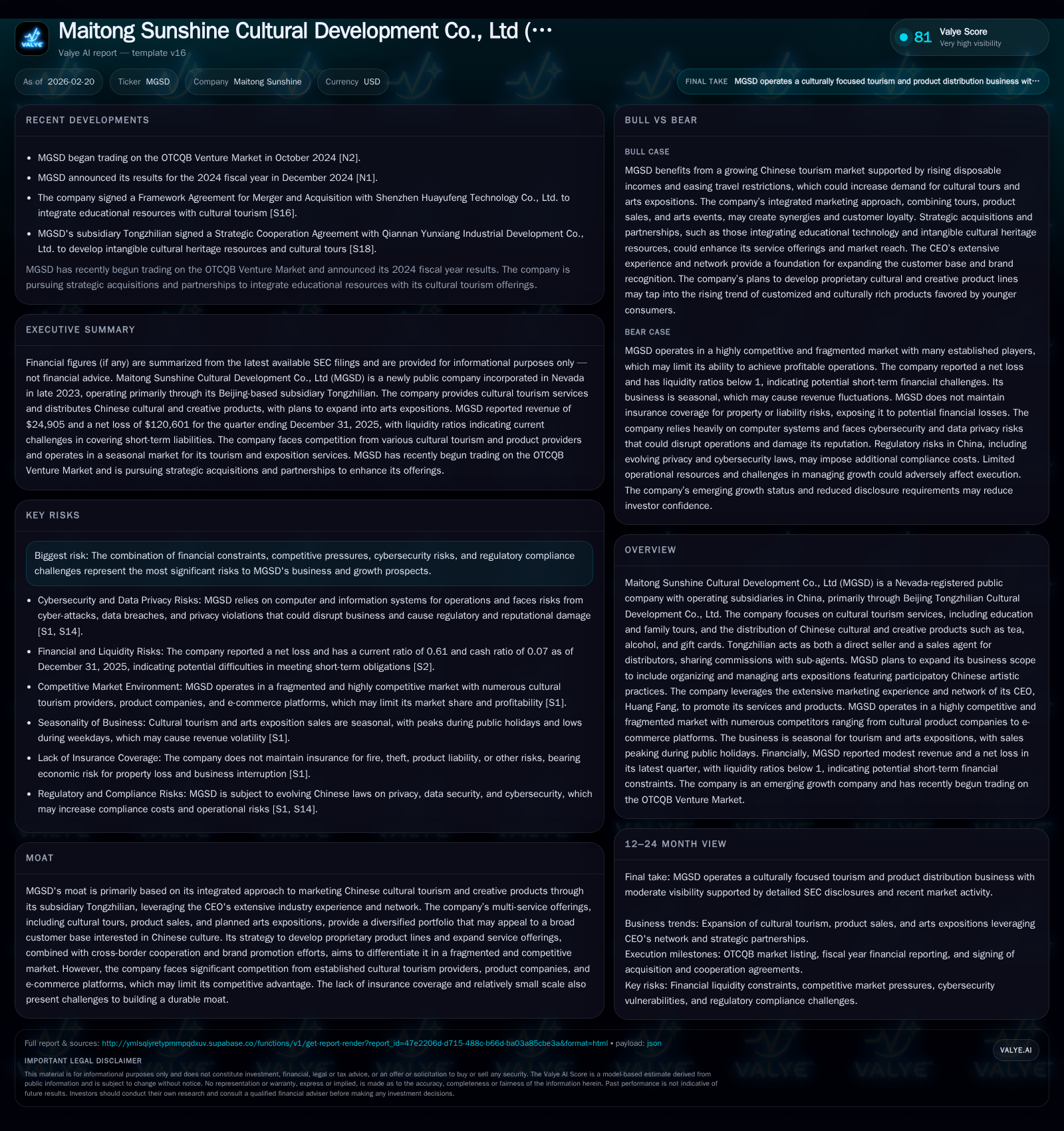
Maitong Sunshine Cultural Development Co., Ltd (MGSD) has demonstrated impressive revenue growth, expanding nearly 72% year-over-year from FY2024 to FY2025. This surge reflects its integrated cultural tourism and creative products business led by CEO Huang Fang’s industry network. However, despite operational scale gains, MGSD continues to face significant net losses and a stark deterioration in operating cash flows, underscoring persistent profitability and liquidity challenges. The company operates in a fragmented Chinese market with tight competition, regulatory complexities, and emerging cybersecurity risks that temper near-term expansion prospects.
Historic Growth Trajectory: Revenue Surge Coupled with Profitability Gaps
Maitong Sunshine Cultural Development Co., Ltd (MGSD) has exhibited robust topline momentum since its inception. Annual revenues advanced from $804.9k in FY2024 to $1.38 million in FY2025—a notable 71.5% growth rate indicative of scaling operations within Beijing-based Tongzhilian subsidiary [F1]. This expansion largely reflects MGSD's strategy of integrating cultural tourism services alongside the distribution of Chinese cultural products. Yet while operating income swung from a negative $22.9k in FY2024 to a positive $86.8k in FY2025—signaling improved cost management—the bottom line remained in the red with net losses standing at $21.2k versus $30.8k the prior year [F1].
The divergence between rising revenues and continued net losses highlights challenges intrinsic to the company’s early-stage growth phase during market competition and cost absorption dynamics.
A critical concern arises from operating cash flows which deteriorated dramatically from a positive $436.7k in FY2024 to a substantial negative $674.8k in FY2025, implying working capital strain or delayed collections undermining liquidity [F1]. Capital expenditures remained stable at approximately $3.7k across periods indicating limited investment spend but insufficient to offset negative free cash flow.
Historical performance (annual)
| FY | Rev ($) | Net ($) | CFO ($) | OpInc ($) | Rev YoY | Net YoY |
|---|---|---|---|---|---|---|
| 2025 | 1380218 | -21229 | -674758 | 86790 | +71.5% | +31.1% |
| 2024 | 804887 | -30810 | 436701 | -22953 |
Note: Omitted columns lack sufficient annual XBRL coverage in the provided tags (need ≥2 annual points): Capex, Div, Buybacks. Source: SEC companyfacts cache [F1].
Capital returns and efficiency (annual)
| FY | FCF ($) | ROE% |
|---|---|---|
| 2025 | -678482 | -46.4 |
| 2024 | 432977 | 397.6 |
Source: SEC companyfacts cache [F1].
Table note: Dividends and buybacks not available.
Business Model Nuances: Integrated Cultural Tourism and Creative Product Sales
MGSD's operations are centralized around Beijing Tongzhilian Cultural Development Co., Ltd., which orchestrates an integrated portfolio of offerings encompassing educational and family-oriented cultural tours alongside sales of Chinese cultural products such as tea, alcohol, and gift cards redeeming for items like seafood delicacies [S14]. Unlike more traditional travel companies focused solely on logistics or accommodations, MGSD embeds itself within the cultural enrichment value chain—curating tours that emphasize Chinese heritage via expert content design while relying on partner tour operators for ancillary services.
Furthermore, Tongzhilian engages multiple layers of sales agents via a hybrid direct selling and agency commission framework that distributes commissions across sub-agents—enabling broad market reach through grassroots reseller networks equipped with localized relationships cultivated by CEO Huang Fang's two decades-long experience and connections within Chinese cultural marketing sectors [S14].
Plans are underway to widen the scope toward arts expositions featuring participatory Chinese artistic practices such as calligraphy exhibitions coupled with interactive audience involvement, choir competitions, dance events, and variety shows cultivating immersive experiences appealing especially to youth audiences desirous of hands-on traditional art engagement [N#][S14].
This multi-service model aims not only at cross-selling but also at deepening client engagement across cultural touchpoints—a strategy fundamentally designed to differentiate amid fragmented competitors.
Competitive Dynamics and Market Differentiation Strategy
The competitive landscape is extensive and fragmented, ranging from established cultural tourism companies with strong franchise networks to diverse regional providers plus numerous localized independent service operators across almost every Chinese city [S3][S19]. Additionally, MGSD confronts competition from specialized distributors of Chinese cultural products as well as mainstream e-commerce platforms blending art retail with lifestyle merchandise.
MGSD seeks differentiation through the educational function embedded within its product lines that accentuate authentic cultural attributes combined with personalized customization—a relevant factor given the rising consumer appetite among China's middle class for culturally resonant goods that exhibit distinctive quality over mass-market alternatives [S14]. Moreover, leveraging proprietary product development with design firms coupled with strategic cross-border cooperation efforts aims to harness complementary expertise enhancing branding capabilities beyond domestic confines [S14].
Yet price remains a critical battleground given limited brand recognition relative to entrenched players; channel conflicts between agent-distributor frameworks further add complexity in margin management.
Operational and Financial Risks Including Cybersecurity and Regulatory Environment
MGSD operates amid significant operational risk exposures centering around its information systems infrastructure heavily reliant on internet connectivity for marketing coordination, customer data processing, agent management, and supplier communications [S1][S5]. The company discloses vulnerability to cyberattacks including social engineering scams targeting personnel as well as systemic breaches through third-party service providers who may have disparate security protocols potentially exposing sensitive data on customers or partners.
In the context of tightening PRC regulations spanning cybersecurity law frameworks effective since 2017 alongside subsequent globally impactful privacy statutes like the PRC Data Security Law (effective September 2021), MGSD must continuously adapt policies ensuring compliance to avoid penalties including operational suspensions or license revocations [S12][S15][S21]. Failure to adequately secure private information or lapses due to non-compliance can materially impair reputation directly tied to trustworthiness essential in cultural tourism sectors.
Further shadow risks arise due to jurisdictional uncertainties posing enforcement challenges for investors given geographic separation between MGSD’s U.S.-registered parent entity versus China-based operations under evolving regulatory scrutiny including publicly detailed Trial Administrative Measures concerning overseas listings filed with CSRC (China Securities Regulatory Commission) [S6][S7][S23][S26].
Liquidity Challenges and Capital Structure Analysis
Financially, MGSD presently faces strained liquidity highlighted by its current ratio of approximately 0.61 (current assets at $271.9k vs current liabilities of $445.2k as of end-September 2025), signaling potential difficulties meeting short-term obligations without additional capital infusion or operational cash flow improvements [F1]. Negative free cash flow approximates -$678k driven predominantly by operating cash outflows far exceeding minimal capex commitments underscoring working capital management pressures possibly due to inventory buildup or extended payables cycles.
Capitalization remains modest; shareholders’ equity improved from -$7.7k in FY2024 to +$45.8k in FY2025 yet still constrained relative to revenue scale—reflecting early-stage investment cycles compounded by ongoing net losses causing negative approximate return on equity near -46% which is suboptimal for sustained shareholder value creation absent profitable inflection [F1][S8].
No dividends or share repurchases have been authorized indicating retained earnings are currently prioritized toward funding operations rather than returning capital.[S8]
Growth Opportunities: Arts Expositions and Cross-Border Collaborations
Important growth vectors flagged by MGSD include planned launching of arts expositions that transform passive consumption into participatory experiences manifesting hundreds of artistic modes integral to Chinese culture—aimed at attracting an engaged audience willing both to learn new skills and showcase talents elevating platform stickiness beyond touristic strolls or transactional product buying [N#][S14].
The company’s strategic agenda further embraces cross-border cooperation pursuing partnerships enhancing resource sharing capabilities potentially accessing foreign markets or complementary product developments through joint ventures or licensing arrangements aligned closely with CEO Huang Fang’s extensive network facilitating accelerated brand building beyond mainland China.[S4]
Practitioner commentary suggests such event-driven cultural immersion can diversify revenue streams but also poses increased operational complexity requiring sophisticated event management skills and sizeable marketing investment ahead of material revenue realization.
Financial Expectations and Performance Monitoring Metrics
While explicit forward guidance remains undisclosed by management,[N#] practical performance indicators warrant close observation:
- Improvement trajectory in operating margins reflecting optimized cost control post-scale-up,
- Stabilization and eventual reversal of negative operating cash flows signaling better receivables/payables synchronization,
- Geographic footprint expansion metrics particularly penetration into less-served provincial markets enhancing brand visibility,
- Market share gains vis-à-vis large franchise competitors reflecting efficacy of educational differentiation strategies,
- Successful rollout cadence of arts expositions quantifiable via attendance figures and repeat visitation analytics. These KPIs will be instrumental for stakeholders evaluating MGSD’s capacity to transcend initial financial setbacks toward sustained profitability.
Capital Allocation Practices: Returns, Dividends, and Shareholder Impact
Capital allocation is currently centered on reinvestment given absence of dividend distributions or buyback programs documented through latest filings reinforcing growth stage posture focused on establishing market presence over immediate shareholder returns.[S8] With return on equity registering substantially negative (-46%), investor patience will be paramount as the company attempts operational leverage while navigating challenged liquidity conditions.[F1] Tradeoffs inherent include balancing working capital demands against expansion investments required for diversified offerings such as arts expositions. Market fragmentation among competitors further pressures pricing power thus limiting margin enhancement possibilities without proprietary innovation breakthroughs.[S3] To conclude, MGSD embodies a high-potential yet financially constrained enterprise leveraging CEO Huang Fang's marketing acumen amidst structural industry hurdles reflective in its financial profile.
Disclaimer: This analysis is based solely on information publicly disclosed by Maitong Sunshine Cultural Development Co., Ltd through SEC filings as of February 2026 and relates no investment recommendations. Financial data cited are drawn exclusively from reported figures without projection beyond stated periods.
Disclaimer: This is research-only, informational analysis and not investment advice. It may include AI-generated interpretation and general industry context. Always verify important details using primary sources.

Comments