
ESAB Corp's Growth Balances Acquisition-Driven Expansion with Cyclical Industry Risks
ESAB Corp leverages global scale and disciplined acquisitions to grow amid cyclical demand and international uncertainties.
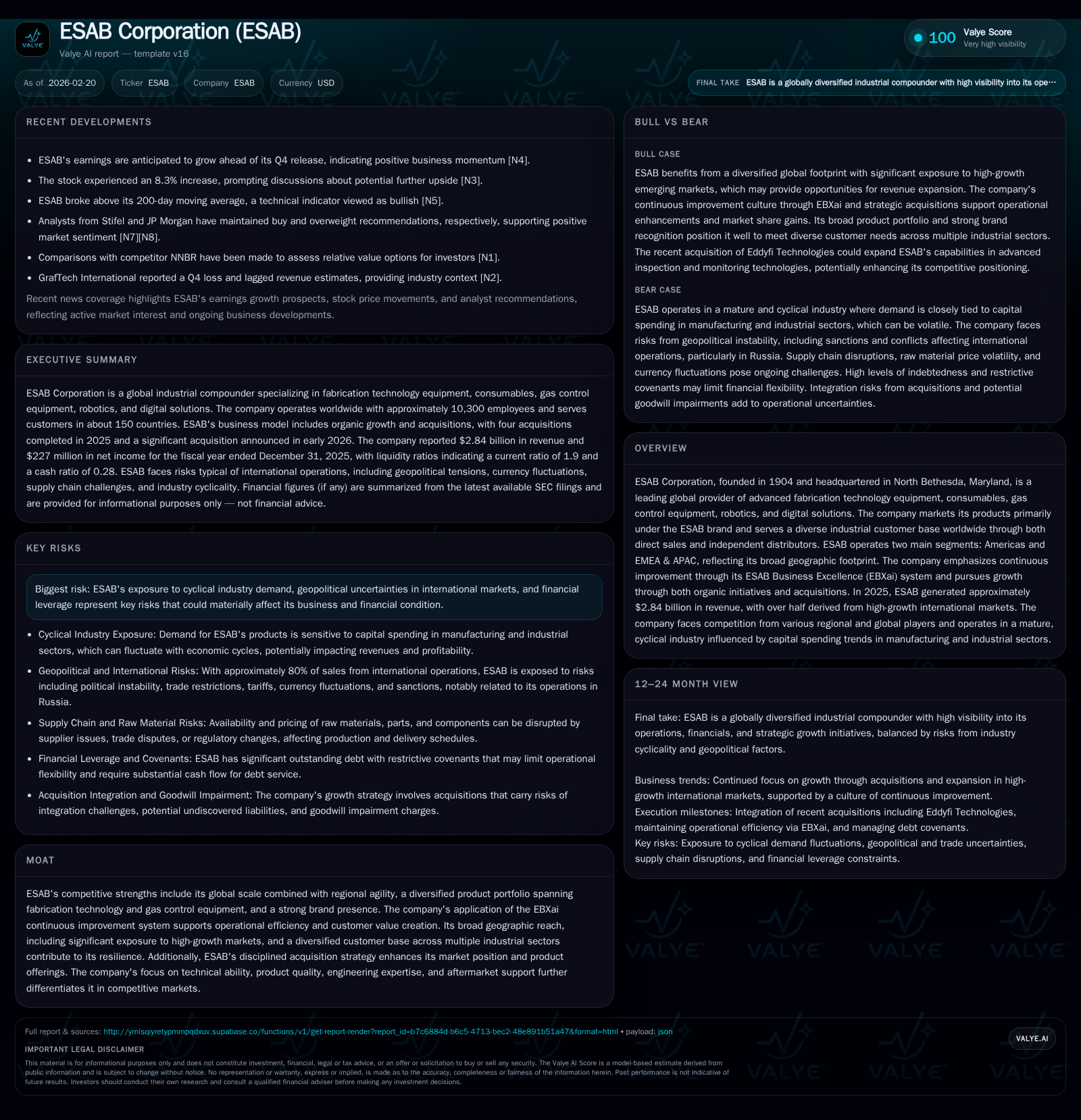
Founded in 1904, ESAB Corporation is a leading global fabricator providing welding, cutting, gas control equipment, robotics, and digital solutions. The company has shown steady revenue growth driven by organic expansion and acquisitions, with 80% of sales generated internationally across two main reportable segments: Americas and EMEA & APAC. While ESAB’s application of its continuous improvement system EBXai supports operational efficiency, the mature and cyclical industrial markets it serves pose demand risks. The company's growth outlook remains supported by exposure to high-growth emerging markets and continued acquisition activity, yet constrained by geopolitical risks, raw material price volatility, and financial leverage concerns.
Company Overview and Industry Context
Founded over a century ago in 1904, ESAB Corporation has evolved into a premier global industrial compounding enterprise specializing in advanced fabrication technology equipment—including consumables for welding and cutting—gas control apparatus, integrated robotics, and digital workflow solutions. Headquartered in North Bethesda, Maryland, ESAB operates globally with approximately 10,300 employees serving customers across roughly 150 countries through a blend of direct sales forces and independent distributors.
Operating primarily under the widely recognized ESAB brand name, the company segments its operations into Americas (covering North and South America) and EMEA & APAC (encompassing Europe, Middle East, Africa, India and Asia Pacific), capturing broad geographic diversity that mitigates localized economic fluctuations while offering access to emerging high-growth markets such as India and Eastern Europe.[S4][S5]
The global market for welding and gas control systems is estimated to approach $45 billion by the end of 2028. ESAB enjoys a substantial position across multiple major geographies by balancing global scale with regional agility. Approximately 52% of revenue in FY2025 derived from high-growth regions defined by higher GDP growth trajectories than mature Western economies provides a meaningful growth runway.[S5]
Product differentiation hinges on technical excellence—high quality consumables and equipment reliability—as well as engineering services including application expertise and robust aftermarket support. The firm faces competition from notable peers including Lincoln Electric and Illinois Tool Works among others but leverages its breadth across product categories to maintain resilience.[S6]
Historical Financial Performance
ESAB’s latest fiscal year results through December 31, 2025 reveal steady topline momentum with revenue reaching approximately $2.84 billion representing a 3.7% increase over prior year’s $2.74 billion.[F1] Despite this revenue gain, operating income declined by roughly 7.9%, falling to $412 million from $447 million due primarily to inflationary pressures on raw materials costs and elevated supply chain expenses impacting margins.[F1]
This trend cascaded further down the income statement where net income contracted by approximately 14.4% to $227 million compared to $265 million in FY2024.[F1] These profit reductions signal margin pressure despite top-line expansion.
Historical performance summarized:
Historical performance (annual)
| FY | Rev ($bn) | Net ($mm) | CFO ($mm) | OpInc ($mm) | Rev YoY | Net YoY |
|---|---|---|---|---|---|---|
| 2025 | 2.8 | 227 | 261 | 412 | +3.7% | -14.4% |
| 2024 | 2.7 | 265 | 355 | 447 | -1.2% | +29.0% |
| 2023 | 2.8 | 205 | 330 | 404 | +7.0% | -8.3% |
| 2022 | 2.6 | 224 | 214 | 329 |
Note: Omitted columns lack sufficient annual XBRL coverage in the provided tags (need ≥2 annual points): Capex, Buybacks. Source: SEC companyfacts cache [F1].
Capital returns and efficiency (annual)
| FY | Div ($mm) | FCF ($mm) | ROE% |
|---|---|---|---|
| 2025 | 22 | 213 | 10.5 |
| 2024 | 17 | 304 | 15.0 |
| 2023 | 13 | 282 | 12.8 |
| 2022 | 6 | 174 | 16.6 |
Source: SEC companyfacts cache [F1].
Note: Buyback data not available; exclude metrics with insufficient data.
Free cash flow (operating cash flow minus capex) remained strongly positive at approximately $213 million in FY2025 despite the decline versus previous years.[F1]
Return on equity (ROE), derived from net income over average equity ($2.16 billion at end-FY25), stands at a respectable but moderate ~10.5%, reflecting modest profitability relative to capital employed.[F1]
Drivers Behind Past Growth
Organic factors contributing to revenue growth include expansion within emerging geographic markets coupled with ongoing innovation in fabrication technology solutions integrating automation and digital workflows.[S5] The company’s embrace of its proprietary EBXai continuous improvement system aims at enhancing manufacturing efficiency while improving customer responsiveness—a key differentiator supporting volume gains.[S5]
Acquisitions remain pivotal as well; in FY2025 alone ESAB completed four strategic acquisitions designed primarily to broaden product portfolio breadth or strengthen footholds in attractive niche markets—reflecting a disciplined approach prioritizing alignment with long-term financial returns.[S6]
Demand is heavily influenced by capital expenditure cycles within diversified industrial sectors such as automotive manufacture, energy infrastructure projects, general fabrication and increasingly healthcare gas control markets where technical sophistication commands premium positioning.[S1][S8]
Future Growth Prospects
Looking ahead, ESAB aims to capitalize on several tailwinds:
- High-growth Markets: Nearly half of revenues come from regions expected to grow materially faster than developed economies including Asia Pacific countries like India where increasing industrialization spurs demand for welding automation.
- Technological Innovation: Expanding capabilities in robotic welding arms coupled with digital integration could unlock new value propositions attracting larger contracts or longer-term service agreements.
- Continued M&A Activity: Management anticipates further acquisitions leveraging their proven integration framework to fuel incremental scale without dilutive effects on margins.[S6][S21]
Nonetheless growth faces headwinds:
- Cyclical Demand: As noted extensively by management risk disclosures highlight the vulnerability of capital investment-driven industries whose downturns directly suppress fabrication equipment orders.[S1][S7]
- Raw Material Volatility: Recent inflationary environments expose margins especially since some key consumables rely on metals susceptible to commodities price swings.
- Geopolitical Uncertainty: Operations across numerous jurisdictions expose ESAB to sanctions risks (e.g., Russia/Ukraine), trade tensions potentially restricting cross-border supply chains or customer access.[S8][S22][S25]
- Regulatory Compliance Burdens: Increasing standards especially for medical device components within the gas control segment add costs but may also constitute barriers limiting new entrants.[S13][S18]
Forecasts and Forward-Looking Considerations
While the company provided no explicit formal guidance for fiscal year 2026 at filing,[S3] recent market commentary expects continued earnings growth buoyed by recovery trends post-pandemic supply chain normalization alongside benefit from recent acquisitions advancing results.[N1][N3]
Investors should watch key developments including:
- Quarterly earnings releases for margin update trajectories post-acquisition integrations
- Capital expenditure trends among key industrial end markets signaling demand shifts
- Currency fluctuations affecting reported overseas revenues given large international footprint
- Any changes in credit facility conditions or refinancing impacting financial flexibility[S12][S16]
Returns and Capital Allocation Policy
ESAB has pursued consistent dividend increases indicative of steady free cash flow generation capability despite volatile earnings trends—dividends rose from roughly $6 million distributed in FY2022 ascending steadily through FY2025 reaching over $22 million.[F1] There was no public disclosure regarding share repurchase activities during this period.
Operating cash flows have been generally robust albeit declining significantly last year likely associated with working capital increases or cost escalations amid inflationary pressures,[F1] yet still generating positive free cash flow after modestly stable capital investments primarily targeting capacity maintenance rather than large expansions.
The balance sheet exhibits moderate liquidity concentration—a current ratio of about 1.9 reflects sound short-term asset coverage against current liabilities ensuring operational stability.[F1] However significant gross indebtedness totaling around $1.2 billion combined with leverage covenants constrains flexibility for large sudden expenditures or unplanned opportunities necessitating prudent fiscal management going forward.[S12][S17]
Risks Highlighted By Management
ESAB’s documented risk factors underscore several critical points:
- Industry cyclicality tied closely to manufacturing capex can cause rapid revenue fluctuations impacting profitability[S1][S7].
- International exposure introduces geopolitical uncertainties including sanctions compliance on transactions involving sensitive territories which bring regulatory scrutiny[S8][S22].
- Raw material dependencies subject the cost base to commodity market volatility potentially compressing margins absent price pass-through[S9].
- The legacy asbestos-related litigations linked indirectly through formerly acquired subsidiaries introduce contingent legal costs[S10].
- Intensifying environmental regulations alongside privacy/data security compliance impose growing operational overheads[S13][S18][S24].
- Labor union negotiations affecting nearly one-third of workforce pose risk for labor disruptions that could delay production[S20]. These systemic risks require vigilant mitigation strategies embedded into operational planning.
Sector Native Context Analysis
In fabricated metal products industries serving heavy manufacturing customers alike—where fabrication technology such as welding equipment forms a critical input—the absorption rate of fixed manufacturing overhead typically fluctuates sharply during downturns as capacity utilization declines; this phenomenon likely contributed to operating margin contraction despite nominal revenue growth at ESAB.
Furthermore, robotics adoption represents a pivotal inflection point within this sector; automating repetitive high precision welding tasks drives productivity gains but also requires significant upfront R&D investment coupled with skilled talent acquisition—a balancing act companies like ESAB manage carefully under its EBXai continuous improvement ethos.
Conclusion
ESAB Corporation stands as a significant global player navigating the interplay between mature industry cyclicality and promising pockets of emerging market expansion supported by strategic acquisitions and operational excellence initiatives via EBXai. While revenues have grown steadily near mid-single digits recently accompanying geographic diversification that cushions volatile conditions locally, the dip in profitability mandated close monitoring around cost management especially raw materials procurement plus successful integration of newly acquired businesses. Further vigilance toward external risks — encompassing geopolitical developments along with regulatory complexities — remains paramount given international scope. Capital deployment favors shareholder returns through dividends sustained amidst cautious leverage management but lacks visibility on buyback programs currently. Subsequent earnings releases will offer critical guidance clarifying trajectory amid these offsetting dynamics.
Disclaimer: This analysis is for informational purposes only aimed at providing a comprehensive overview of ESAB Corp based on publicly available information as of February 20, 2026 without making investment recommendations.
Disclaimer: This is research-only, informational analysis and not investment advice. It may include AI-generated interpretation and general industry context. Always verify important details using primary sources.

Comments