
Savers Value Village’s Strategic Footprint and Financials Signal Shifting Operating Dynamics
The largest for-profit thrift retailer faces margin pressures despite scale and supply chain innovation amid increased capital spending.
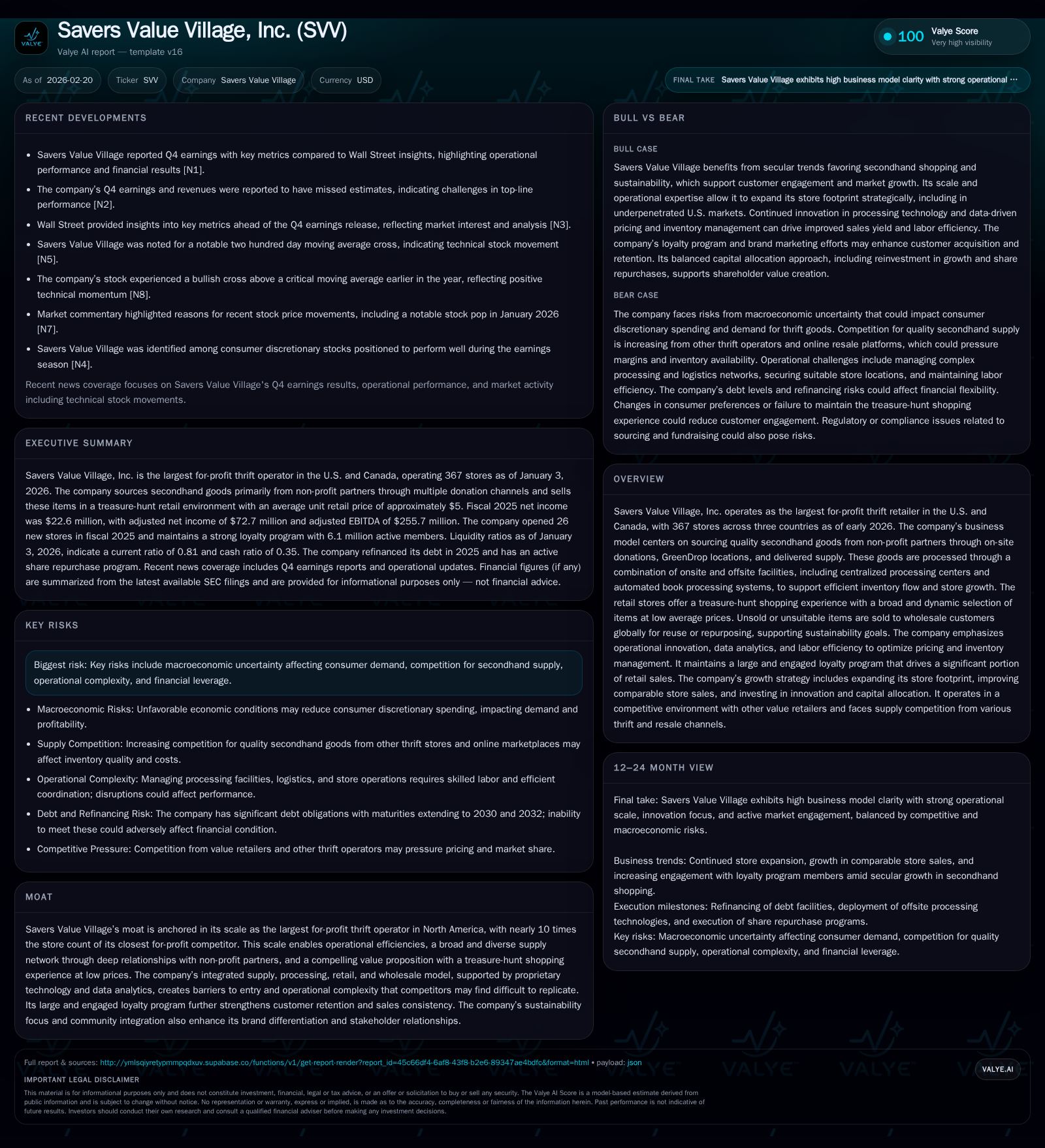
Savers Value Village, Inc. operates the biggest network of for-profit thrift stores in North America and Australia, leveraging a unique model sourcing secondhand goods from non-profit partners. While the company sustained revenue resilience through 2025 driven by loyal customers and operational scale, operating income declined 4.7% year-over-year accompanied by a sharper 22% drop in net income. These profitability headwinds reflect cost pressures and complexity from expanding automated processing and logistics infrastructure. Meanwhile, substantial capital expenditures rose 12% as the firm invests in store growth and technology amid cautious return on equity near 5%. Liquidity remains stable but leverage is notable, constrained by restrictive debt covenants. Key risks from consumer discretionary trends and competitive supply dynamics temper growth prospects, making operational execution pivotal in upcoming quarters.
Building the Largest For-Profit Thrift Network: Historical Growth and Supply Model
Savers Value Village has solidified its position as the dominant player in the for-profit thrift sector with a sprawling network of 367 stores across the U.S., Canada, and Australia as of January 2026 [S1][S2]. This footprint dwarfs competitors by nearly tenfold in store count, providing formidable scale advantages.
Central to Savers’ model is its hyper-local sourcing strategy that relies chiefly on purchasing secondhand goods donated to its nonprofit partners (NPPs). The company procures inventory via three distinct channels:
- On-site Donations (OSDs): Donations made directly at Community Donation Centers located adjacent to Savers’ retail outlets.
- GreenDrop Locations: Designated collection points managed by NPPs allowing donors to contribute items at convenience.
- Delivered Supply: Items physically transported from various NPPs or donation depots into Savers' processing centers.
OSDs and GreenDrop collectively accounted for approximately 78% of total pounds processed in fiscal 2025, highlighting their importance not only for volume but also because these sources typically deliver higher quality merchandise at lower contractual purchase costs — a critical driver of sales yield and gross product margin [S1][S23].
The company integrates this supply through sophisticated processing operations including both onsite sorting at stores and centralized offsite facilities equipped with automation such as book processing systems. These innovations enable Savers to efficiently handle over one billion pounds of product annually while maintaining a treasure-hunt retail experience characterized by broad merchandise variety at an average unit retail (AUR) price near $5 [S1]. This approach ensures dynamic inventory turnover compared to competitors limited by less efficient supply chains or new merchandise designs (analysis).
Evolving Operating Performance: Operating Income Declines Despite Revenue Resilience
Fiscal year 2025 marked a period of financial contrasts for Savers [F1]. Operating income contracted by approximately 4.7% year-over-year from $130.2 million in FY24 to $124.1 million in FY25. Net income plunged more steeply by about 22%, sliding from $29.0 million to $22.6 million [F1], signaling margin compression.
This divergence relates partly to growing costs associated with expanding automation capabilities within its centralized processing hubs and escalating freight expenses connected to cross-border operations [N2]. Moreover, finance costs linked to recent refinancing activities have slightly pressured bottom-line profitability [S15]. Despite these headwinds, operating cash flow strengthened substantially by nearly one-quarter (24.6%), rising from $134.3 million in FY24 to $167.3 million in FY25 [F1][N1]. This improved cash generation underscores strong working capital management even as net earnings rebounded unevenly.
Margin pressure further reflects shifts in product mix toward categories or regions with thinner gross margins alongside inflationary wage cost increases for over 23,000 team members supporting retail stores and complex logistics networks [S1][N2]. The disconnect between CFO gains versus net income declines indicates non-cash charges or timing differences warranting scrutiny ahead.
Historical performance (annual)
| FY | Net ($mm) | CFO ($mm) | OpInc ($mm) | Capex ($mm) | Net YoY |
|---|---|---|---|---|---|
| 2025 | 23 | 167 | 124 | 119 | -22.0% |
| 2024 | 29 | 134 | 130 | 106 | -45.3% |
| 2023 | 53 | 175 | 142 | 92 |
Note: Omitted columns lack sufficient annual XBRL coverage in the provided tags (need ≥2 annual points): Rev. Source: SEC companyfacts cache [F1].
Capital returns and efficiency (annual)
| FY | Div ($mm) | Buybacks ($mm) | FCF ($mm) |
|---|---|---|---|
| 2025 | 0 | 45 | 49 |
| 2024 | 0 | 32 | 28 |
| 2023 | 262 | 83 |
Source: SEC companyfacts cache [F1].
- Note: Revenue not available; Dividends show large payment spike in FY23 but nil thereafter; ROE derived as net income / equity; Buybacks resumed materially FY24 onward.
Complex Supply Chain and Logistics Innovation Sustain Competitive Moat
Savers’ moat increasingly rests on its integration of proprietary technology across supply chain touchpoints combined with vast scale advantages [S29][S1]. Its offsite processing centers utilize advanced automation systems — particularly for high-volume categories like books — which significantly enhances throughput capacity while limiting manual labor dependencies.
These innovations drive higher sales yield ($ per pound processed), enabling more granular item selection, pricing adjustments via data analytics algorithms, and prioritized stocking that directly improves assortments offered frontline at stores [S23]. The processing throughput improvements also reduce spoilage or aging inventory risks common in secondhand retailing.
Average Unit Retail prices remain stable around $5 but product mix enhancements allow deliberate upselling on rare or premium items identified through data-driven merchandising models deployed across loyalty member behaviors (analysis). Such technological investments have raised upfront capital intensity but are designed to foster longer-term margin expansion if operating leverage materializes.
Future Growth Horizons: Store Expansion, Loyalty Gains, and Market Headwinds
Looking forward, Savers plans incremental increases beyond the current store base spanning three countries — predominantly emphasizing deeper penetration in existing markets rather than aggressive new geographies given operational concentration benefits [N5][S1]. The active loyalty membership base expanded modestly from approximately 5.9 million active users in FY24 to over 6.1 million in FY25 who drove around three-fourths of sales revenues across retail stores [S1][N5].
Nonetheless growth could be capped by shifting consumer perceptions around thrift shopping amidst evolving style preferences or increasing competition from digital resale peers ramping presence through online marketplaces targeting similar customer cohorts [S17]. Additionally, securing secondhand supply at scale remains competitive since other organizations pursue donor relationships aggressively.
Operational constraints limit rapid scaling given the intricacies of maintaining localized procurement networks alongside nationwide logistical coordination — any dilution of quality inputs could degrade throughput KPIs impacting sales yields negatively (analysis).
Capital Allocation: Significant Capex Increases Contrast With Conservative Returns
Capital expenditures climbed notably by over $12% year-over-year to $118.6 million in FY25 from approximately $105.9 million the prior year as investments concentrated on expanding store count modestly while heavily funding automation upgrades within processing hubs [F1][S27]. These capex commitments underscore management’s intent to deepen efficiency via technology leveraging despite near-term pressure on margins.
Meanwhile, no dividends were distributed during fiscal years FY24 or FY25 consistent with restrictive credit facility covenants limiting shareholder payouts under material indebtedness conditions [S6][S18]. Instead, share repurchases surged—$45.2 million executed during FY25 under a freshly authorized $50 million buyback program commencing November quarter-end—which signals preference towards enhancing per-share metrics while preserving financial flexibility [S11][N1].
Return on equity hovered around a moderate ~5.2% reflective of constrained earnings growth relative to stockholders’ equity expansion from prior bullish retention rather than payout strategies [F1]. This ROE level indicates conservative returns inconsistent with high-growth enterprises but arguably appropriate considering heavy reinvestment cycles currently underway.
Financial Position and Liquidity: Managing Leverage Amid Expanding Operations
The company's liquidity profile exhibits stress owing primarily to significant current liabilities surpassing current assets—current ratio stood at a lean ~0.81 as of January end-2026—with current liabilities totaling approximately $244 million against roughly $197 million of current assets including cash & equivalents near $86 million [F1][S4][S8].
This imbalance largely arises from operating lease liabilities associated with long-term store leases and accrued incentives payable within short-term horizons combined with trade payables tied closely to supply chain commitments amid growth initiatives [S10][S14]. Elevated leverage remains a central concern given total indebtedness approximating $730 million following September’s refinancing that replaced older instruments with longer maturities but includes restrictive covenants limiting dividend payments or asset disposals without creditor consent [S15][S16][S21].
Ongoing compliance with these covenants is critical; any breach could lead to default scenarios jeopardizing liquidity access while interest expense volatility persists due to partly variable rate debt components requiring hedging strategies recently deployed through interest rate swaps [S15][N2].
Key Risks: Macroeconomic Impact, Labor Dynamics, and Competitive Pressures
The business is inherently sensitive to consumer discretionary spending dynamics where economic uncertainty may reduce foot traffic or thrift purchasing willingness despite lower average price points relative to traditional retailers [S17][N2]. Competition extends beyond public thrift organizations into private resellers leveraging digital platforms disrupting traditional brick-and-mortar advantage.
Labor market tightness challenges recruiting and retaining over twenty-three thousand team members needed across differing operational segments including sophisticated offsite processing units; wage inflation continues as a margin headwind potentially exacerbated should worker turnover rise causing training costs spikes or temporary productivity declines [N2][S17].
Operational complexity spanning domestic cross-border coordination plus international exposure imposes risk centered on logistics disruptions or regulatory changes affecting resale import/export compliance potentially impacting wholesale channel effectiveness downstream [S22][N17] (analysis).
What to Watch: Indicators for Margin Recovery and Wholesale Channel Execution
Key upcoming markers include quarterly earnings releases beyond Q4 FY25 showing whether efficiency gains from new automated centers mature fully into measurable margin improvement or if persistent cost inputs dilute profitability further [N1][N3]. Monitoring wholesale resale margins will also signal execution success since this channel absorbs unsold inventory critical for controlling stock aging risks yet involves varying counterparties internationally increasing unpredictability.
Loyalty program engagement rates provide real-time feedback loop on consumer retention strength especially if active member numbers accelerate past mid-six millions thresholds driving higher traffic frequency sustaining revenue stability around thin margins inherent in value retailing [N5] (analysis).
Close attention should also be paid to announcements regarding supply sourcing mix evolution between OSD/GreenDrop proportions relative to delivered volumes which materially affect gross product margins due to contractual cost differentials documented historically [S23].
This report provides an analytical review based strictly on available SEC filings and recent news disclosures up through February 2026 without offering investment advice.
Disclaimer: This is research-only, informational analysis and not investment advice. It may include AI-generated interpretation and general industry context. Always verify important details using primary sources.

Comments