
Claros Mortgage Trust Balances Transitional CRE Opportunities with Rising Capital and Liquidity Pressures
Specialized focus on transitional commercial real estate drives complexity amid financial headwinds and covenant constraints.
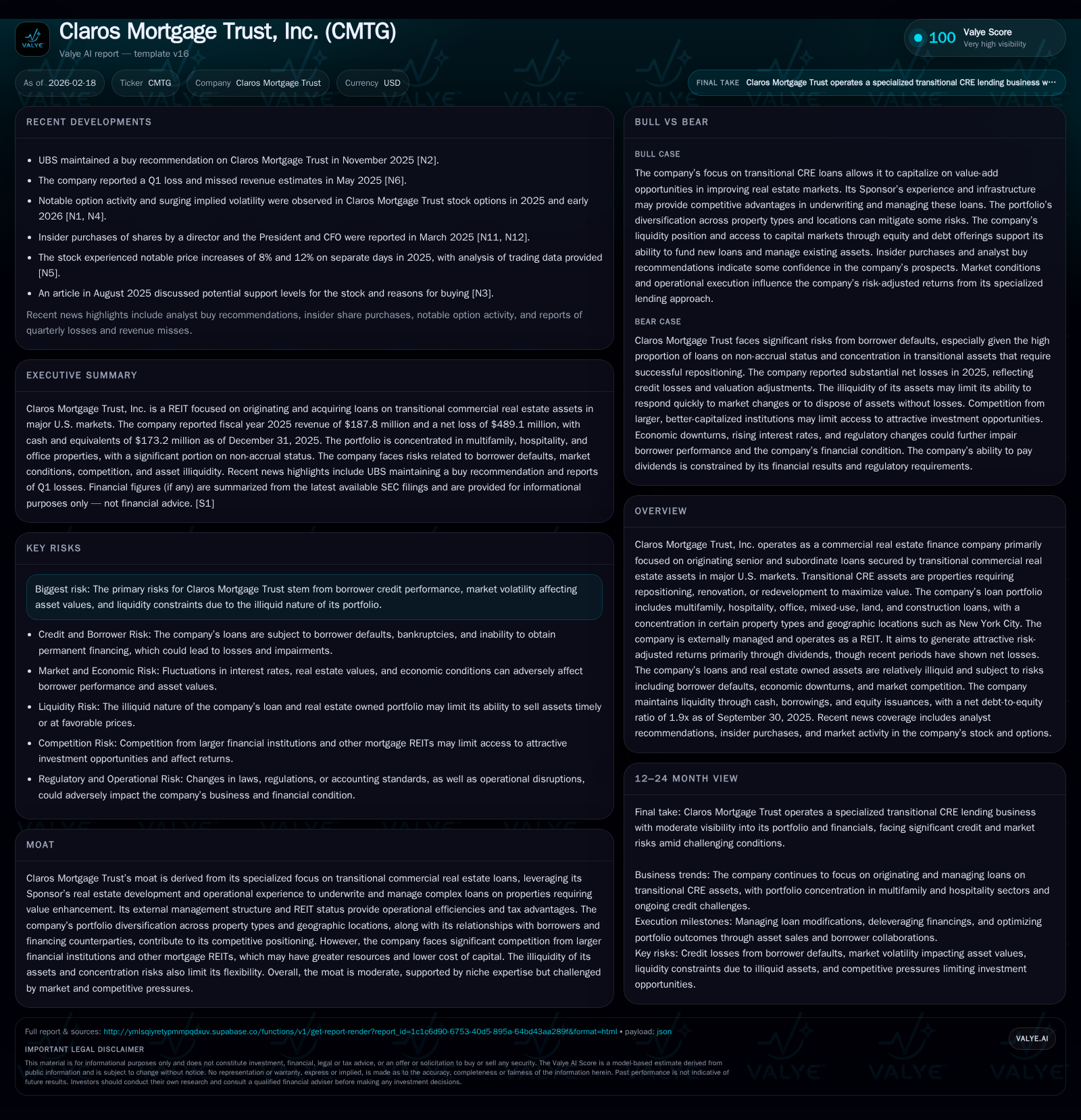
Claros Mortgage Trust, Inc. (CMTG) has carved a niche in senior and subordinate loans on transitional commercial real estate assets in major U.S. markets, leveraging its Sponsor’s development expertise. Over recent years, revenue has contracted significantly alongside mounting net losses driven by elevated credit costs and market volatility impacting borrower performance. Liquidity management remains critical given increased leverage and debt maturities through 2026–2027, alongside regulatory covenant requirements. Future growth hinges on successful loan originations in targeted property types and geographic concentration, but risks from borrower defaults and financing challenges cap upside. Returns have deteriorated with a negative ROE and strained operating cash flows, while dividends were suspended in 2025 reflecting operational stress.
Company Overview and Niche Focus
Claros Mortgage Trust, Inc. operates as a specialized commercial real estate finance company focused primarily on originating senior and subordinate loans for transitional commercial real estate (CRE) properties across major U.S. urban markets. Transitional CRE refers to assets requiring significant repositioning or redevelopment—an inherently riskier space compared with stabilized property financing because of construction risk, execution uncertainty, and market dependency for value realization [S2].
A key component of Claros’ competitive positioning derives from its Sponsor’s real estate development and operational experience, which informs underwriting discipline for complex loans secured by multifamily, hospitality, office, mixed-use, land, and construction projects. Moreover, geographic concentration notably includes New York City where the company leverages local market expertise . The externally managed REIT structure promotes tax efficiencies but necessitates careful capital management.
Historical Financial Performance
The company’s revenue trajectory reveals pronounced instability reflecting sector dynamics and portfolio credit challenges:
Historical performance (annual)
| FY | Rev ($mm) | Net ($mm) | CFO ($mm) | Rev YoY | Net YoY |
|---|---|---|---|---|---|
| 2025 | 188 | -489 | -30 | -24.4% | -121.0% |
| 2024 | 248 | -221 | 85 | -19.0% | -3771.2% |
| 2023 | 307 | 6 | 111 | +6.7% | -94.6% |
| 2022 | 287 | 112 | 111 |
Note: Omitted columns lack sufficient annual XBRL coverage in the provided tags (need ≥2 annual points): OpInc, Capex, FCF, ROE%. Source: SEC companyfacts cache [F1].
Capital returns and efficiency (annual)
| FY | Div ($mm) | Buybacks ($mm) |
|---|---|---|
| 2025 | 0 | |
| 2024 | 121 | 21 |
| 2023 | 192 | 21 |
| 2022 | 21 |
Source: SEC companyfacts cache [F1].
Data suggests a peak revenue year around FY22-23 followed by steep declines coinciding with rising credit costs and economic headwinds impacting borrower's ability to service loans [F1]. Net income swings from strong profitability (+$112M) in FY22 to deep losses (-$489M) by FY25 highlight rising impairments and valuation pressures likely triggered by borrower defaults or loan restructurings common in transitional CRE funding environments.
Operating cash flows declined into negative territory by FY25 despite positive prior periods indicating stressed recurring earnings capacity [F1]. These trends underscore the cyclical vulnerabilities of the transitional CRE sub-sector intensified by macroeconomic volatility including interest rate hikes increasing debt service burdens.
Loan Portfolio Characteristics & Risk Profile
Claros concentrates its loan book on properties needing repositioning: renovation, rehabilitation, leasing augmentation or redevelopment — categories fraught with execution risks such as cost overruns or delayed timelines leading to borrower payment difficulties [S1][S2]. Borrowers tend to be sponsors targeting undervalued or mismanaged assets in improving markets.
Key portfolio segments include:
- Multifamily residential housing
- Hospitality properties (hotels)
- Office buildings
- Mixed-use developments
- Land parcels
- Construction financing arrangements
Geographic concentration notably biases toward large coastal metro areas (especially NYC), which offers underwriting advantages but also exposes portfolio to localized economic shifts or regulatory changes that can affect asset liquidity or value realization.
Portfolio illiquidity limits flexibility for rapid rebalancing; deleveraging may require asset sales potentially at discounted prices amid market downturns [S13]. These factors heighten borrower credit risk evidenced by increasing non-accruals affecting operational results.
Liquidity Position and Capital Structure
Liquidity remains a strategic concern due to upcoming debt maturities coinciding with legacy loan resolutions:
- As of December 31, 2025, cash & equivalents stood at approximately $173 million—a modest buffer against ~$3.7 billion total secured borrowings including repurchase agreements, term participation facilities, notes payable, plus a secured term loan maturing August 9, 2026 [F1][S4][S11][S23].
- The weighted average spread on secured borrowings hovers around SOFR plus ~3%, reflecting current borrowing costs under tightened credit conditions [S19][S23].
- Aggregate unfunded loan commitments totaled about $348 million as of September 30, 2025 with funding timing uncertain given borrower performance variances [S12][S16].
- The company has actively deleveraged over recent years cumulatively repaying more than $900 million since end-2023 per filings indicating disciplined capital management aiming at reducing vulnerability amid market stress [S5][S18].
Financial covenants imposed by lenders restrict the company’s leverage (max 77.8% of total assets) and require minimum tangible net worth thresholds ($1 billion plus equity raise adjustments) along with defined interest coverage ratios that tighten progressively through late 2027 (e.g., from no measurement during major part of FY25 up to minimum ICR of between 1.10x to 1.30x subsequently) [S4][S15][S24].
Failure to meet these covenants introduces material default risk that could trigger accelerated repayments or collateral enforcement worsening liquidity crunches.
Additionally, certain amendments grant lenders governance rights such as appointing independent board observers under default conditions potentially influencing strategic decisions including management oversight [S22]. This governance shift underscores creditor influence reflecting elevated refinancing risks.
Claros holds approved but unused shelf registration capacity for equity issuance up to $250 million plus an ATM facility of $150 million (unused as of late 2025), which could provide liquidity if market conditions allow favorable capital raises [S8]. However, issuances depend heavily on share price performance and investor appetite constrained by recent operating losses.
Returns & Capital Allocation Trends
ROE remains negative at nearly -20% based on net loss relative to shareholders' equity around $1.74 billion as of FY25 end illustrating ongoing profitability challenges exacerbated by higher than normalized credit expenses amid transitional asset risk profiles [F1].
The dividend payout was halted in FY25 after distributions totaling $120 million in FY24 reflecting preservation of cash amidst deteriorating fundamentals consistent with REIT compliance requirements linking dividends to taxable income generated [F1][S24].
Capital allocation increasingly favors deleveraging efforts aimed at stabilizing balance sheets by reducing total borrowing levels rather than aggressive stock repurchases which appear limited post-FY22 when buybacks were about $21 million annually coinciding with better operational footing [F1][S16].
Managers have focused on optimizing existing loan portfolio outcomes including work-outs or strategic sales rather than aggressive new originations given market uncertainties—this conservative bias aims to protect liquidity buffers but caps near-term growth potential absent significant portfolio turnarounds or market recovery.
Growth Prospects & Strategic Outlook
Future growth catalysts center on:
- Originating new loans within Claros’ transitional CRE niche leveraging the Sponsor’s underwriting acumen allied with macroeconomic tailwinds favoring urban redevelopment projects if economic conditions stabilize or improve
- Successfully managing loan workouts or transfers mitigating defaults while redeploying capital efficiently into higher quality assets
- Geographic focus on top-tier markets like NYC that may offer superior risk-adjusted returns despite competition
- Maintaining access to capital markets for refinancing enabling incremental investments
Constraints include:
- Heightened borrower default risks due to execution delays, cost overruns compounded by input cost inflation such as labor/material shortages
- Market volatility dampening property valuations complicating collateral realizations
- Regulatory environment potentially affecting REIT operations or financing mechanisms
- Competition from larger mortgage REITs or banks offering lower cost funding challenging Claros’ scale advantages
- Tightening financing covenants constraining operational agility
Currently no explicit forward guidance was provided; key milestones to monitor include quarterly covenant compliance updates, refinancing transactions post-August 2026 term loan maturity date, new loan originations volumes/quality metrics possibly disclosed in subsequent SEC filings or press releases [N1][S3].
Industry Contextual Analysis
The transitional CRE lending sub-sector remains challenged amid persistent inflationary pressures elevating capex budgets producing cost overruns; meanwhile rising interest rates further strain borrower debt serviceability leading many lenders like Claros to see increasing impairments or workout activities typical for this asset class cycling through market phases.
Mortgage REITs finance portfolios predominantly through short-duration leveraged structures often using repurchase agreements collateralized by underlying loans or properties; hence managing margin maintenance provisions is critical since adverse asset price shocks can trigger liquidity calls—a risk mitigated so far without margin calls per Claros’ disclosures through September 30, 2025 [S11][S17].
Depending on capital markets environment refinance windows remain narrow during periods of volatility requiring proactive deleveraging strategies observed here.
Conclusion
Claros Mortgage Trust's strategy hinges on deriving value from specialized transitional CRE lending acumen balanced against significant credit stresses impacting financial results prominently since early-to-mid decade rent cycles peaked. Challenges include steep revenue contractions (-24% YoY), substantial net losses magnified annually (-$489M full year FY25), negative operating cash flow outflows exacerbating liquidity risk, and looming debt maturities imposing heavy covenant discipline narrowing strategic flexibility. While the firm maintains a moderate competitive moat based on niche expertise addressing complex underwriting scenarios, mounting financial pressures necessitate cautious monitoring of covenant compliance, stability of borrower repayment performance, and successful execution against refinancing needs slated for key maturities over the next two years. Investors tracking CMTG should pay close attention to future loan origination success rates, potential asset sales realizing fair values, adjustments in dividend policy reflective of operational recovery, and changes in financing arrangements shaping available liquidity over time. This analysis excludes investment advice but highlights fundamental operating dynamics shaping Claros’ prospects within the evolving U.S. transitional CRE finance landscape.
Disclaimer: This memorandum is an informational analysis based solely on publicly available data as of February 18, 2026, and does not constitute investment advice or recommendations regarding Claros Mortgage Trust securities.
Disclaimer: This is research-only, informational analysis and not investment advice. It may include AI-generated interpretation and general industry context. Always verify important details using primary sources.

Comments