
Kaiser Aluminum’s Surge in Operating Income and Growth Prospects in Specialty Markets
A detailed review of Kaiser Aluminum’s recent financial turnaround, underpinned by specialty alloys focus and strategic metal price risk management.
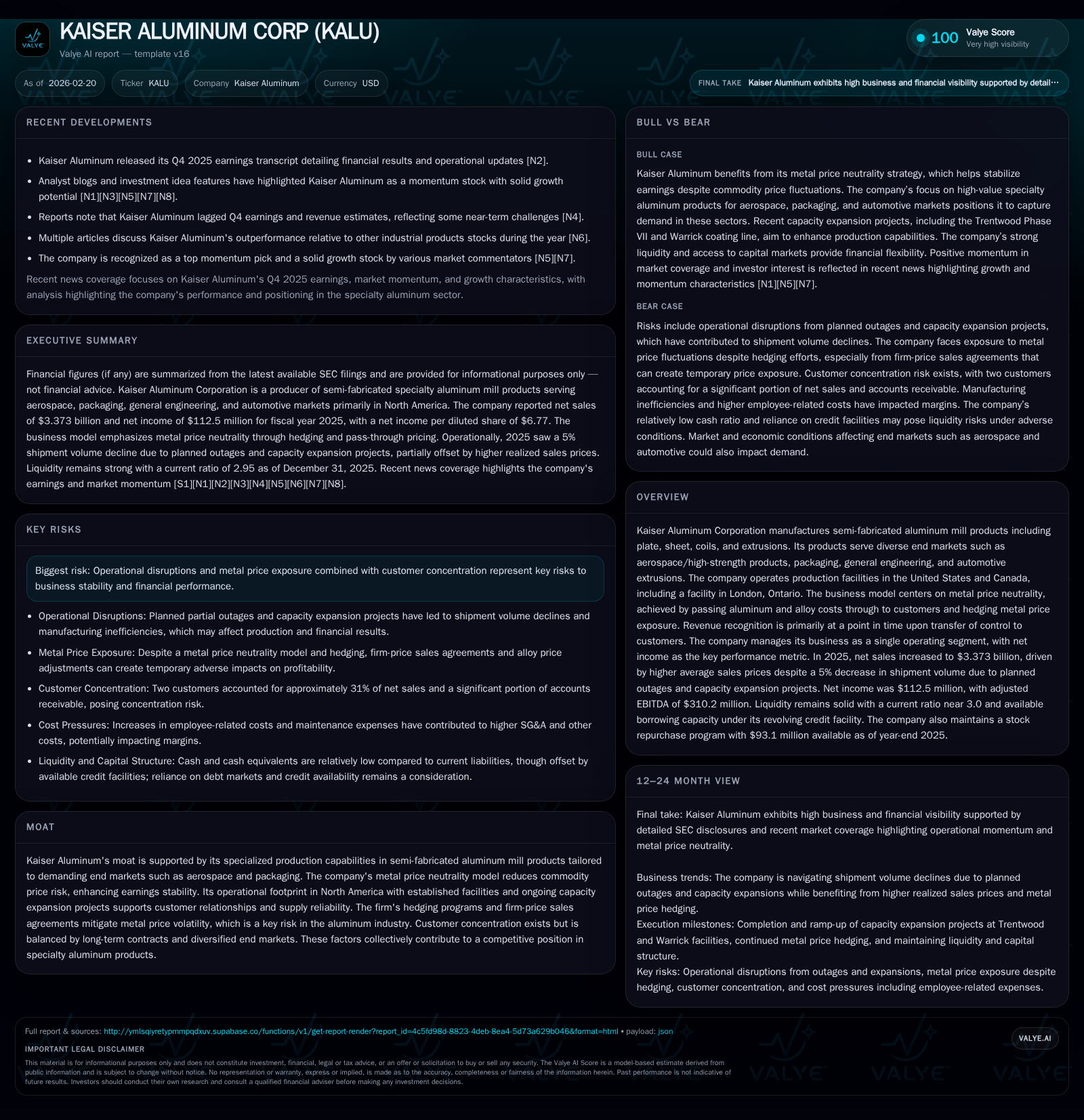
Kaiser Aluminum Corp has transformed its operating income from near breakeven in 2022 to $189 million in 2025, driven primarily by higher average selling prices amid a modest volume decline due to planned outages. The company's focus on semi-fabricated aluminum products geared towards aerospace, packaging, and automotive end markets, combined with its metal price neutrality strategy and hedging programs, has insulated earnings from commodity price swings. Despite operational headwinds and a negative free cash flow due to elevated capital spending, Kaiser maintains liquidity flexibility through amended credit facilities expiring in 2030. Going forward, ongoing capacity expansions and diverse end market exposure underpin growth potential, balanced by risks around customer concentration and operational disruptions.
Transformative Growth Over the Past Three Years
Kaiser Aluminum has demonstrated remarkable financial transformation between FY2022 and FY2025. In 2022, the company reported an operating income of just $4.0 million, reflecting challenging market conditions including commodity price volatility and the ramp-up costs of capacity projects [F1]. By contrast, operating income nearly doubled year-over-year from $87.7 million in 2024 to $188.8 million in 2025—a striking +115.3% increase [F1]. This resurgence was fueled principally by improved average selling prices rather than shipment volume growth; indeed, volumes declined approximately 5% due to planned maintenance outages designed to optimize long-term manufacturing efficiency [N1]. Net income followed a similar trajectory—recovering from a net loss of $29.6 million in 2022 to a robust $112.5 million in 2025 (+140% YoY)—underscoring improved profitability dynamics fortified by operational discipline [F1].
Cash flow from operations (CFO) contracted year-over-year by about one-third to $111.4 million in 2025 against $167.1 million in the prior year due mainly to working capital absorption from rising metal prices and inventory build ahead of supply chain stabilization [F1][S4]. Meanwhile, capital expenditures (capex) decreased by roughly 24%, totaling $136.9 million in 2025 compared with near-term peak investments aimed at capacity expansion and modernization in prior years [F1][S21]. The net impact was a negative free cash flow (FCF) position approaching -$25.5 million for the year—indicative of Kaiser’s current investment phase supporting future organic growth.
Table: Kaiser Aluminum Historical Financial Performance (FY2022-FY2025)
Historical performance (annual)
| FY | Net ($mm) | CFO ($mm) | OpInc ($mm) | Capex ($mm) | Net YoY |
|---|---|---|---|---|---|
| 2025 | 113 | 111 | 189 | 137 | +140.4% |
| 2024 | 47 | 167 | 88 | 181 | -0.8% |
| 2023 | 47 | 212 | 96 | 143 | +259.5% |
| 2022 | -30 | -63 | 4 | 143 |
Note: Omitted columns lack sufficient annual XBRL coverage in the provided tags (need ≥2 annual points): Rev, Buybacks. Source: SEC companyfacts cache [F1].
Capital returns and efficiency (annual)
| FY | Div ($mm) | FCF ($mm) | ROE% |
|---|---|---|---|
| 2025 | 51 | -25 | 13.6 |
| 2024 | 51 | -14 | 7.0 |
| 2023 | 50 | 69 | 7.2 |
| 2022 | 50 | -206 | -4.7 |
Source: SEC companyfacts cache [F1].
Note: Revenue prior to FY2025 not available from provided tags; segment revenue data sourced from SEC filings [S11][F1].
Specialized Product Portfolio Driving Resilient Demand
Kaiser's product suite centers on semi-fabricated aluminum mill products—including plates, sheets, coils (bare and coated), as well as extrusions—targeted toward demanding markets such as aerospace/high-strength applications (leveraging specialized alloys), packaging requiring high-margin coated aluminum materials, general engineering products, and automotive extrusions [S11][S19]. This multi-industry approach affords revenue diversification across cyclical end markets while anchoring growth in innovation-driven segments like aerospace that require exacting quality standards.
Manufacturing operations remain concentrated within North America with key facilities across the U.S. and a major site in London, Ontario [S19]. Recent investments have emphasized coating line enhancements at the Warrick plant for packaging grades as well as equipment modernization at Trentwood to boost capacity for Aero/HS Products with superior quality marks such as Kaiser Select® [S21]. These tailored capabilities coupled with regional proximity support competitive advantages amid global aluminum competition.
Customer concentration risks persist but are mitigated through long-standing contracts with industry leaders; two customers represented roughly one-third (~31%) of net sales recently [S19]. Stable relationships backed by firm-price commitments dilute associated revenue volatility.
Metal Price Neutrality: Mitigating Commodity Volatility
A cornerstone of Kaiser Aluminum's business model is its metal price neutrality framework designed to protect earnings integrity against upstream commodity swings—a pervasive challenge within aluminum manufacturing [S20][S26]. The company strategically passes alloy costs directly through to customers via firm-price sales agreements while concurrently hedging underlying metal price exposures through derivative instruments executed under ISDA Master Agreements with investment-grade counterparties [S20][S26].
This approach stabilizes gross margins and shields operating results from spot market perturbations common within primary metals sectors [S16]. Hedge gains or losses are recognized symmetrically alongside changes in metal costs embedded within revenues and cost of goods sold (COGS), aligning earnings with operational performance rather than raw commodity movements alone [S16]. The hedging program is governed internally with semi-annual board reporting on risk exposures and counterparty standing [S1][S26].
Strategic Capital Allocation Amid Operational Challenges
Capital allocation balances continued investment for growth against maintaining prudent financial position during market uncertainty [S7][S8]. After a capex peak near $181M in FY2024 driven by expansion projects, spending retreated ~24% to ~$137M in FY2025 as initiatives matured while sustaining upgrades continued [F1][S21]. Planned capex guidance for FY2026 is approximately $120–130 million targeting incremental capacity extensions aligned with demand trends.
Kaiser suspended share repurchases since March 2020 but continues regular dividends exceeding $50 million annually since FY2022—a steady cash return priority despite cyclical headwinds [F1][S7][S8]. Negative free cash flow recorded in FY2025 (-$25.5M) stems from this investment phase outpacing CFO contraction linked mainly to working capital shifts induced by higher metal price inventories rather than operating deterioration.
Operationally, planned maintenance outages constrained shipment volumes ~5% below prior year despite strong pricing supporting top-line gains [N1]. Ongoing investments aim for margin improvements via efficiencies once full operational normalization occurs.
Liquidity Profile and Leverage Flexibility Post-2025
Liquidity was bolstered by extending the revolving credit facility maturity to October 2030 via amendment No. 5 executed late FY2025—unlocking up to $575 million commitment with potential incremental tranches subject to lender approval [S4][S5]. Borrowing capacity is based on collateralized eligible accounts receivable plus inventory comprising core working capital assets valued above half a billion dollars net after letters of credit adjustments [S6][S10].
As of December 31, borrowings under this facility were $22.3 million but subsequently repaid fully by mid-February per disclosures [S6]. Senior notes total approximately $1.05 billion split between fixed-rate instruments maturing across early thirties—with interest rates ranging mid-4%s-to-6%s depending on issuance vintage—and covenants allowing operational flexibility barring extreme stress scenarios [S14]. This mature debt profile alongside ample liquidity supports agility amid fluctuating markets.
Outlook: Capacity Expansion and Market Tailwinds vs Risks
Looking into calendar ’26 and beyond, Kaiser’s growth hinges on further capacity ramp-ups including enhanced thin gauge plate production at Trentwood aligned with Aero/HS product demand recovery alongside expanded coated aluminum output at Warrick targeting resilient packaging segments supported by consumer staples demand despite macro uncertainties [N1][S15]. Incremental offerings targeting automotive extrusion alloys also bolster penetration aligned with electrification trends.
Risks include disruption probabilities tied to concentrated customer base where two clients generate roughly one-third of revenues raising counterparty risk should demand falter or contractual terms shift abruptly [S19]. Planned maintenance outages impose transient volume pressures while improving supply chains can still cause episodic inefficiencies affecting order fulfillment.
Commodity pricing vigilance remains critical despite sophisticated hedges given inherent uncertainties influenced by geopolitical developments affecting alumina feedstocks or energy costs integral to smelting processes.
What to Watch: Financial and Operational Milestones in 2026
Key indicators include shipment volume trends normalizing outage impacts versus prior periods alongside pricing relative to metal cost inflation driving gross margin stability or compression dynamics [N1][N2]. Hedge effectiveness shown via realized gains/losses recorded within COGS will provide transparency around execution fidelity vis-à-vis spot LME moves.
Capital spending progress against guidance will reveal if expansions deliver throughput or efficiency gains supportive of margin uplift plans while liquidity metrics reflecting revolver usage disclose financial flexibility amid economic backdrops.
Quarterly dividend declarations may signal management confidence; share repurchase resumption remains discretionary given suspension since early pandemic onset prioritizing capex over balance sheet adjustments currently [S7][S8].
Overall, Kaiser's specialized positioning anchored by semi-fabricated alloy expertise combined with prudent risk management poises it well for evolving aluminum-intensive markets navigating near-to-medium term challenges.
This analysis is based solely on publicly available information cited herein through February 20, 2026, including Kaiser Aluminum's SEC filings and earnings transcripts; it does not constitute investment advice.
Disclaimer: This is research-only, informational analysis and not investment advice. It may include AI-generated interpretation and general industry context. Always verify important details using primary sources.

Comments