
Live Nation's 2025 Revenue Surge Contrasts with Profit Decline Amid Heavy Capex and Legal Pressures
Strong 2025 top-line growth and operational scale are tempered by net income contraction and mounting regulatory risks.
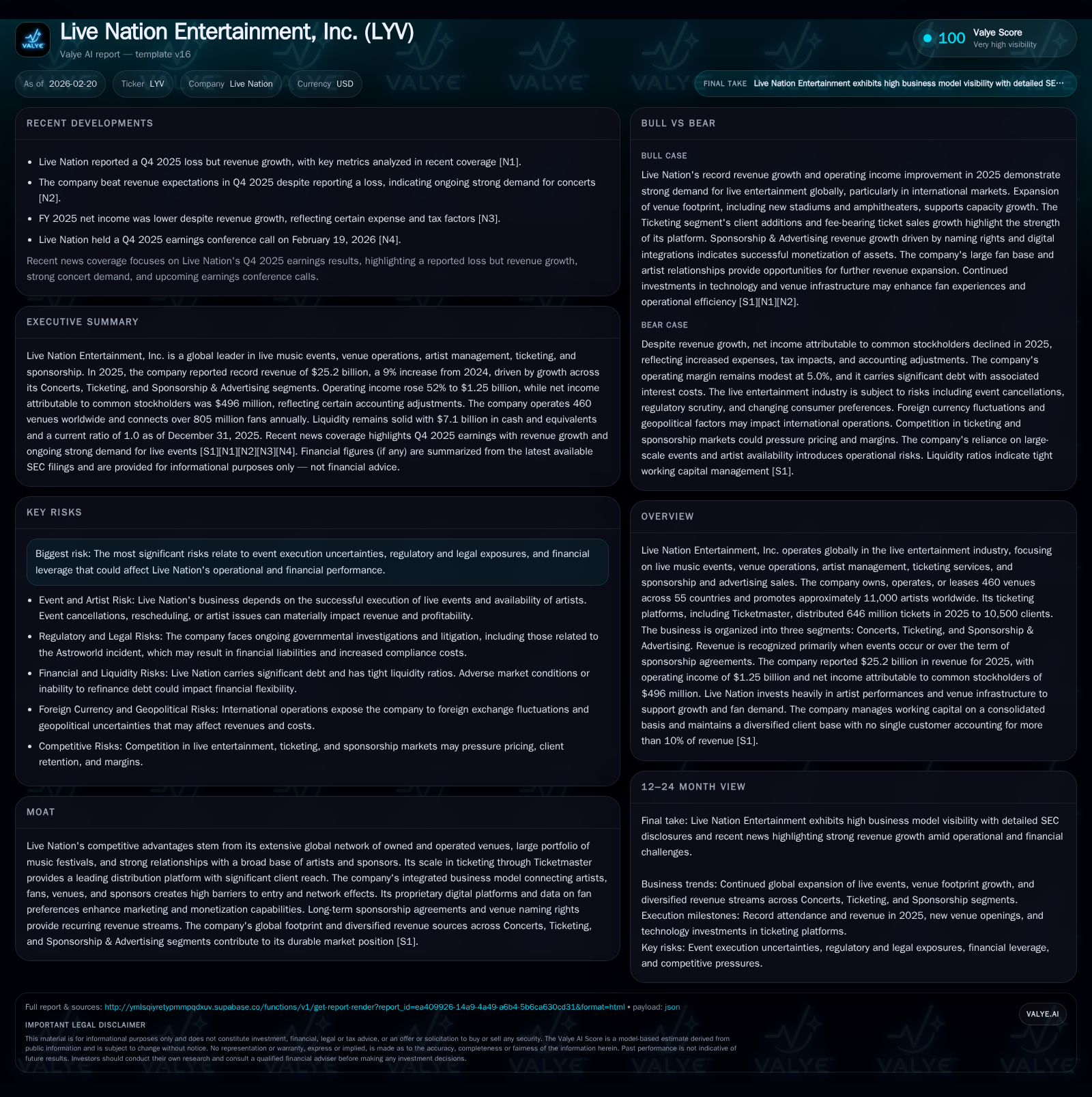
Live Nation Entertainment reported robust revenue growth of nearly 9% in 2025 driven by expanding concert volumes and ticketing scale, reaching $25.2 billion. However, net income declined sharply by 44.7% due to rising costs, legal provisions, and increased capital expenditures focused on venues and technology upgrades. The company maintains a complex debt structure with ongoing refinancing efforts, while facing significant antitrust litigation and regulatory scrutiny over ticketing practices. Monitoring its margin recovery, cash flow generation, and legal outcomes will be critical for evaluating future financial health.
Historical Financial Performance
Live Nation Entertainment demonstrated strong revenue momentum in the three years leading up to fiscal year (FY) 2025. From a base of $16.7 billion in FY2022, revenues grew steadily to $22.7 billion in FY2023 (+36%), followed by a moderate increase to $23.2 billion in FY2024 (+1.7%), then a marked acceleration to $25.2 billion in FY2025 (+8.8%) [F1]. This top-line expansion reflects the company’s broad concert footprint and the dynamism of its Ticketmaster segment, which distributed some 646 million tickets worldwide in 2025 to over 10,500 clients.
Operating income exhibited more volatility but overall upward trajectory: it rose from $732 million in FY2022 to over $1 billion in FY2023 (+45%), dipped slightly in FY2024 to $824 million (-22%), before surging by nearly 52% to reach $1.25 billion in FY2025 [F1]. The rebound underscores operational leverage leveraging incremental live events volume as well as efficiencies gained across venue management.
Conversely, net income revealed pressure points tied primarily to financing costs and legal provisions related to regulatory investigations against Ticketmaster. Net income increased substantially between FY2022 ($296 million) and FY2024 ($896 million), but then contracted sharply in FY2025 to just under half at $496 million (-44.7%) [F1]. This pattern suggests that while core operations scaled well, non-operating expenses including interest coverage and litigation-related contingencies weigh heavily on the bottom line.
Operating cash flow (CFO) decreased by approximately one-fifth from FY2024 ($1.73 billion) to FY2025 ($1.40 billion) after some fluctuations in prior years [F1]. Meanwhile capital expenditures (capex) more than doubled over four years from roughly $347 million to over $1 billion in FY2025 (+64% YoY), indicating heightened investment intensity particularly related to venue enhancements and ticketing technology upgrades [F1]. This sharp rise in capex pressured free cash flow despite record operating cash inflows.
The company's equity position shifted dramatically from negative territory between FY2022 and FY2023 (around -$368 million then -$17 million) into positive equity of about $173 million in FY2024, further increasing substantially to $271 million by year-end 2025 [F1]. This transition reflects retained earnings accumulation through profitable years combined with adjustments linked to share repurchases and other capital actions.
Historical performance (annual)
| FY | Rev ($bn) | Net ($mm) | CFO ($mm) | OpInc ($mm) | Rev YoY | Net YoY |
|---|---|---|---|---|---|---|
| 2025 | 25.2 | 496 | 1395 | 1251 | +8.8% | -44.7% |
| 2024 | 23.2 | 896 | 1725 | 825 | +1.8% | +59.1% |
| 2023 | 22.7 | 563 | 1371 | 1066 | +36.4% | +90.3% |
| 2022 | 16.7 | 296 | 1832 | 732 |
Note: Omitted columns lack sufficient annual XBRL coverage in the provided tags (need ≥2 annual points): Capex, Div, Buybacks. Source: SEC companyfacts cache [F1].
Capital returns and efficiency (annual)
| FY | FCF ($mm) | ROE% |
|---|---|---|
| 2025 | 334 | 183.0 |
| 2024 | 1079 | 517.3 |
| 2023 | 932 | -3284.8 |
| 2022 | 1485 | -80.5 |
Source: SEC companyfacts cache [F1].
Note: Dividends not available; Buybacks represent shares repurchased (net of shares surrendered for tax withholding).
Business Overview & Competitive Positioning
Live Nation operates as a globally integrated live entertainment powerhouse spanning concerts, venue operations, artist management, ticketing via Ticketmaster, plus sponsorship/advertising sales [S1]. The scale of their venue portfolio—325 North American venues plus another 127 internationally—combined with a roster of roughly 11,000 promoted artists worldwide creates significant market reach and attendee draw.
Ticketmaster remains the dominant ticketing platform distributing hundreds of millions of tickets annually allowing Live Nation extensive control over customer engagement data. Its proprietary digital channels enable personalized marketing campaigns that harness fan preferences analytics for optimized upselling premium experiences onsite or online.
The company’s vertical integration affords both network effects—increased artist booking drives fan attendance which attracts sponsor dollars—and high entry barriers given high capital requirements for venue ownership/operation along with deep contractual ties with artists and sponsors [S1]. Additionally long-duration leases on venues provide revenue stability while enabling experiential investments that enhance fan hospitality spend.
Future Growth Prospects & Catalysts
Growth drivers likely rest on several synergistic levers:
- Continued expansion/improvement of venue portfolio globally coupled with fan experience enhancements could raise average spend per attendee.
- Innovative ticketing tools that improve transaction ease/security alongside secondary market management may bolster Ticketmaster’s client retention amid regulatory headwinds.
- Further data monetization could unlock incremental sponsorship/advertising agreements priced on granular audience insights.
- Strategic acquisitions or partnerships targeting emerging artist markets or technology platforms could diversify offerings.
However, risks remain significant:
- Pending DOJ antitrust trial scheduled for March 2026 threatens substantial disruption if divestiture or forced behavioral remedies materialize [S15].
- FTC lawsuits related to pricing practices impose reputational risk; outcomes remain uncertain but potential penalties could affect profitability [S17].
- Rising interest rates elevate financing costs due to substantial indebtedness exceeding $8 billion as of year-end; refinancing windows will need careful management [S20].
- Event execution uncertainties tied to artist availability or global economic factors could limit concert attendance growth.
Capital Structure & Returns Analysis
Live Nation's capital structure is characterized by a layered debt profile totaling approximately $8.2 billion net of discounts including multiple senior secured notes due between 2027–2030 plus convertible senior notes issued recently at attractive fixed coupon rates around ~2.875% [S20][S26]. The company refinanced its senior secured credit facility in October 2025 establishing revolving facilities totaling about $1.7 billion combined with term loans intended for venue expansion [S7][S8]. Interest rate swaps partially hedge floating rate exposures ensuring certain borrowings cap at ~3.445% through October 2026 [S25].
Financial covenants mandate maintaining maximum consolidated net debt-to-EBITDA ratios tapering down from about 6.75x currently toward ~5.25x by March 2029; Live Nation asserts compliance as of December 31, 2025 [S10][S13][S25].
Equity investors witnessed a rollercoaster with past negative equity positions turning sharply positive in recent years thanks largely to improved operational cash generation offsetting large capex outlays; approximate return on equity (ROE) for fiscal year-end was an exceptionally high ~183%, signaling significant profit relative to book equity though this metric is distorted by low equity base levels amid heavy leverage [F1].
Despite revenue strength generating solid operating cash flows above $1.3 billion annually over the last two years, capex investments have escalated materially impacting free cash flow which remains positive but modest at roughly $334 million after adjusted capex commitments linked chiefly to strategic venue refurbishments and ticketing platform development [F1][S22]. Buyback activity resumed at a modest level with ~$23 million spent during calendar year 2025 representing cautious capital return amid regulatory/legal uncertainties [F1][S1]. No dividends were disclosed.
Legal & Regulatory Environment Impact
Live Nation faces heightened legal scrutiny following multifaceted antitrust complaints filed by the Department of Justice (DOJ) alongside numerous state attorneys general since mid-2024 alleging monopolistic practices associated with Ticketmaster’s dominance [S15][S18][S19]. Discovery is substantially complete ahead of trial expected March 2026; motions for summary judgment have been partially granted but residual claims remain active potentially impacting business conduct or triggering structural remedies such as mandated divestitures.
Separately the Federal Trade Commission (FTC)—joined by states in late 2025—accuses Live Nation/Ticketmaster of deceptive pricing tactics including misleading pre-checkout ticket advertisements violating consumer protection statutes requiring injunctive relief along with penalties [S17]. Management contests these allegations vigorously with motions pending.
Ongoing class action lawsuits also pose contingent liabilities though quantifying exposure remains challenging; Live Nation estimates no probable loss currently but acknowledges potential for material financial impact depending on judicial outcomes [S15][S19][S29].
These legal challenges impose operational constraints including adherence to state-specific resale restrictions placing Ticketmaster potentially at competitive disadvantage relative to less regulated secondary sellers [S18], necessitating proactive risk management investment consuming resources otherwise availably for brand expansion or product innovation.
Operational Highlights & Sector Context
The live entertainment sector continues experiencing post-pandemic resurgence fueled by consumer demand for experiential events yet grappling simultaneously with inflationary cost pressures informatic of labor markets tightness plus escalating compliance costs linked to evolving data privacy regimes such as GDPR extension effects on ticket purchaser data security obligations [S21]. Live Nation’s sizable international footprint—including venue leases extending up to multiple decades—offers scale advantages but requires consistent capital deployment averaging over a billion annually now justifying accelerated capex campaigns focused on digital transaction enhancements critical as consumers demand seamless omnichannel access against burgeoning fraud threats [S22][S26][S27].
Ticketmaster’s proprietary technology stack including AI-assisted dynamic pricing modules positions Live Nation competitively versus newer entrants attempting niche-play secondary marketplaces lacking integration breadth; however erosion risk persists if unfavorable rulings trigger structural business changes reducing platform exclusivity or deter artist contracts due to perceived market power concerns.
Venue attendance trends remain positive though margins are susceptible notably via ancillary hospitality spends influenced by premium seating offerings upgraded sound/light technologies demanding continual reinvestment—a key component driving capex increases beyond maintenance levels [F1][S22][S23].
What To Watch Next—Analysis Outlook Points
Absent explicit forward guidance disclosures within recent filings or earnings calls ([N3],[N4]), key indicators warrant close tracking include:
- Progression and rulings from March 2026 DOJ antitrust trial bearing on potential divestitures or conduct remedies affecting Ticketmaster operations.
- Outcomes or settlement developments regarding FTC deceptive pricing complaints materially impacting revenue recognition policies or requiring changes in consumer communication protocols.
- Quarterly margin trends reflecting how capex deployments translate into revenue uplift versus cost absorption especially given ongoing inflationary cost environment.
- Debt covenant compliance updates following newly amended credit agreements where free cash flow adequacy will influence refinancing flexibility or dividend/buyback capacity.
- Investor communications addressing strategic initiatives towards new digital innovations leveraging fan data analytics aiming at diversifying sponsorship revenue streams beyond traditional concert-advertising models.
In sum, Live Nation occupies a dominant position within live entertainment featuring expanding concert promotion volumes paired with a leading global ticketing platform underpinning its moat qualities; nevertheless elevated leverage coupled with intensifying regulatory challenges create a nuanced risk-return backdrop necessitating careful monitoring as legal adjudications unfold alongside continued execution against robust growth ambitions made tangible through capital-intensive investment programs.
Disclaimer: This analysis is provided solely for informational purposes based on publicly available data as of February 20, 2026, including SEC filings and news sources referenced herein. It does not constitute investment advice or recommendations regarding securities transactions.
Disclaimer: This is research-only, informational analysis and not investment advice. It may include AI-generated interpretation and general industry context. Always verify important details using primary sources.

Comments