
Black Spade Acquisition III Co’s SPAC Launch and Capital Structure Set Against Digitization Focus
Black Spade Acquisition III Co completed its IPO in early 2026, raising $172.5 million to pursue acquisitions in digitized financial infrastructure sectors.
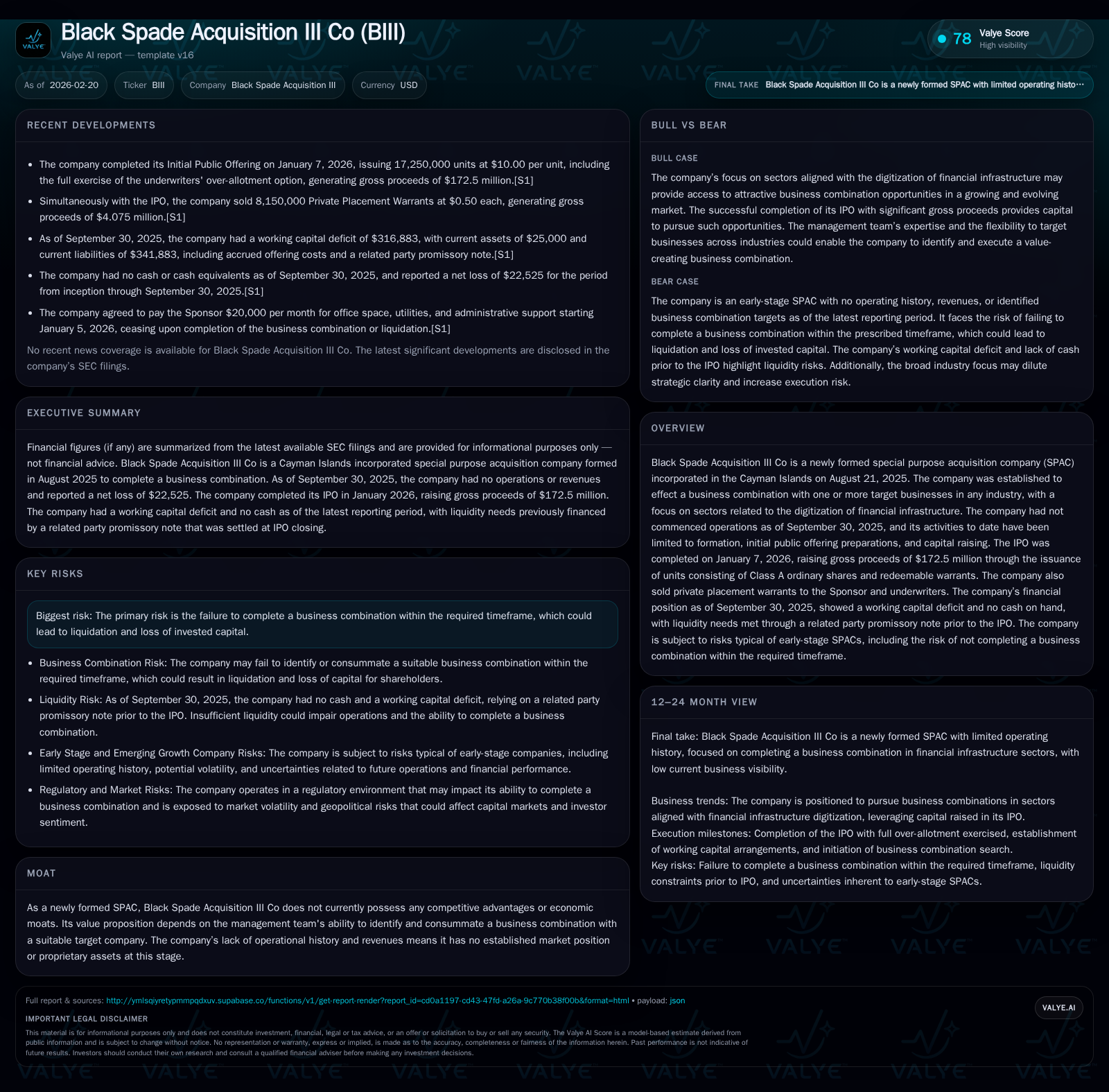
Black Spade Acquisition III Co (BIII) is a Cayman Islands-incorporated special purpose acquisition company (SPAC) formed in August 2025 to target the digitization of financial infrastructure. After initial formation and capital raising phases, it successfully raised $172.5 million via an IPO on January 7, 2026. The company has no operating history or revenues yet; its value depends entirely on management’s ability to execute a qualifying business combination within a strict time frame or face liquidation risks. Its capital structure includes Class A shares, redeemable warrants, founder shares, and private placement warrants, with funds held primarily in a trust account invested in U.S. government securities. Early financials reflect organizational costs and losses typical of a newly formed SPAC.
Company Overview and Formation Background
Black Spade Acquisition III Co (ticker: BIII) is a newly established special purpose acquisition company incorporated in the Cayman Islands on August 21, 2025 [S2]. As a blank-check entity, BIII currently lacks operational revenues or commercial activities beyond capital raising efforts geared toward identifying suitable acquisition targets. The company's strategic focus is broad by SPAC standards but concentrates on the rapidly evolving digital transformation of financial infrastructure—an area experiencing heightened investor interest amid growing fintech adoption [S2].
Historical Performance and Financial Snapshot
Due to BIII's nascent status, there are no historical revenues or operating segments apart from costs associated with corporate formation and initial offering preparations up to September 30, 2025 [F1][S2]. Operating income and net income each amounted to negative $22,525 for this period, encapsulating expenses such as legal fees, underwriting costs allocated as deferred offering expenses ($319,358), and sundry administrative charges [F1][S2]. These figures are typical for an early-stage SPAC where pre-transaction cash burn reflects setup rather than ongoing commercial activity.
As of that same date, BIII reported zero cash and cash equivalents on hand with current assets limited to prepaid expenses totaling $25,000 while current liabilities stood at roughly $341,883 – predominantly accounts payable related to offering costs [F1][S2]. This resulted in a working capital deficit of approximately $316,883—a reflection of timing differences between expenditures incurred during launch phases versus capital inflows closing after quarter-end [F1].
Historical performance (annual)
| FY |
|---|
| 2025 |
Note: Omitted columns lack sufficient annual XBRL coverage in the provided tags (need ≥2 annual points): Rev, Net, CFO, OpInc, Capex, Div, Buybacks, FCF, ROE%. Source: SEC companyfacts cache [F1].
Note: Revenue data is not available from provided tags; dividends paid and share buybacks have not been conducted since the company recently completed its IPO.
Capital Raising and Post-IPO Capital Structure
BIII consummated its initial public offering on January 7, 2026. The Company issued 17.25 million units priced at $10 per unit including full exercise of underwriters’ overallotment options representing an increase of approximately 15% above the base issue size [S3][S16]. Each unit comprises one Class A ordinary share plus one-third of one redeemable warrant exercisable at $11.50 per share post-business combination [S3][S17]. Gross proceeds amounted to about $172.5 million.
Concurrently, BIII sold roughly 8.15 million private placement warrants at $0.50 per warrant for an additional $4.1 million gross proceeds primarily subscribed by Sponsor-affiliated entities and underwriters [S4][S17][S18]. These warrants carry similar exercise terms but include transfer restrictions for up to six months post-business combination.
A material portion of net IPO proceeds ($10 per share or roughly $172.5 million) is held in a segregated U.S.-based Trust Account invested exclusively in short-term U.S. government securities with maturities under six months until used for acquisitions or redemption payments [S25][S26]. This escrow structure preserves shareholder capital while mitigating risk but introduces interest income as the sole source of revenue prior to business combinations.
The Sponsor holds founder shares equating to approximately 25% of total issued shares outstanding immediately after the IPO (including founder shares conversion) granting enhanced voting rights before closing any merger transaction [S23][S24]. Class B shares held by sponsors convert one-for-one into Class A shares upon completion of the Business Combination.
Growth Prospects and Value Drivers
Since Black Spade Acquisition III Co has not yet identified or announced any target businesses for merger acquisition as of February 2026 [N/A], growth prospects depend entirely upon management’s ability to consummate a combination transaction that creates value above the IPO price plus accrued interest. The focus on digital transformation within financial services infrastructure could encompass fintech innovators delivering efficiency gains across payments processing, clearinghouses, decentralized finance platforms or regulatory technology.
The sector itself continues rapid innovation driven by cloud migration trends and increased demand for real-time data connectivity among banks and third-party providers—trends that may fuel attractive acquisition targets aligning with BIII’s mandate.
Forecasts and Milestones to Monitor
While explicit forward guidance is absent given BIII's early stage [N/A], key milestones investors should monitor include:
- Announcement of a definitive agreement regarding an initial Business Combination.
- Completion timeline subject to regulatory approval processes that typically span several months post-announcement.
- Execution outcomes related to shareholder redemption votes impacting post-merger capital structure.
- Exercising timeline and volume of warrants which may influence dilution.
- Market reception evidenced by subsequent trading dynamics following deal announcements.
- Potential equity raising events if preliminary funds are insufficient for transaction-related expenses beyond IPO proceeds.
Regular updates will be detailed in SEC filings such as Form 8-Ks following material developments alongside quarterly earnings releases monitoring accrued deal-related expenses [N/A].
Returns Profile and Capital Allocation Considerations
Due to no operating profits or dividends distributed yet by design as an acquisition vehicle without substantial business operations pre-merger [F1], traditional returns metrics like ROE stand negative at over -900% when reflecting organizational losses against minimal equity (net loss: -$22,525; equity: $2,475 yielding approx -910% ROE) [F1]. Operating cash flow was effectively zero for the period ending September 30, consistent with no operating activities [F1].
Capital allocation is focused squarely on deploying IPO proceeds toward successful target acquisitions rather than distributions or buybacks at this stage [S14][S19]. The company pays monthly administrative fees ($20k/month) for office space and services provided by sponsor affiliates until either transaction completion or liquidation cessation occurs [S6][S16]. Any remaining funds following liquidation would be returned pro rata to public shareholders minus permitted deductions including dissolution costs.
One typical SPAC structural safeguard is shareholder redemption rights that enable public investors exit opportunities prior to merger consummation; however Founder Shares lack these rights enhancing Sponsor control alignment toward deal execution [S19][S22]. Warrants expire worthless absent business combinations completing within prescribed timelines usually capped at two years post-IPO [S19], thus providing further incentive for management urgency.
Risks and Strategic Constraints
The principal risk confronting Black Spade Acquisition III Co remains failure to consummate a qualifying Business Combination within its contractual Combination Period (commonly set at two years post-offering), triggering mandatory liquidation at then-current Trust Account values which may be below initial investment values due to transaction costs or market price volatility causing loss realization risk [S19]. Regulatory considerations related to Investment Company Act compliance constrain ownership structures post-merger limiting acquisitive flexibility.
Additionally geopolitical factors such as global market instability from conflicts could heighten credit spreads affecting Trust Account yields; although invested conservatively in short-dated US treasuries these risks remain minimal but non-zero currently [S12]. Further sector-specific risk includes valuation frothiness common in digital fintech subsectors that could pressure negotiation leverage during acquisitions.
Summary & Conclusion
Black Spade Acquisition III Co represents an archetypal early-stage SPAC positioned strategically at the confluence of financial technology digitization themes with significant capital raised ($172.5M plus private placements) ready for deployment following identification of accretive merger partners. Its operation history is minimal but typical for SPAC vehicles—negative earnings stemming from formation expenses preceding revenue generation via acquired entities post-combination.
Success hinges wholly on management execution capabilities integrating rigorous target diligence given intense sector competition along with timely transaction closure while maintaining shareholder alignment through structured voting and redemption rights. Observers should track forthcoming announcements around definitive agreements next steps critical for transitioning from holding company status toward operating entity generation value potential.
Disclaimer: This analysis is based solely on publicly available information as of February 20, 2026 including SEC filings cited herein and offers no investment advice or recommendation.
Disclaimer: This is research-only, informational analysis and not investment advice. It may include AI-generated interpretation and general industry context. Always verify important details using primary sources.

Comments