
Bausch + Lomb's Strategic Balancing Act: Growth, Debt, and Operational Transformation
Bausch + Lomb shows healthy revenue gains but faces persistent profitability pressures while investing heavily in operational transformation and managing significant debt.
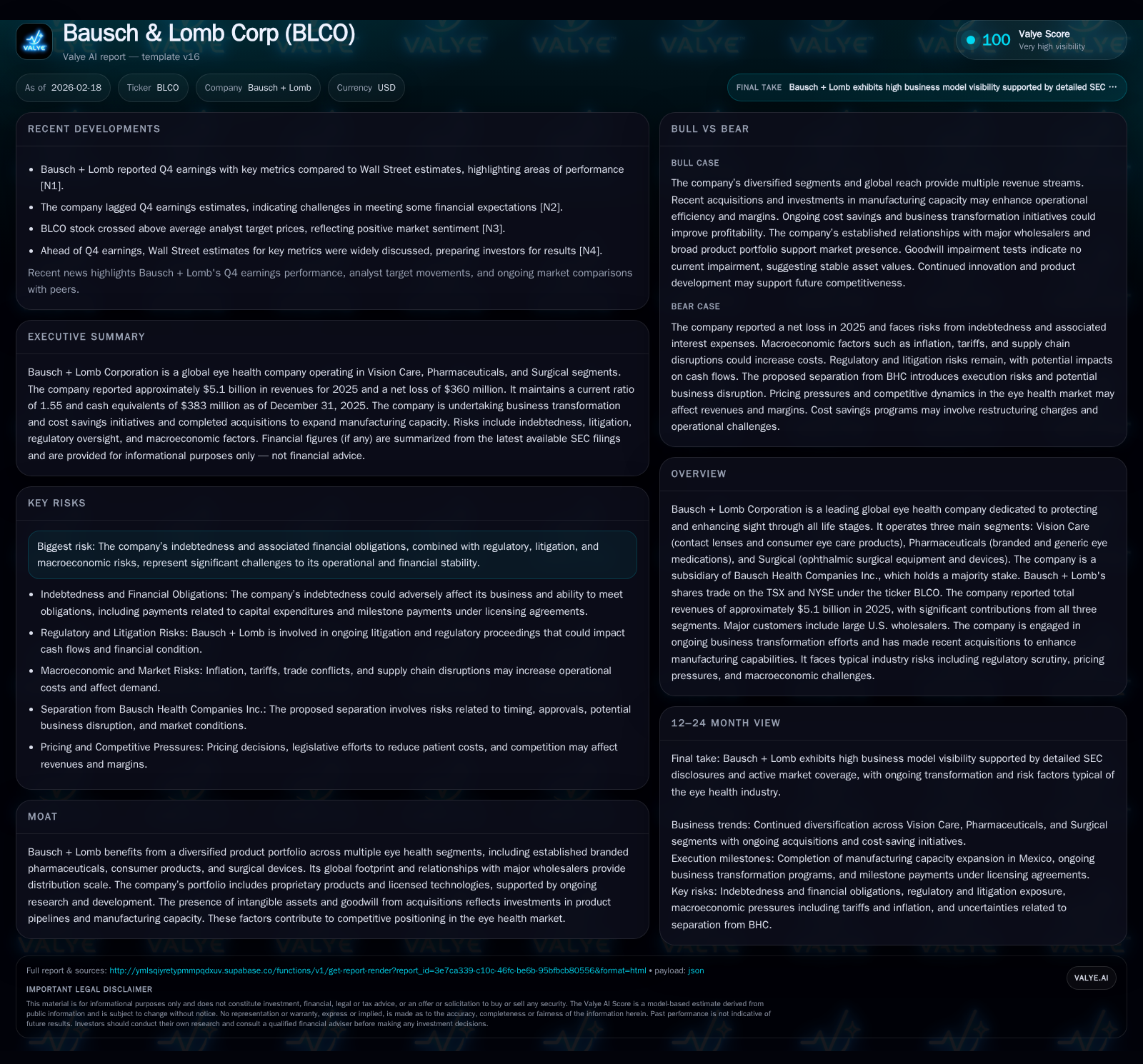
Bausch + Lomb Corporation has achieved revenue growth driven by its diversified eye health portfolio, including vision care, pharmaceuticals, and surgical segments. However, operating income declined by over 30% year-over-year in FY2025 due to cost pressures, business transformation expenses, and elevated SG&A costs. The company is undergoing major operational restructuring and expanding manufacturing capacity with substantial capital expenditures. Concurrently, Bausch + Lomb refinanced significant debt facilities to extend maturities and reduce interest expenses while maintaining covenant compliance. Operating cash flows improved by 22%, yet free cash flow remains negative due to high capex. No dividends or share repurchases were disclosed, indicating a focus on deleveraging and investment. Key near-term milestones include a $35 million Novaliq licensing milestone payment and closing of a Mexican manufacturing asset acquisition. Investors should monitor execution on cost savings programs, operational leverage improvements, and ongoing regulatory and litigation risks [F1][S1][S2][S4][S5][S6][N1][N2].
From Growth Drivers to Profit Pressures: Reviewing Historical Financial Performance
Bausch + Lomb’s top-line momentum is anchored by its tri-segment portfolio comprising Vision Care (contact lenses and consumer eye care products), Pharmaceuticals (branded and generic ophthalmic medications), and Surgical (ophthalmic surgical devices). In 2025, total revenues reached about $5.1 billion [S4], propelled by sustained demand across geographically diverse markets. Notably, the U.S. and Puerto Rico accounted for roughly half the revenue ($2.55 billion), followed by sizable contributions from Europe (France, Germany, UK) and Asia (China, Japan) [S4]. The two largest customers, McKesson Corporation and Cardinal Health Inc., together represented approximately 20% of revenues within North America [S4].
Despite revenue expansion supporting operating leverage opportunities inherent in the sector’s business model—where fixed costs associated with manufacturing facilities can dilute per-unit costs as volumes grow—Bausch + Lomb’s operating income fell from $162 million in FY2024 to $113 million in FY2025 (a -30% year-over-year decline) [F1]. This decline reflects margin pressure from increased SG&A related to business transformation costs and investments in commercial infrastructure as well as inflationary headwinds impacting input costs [S1][S2][N1]. Net losses widened from -$317 million in FY2024 to -$360 million in FY2025 despite these sustained sales gains [F1].
Operating cash flow improved by 22%, reaching $283 million in FY2025 compared with $232 million prior year [F1], indicating some recovery of underlying earnings quality amidst restructuring-driven expense outlays.
Historical performance (annual)
| FY | Net ($mm) | CFO ($mm) | OpInc ($mm) | Capex ($mm) | Net YoY |
|---|---|---|---|---|---|
| 2025 | -360 | 283 | 113 | 349 | -13.6% |
| 2024 | -317 | 232 | 162 | 291 | -21.9% |
| 2023 | -260 | -17 | 130 | 181 | -4433.3% |
| 2022 | 6 | 345 | 207 | 175 |
Note: Omitted columns lack sufficient annual XBRL coverage in the provided tags (need ≥2 annual points): Rev, Div, Buybacks. Source: SEC companyfacts cache [F1].
Capital returns and efficiency (annual)
| FY | FCF ($mm) | ROE% |
|---|---|---|
| 2025 | -66 | -5.6 |
| 2024 | -59 | -4.9 |
| 2023 | -198 | -3.8 |
| 2022 | 170 | 0.1 |
Source: SEC companyfacts cache [F1].
Note: Revenue data not available from provided tags; YoY changes for Net Income computed where possible.
This divergence between profitability deterioration yet positive cash flow performance signals the complex interplay of non-cash charges such as amortization on acquired intangibles balanced against working capital management amid restructuring.
Transforming Operations Amid a Diversified Eye Health Portfolio
Bausch + Lomb has embarked on comprehensive operational restructuring aiming at reducing redundant overheads while strengthening core manufacturing and R&D capabilities [S1][S2]. These initiatives—classified as Business Transformation Costs—involve severance upon executive turnover and consulting fees recorded within SG&A [S1]. Planned headcount rationalizations align with attempts to reduce real estate expenses tied to underutilized sites while pursuing contribution margin improvements through supply chain efficiency enhancements.
A key strategic move is the acquisition agreement signed in September 2025 for certain manufacturing equipment and lease assumption of a Mexican facility intended to boost device production capacity—expected close late Q4-25 or early Q1-26 pending regulatory approvals with an upfront payment around $75 million [S2]. This aligns with industry trends emphasizing nearshoring capabilities given global supply chain volatility.
Licensing agreements continue affecting cost structures; notably, future milestone payments tied to technologies like MIEBO® under Novaliq GmbH licensing require financial accruals reflecting sales-based triggers realized recently—a $35 million payment anticipated Q1-26 [S1]. These licensing obligations introduce variable cost components complicating margin forecasting during this transformative phase.
Taken together, these operational revamps aim for long-term margin expansion once upfront costs are absorbed—a typical dynamic where transformative investments precede sustainable contribution margin improvements.
Capital Investments Driving Future Manufacturing Capabilities
Capital expenditures have been elevated as Bausch + Lomb invests heavily in expanding manufacturing scale aligned with product pipeline demands and technology upgrades [F1]. FY2025 capex was approximately $349 million representing nearly a 20% increase versus prior year—underscoring heightened asset building activity focused on long-lived property plant & equipment investments [F1][S28].
Looking forward into calendar year 2026, planned capital spending is projected at roughly $285 million [S1], focused on device production capacity enhancements leveraging new Mexican facilities alongside upgrades at existing plants predominantly located across U.S., Ireland and Germany—which account for over two-thirds of net PP&E assets [S4].
This capex intensity exceeds typical maintenance levels seen in ophthalmic device manufacturers but aligns with growth strategies requiring expanded throughput capability such as cleanroom capacity additions or automation integration.
The elevated investment posture reflects both the necessity of maintaining technological leadership amid rapid innovation cycles as well as geographic diversification for supply chain risk mitigation.
Debt Refinancing and Capital Structure: Managing Financial Obligations
In January 2026, Bausch + Lomb refinanced significant term loans due between 2027–28 with a new $2.8 billion term loan maturing January 2031 [S5][S6]. This refinancing reduced weighted average interest rates from approximately 7.95% down towards ~7.7%, extending maturity profiles beyond five years—affording enhanced liquidity runway for ongoing transformation efforts.
Total gross debt maturities exceed $5 billion extending into early-2030s [S5]. Borrowings under senior secured credit facilities are supported by first priority liens on material subsidiaries’ assets but impose customary affirmative/negative covenants restricting additional indebtedness, asset sales, dividends or share repurchases without lender consent [S6].
Financial covenants require adherence to maximum first lien leverage ratios starting at no greater than ~5.75x tapering down over time—a standard regime among highly leveraged medical device firms undergoing restructurings [S6]. The company is currently compliant with all covenant tests reported thus far.
These constraints necessitate prudent stewardship of operating cash flows balancing debt servicing alongside capital investments outlined above.
Cash Flow Realities and Capital Allocation Stance
FY2025 saw operating cash flow improve to $283 million reflecting better collection cycles alongside moderation of working capital outflows compared with prior years’ fluctuations which included temporary negative CFO of -$17 million in FY2023 [F1].
However free cash flow remains negative around -$66 million given sustained high capital expenditures related to growth phase investments [F1]. This negative FCF underscores management’s prioritization of long-term scalability over short-term distributable cash generation.
No dividends or share buybacks were disclosed during this period indicating a conservative capital allocation stance focused on deleveraging supplemented by reinvestment rather than shareholder returns—a prudent approach given elevated indebtedness exceeding several billions USD alongside ongoing litigation risks detailed below [F1][S1][S7].
Monitoring conversion from negative free cash flow toward sustained positive generation will be key for assessing future shifts toward more active shareholder return policies.
What Investors Should Monitor Next: Key Milestones and Market Expectations
Near-term catalysts include completion of milestone payments linked to Novaliq GmbH licensing obligations whose $35 million tranche is forecasted early Q1-26 following achievement of sales-based thresholds [S1]. This event will impact P&L discretely alongside signaling effects regarding product commercial traction.
The closing timeline on Mexican manufacturing assets acquisition expected late Q4-25 or early Q1-26 pending regulatory clearance will materially affect capacity planning variables along with depreciation profiles going forward [S2]. Additionally monitoring sequential quarterly operating results throughout first half calendar year will be crucial given recent Q4 earnings performance lagging consensus estimates reflecting lingering transformation costs burdens [N2][N3].
Investors should also watch updates on regulatory oversight post-transformation especially FDA audits given historical scrutiny faced by ophthalmic device manufacturers—non-compliance could trigger corrective expenses or recalls impacting margins [S7][N1]. Meanwhile recent partial resolution on significant class-action litigation related to legacy issues reduces some overhang though other legal exposures persist requiring vigilance [S10].
Given absence of formal earnings guidance post-filing, market participants will likely focus on qualitative disclosure around synergy realization within SG&A line items as cost savings mature plus commentary on product pipeline tied to proprietary licensed technologies influencing future prospects [N5].
Disclaimer: This report is for informational purposes only and does not constitute investment advice or recommendations regarding Bausch + Lomb Corp or its securities.
Disclaimer: This is research-only, informational analysis and not investment advice. It may include AI-generated interpretation and general industry context. Always verify important details using primary sources.

Comments