
Triller Group Inc.: Balancing AI Innovation with Financial Strains
Triller’s ambitious AI-powered platform growth contends with worsening losses and challenging regulatory backdrop.
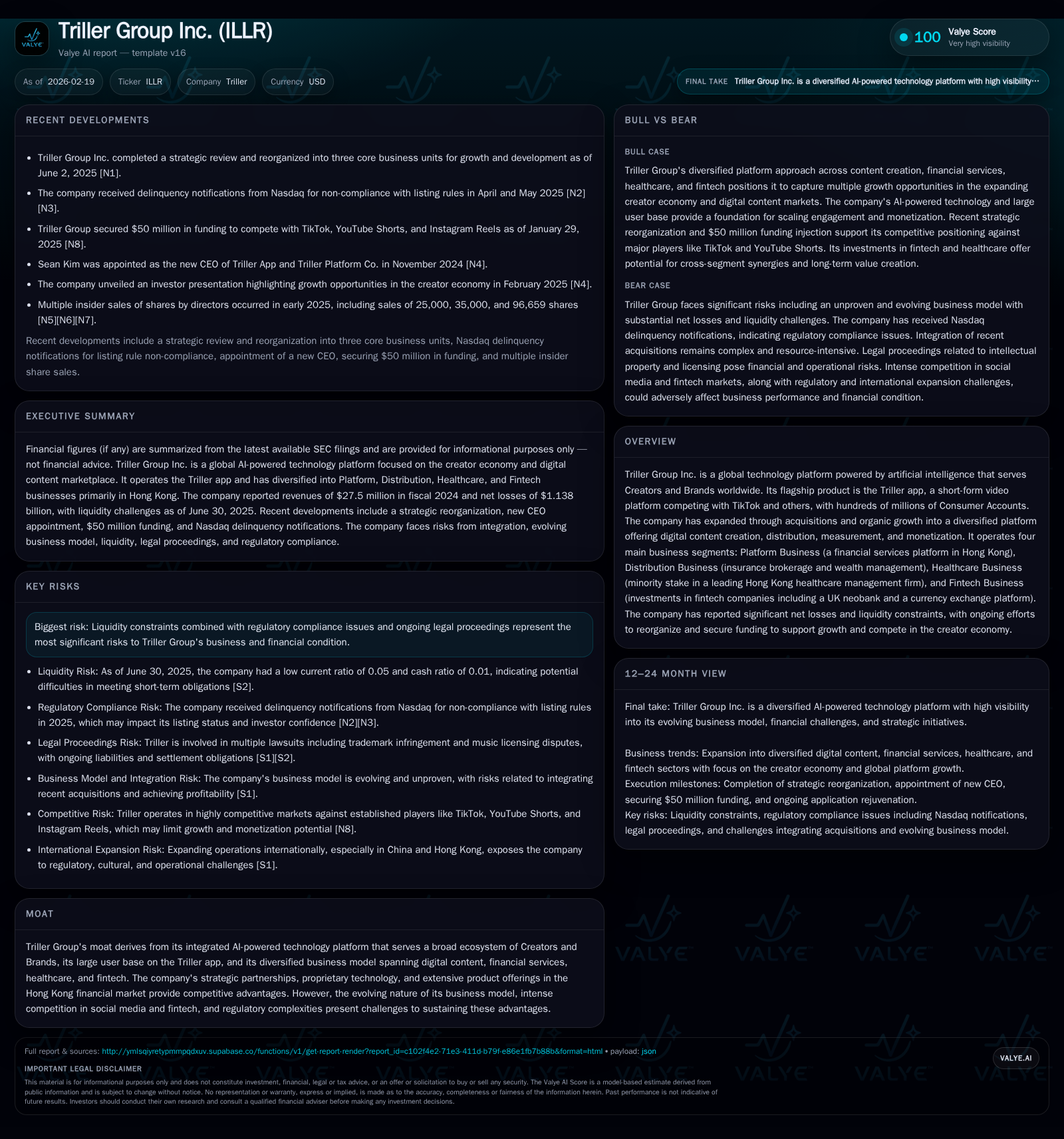
Triller Group Inc. has rapidly expanded its AI-driven short-form video platform, establishing over 327 million consumer accounts after a rigorous bot purge, while diversifying into financial services, healthcare, and fintech mainly in Hong Kong. Despite this broadening footprint and innovative technological core, the company faces steep revenue declines (-11.6% YoY) alongside large and escalating net losses (FY2024 net income down more than twentyfold). Significant legal challenges and an evolving regulatory environment, especially in Hong Kong and implications from PRC laws, compound liquidity constraints reflected in an alarmingly low current ratio (~0.05). Triller’s capital allocation remains conservative given its financial condition, with no recent dividends or meaningful capex investment, leaving future growth heavily dependent on successful navigation of regulatory hurdles and monetization paths within its diverse segments.
Growth Trajectory and Business Model Evolution
Triller Group Inc. has established itself as a distinctive player leveraging artificial intelligence at the core of its technology platform serving Creators and Brands globally. Central to its identity is the Triller app — a social media competitor in the short-form video segment vying with TikTok and others — which has amassed over 327 million Consumer Accounts after conducting an extensive cleanse removing more than 200 million duplicates and bots [S1][F1]. This proactive user base hygiene is relatively uncommon among social platforms and underpins its ecosystem credibility.
Beyond consumer content creation and engagement via Triller app, the company has pursued an ambitious diversification path encompassing four principal business segments:
- Platform Business: A comprehensive financial services platform headquartered in Hong Kong offering insurance, wealth management product access, brokerage, and digital tools branded as “OnePlatform.” [S10]
- Distribution Business: Licensed insurance brokerage and Mandatory Provident Fund intermediary operations serving both institutions and individuals through a network of approximately 1,500 independent advisors [S15].
- Healthcare Business: A minority stake investment within a leading healthcare management firm based in Hong Kong broadens exposure to service sectors beyond fintech.
- Fintech Business: Participates through investments in emerging fintech ventures including a UK neobank initiative and currency exchange platforms, adding global reach but also sectoral complexity.
This multi-pronged model combines content-driven consumer engagement with heavily regulated financial services infrastructure mainly oriented toward Hong Kong’s markets. The approach aims to intertwine AI-enabled data analytics across verticals to foster customer acquisition, cross-selling opportunities, and competitive moats around the integrated customer lifecycle [S10].
Financial Performance Review: Declining Revenues and Escalating Losses
Triller's recent financial performance reflects substantial challenges converting scale into sustained profitability. Annual revenues fell approximately 11.6% from $31.1 million in FY2022 to about $27.5 million in FY2024 [F1]. This decline evidences difficulties enhancing monetization across both digital content distribution and associated financial product sales amid growing regulatory friction.
Operating income losses have widened sharply from -$28.4 million (FY2022) to -$113.2 million (FY2024), magnifying by over 150% year-over-year [F1]. Net income deteriorated even more drastically — from -$44.5 million (FY2022) to a staggering -$1.14 billion (FY2024), indicating one or more substantial one-off impairments or extraordinary charges [F1].
Operating cash flow trends mirror these headwinds but show some moderation in deterioration: CFO dropped from -$19.3 million (FY2022) to about -$29 million (FY2024), albeit with a milder 31% YoY increase in negative outflows suggesting temporary fiscal tightening [F1]. Capital expenditures have remained stable yet minimal ($105k annually), signaling constrained investment capacity.
Historical performance (annual)
| FY | Rev ($mm) | Net ($mm) | CFO ($mm) | OpInc ($mm) | Net YoY |
|---|---|---|---|---|---|
| 2024 | 27 | -1138 | -29 | -113 | -2212.8% |
| 2023 | -49 | -42 | -44 | -10.5% | |
| 2022 | 31 | -45 | -19 | -28 | -5687.0% |
| 2021 | -1 | -1 |
Note: Omitted columns lack sufficient annual XBRL coverage in the provided tags (need ≥2 annual points): Capex, Buybacks. Source: SEC companyfacts cache [F1].
Capital returns and efficiency (annual)
| FY | Div ($mm) | FCF ($mm) | ROE% |
|---|---|---|---|
| 2024 | -29 | 462.7 | |
| 2023 | 17 | -42 | -607.3 |
| 2022 | 17 | -20 | -1072.7 |
| 2021 | 11.2 |
Source: SEC companyfacts cache [F1].
Table: Historical Financial Summary for Triller Group Inc., showing deteriorating profitability metrics alongside constrained investment spend [F1]
Regulatory Environment and Legal Challenges Impacting Operations
Triller operates predominantly out of Hong Kong with no direct mainland China operations; however, it prudently discloses exposure to evolving PRC laws which might extend extraterritorially or indirectly affect subsidiaries given geopolitical nuances [S1][S24]. The regulatory landscape is notably complex with oversight bodies regulating financial distribution businesses under licenses issued by the Hong Kong Insurance Authority, Mandatory Provident Fund Schemes Authority, Securities & Futures Commission among others [S15][S19].
Potential legislative shifts include data security laws such as the PRC Personal Information Protection Law effective since late 2021 that impose heightened personal data handling duties potentially restricting cross-border data flows crucial for AI algorithm training [S16][S13]. Furthermore, intensified scrutiny over overseas-listed firms like those governed under Holding Foreign Companies Accountable Act threatens trading privileges if audit inspections remain limited [S26].
On top of that backdrop are numerous legal proceedings alleging trademark infringement dating back several years with notable trials concluded unfavorably warranting ongoing appeals [S20]. Various class actions charge unpaid wages for production staff overseeing media content creation alongside personal data privacy lawsuits reflecting operational lapses or perceived violations [S5][S21]. Such disputes impose costly legal defense outlays diverting management attention and risk large damage assessments potentially imperiling solvency without fresh capital infusions.
Compliance risks extend further into anti-money laundering statutes, export controls limiting dealings with sanctioned entities, advertising regulations affecting marketing formats, athlete agent licensing relevant for live events promotion, as well as COVID-era restrictions impacting international travel or event staging [S7][S22][S23][S9]. Any violation incurs penalties ranging from fines through license revocations that would curtail certain revenue streams critically tied to financial products or fan engagement experiences.
Multi-Segment Strategy: Synergies and Sector-Specific Risks
The multi-segment portfolio brings operational scale but also disparate regulatory frameworks requiring specialized governance structures within each segment:
- The Platform Business focuses on offering a wide breadth of insurance products (over 1,200 offerings spanning life insurance to MPF) alongside mutual funds sourced from nearly fifty asset managers supporting over nine hundred fund products — assembled into an AI-enabled "one-stop" digital interface targeting Hong Kong's affluent consumers using advanced lead management systems for upselling cross-financial solutions [S10][S15].
- The Distribution segment operates as a regulated insurance brokerage employing a large team of licensed advisors providing wealth management advisory under stringent local compliance rules supervised by multiple authorities[S15][S19].
- Healthcare investments although minor do introduce healthcare regulatory considerations common in Hong Kong’s managed care sector including patient data governance.
- Fintech ventures build international exposure but face evolving fintech licensing regimes subject to interpretation around consumer lending practices or currency exchange controls applying variably across jurisdictions like the UK where the neobank operates[S10][S7].
Notably absent are variable interest entities (VIEs), which many China-based companies use to circumvent foreign ownership restrictions; Triller confirms it does not employ VIEs for mainland China expansion but acknowledges uncertainties if PRC law interpretations evolve regarding overseas-listed companies connected indirectly to China-based customers [S15][S24].
The broad diversification strategy aims at creating cross-segment synergies using shared AI analytics capabilities but also risks resource dilution coupled with significant compliance challenges needing heavy investments into internal control frameworks across heterogeneous regulatory environments.
Liquidity Constraints and Capital Structure Analysis
Liquidity metrics spotlight critical short-term solvency concerns threatening operational continuity without new funding mechanisms or drastic cost curtailment measures:
At June 30, 2025, Triller reported roughly $2.09 million in cash versus approximately $327.7 million in current liabilities producing an extremely weak current ratio around 0.05 [F1], indicative of deep liquidity stress reminiscent of insolvency warning signals commonly seen in distressed technology platform peers facing rapid burn rates.
This disproportionate capital structure suggests high risk related to meeting imminent debt obligations including pending litigation settlements or accrued payable accounts linked particularly to financial services providers engaged by the Platform/Distribution segments [S25]. The company's stockholders' equity plunged into deeply negative territory (-$246 million at end FY2024)[F1], reflecting accumulated deficits exacerbated by extraordinary losses accrued during that period hinting at severe erosion of balance sheet integrity.
Absent substantial fresh capital injections or asset disposals to relieve this pressure, sustaining day-to-day operations while simultaneously investing adequately across the AI-platform ecosystem poses formidable challenges given narrow cash runway highlighted by consistent negative operating cash flows trending above $29 million annually despite cost controls [F1].
Capital Allocation: Dividends, Buybacks & Returns Analysis
Capital deployment patterns reflect defensive stances amid ongoing hemorrhaging:
Triller paid dividends totaling about $17.4 million notably during FY2022 only before ceasing payouts entirely thereafter consistent with worsening loss profiles; no dividends were recorded post-FY2023 [F1]. Stock repurchases were last reported at approximately $8.1 million during FY2022 with no subsequent buybacks disclosed [F1].
Investment in property plant & equipment has been negligible (~$100k annually) indicating limited appetite or capability for fixed asset expansion; rather focus appears on maintaining existing technology infrastructure perhaps pivoting towards software-centric development instead [F1].
Return on equity calculations are distorted due to the negative equity base; approximated ROE based on latest annual net income relative to equity is positive but misleading at ~462%, driven by large negative equity rather than profitable operations [F1]. Free cash flow remains negative at approximately -$29 million (operating cash flow minus capex), underscoring persistent cash burn without signs of operational breakeven [F1].
Future Outlook: Strategic Considerations & Risks Ahead
No explicit forward guidance or milestone commitments are available from filings or news sources; critical areas for investor focus include:
- Resolution timelines for ongoing litigation including trademark infringement appeals and class action lawsuits scheduled through late 2024 into early 2025 which bear material financial risk.
- Regulatory developments impacting cross-border data flows due to PRC Personal Information Protection Law enforcement combined with heightened scrutiny on overseas-listed companies may constrain operational flexibility.
- Execution progress on customer acquisition strategies targeting Greater Bay Area affluent clients via partnerships leveraging digital marketing platforms remains pivotal.
- Ability to secure additional financing or restructure liabilities will be vital given severely constrained liquidity impacting growth investments.
- Effectiveness of proprietary AI models deployed across content distribution and fintech verticals will influence monetization success amid fierce competition.
- Competitive pressures from entrenched players like TikTok continue presenting barriers for user engagement expansion despite differentiated technology offerings.
Success along these vectors could stabilize operations but considerable execution risk persists given external macro-regulatory pressures compounded by internal structural deficits.
Note: Return on equity figures are approximate given negative equity values distorting ratios; dividend yield is effectively zero post-FY2023; no explicit guidance on future dividends or buybacks was found within provided filings [F1].
Disclaimer: This is research-only, informational analysis and not investment advice. It may include AI-generated interpretation and general industry context. Always verify important details using primary sources.

Comments