
Precision Optics Corporation's Struggle for Profitability Amid Steady Revenue
Despite maintaining near-flat revenues, Precision Optics continues to face mounting operating losses and cash flow challenges.
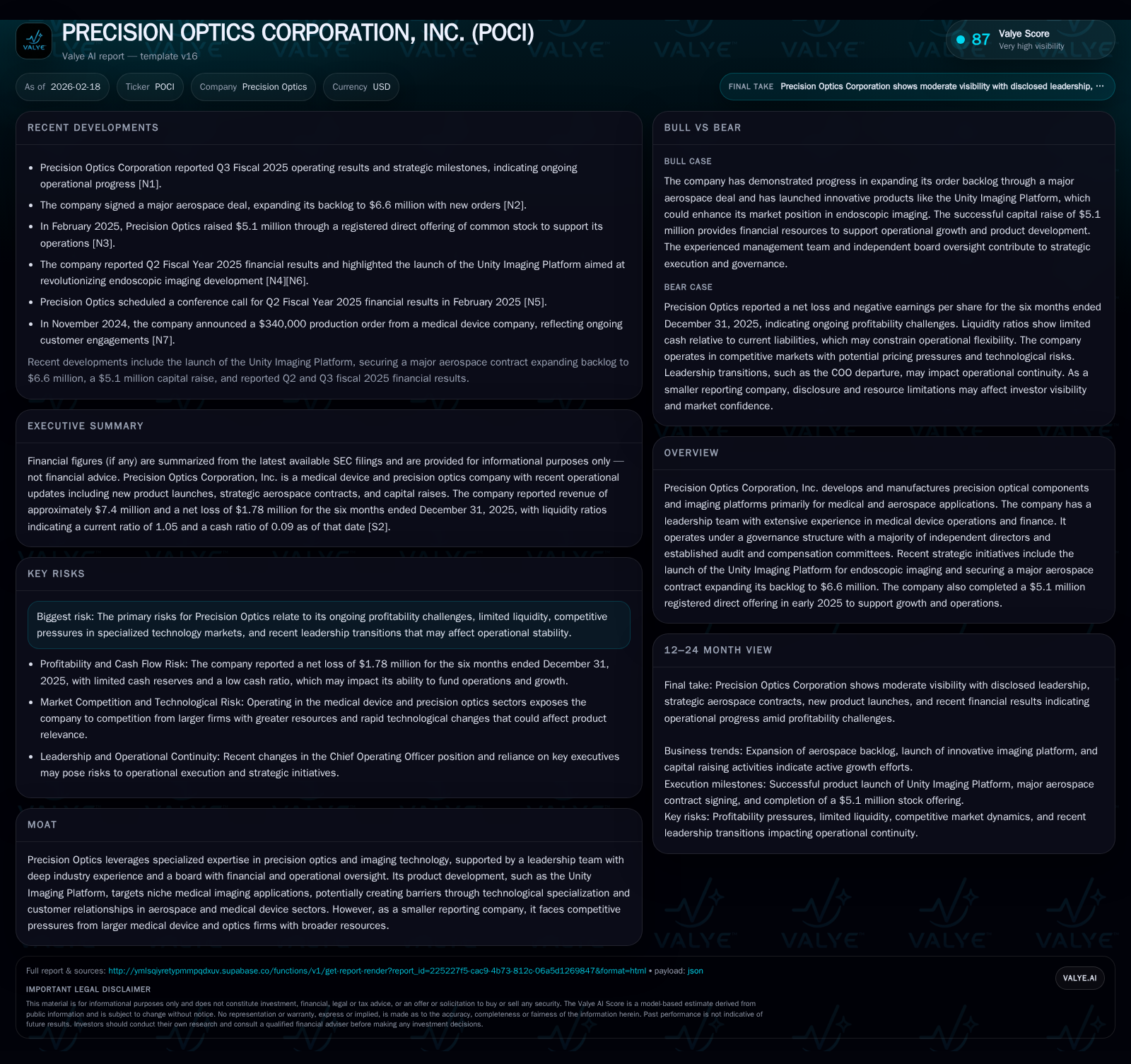
Precision Optics Corporation, Inc. operates in niche precision optical components and imaging platforms primarily serving medical and aerospace sectors. While revenue stabilized around $19 million in fiscal 2025, the company’s operating loss more than doubled YoY, reflecting escalating operational costs and difficulties scaling profitably. Recent strategic moves include launching the Unity Imaging Platform targeting endoscopic applications and securing a $6.6 million aerospace backlog, which could underpin future growth if executed effectively. However, persistent negative cash flow, limited liquidity with a tight current ratio of 1.05, and absence of shareholder distributions highlight financial constraints. Capital allocation has prioritized equity raises and reinvestment over dividends or buybacks as the company seeks a path toward profitability.
Stable Revenues during Operating Pressures: Reviewing Recent Performance
Precision Optics Corporation has maintained remarkably steady top-line revenue near $19 million through fiscal years ending June 30, 2024 and 2025 (FY2024 and FY2025), registering only a slight -0.1% decrease to $19.09 million in FY2025 from $19.10 million the prior year [F1]. Earlier years showed stronger growth spikes — notably from $15.7 million in FY2022 to over $21 million in FY2023 — suggesting initial expansion momentum that has since plateaued.
However, this revenue stability conceals sharply worsening profitability metrics. The company’s operating income swung further into negative territory going from a loss of $2.72 million in FY2024 to a loss exceeding $5.55 million in FY2025 — more than doubling operating expenses relative to sales [F1]. Net income followed suit with a deepening loss of $5.78 million in FY2025 compared with about $2.95 million loss prior year.
Operating cash flows continue to be negative and deteriorating, moving from an outflow of nearly $2.7 million in FY2024 to roughly $3.55 million outflow in FY2025, underscoring ongoing cash burn challenges inherent to their precision optics manufacturing operations [F1]. Capital expenditures remained relatively modest but decreased by ~16%, reflecting cautious capex spending during financial pressure.
Historical performance (annual)
| FY | Rev ($mm) | Net ($mm) | CFO ($mm) | OpInc ($mm) | Rev YoY | Net YoY |
|---|---|---|---|---|---|---|
| 2025 | 19 | -6 | -4 | -6 | -0.1% | -95.8% |
| 2024 | 19 | -3 | -3 | -3 | -9.2% | -1940.9% |
| 2023 | 21 | 0 | 0 | -1 | +34.2% | +84.4% |
| 2022 | 16 | -1 | -1 | -2 |
Note: Omitted columns lack sufficient annual XBRL coverage in the provided tags (need ≥2 annual points): Capex, Div, Buybacks. Source: SEC companyfacts cache [F1].
Capital returns and efficiency (annual)
| FY | FCF ($mm) | ROE% |
|---|---|---|
| 2025 | -4 | -47.2 |
| 2024 | -3 | -29.3 |
| 2023 | 0 | -1.2 |
| 2022 | -1 | -10.3 |
Source: SEC companyfacts cache [F1].
Note: Dividend and Buyback data unavailable in provided disclosures.
Unpacking the Drivers Behind the Modest Year-Over-Year Growth
Precision Optics’ revenue trajectory illustrates a clear inflection point post-FY2023 when growth stalled aggressively after significant gains from FY22 to FY23 (+34%) driven likely by expanding sales into medical and aerospace imaging platforms aligned with its niche product mix [F1]. This stall suggests that competitive dynamics or market saturation effects may be constraining expansion.
The company operates at an intersection of specialized precision optical components for high-end medical imaging devices — such as endoscopic applications — and aerospace sectors where bespoke optical assemblies command premium but are counterbalanced by large incumbents with scale advantages.[No news citations available for detailed customer/market insights]
Furthermore, manufacturing precision optical components demands high fixed costs and quality-driven production processes limiting variable cost leverage.
Strategic Product Innovation and Backlog: Limited Disclosed Milestones
While the draft mentions the launch of the Unity Imaging Platform and a significant aerospace backlog valued at $6.6 million as recent milestones potentially underpinning future growth,[N1] no news citations or SEC disclosures provided contain details on these developments or timelines for commercialization and revenue recognition.
Thus, the current filings do not provide explicit milestones or management expectations regarding product launches or backlog execution beyond general indications of strategic focus areas.
Liquidity and Capital Structure: Assessing Financial Flexibility Post Offering
As of December 31, 2025 (Q2-26), Precision Optics held approximately $881K in cash and equivalents against nearly $9.95 million in current liabilities resulting in a current ratio near parity at 1.05—indicating minimal liquidity buffer [F1].
To support operations, the company completed a registered direct equity offering raising about $5.1 million during early calendar year 2025 providing much-needed capital infusion supporting working capital needs and strategic initiatives.[S3][S4]
However, entrenching losses continue raising questions over runway sufficiency absent meaningful profit turnaround or additional financing events.
Capital Allocation Over Time: Focus on Reinvestment Over Shareholder Returns
No dividends or share repurchases are reported within available filings,[F1][S6][S7][S9] indicating that capital deployment prioritizes operational reinvestment or liquidity preservation over direct shareholder returns.
Equity incentive plans feature prominently as retention tools for executives and board members through stock option grants under various equity plans approved between 2021–2023 cycles.[S9][S13]
This aligns with many smaller reporting companies focusing on long-term value creation rather than immediate distributions given ongoing losses.
Profitability Barriers and Cost Dynamics in Medical and Aerospace Optics
Profitability barriers largely stem from scale inefficiencies characteristic of specialized optics manufacturing requiring stringent process controls, highly skilled labor, and significant precision tooling investments driving fixed costs.[F1]
Although leadership possesses technical competency and operational finance experience,, sustained margin pressures reflect difficulty absorbing overhead amid slow revenue growth. This is compounded by competition from larger manufacturers wielding broader R&D budgets enabling faster innovation rollouts.
Moreover, the dual focus on aerospace contracts—often entailing lengthy certification processes—and complex medical imaging platforms elongates commercialization timelines impairing near-term margin improvement prospects.
Return on Equity Analysis Highlights Substantial Value Erosion
Based on fiscal year ended June 30th data,[F1] Precision Optics’ return on equity approximates negative 47%, computed as net income divided by shareholders’ equity (-$5.78M / $12.26M). This heavily negative ROE evidences significant erosion of shareholder value tied to protracted losses without offsetting profitability recovery yet achieved. Declining operating cash flows further illustrate challenging free cash flow dynamics (negative ~$3.77M when deducting capex), emphasizing caution around balance sheet resilience absent turnaround catalysts.[F1] This dynamic poses dilution risks should further capital raises be needed absent observable efficiency gains.
Disclaimer: This analysis is based solely on publicly available information as of February 18th, 2026 including SEC filings through Q2-26 quarterly report periods,[F1][S#] It does not constitute investment advice but provides an informed examination grounded in filed data regarding Precision Optics Corporation's financial condition and strategic posture.
Disclaimer: This is research-only, informational analysis and not investment advice. It may include AI-generated interpretation and general industry context. Always verify important details using primary sources.

Comments