
Ingredion Inc’s Growth Leverage Hinges on Innovation Amid Raw Material Volatility
Ingredion’s robust R&D and manufacturing footprint support growth, but commodity swings and segment dynamics pose balancing challenges.
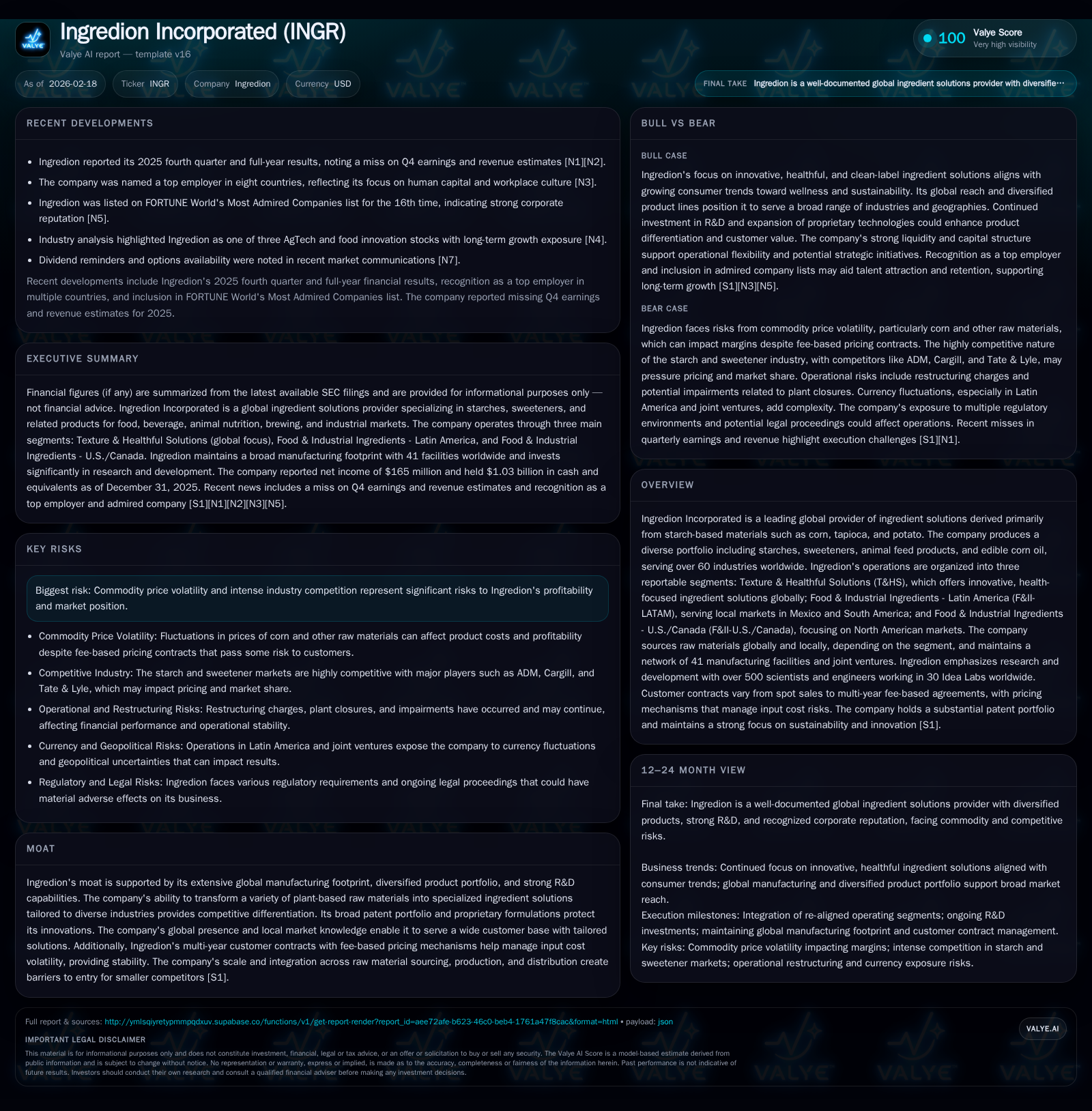
Ingredion Incorporated has grown operating income by over 15% year-over-year in 2025 through focused innovation in starch- and sweetener-based ingredient solutions. The company’s global manufacturing network spanning three key segments supports a wide industrial and food customer base, while multi-year fee-based contracts help offset raw material volatility. Despite strong operating cash flows, rising capital expenditures and input price fluctuations present key near-term risks. Monitoring contract renewals, new product commercialization, and geographic market trends will be critical for assessing future growth sustainability.
Company Overview
Ingredion Incorporated transforms plant-based raw materials into diverse ingredient solutions primarily centered around starches and sweeteners derived from corn, tapioca, potato, peas, and rice. With a global reach across more than 60 industries including food processing, brewing, beverages, animal nutrition, paper packaging, pharmaceuticals, and cosmetics, Ingredion's portfolio encompasses food-grade starches, industrial starches, sweeteners such as high-fructose corn syrup and maltose syrups, edible corn oil, animal feed products, and specialty ingredients like pea proteins and stevia extracts [S1], [S6].
The company is segmented into three reportable business units:
- Texture & Healthful Solutions (T&HS): Global segment specializing in innovative texturizing ingredients emphasizing health trends.
- Food & Industrial Ingredients - Latin America (F&II-LATAM): Focused on localized production serving Mexico and South American customers.
- Food & Industrial Ingredients - U.S./Canada (F&II-U.S./Canada): Regional operations sourcing North American raw materials targeting local food production and industrial applications.
Supplemental revenue arises from smaller units grouped under All Other consisting of Pakistan sweetener/starch sales (with recent divestiture plans), PureCircle sweeteners including stevia products, sugar reduction initiatives, and protein fortification [S7], [S11], [S14].
Historical Performance
The company's financial trajectory through fiscal year 2025 demonstrates steady improvements across operating metrics despite sector challenges:
Historical performance (annual)
| FY | Net ($mm) | CFO ($mm) | OpInc ($mm) | Capex ($mm) | Net YoY |
|---|---|---|---|---|---|
| 2025 | 165 | 944 | 1016 | 433 | +73.7% |
| 2024 | 95 | 1436 | 883 | 301 | -27.5% |
| 2023 | 131 | 1057 | 957 | 316 | +14.9% |
| 2022 | 114 | 152 | 762 | 300 |
Note: Omitted columns lack sufficient annual XBRL coverage in the provided tags (need ≥2 annual points): Rev, Buybacks. Source: SEC companyfacts cache [F1].
Capital returns and efficiency (annual)
| FY | Div ($mm) | FCF ($mm) | ROE% |
|---|---|---|---|
| 2025 | 211 | 511 | 3.9 |
| 2024 | 210 | 1135 | 2.5 |
| 2023 | 194 | 741 | 3.7 |
| 2022 | 181 | -148 | 3.6 |
Source: SEC companyfacts cache [F1].
*Note: The spike in operating cash flow for FY2024 reflects timing differences related to working capital adjustments as detailed in MD&A.
Net income rebounded strongly in FY2025 aided by improved operational leverage after normalization of restructuring-related impairments recorded in prior years tied to plant closures in Canada, Brazil, and the United Kingdom [S1], [S23]. Operating income gains reflect successful innovation-driven growth despite inflationary cost pressures.
Future Growth Prospects
Ingredion's growth outlook is shaped by several strategic vectors:
Innovation-led expansion: R&D spending reached $71 million in FY2025 with focus areas including plant-based proteins, clean-label starches/sweeteners, non-GMO products, and sugar reduction technologies aligned with consumer health trends globally. The planned Global Innovation headquarters opening targeted for early 2028 symbolizes this commitment [S17].
Geographic specialization: Latin America operations leverage local raw material sourcing contrasting with T&HS's global product focus. Segments employ a mix of fixed-price and fee-based contracts that balance risk differently across regions [S11], [S14].
Contractual structures: Fee-based multi-year contracts predominantly serve brewing customers worldwide offering pricing adjustments that hedge against commodity input volatility especially for corn sourced locally or imported depending on geography [S7], [S11].
Constraints include ongoing raw material cost exposure despite hedging efforts; intense competition from peers such as ADM and Cargill; regulatory compliance costs especially environmental controls affecting CAPEX needs; plus macroeconomic factors impacting currency and supply chain stability.
Capital Allocation and Returns
Capital deployment prioritizes shareholder returns alongside reinvestment:
- Dividends paid remained stable at $211 million in FY2025 reflecting conservative payout amid earnings variability.
- Share repurchases totaled approximately $224 million during FY2025 aimed at offsetting dilution from equity incentives evidencing confidence in cash flow generation ability [F1], [S4].
- Capital expenditures rose sharply (+44%) driven by capacity expansions and innovation infrastructure investments supporting longer-term organic growth ambitions.
- Operating cash flow declined year-over-year due to higher working capital use alongside elevated CAPEX but remained robust at $944 million yielding an estimated free cash flow of $511 million after investments.
- Return on equity remains modest (~3.9%) influenced by the capital-intensive asset base typical of heavy processing industries; however adjusted return on invested capital improved to mid-teens percentage range indicative of effective capital deployment relative to invested assets/net debt structure [F1], [S15].
Segment Outlook Considerations
Texture & Healthful Solutions (T&HS)
With twenty manufacturing sites globally plus tolling partners producing texturizing ingredients aligned with clean-label trends; this segment benefits from longer contract tenors but faces complex regulatory requirements necessitating significant compliance investment. Close customer collaboration on product innovation fosters loyalty and differentiation [S14], [S18].
Food & Industrial Ingredients – LATAM (F&II-LATAM)
Nine plants primarily produce starches/sweeteners for Latin American markets where corn sourcing is local supplemented by imports into Mexico/Colombia. Brewing industry reliance drives prevalence of fee-based contracts though Mexico also has fixed price agreements introducing margin volatility risks amid inflationary pressures compounded by currency fluctuations affecting Argentina joint venture results with Grupo Arcor exposure [S11], [S14].
Food & Industrial Ingredients – U.S./Canada (F&II-U.S./Canada)
Six manufacturing facilities use predominantly North American corn supporting staple starch/sweetener products utilized broadly including industrial applications beyond food/beverages such as paper strength additives or bioplastics precursors providing some demand diversification. Competitive intensity is high with peers like ADM/Cargill pressuring margins; contract durations tend shorter but one-third are fee-based mitigating some input cost risk downstream for customers offering partial hedging within segment dynamics itself [S6], [S14].
Industry Context Analysis
The starch-sweetener sector remains cyclical linked tightly to corn commodity prices which have exhibited elevated volatility recently due to weather events impacting Midwestern U.S. crops coupled with geopolitical trade tensions affecting global supply chains. Consumer shifts toward plant-protein enriched diets plus natural sweetener alternatives are reshaping product innovation priorities favoring diversified ingredient portfolios leveraging non-corn raw materials such as pea protein or tapioca derived starches incorporated incrementally into Ingredion’s offerings.
Capital-intensive wet-milling processes combined with chemical transformations result in moderate asset turns balanced against stable but narrow margins requiring disciplined CAPEX allocation optimizing capacity utilization central to sustainable profitability improvements.
Key Developments To Monitor
Investors should track milestones likely to influence Ingredion's trajectory:
- Progress toward opening the Global Innovation campus targeted for early H1-2028 validating R&D investment focus shifts toward next-generation high-functionality ingredients.
- Execution outcomes of announced plant closures finalized mainly across low-margin facilities potentially streamlining operations enhancing operating leverage but reducing geographic coverage needing careful monitoring of regional customer retention.
- Advancement of Pakistan business divestiture agreement involving Nishat Group option activity.
- Shifts in fee-based versus fixed-price contract mix signaling changes in market pricing power amid inflation normalization post-pandemic supply chain disruptions.
- Regulatory compliance expenditure trends particularly environmental emissions controls potentially compressing free cash flow generation amid tightening standards globally.
Conclusion
Ingredion leverages strong scientific innovation embedded within a broad manufacturing footprint delivering tailored ingredient solutions across diverse geographies serving multiple end-markets exhibiting differing risk-reward profiles inherent to multi-segment operations within raw material-driven industry economics. The approach has translated into encouraging operating income gains accompanied by substantial net income improvement demonstrating management's ability to navigate turbulent input cost cycles effectively aided by contractual structuring innovations alongside prudent capital deployments maintaining shareholder return continuity through dividends plus buybacks even amid rising CAPEX demands underpinning longer-term growth aspirations. Nonetheless raw material cost pressures combined with intense competitor dynamics plus regulatory complexity domestically internationally continue posing execution challenges requiring vigilant adherence to strategic initiatives along technology commercialization timelines critical for Ingredion's sustained competitive positioning within the evolving global ingredients landscape.
This analysis is based solely on publicly available information including SEC filings up to February 18th, 2026 ([F1]-[S29]) and recent news releases ([N1]-[N5]). It does not constitute investment advice or recommendations regarding Ingredion Inc or its securities.
Disclaimer: This is research-only, informational analysis and not investment advice. It may include AI-generated interpretation and general industry context. Always verify important details using primary sources.

Comments