
Artisan Consumer Goods Faces Critical Capital and Operational Challenges
The company’s efforts to revive the Within / Without Granola brand are stymied by severe cash shortfalls and absent manufacturing arrangements.
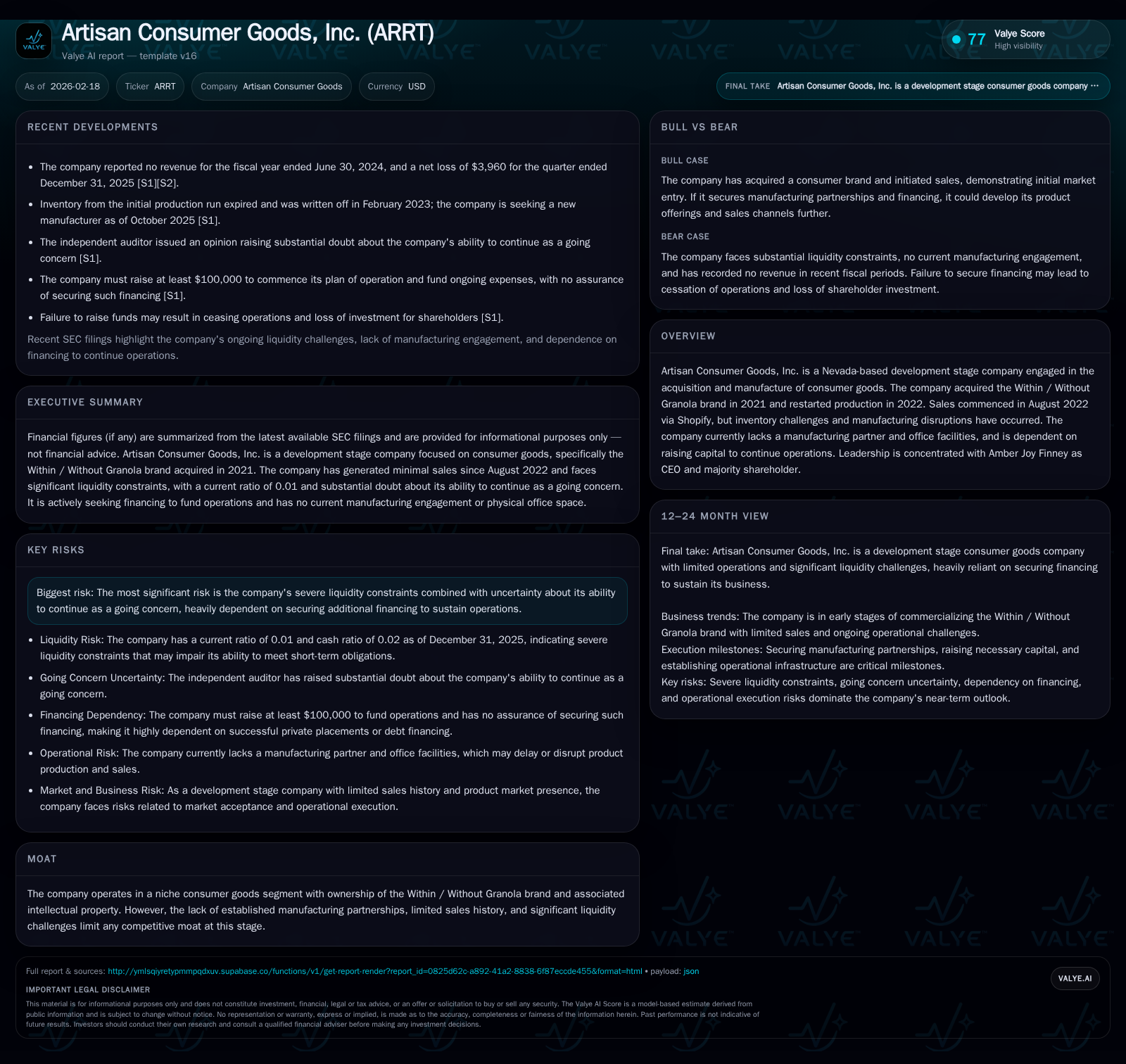
Artisan Consumer Goods, Inc. has pursued growth through the 2021 acquisition of the Within / Without Granola brand, aiming to resurrect its market presence with initial sales starting mid-2022 via direct-to-consumer channels. However, repeated operational setbacks — notably inventory expiration and a persistent absence of manufacturing partners — have led to zero revenue in FY2024 and increasing losses. The company confronts acute liquidity constraints, underscored by a critically weak current ratio and an urgent need to raise $100,000 to sustain operations. Leadership remains concentrated with CEO Amber Joy Finney holding a majority stake and overseeing multiple executive roles amid governance challenges typical of micro-cap developmental firms. Future survival hinges on securing new capital to reestablish production capabilities and stabilize operations, with critical milestones including manufacturer engagement and capital raises serving as bellwethers for viability.
History of Growth and Acquisition Strategy
Artisan Consumer Goods, Inc., originally incorporated in Nevada in 2009 under different names before adopting its current identity in 2018, embarked on a developmental growth path centered around acquiring consumer goods brands. The pivotal event came in July 2021 when Artisan acquired Paleo Scavenger LLC’s assets for $10,000, securing ownership of the Within / Without Granola brand along with trademarks, intellectual property rights, customer lists, and manufacturing access rights [S1][S11]. This acquisition represented Artisan's strategic bet on reviving a niche granola brand with an existing albeit dormant customer base.
Following acquisition, the company restarted production activities starting June 2022 after WWG had ceased operations prior to that year. Sales commenced that August through Shopify's e-commerce platform focusing on original and maple-flavored granola varieties [S1]. This move marked the company's first active commercial footprint after years dominated by preparatory arrangements.
However, Artisan's operating model remains nascent with no physical offices or owned manufacturing plants; it depends entirely on external contract manufacturers — none currently secured as of late 2025 [S4][S11]. This limited infrastructure indicates Artisan remains very much a developmental-stage enterprise reliant on fundraising to reach sustainable scale.
Operational Setbacks Impacting Revenue Trajectory
Artisan's initial production run soon ran into complications that prominently stalled growth initiatives. The inventory produced during early runs expired by February 2023 leading to a full write-off of that stock — effectively wiping out any tangible revenue gains from that batch [S1][S5]. Since then, the search for new manufacturing partners capable of fulfilling smaller batch orders — critical for managing inventory risk in specialty consumer packaged goods (CPG) segments like artisanal granola — has remained unfulfilled.
This inability to secure a reliable manufacturing partner crucially interrupts product availability on digital storefronts, curtailing sustained sales volumes typical for direct-to-consumer CPG startups where supply consistency directly impacts consumer retention. As such, fiscal year 2024 posted zero revenues compared with modest $7.6K recorded in FY2023 — indicating a complete stall in top-line traction due to operational failures rather than market demand headwinds [F1].
This disruption underscores how crucial manufacturing partnerships are for micro-cap CPG companies seeking scalability without incurring heavy fixed capital costs. The absence thereof amplifies inventory risks including spoilage given perishable ingredient profiles common among granolas.
Financial Performance Deep Dive: Losses and Liquidity Struggles
Artisan's financial trajectory reflects its troubled operational environment with increasing losses characterizing recent years. Operating income deteriorated from -$30.3K in FY2022 to -$42.9K in FY2023 then worsened further to nearly -$50K by FY2025 end [F1]. Net income followed similarly adverse trends: escalating from -$38.5K (FY22) through -$42.8K (FY23) before spiking at -$50.7K (FY25) despite near-zero revenues during latter periods.
This persistent loss-making consistent with pre-revenue development companies highlights ongoing cash burn without offsetting sales inflows [F1]. Meanwhile, operating cash flows remain negative throughout with CFO hitting -$55.4K as recently as FY25 indicating cash outflows arising from continued administrative expenses and production restart attempts.
Liquidity issues compound these earnings dilemmas starkly: current assets totaled only approximately $5.2K against gargantuan current liabilities nearing $357K as of late 2025 — resulting in an insolvent current ratio near 0.01 [F1][S4]. Such imbalance manifests an acute inability to cover short-term obligations risking immediate solvency crises unless rapid funding materializes.
The equity base has been eroding into deep negatives from -$219K (FY22) down to -$327K (FY25), underscoring ongoing shareholder value attrition despite management efforts [F1]. No dividends or buybacks have been declared representing typical developmental stage capital preservation behavior.
Historical performance (annual)
| FY | Rev ($) | Net ($) | CFO ($) | OpInc ($) | Rev YoY | Net YoY |
|---|---|---|---|---|---|---|
| 2025 | -50732 | -55425 | -49991 | -168.3% | ||
| 2024 | 0 | -18910 | -32272 | -32059 | -100.0% | +55.8% |
| 2023 | 7648 | -42825 | -35938 | -42854 | -11.1% | |
| 2022 | -38537 | -29065 | -30297 |
Note: Omitted columns lack sufficient annual XBRL coverage in the provided tags (need ≥2 annual points): Capex, Div, Buybacks, FCF. Source: SEC companyfacts cache [F1].
Capital returns and efficiency (annual)
| FY | ROE% |
|---|---|
| 2025 | 15.5 |
| 2024 | 6.8 |
| 2023 | 16.5 |
| 2022 | 17.6 |
Source: SEC companyfacts cache [F1].
Note: Percentage changes are indicative but complicated by fluctuating revenue recognition patterns.
Capital Structure and Cash Flow Considerations
Artisan reports no dividends or share repurchases during the period covered; these data points are not available in provided tags indicating no distributions or buybacks occurred [F1]. The company depends heavily on external financing sources to sustain operations amid persistent negative cash flows and equity erosion.
Management emphasizes the urgent need to raise at least $100,000 imminently to continue operations; failure would likely lead to business cessation and complete loss for shareholders [S1][S4][S5]. While debt financing remains a fallback option if private placements falter, it is expected to carry prohibitive costs given the company's development stage profile and lack of collateral security [S4].
Recently appointed independent auditors Aloba Awomolo & Partners replaced prior auditors amid going concern warnings but no reported accounting disagreements were noted [S13][S14], suggesting ongoing but challenging financial reporting conditions.
Outlook: Milestones and Expectations
Critical upcoming milestones include securing sufficient capital through private placements to restart operations successfully within twelve months post-financing closure [S1]. Concurrently, Artisan must finalize agreements with manufacturing partners capable of producing small batch orders essential for niche artisanal granola production while minimizing inventory risk.
Investors should monitor announcements regarding:
- Completion of equity raises meeting or exceeding the stated $100k threshold,
- Engagements or contracts signed with contract manufacturers,
- Avoidance of further inventory expirations or write-offs,
- Updates on auditor assessments particularly around going concern status,
- Any expansion beyond Shopify sales channels indicating broader distribution progress.
Given historical revenue volatility combined with severe liquidity constraints and ongoing losses detailed above, these milestones will be pivotal indicators determining whether Artisan can transition beyond its developmental stage toward sustainable commercial viability within competitive consumer packaged goods markets.
Leadership Structure Amid Financial Strains
CEO Amber Joy Finney maintains majority ownership (51.6%) alongside serving simultaneously as President, Treasurer, and sole director following predecessor William Drury’s passing in 2023 [S1][S11]. This concentrated leadership is characteristic of founder-led microcap firms but may limit independent oversight during critical restructuring phases.
Disclaimer: This report is based solely on publicly available SEC filings up to February 18th, 2026 ([F1],[S1]-[S14]) without projections or estimates beyond disclosed facts; it does not constitute investment advice or recommendations regarding Artisan Consumer Goods Inc.
Disclaimer: This is research-only, informational analysis and not investment advice. It may include AI-generated interpretation and general industry context. Always verify important details using primary sources.

Comments