
GCM Grosvenor’s Growth Anchored by Long-Duration Capital and Operating Leverage Expansion
GCM Grosvenor capitalizes on its diversified alternative asset platform and client-centric model while managing international and market-related risks.
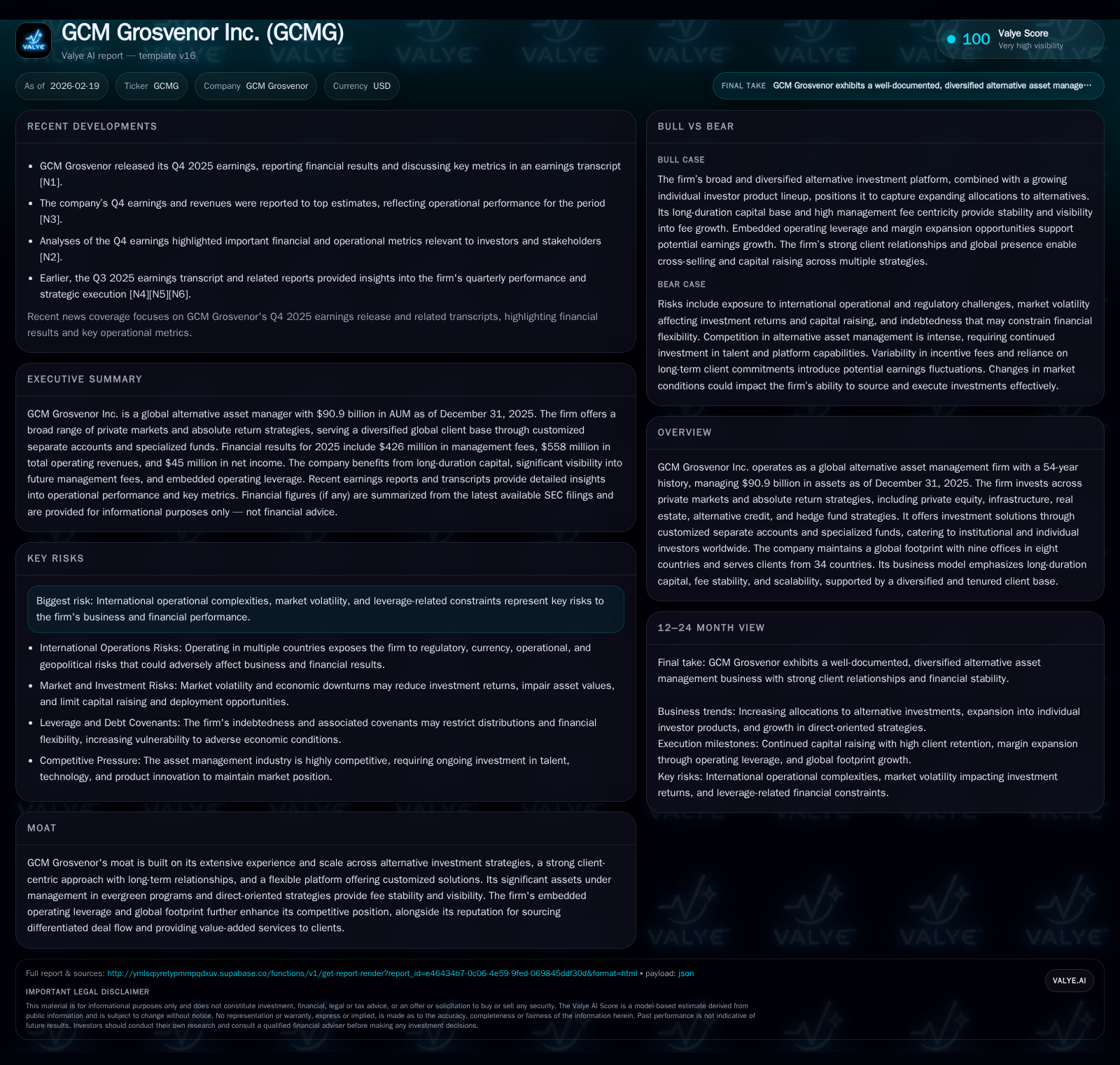
GCM Grosvenor Inc. maintains a robust growth trajectory supported by $90.9 billion in AUM as of year-end 2025, driven by long-duration private markets strategies and increasing fee-related earnings. The firm’s embedded operating leverage and global footprint contribute to margin expansion, with a strong renewal rate from its established client base. Despite market volatility and international operational complexities posing risks, the company's scalable business model positions it well for steadily increasing fee-paying assets and potential incentive fee growth. Key metrics show a significant rebound in profitability and cash flow in 2025 after volatility in prior years.
Historical Growth and Performance
GCM Grosvenor operates as a global alternative asset manager with a focus on private markets and absolute return strategies. Over its 54-year history, the firm has built up substantial scale managing $90.9 billion in assets as of December 31, 2025 [S1][F1]. The firm's growth trajectory over the past several years evidences resilience amid challenging market conditions experienced especially during the volatile period of 2022-2023.
A summary of key financials illustrates this trend:
Historical performance (annual)
| FY | Net ($mm) | CFO ($mm) | OpInc ($mm) | Capex ($mm) | Net YoY |
|---|---|---|---|---|---|
| 2025 | 45 | 184 | 133 | 8 | +142.7% |
| 2024 | 19 | 149 | 73 | 17 | +46.4% |
| 2023 | 13 | 92 | -12 | 4 | -35.5% |
| 2022 | 20 | 217 | 80 | 1 |
Note: Omitted columns lack sufficient annual XBRL coverage in the provided tags (need ≥2 annual points): Rev, Div. Source: SEC companyfacts cache [F1].
Capital returns and efficiency (annual)
| FY | Buybacks ($mm) | FCF ($mm) | ROE% |
|---|---|---|---|
| 2025 | 31 | 175 | 168.1 |
| 2024 | 0 | 132 | -67.7 |
| 2023 | 4 | 88 | -46.2 |
| 2022 | 26 | 216 | -100.0 |
Source: SEC companyfacts cache [F1].
Note: Revenue data unavailable; operating income, net income, operating cash flow (CFO), capital expenditures (capex), and buybacks shown [F1].
The dramatic swing from negative operating income in FY23 to robust profitability in FY25 reflects both investment performance recovery and operational efficiency gains. Fee-related earnings margins expanded from approximately 31% at end-2020 to around 44% by end-2025 [S25][S22], demonstrating embedded operating leverage benefiting margins as scale increased.
Business Model Drivers
GCM’s business model emphasizes long-duration capital commitments that generate durable management fees. Approximately $36.9 billion of AUM is invested in evergreen programs—open-ended or NAV-targeted vehicles—offering predictable fee streams [S22]. Additionally, about $44.3 billion of private markets AUM has tenors exceeding seven years, contributing to fee stability over extended periods.
Capital raising depends heavily on the renewal of existing customized separate accounts which historically renew at a ~90% success rate, often at sizes ~25% larger than predecessor programs [S22]. New program launches also provide incremental growth opportunities.
The firm’s flexible platform invests across multiple strategies: private equity ($32.9 billion AUM), infrastructure, real estate, alternative credit, hedge funds via specialized funds or separate accounts serving over700 institutional clients globally [S1][S11][S16]. This breadth allows cross-selling which contributed significantly to raising over $1.5 billion from individual investors recently—a segment growing from ~5% of total AUM.
Future Growth Prospects
Growth levers include continued expansion of fee-paying AUM bolstered by contracted but not yet fee-paying capital (~$10.4 billion), likely increasing revenue as management fees start during these commitment periods [S22]. Incentive fees currently represent a smaller but growing component as portfolio appreciation accrues.
The embedded deal origination capabilities position GCM well to expand co-investments, secondaries, infrastructure debt and value-add real estate strategies—segments aligned with institutional demand for differentiated yield sources [S25]. Their decade-long effort scaling investment teams across regions supports geographic diversification benefits amid rising cross-border investor allocations.
The increasing penetration among individual investors also offers a medium-term organic growth runway driven by innovations making alternatives more accessible [S11]. However, market volatility could temper fundraising activity or lead to redemptions particularly from open-ended funds despite restrictions designed to manage liquidity risk [S1][S8].
Forecasts and Milestones
While specific forward guidance was not provided explicitly in recent disclosures or earnings transcripts , monitoring key indicators is essential:
- Fund performance metrics that influence incentive fees.
- Renewal rates of customized separate accounts.
- Conversion of contracted non-fee paying AUM to fee-paying status.
- Expansion outcomes within newer product verticals such as individual investor platforms.
- Operating margin trends reflecting capture of embedded leverage vs incremental investments in growth areas.
Returns and Capital Allocation
GCM Grosvenor’s balance sheet shows prudent use of leverage with total debt reported at approximately $431 million as of December 31, 2025 [S4][S5][F1]. Covenants restrict distributions if leverage exceeds thresholds; however, compliance was maintained allowing shareholder returns via stock repurchases [$30.7 million spent on buybacks during FY25] [S13][F1]. No dividends were reported or indicated.
Operating cash flow has remained robust at $184 million with modest capex needs (~$8 million), facilitating free cash flow near $175 million for potential further return of capital or strategic reinvestment [F1].
Notably, reported equity rose substantially into positive territory ($27 million as of FY25) reversing previous negative equity balances linked to prior years’ results ensuring healthier financial ratios going forward [F1]. Estimated return on equity based on net income/equity scaled impressively (~168%) but is sensitive due to relatively low equity base dominated by share dynamics and prior losses.
Competitive Position and Moat
GCM Grosvenor’s competitive advantages stem from its extensive history (54 years), global reach with offices across eight countries, diversified alternative strategy exposure, and client-centric tailored solutions approach [S7][S12]. The firm’s reputation for sourcing differentiated deal flow coupled with enduring client relationships provides barriers against commoditization risks common among alternative asset managers.
The ability to customize offerings aligns with investor specificity often unmet by more standardized competitors offering funds-of-funds or consulting services alone.
However, competition remains intense from other large institutions and boutique alternative managers alike with overlapping product sets—requiring continuous innovation particularly leveraging data analytics and technology enhancements highlighted by the firm [S15].
Risks Overview
Key risks include:
- Market volatility impacting fund performance directly affecting incentive fees and overall earnings [S8].
- Redemption risk particularly from open-ended structures requiring liquidity management which can affect stable revenues [S8].
- International operations complexity exposing the firm to geopolitical/regulatory uncertainties plus challenges moving capital efficiently across borders [S5].
- Debt covenants limiting distribution flexibility especially if leverage rises unexpectedly during economic downturns or investment pauses [S6].
- Increasingly stringent regulatory compliance costs related to global privacy laws (e.g., GDPR) and evolving asset management rules could raise operational expenses/taxes on growth [S17][S24].
- Litigation or reputational risks stemming from misconduct allegations though currently no material cases pending have been disclosed [S8][S18].
Conclusion: Balanced Momentum With Scale Advantages Amid Uncertainties
GCM Grosvenor’s scale across alternative strategies combined with a demonstrated ability to grow embedded fee-paying assets delivers ongoing revenue consistency uncommon amongst peers reliant on shorter duration mandates or narrower product suites. The firm's recent improvements in profitability metrics affirm that investments in platform infrastructure and distribution are translating into expanded margins thanks to operating leverage effects. Visibility into near-term growth is reinforced by considerable contracted but uncharged commitments supporting future management fees alongside rising incentive earnings potential as funds mature favorably. Nevertheless, structural challenges posed by market cycles, the firm's international scope regulatory landscape shifts require vigilant risk management maintaining capital flexibility through prudent leverage governance. In aggregate, GCM Grosvenor exemplifies how diversified alternative managers can harness long-dated capital programs combined with client-centric customization advantages while navigating industry cyclicality inherent to asset management businesses.
This report is for informational purposes only based on public data sources without providing investment recommendations or advice.
Disclaimer: This is research-only, informational analysis and not investment advice. It may include AI-generated interpretation and general industry context. Always verify important details using primary sources.

Comments