
iRhythm Holdings Balances Regulatory Challenges and Cash Flow Improvement in Ambulatory Cardiac Monitoring
The company shows operating loss reduction and strong cash flow despite regulatory headwinds in a competitive cardiac monitoring market.
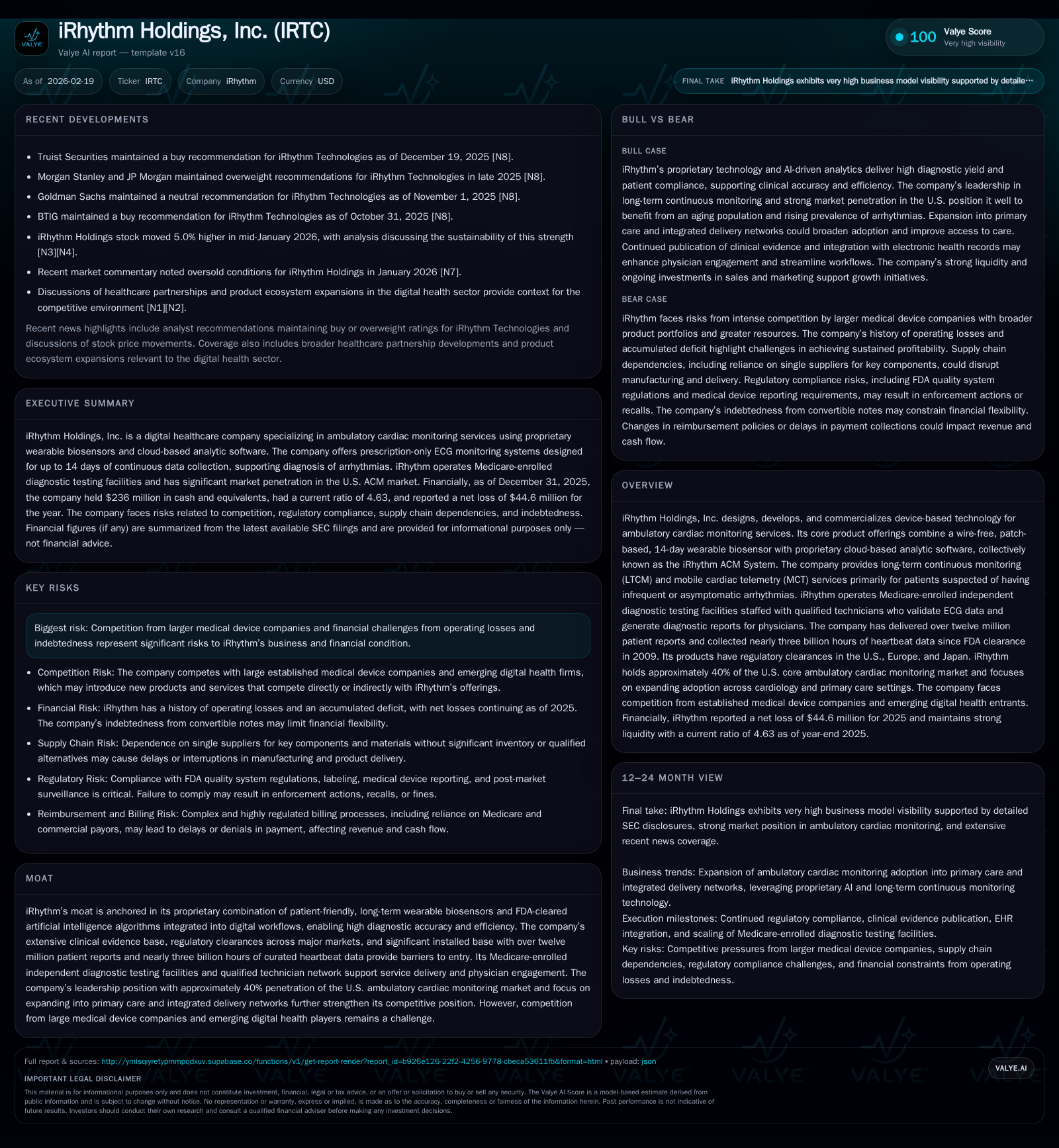
iRhythm Holdings, a leader in ambulatory cardiac monitoring with its wearable biosensor and AI analytics system, reported narrowing operating losses and significant improvement in operating cash flow in FY2025. The business benefits from proprietary technology, strong Medicare enrollment, and international regulatory clearances but faces ongoing legal, regulatory, and reimbursement challenges that could limit future growth. While revenue details remain undisclosed, the company’s transition toward positive free cash flow and a robust balance sheet provide financial flexibility. Key milestones to watch include regulatory risk mitigation efforts, Medicare reimbursement developments, and market penetration expansion beyond cardiology specialties.
Company Overview and Historical Performance
iRhythm Holdings, Inc., through its flagship iRhythm ACM System, pioneered long-term continuous ambulatory cardiac monitoring using a wire-free, patch-based biosensor combined with proprietary AI-driven cloud analytics. Since receiving FDA clearance in 2009, iRhythm has delivered over twelve million patient reports and collected nearly three billion hours of heartbeat data, supporting diagnostics primarily for infrequent or asymptomatic arrhythmias.
Operationally, iRhythm runs Medicare-enrolled independent diagnostic testing facilities staffed with qualified technicians managing ECG data verification and report generation – a critical part of its service delivery model.[S1]
Financially, the company has faced persistent operating losses but showed meaningful progress in FY2025. Operating income loss shrank to -$57.4 million from -$115.5 million the previous year (a roughly 50% improvement), while net income loss narrowed even more sharply to -$44.6 million from -$113.3 million (over 60% better) [F1]. This trend reflects ongoing cost controls and scaling of operations.
Operating cash flow swung positive dramatically to $80.9 million from just $3.4 million last year — underscoring improved collections or working capital management — resulting in estimated free cash flow around $34.5 million after capital expenditures of approximately $46.3 million (up 36% YoY) [F1]. The latter reflects continued investment into technology platforms and manufacturing capacity to support growth.
A solid balance sheet complements these trends: as of December 31, 2025, iRhythm held about $236 million liquidity against current liabilities around $152 million yielding a strong current ratio of ~4.6x [F1], providing operational runway amid ongoing losses.
Historical performance (annual)
| FY | Net ($mm) | CFO ($mm) | OpInc ($mm) | Capex ($mm) | Net YoY |
|---|---|---|---|---|---|
| 2025 | -45 | 81 | -57 | 46 | +60.7% |
| 2024 | -113 | 3 | -116 | 34 | +8.2% |
| 2023 | -123 | -50 | -125 | 40 | -6.2% |
| 2022 | -116 | -23 | -114 | 30 |
Note: Omitted columns lack sufficient annual XBRL coverage in the provided tags (need ≥2 annual points): Rev, Div. Source: SEC companyfacts cache [F1].
Capital returns and efficiency (annual)
| FY | Buybacks ($mm) | FCF ($mm) | ROE% |
|---|---|---|---|
| 2025 | 0 | 35 | -29.2 |
| 2024 | 25 | -31 | -124.6 |
| 2023 | -91 | -58.7 | |
| 2022 | -53 | -48.4 |
Source: SEC companyfacts cache [F1].
Note: Revenue data is not available from provided tags; ROE is approximated as net income divided by shareholders' equity for latest fiscal year only[F1]
Growth Drivers and Market Positioning
iRhythm's moat centers on its unique combination of patient-friendly biosensors cleared by major regulators (FDA U.S., CE Europe, PMDA Japan) integrated with advanced AI analytics forming an end-to-end digital workflow that enhances diagnostic accuracy for arrhythmia detection.[S1][S17]
Approximately 40% penetration of the U.S ambulatory cardiac monitoring market attests to its leadership status.[S17] Expansion into primary care channels and Integrated Delivery Networks (IDNs), where population health strategies are key, opens further adoption avenues beyond traditional cardiologists.[S17]
International sales footprints extend through direct infrastructure in the UK and distribution partnerships across Europe (including Spain, Netherlands) and Japan.[S17]
Regulatory clearances support this global reach but also impose rigorous quality system compliance demands as evidenced by multiple FDA inspections revealing quality management deficiencies leading to corrective commitments.[S21] Such regulatory scrutiny is poised to continue given recent warning letters related to Zio AT systems,[S21] and evolving standards under EU MDR/UK MDR frameworks[S18], positioning compliance as both a growth enabler and key risk factor.
Regulatory and Litigation Risks
iRhythm's reliance on Medicare reimbursement—which accounted for about 24% of revenue during the year ended December 31, 2025[S1]—introduces exposure to CMS policy shifts and ongoing uncertainties around Independent Diagnostic Testing Facility (IDTF) regulations ill-fitted for remote diagnostic models like theirs.[S1]
Non-compliance or regulatory interpretation disagreements risk claim denials or clawbacks potentially impacting revenue materially.[S1][S20]
The company faces active government investigations including subpoenas from DOJ related to FDA communications and billing claims,[S7] alongside securities class action lawsuits filed alleging violations of securities laws,[S7][S23] and patent infringement disputes initiated by industry competitors.[S23]
Furthermore, complex healthcare fraud & abuse laws like the False Claims Act expose iRhythm to potential civil penalties including hefty treble damages if alleged billing improprieties are substantiated.[S6][S19]
Quality system enforcement actions such as recalls or stringent FDA oversight may also disrupt operations or delay new product rollouts.[S21][S24]
Capital Allocation and Financial Returns
iRhythm has curtailed repurchases—none executed in fiscal 2025 versus $25 million bought back last year—and currently pays no dividends as this metric is not available from provided data.[F1]
Despite persistent net losses driving an approximate negative ROE near -29% for FY2025,[F1] cash flow improvements suggest shifting dynamics potentially supporting future profitability if sustained growth materializes.
Capital expenditures rose moderately by over one-third YoY as iRhythm continues investing in manufacturing capability expansions critical for scaling their biosensor output.[F1]
The sizable cash balance mitigates immediate liquidity concerns allowing strategic flexibility amidst uncertain reimbursement environments and compliance remediation costs.
Outlook Considerations and What To Watch
iRhythm has not provided explicit quantitative guidance publicly for revenues or profits this cycle[N1], leaving external observers reliant on macro factors:
- Efforts to resolve FDA compliance issues without disrupting supply chains or product innovation timelines remain critical.
- Medicare reimbursement policy adaptations toward remote diagnostic telehealth will directly affect short-to-medium term demand.
- Expansion success into non-cardiology specialists such as primary care physicians could unlock broad incremental markets.[S17]
- Legal outcomes related to ongoing litigation pose downside event risks.
- Competitive intensity from larger device makers necessitates continued AI algorithm differentiation backed by growing clinical evidence.
Monitoring quarterly earnings updates for margin improvements, unit volumes indications, pending regulatory milestones including new device clearances or labeling expansions will yield signals on growth trajectory sustainability.
Industry Context Analysis
iRhythm operates within digital health’s convergence with medical devices—an area demanding seamless integration between hardware reliability (wearable biosensors), software sophistication (AI diagnostics), clinical evidence validation, payer acceptance mechanisms (Medicare/Commercial reimbursement), plus stringent regulatory oversight.
Market dynamics increasingly favor scalable remote patient monitoring solutions especially given aging populations prone to cardiovascular diseases needing frequent arrhythmia surveillance without hospital visits.
However regulatory frameworks historically tailored for point-in-time testing struggle to accommodate evolving continuous remote telemetry models requiring active advocacy for policy modernization as part of corporate strategy.[S1][S20]
Moreover, tech-driven competitors backed by large med device incumbents intensify R&D races needing deep pockets coupled with nimble commercial execution capability.
iRhythm's ability to leverage immense longitudinal data accrued over years provides a competitive edge if it can translate these insights into clear clinical utility demonstrated through peer-reviewed studies influencing reimbursement coding decisions.
Conclusion
iRhythm Holdings presents a compelling case study balancing innovative heart-monitoring technology leadership against significant hurdles: navigating intricate regulatory landscapes especially around Medicare reimbursement; managing costly quality assurance remediations following adverse FDA findings; progressing through substantial litigation exposures; all while demonstrating impressive operational cash flow turnarounds that hint at nearing financial sustainability.
Investors and stakeholders should track regulatory remediation progress reports closely along with indicators of geographic expansion momentum and payer acceptance trends to gauge real prospects for translating substantial installed base advantages into durable profitable growth.
This analysis relies solely on publicly available information up to February 19, 2026 including SEC filings [S#], news articles [N#], and factual XBRL financial data snapshots [F1]. It does not constitute investment advice or recommendations.
Disclaimer: This is research-only, informational analysis and not investment advice. It may include AI-generated interpretation and general industry context. Always verify important details using primary sources.

Comments