
Perdoceo Education’s Financial Rebound and the Strategic Role of Technology in Student Engagement
Perdoceo Education leverages AI-driven adaptive learning and employer partnerships to drive stable growth and navigate regulatory pressures in postsecondary education.
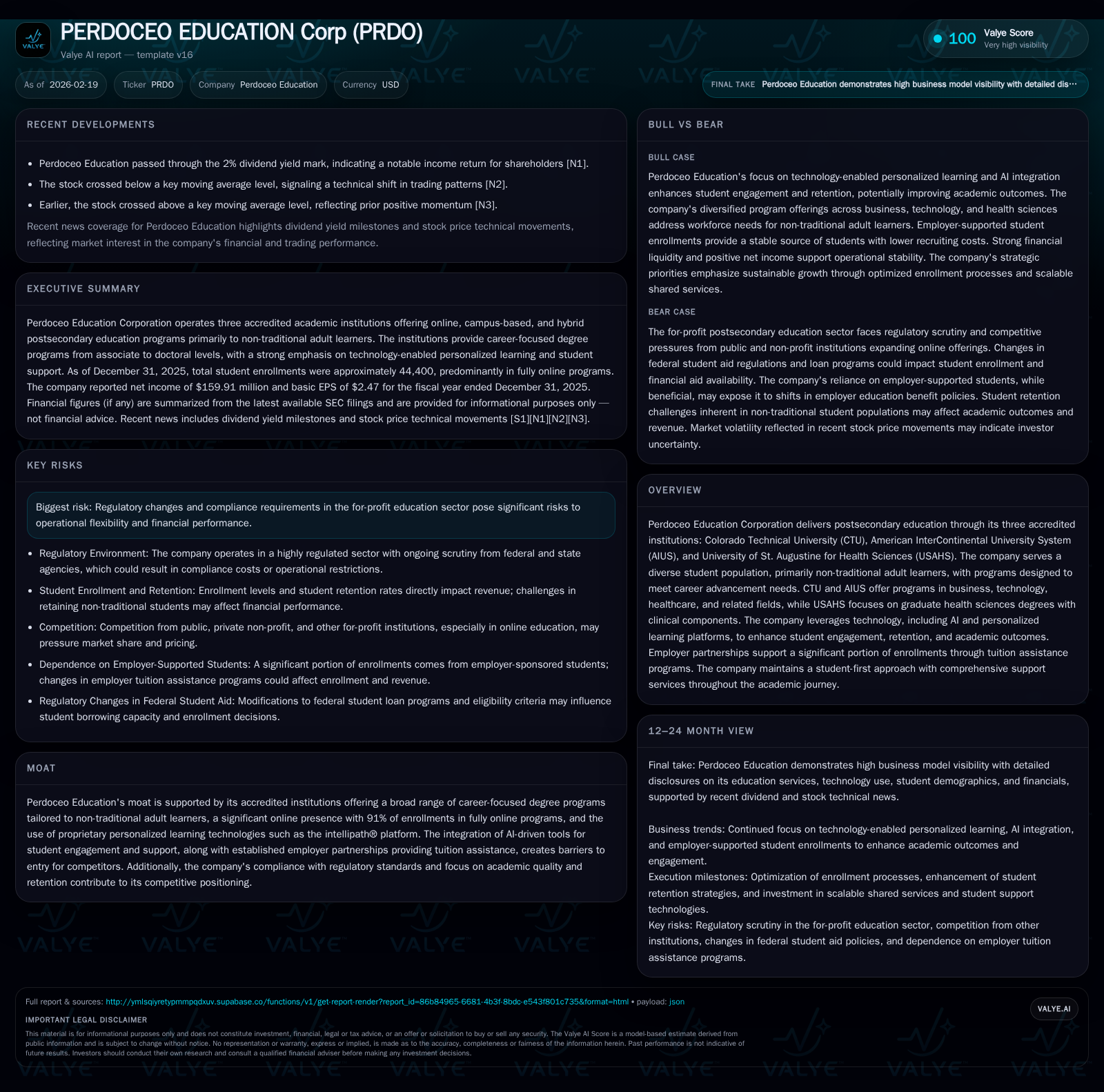
Perdoceo Education Corporation has delivered modest revenue growth and accelerating profitability in recent years, supported by its proprietary intellipath® adaptive learning platform and extensive online program scale. The company's focus on non-traditional adult learners and employer tuition assistance partnerships underpin stable enrollment trends amid a challenging regulatory environment for for-profit education providers. Strong operating cash flow generation supports significant share repurchases and a healthy dividend yield, balancing capital returns with cautious investment amid evolving Title IV compliance demands. Key near-term watchpoints include monitoring regulatory developments, enrollment sustainability in graduate health programs affected by loan caps, and continued enhancement of AI-powered student retention technologies.
Operational Progress Amid Market Shifts: Revenue and Profitability Trends
Perdoceo Education Corporation reported steady financial performance through fiscal year 2025, highlighted by revenue of approximately $1.96 billion—a modest increase of 1.7% compared to FY2024 [F1]. Operating income exhibited accelerated growth at +12.5% YoY, reaching $196.0 million, reflecting enhanced operational leverage alongside ongoing enrollment stability [F1][S3]. Net income advanced by 8.4% year-over-year to $159.9 million, underscoring profitability gains amid sector headwinds [F1]. Operating cash flow surged 39.4% to $225.2 million, indicating strong cash conversion efficiency as margin expansion offset relatively flat revenue growth [F1].
Margins have benefitted from a disciplined cost structure and efficiencies across the company's three accredited institutions—Colorado Technical University (CTU), American InterContinental University System (AIUS), and University of St. Augustine for Health Sciences (USAHS)—each serving distinct but complementary segments within postsecondary education [S1][S22]. The fully online program scale (representing approximately 91% of enrollments) enables Perdoceo to leverage economies of scale against relatively fixed instructional infrastructure costs .
Historical performance (annual)
| FY | Net ($mm) | CFO ($mm) | OpInc ($mm) | Net YoY |
|---|---|---|---|---|
| 2025 | 160 | 225 | 196 | +8.4% |
| 2024 | 148 | 162 | 174 | -0.0% |
| 2023 | 148 | 112 | 150 | +54.0% |
| 2022 | 96 | 148 | 130 |
Note: Omitted columns lack sufficient annual XBRL coverage in the provided tags (need ≥2 annual points): Rev, Capex, Div, FCF. Source: SEC companyfacts cache [F1].
Capital returns and efficiency (annual)
| FY | Buybacks ($mm) | ROE% |
|---|---|---|
| 2025 | 121 | 16.4 |
| 2024 | 7 | 15.4 |
| 2023 | 8 | 17.5 |
| 2022 | 23 | 13.2 |
Source: SEC companyfacts cache [F1].
Note: Prior years omitted for brevity due to data sparsity.
Perdoceo’s Technology-Driven Moat Supporting Learner Outcomes and Retention
A cornerstone of Perdoceo's competitive advantage lies in its deployment of proprietary adaptive learning technology—specifically the intellipath® platform—across CTU and AIUS [S1]. This platform facilitates personalized education pathways through data-driven insights enabling faculty to tailor curricula dynamically based on student performance indicators, engagement metrics, and predictive analytics typical within adaptive learning frameworks.
In a market increasingly committed to improving retention yields among non-traditional adult learners—who comprise roughly two-thirds of Perdoceo’s student body—such technology is pivotal [S23]. The integration of AI tools extends beyond curriculum delivery; two-way messaging platforms foster meaningful faculty-student communication promoting proactive academic support while leveraging analytics for early warning signs of attrition [S13]. The fully online orientation of programs (~91%) not only reduces physical capital expenditures but also generates operational flexibility enabling responsive scaling aligned with demand fluctuations.
This technology-enabled model creates barriers for new entrants given the combined asset of pedagogically validated digital platforms embedded institutionally, alongside employer relationships that funnel prospective students into tuition assistance schemes, forming an interconnected ecosystem resistant to disruption.
Navigating Regulation: Compliance Hurdles and Their Impact on Enrollment Flexibility
Perdoceo operates within the highly regulated domain governing Title IV federal student aid eligibility, subjecting it to stringent Department of Education oversight that directly impacts institutional certification continuity [S7][S8][S9][S10]. Recertification processes mandate compliance with complex accreditation criteria ensuring academic quality alongside financial responsibility standards essential for government funding access.
Post-settlement obligations stemming from a Federal Trade Commission inquiry initiated in 2015 require heightened scrutiny on marketing lead sourcing practices—accompanied by systematic reviews extending over twenty years—escalating compliance risk and associated costs [S10]. Moreover, provisional certifications impose growth caps concerning enrollment volumes or program expansions pending regulatory review outcomes, constraining operational agility.
Of particular note is the scheduled elimination effective July 2026 of the Grad PLUS loan program for new borrowers—a significant financing source for USAHS’s graduate health sciences programs including physical therapy and nursing—which introduces potential headwinds by limiting student borrowing capacity under Title IV [S25][S29]. While private financing alternatives are being actively communicated to prospective students, the extent to which these measures mitigate enrollment declines remains uncertain.
Additionally, the department's evolving audit guide for proprietary schools enforces more rigorous annual compliance testing enhancing oversight burdens starting with FY2023 audits forward [S17]. These factors collectively underline an elevated compliance cost environment requiring meticulous risk management and strategic adjustment.
Financial Health and Liquidity: Balancing Cash Flow Strength with Capital Structure
Perdoceo exhibits resilient liquidity metrics highlighted by a robust current ratio exceeding five times at fiscal year end December 31, 2025 ($696.9 million current assets vs $137.8 million current liabilities) supporting ample short-term operational flexibility [F1][S18]. Cash & cash equivalents standing at approximately $111 million reinforce this position.
Strong operating cash flow generation—$225 million in FY2025—comfortably surpasses capital expenditure outlays resulting in substantial free cash flow estimated near $221 million after modest capex activity focused mainly on sustaining digital infrastructure enhancements rather than aggressive facility expansions or acquisitions [F1]. This conservative capex approach evidences prudent stewardship balancing technological investments with shareholder capital return priorities.
Equity rose to around $972 million by end-2025 supporting an attractive return on equity metric near 16.4%, reflective both of earnings quality improvements and efficient equity utilization [F1]. Healthy cash flows coupled with an enviable balance sheet permit continued operational resilience amid sector uncertainties.
Capital Allocation Priorities: Dividends, Share Repurchases, and Investment Strategy
Capital deployment strategy has shifted decisively towards shareholder returns as demonstrated by expanded share repurchase activities totaling approximately $121 million during FY2025 compared to prior year buybacks below $7 million [F1][S11][N2]. The January 5, 2026 announcement introduced a fresh stock repurchase authorization capped at $100 million replacing the earlier $75 million program—marking clear intent to use surplus free cash flow towards ISS-compliant capital recycling mechanisms intended to enhance per-share metrics.[S4][S28]
Concurrent dividend payments remain modest yet meaningful with dividends paid around $14.4 million in FY2023 amounting to yields surpassing the psychologically important threshold above two percent as recently noted in market commentary [N2]. This blend signals management’s commitment to balanced returns while preserving flexibility given ongoing regulatory uncertainties.
Simultaneously, a notable capex pullback approaching -64.7% YoY suggests diminished need or willingness for large-scale fixed asset investment currently; resources instead prioritize scalable tech enhancements—e.g., AI system upgrades—and compliance apparatus rather than physical campus builds [F1]. This cautiously conservative stance mitigates capital intensity risks common among postsecondary providers adapting business models toward digital-first modalities.
Employer Partnerships as a Growth Vector: Tuition Assistance Programs Insight
Strategic collaborations with employers operate as vital conduits expanding Perdoceo's addressable market through tuition assistance programs where participating employers subsidize part or all educational costs for their workforce pursuing degrees at CTU or AIUS [S13]. As of late-2025 data indicates nearly 38.3% of CTU enrollments benefit from employer sponsorship alongside about 7.5% at AIUS—a material proportion aligning acquisition expenses often significantly below average channel marketing costs thus elevating recruitment efficiency [S13].
These arrangements facilitate access to populations otherwise less reachable via conventional marketing channels while promoting degree completion rates owing partly to reduced personal financial burden—a crucial factor considering studies linking debt aversion with attrition among adult learners . Though such grants lower revenue per student on face value grounds due to subsidized tuition discounts established internally within universities; overall net profitability benefits accruing from lower acquisition costs strengthen economic unit economics substantially.
Employer partnerships also enhance workforce alignment opportunities whereby curriculum relevance synchronizes directly with labor market needs identified through continuous dialogue between institutions and sponsoring companies manifesting in updated program offerings pertinent to career advancement trajectories crucial for adult learners balancing work-study demands.
What Investors Should Monitor Next: Outlook and Key Catalysts for 2026
Looking ahead into calendar year ’26 investors should carefully track several key areas impacting Perdoceo’s trajectory:
- Continued vigilant monitoring around Title IV recertification cycles amid evolving federal policy landscape shaped by executive orders prioritizing deregulation but accompanied by protracted compliance cycles remains top-line uncertainty drivers [N3][S14].
- Enrollment trends within USAHS’s graduate health sciences programs facing borrowing limit constraints post-July ‘26 Grad PLUS cessation present critical demand-side tests necessitating openness toward private financing adoption effectiveness alongside internal communications efficacy addressing responsible borrowing protocols [S29].
- Quarterly reports will be scrutinized relative to reaffirmed adjusted operating income guidance ($234–236 million) disclosed January ‘26 signaling operative consistency versus volatile macroeconomic effects on adult learner participation patterns [S11].
- Technology innovation pace especially involving core AI enhancements improving student retention rates will be fundamental growth enablers maintaining differentiation amid intensifying competition from public non-profit institutions expanding online offerings targeting adult demographics .[N3]
- Capital allocation discipline balancing growing dividends versus opportunistic buybacks amid broader economic uncertainty including interest rate dynamics warrants close observation influencing valuation sentiment despite stable fundamentals documented thus far.
In sum, Perdoceo’s combination of established adaptive learning systems powering engagement metrics, deepening employer tuition sponsorships reducing cost per enrollment acquisition, solid balance sheet liquidity fostering consistent shareholder returns amid regulatory complexities creates a nuanced picture emphasizing steady financial recovery anchored by technology-enabled operations.
This report is intended solely for informational purposes based on publicly available information as of the report date without recommending any investment actions related to Perdoceo Education Corporation securities or its competitors within the postsecondary education industry sector.
Disclaimer: This is research-only, informational analysis and not investment advice. It may include AI-generated interpretation and general industry context. Always verify important details using primary sources.

Comments