
Brady Corporation Eyes Earnings Growth Backed by Strategic Acquisitions and Robust Liquidity
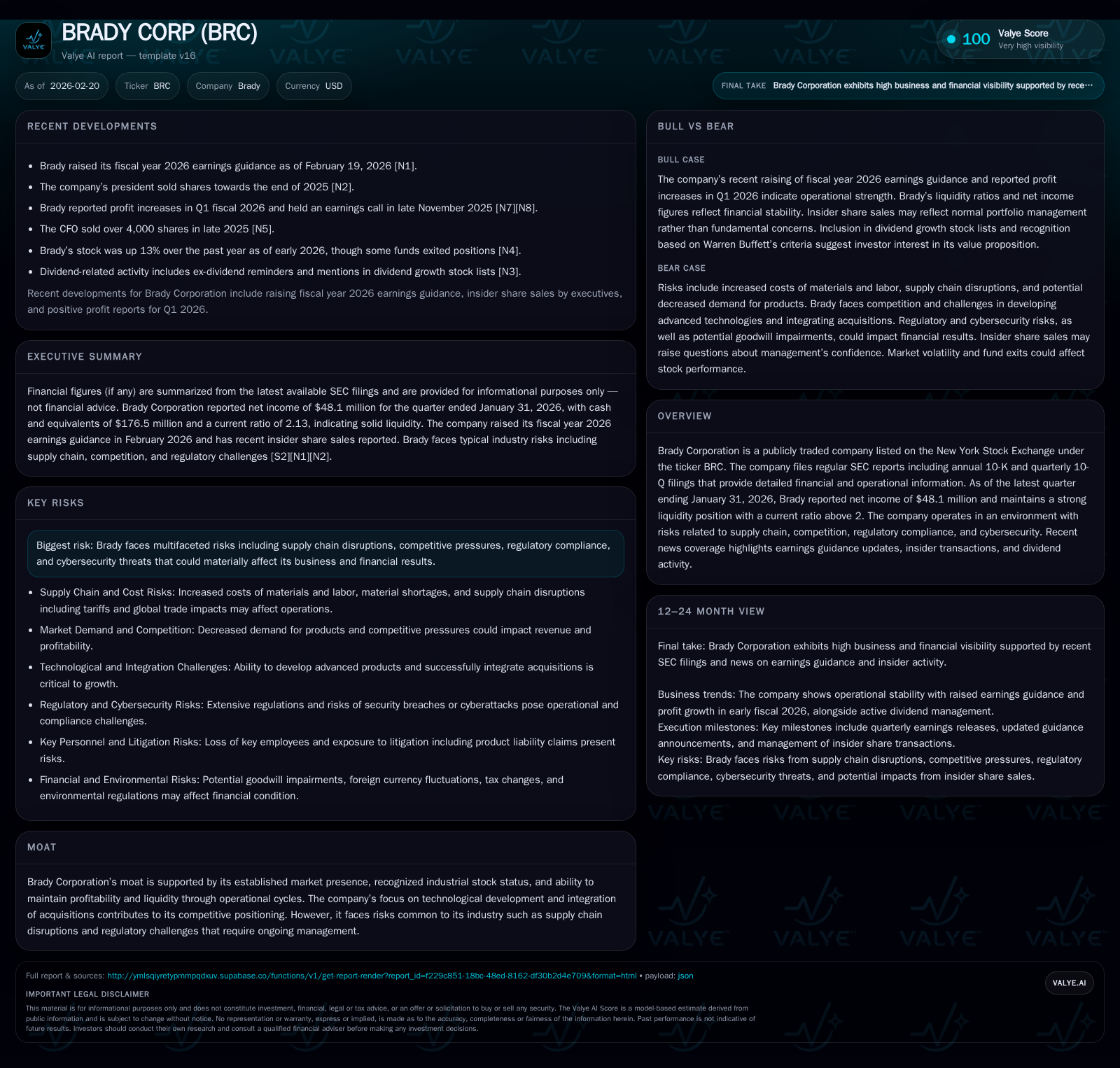
Brady’s raised FY26 earnings guidance reflects confident growth outlook amid operational headwinds and disciplined capital management.
Brady Corporation announced an upward revision to its fiscal 2026 earnings guidance supported by strong liquidity and sustained cash flow generation. Historical financials show robust revenue growth contrasted with slight margin pressure, while capital allocation reflects a balanced approach prioritizing dividends and moderated buybacks alongside reduced capex. Persistent supply chain challenges, regulatory complexity, and cybersecurity risks loom as operational constraints but have yet to materially detract from the company’s earnings momentum.
Operational Performance History: Growth and Margin Dynamics
Brady Corporation has demonstrated notable top-line expansion recently, with fiscal 2025 revenues of approximately $1.4 billion reflecting a sharp increase of 21.6% over fiscal 2024 levels [F1]. This growth trajectory owes itself to a combination of organic volume gains as well as strategic acquisitions that have extended product breadth and market reach. However, this revenue acceleration was accompanied by a slight contraction in operating income (-2.8% YoY) to about $237 million in FY2025 [F1], indicating margin compression.
This decline in operating income underscores pressure stemming from inflationary cost inputs and persistent supply chain disruptions that have constrained operating leverage. Net income fell modestly by 4%, landing at roughly $189 million for FY2025, though profitability metrics remain resilient with an ROE hovering near 15.9% based on reported equity levels [F1].
Cash flow dynamics reveal more volatility: operating cash flow dropped by nearly 29% from the previous year to $181 million, reflecting working capital swings and elevated costs [F1]. Capital expenditures swung markedly lower (-65.5%) to just under $28 million in FY2025 as management curtailed investment intensity post prior heavy spending cycles [F1]. Free cash flow stood robust at about $154 million (operating cash flow less capex), indicating effective conversion despite margin headwinds.
Historical performance (annual)
| FY | Net ($mm) | CFO ($mm) | OpInc ($mm) | Capex ($mm) | Net YoY |
|---|---|---|---|---|---|
| 2025 | 189 | 181 | 237 | 28 | -4.0% |
| 2024 | 197 | 255 | 243 | 80 | +12.8% |
| 2023 | 175 | 209 | 225 | 19 | +16.6% |
| 2022 | 150 | 118 | 193 | 43 |
Note: Omitted columns lack sufficient annual XBRL coverage in the provided tags (need ≥2 annual points): Rev. Source: SEC companyfacts cache [F1].
Capital returns and efficiency (annual)
| FY | Div ($mm) | Buybacks ($mm) | FCF ($mm) |
|---|---|---|---|
| 2025 | 46 | 51 | 154 |
| 2024 | 45 | 72 | 175 |
| 2023 | 45 | 75 | 190 |
| 2022 | 46 | 109 | 75 |
Source: SEC companyfacts cache [F1].
Note: Revenue for FY2023 unavailable from tags; omitted accordingly.
The overall picture shows Brady maintaining operational resilience with disciplined expense management crucial to navigating industry-wide input cost inflation and logistics bottlenecks.
Earnings Guidance Raise: What It Signals for Fiscal 2026
On February 19, 2026, Brady announced an upward revision to its full-year fiscal 2026 earnings guidance [N1], underscoring management's optimism in achieving higher profitability despite lingering industry challenges detailed in their filings [S2][S5]. This recalibration reflects stronger-than-expected demand trends combined with effective cost controls partially offsetting raw material inflation pressures.
While no precise numeric guidance was explicitly provided in the excerpted disclosures, the tone suggests confidence anchored by ongoing strategic initiatives including technology upgrades and acquisition synergies aimed at enhancing competitive positioning [S2]. Nonetheless, Brady continues to caution investors about external uncertainties such as continued supply chain disruptions which may constrain raw material availability or increase freight costs further into the year [S5].
The guidance raise signals Brady’s ability to convert operational strengths into earnings upside even when facing macroeconomic headwinds—a hallmark often associated with durable industrial franchises.
Capital Allocation Strategy: Dividends, Buybacks, and Investment Priorities
Capital deployment highlights Brady’s prudent approach balancing shareholder returns against reinvestment needs. Dividend payments have remained consistent around $45 million annually over recent years ($45.54M paid in FY2025) demonstrating a commitment to steady income distribution [F1][S8][S12]. The Board approved a quarterly dividend increase late in calendar year 2025, signaling confidence but measured growth in payout obligations [S17][N4].
Share repurchases have been moderated recently amid broader market uncertainty and liquidity priorities—FY2025 buybacks totaled roughly $50.8 million compared to $72.2 million the prior year—a clear indication of capital discipline despite ample liquidity on hand [F1][S9][S11]. The president’s insider selling activity observed towards end-2025 warrants contextual interpretation; such transactions often reflect personal financial planning rather than a negative signal on fundamentals [N2].
Capital expenditures underwent steep reductions from nearly $80 million in FY2024 to under $28 million in FY2025 as Brady paused or completed certain investment projects, adjusting for timing rather than structural cutbacks—reflecting flexible allocation aligned with evolving operational priorities [F1][S10].
This allocation framework exhibits balance between sustaining shareholder yield via stable dividends plus opportunistic buybacks while preserving capacity for future investments especially around technology integration and bolt-on acquisitions.
Liquidity Position and Balance Sheet Strength
Liquidity metrics position Brady comfortably to weather near-term uncertainties. As of January 31, 2026, the company held approximately $176 million in cash and equivalents while maintaining current assets exceeding current liabilities by more than twofold—current ratio stands at a healthy ~2.13 [F1].
Debt levels appear well managed per recent disclosures; details from multiple Form 8-K filings affirm conservative leverage profiles supplemented by available credit lines providing financial flexibility if required [S15][S16].
The sizeable equity base over $1.19 billion (FY2025) further underpins balance sheet strength enabling Brady to optimize working capital without excessive refinancing risk [F1]. Such liquidity cushions represent critical buffers amidst volatile raw material markets and global trade disruptions prevalent within Brady’s supply chain.
In sector vernacular terms, Brady maintains a strong liquidity cushion combined with moderate balance sheet leverage supporting ongoing operations plus strategic initiatives without compromising financial agility.
Risks: Supply Chain Headwinds, Regulatory Compliance, and Security Threats
Brady faces multidimensional operational headwinds that could impact business continuity if unmitigated:
- Continuing supply chain disruptions are flagged prominently across SEC filings (notably within Risk Factors sections of both the latest annual report/supplemental quarters), highlighting inflationary pressures on raw materials as well as logistics delays that could contract margins if sustained beyond anticipated timelines [S4][S5][S6].
- Regulatory compliance challenges arise from complex global standards spanning environmental regulations, product safety certifications, export controls, and tax regimes—all necessitating robust internal controls and proactive legal engagement [S4][S7].
- Cyber risk management remains an evolving challenge due to increasing sophistication of phishing attacks and social engineering threats targeting manufacturing supply chains; Brady dedicates resources to cyber defenses though acknowledges inherent residual risks that require continuous vigilance [S4][S7][S12].
Collectively these issues create a regulatory burden coupled with fluctuating input cost environments that can suppress operating margins absent agile mitigation strategies.
Market Reactions and Insider Activity Implications
The company’s share price rose approximately +13% over the past year reflecting positive investor sentiment amid solid earnings delivery contrasted against cautious macroeconomic backdrop [N3]. Despite this appreciation, some institutional investors exited positions completely signaling divergent views on valuation multiples given cyclical risks.
Notably, Brady’s president executed share sales late in calendar year 2025—an event typically interpreted through lenses such as portfolio diversification or personal liquidity needs rather than necessarily an indictment of company fundamentals [N2]. Combined with sustained dividend increases and moderated buybacks this insider activity presents an illustrative picture of balanced executive participation aligned with shareholder interests overall.
Liquidity events by insiders accordingly should be monitored but not overread absent corroborating signs like broadened insider selling or deteriorating financials.
Looking Ahead: Milestones to Monitor Beyond Guidance
Absent explicit numeric forecasts beyond the recent guidance lift, investors should closely track several key catalysts:
- Progress toward supply chain normalization including easing raw material pricing volatility which would support margin recovery.
- Successful integration and scaling of recent acquisitions referenced within management commentary that can accelerate top-line growth sustainably.
- Developments in global regulatory landscapes impacting product compliance costs or trade flows relevant to Brady’s diversified operations.
- Quarterly earnings releases providing incremental insight into organic versus acquisition-driven revenue components as well as expense control efficacy.
- Potential adjustments in dividend policy or share repurchase programs that reflect evolving cash flow generation outlooks or capital needs.
These execution checkpoints may serve as catalysts for re-rating depending on how effectively Brady navigates external uncertainties while leveraging its moat rooted in technological innovation plus operational excellence.
This analysis is based solely on publicly available information including SEC filings ([F1],[S#]) and recent news reports ([N#]). It does not constitute investment advice but aims to provide comprehensive insights into Brady Corporation’s financial condition and strategic context.
Disclaimer: This is research-only, informational analysis and not investment advice. It may include AI-generated interpretation and general industry context. Always verify important details using primary sources.

Comments