
Franklin Ethereum Trust Faces Volatile Launch with Ether Price Headwinds
The Fund's inaugural year underscored the challenges of delivering passive ether exposure amid a declining cryptocurrency market.
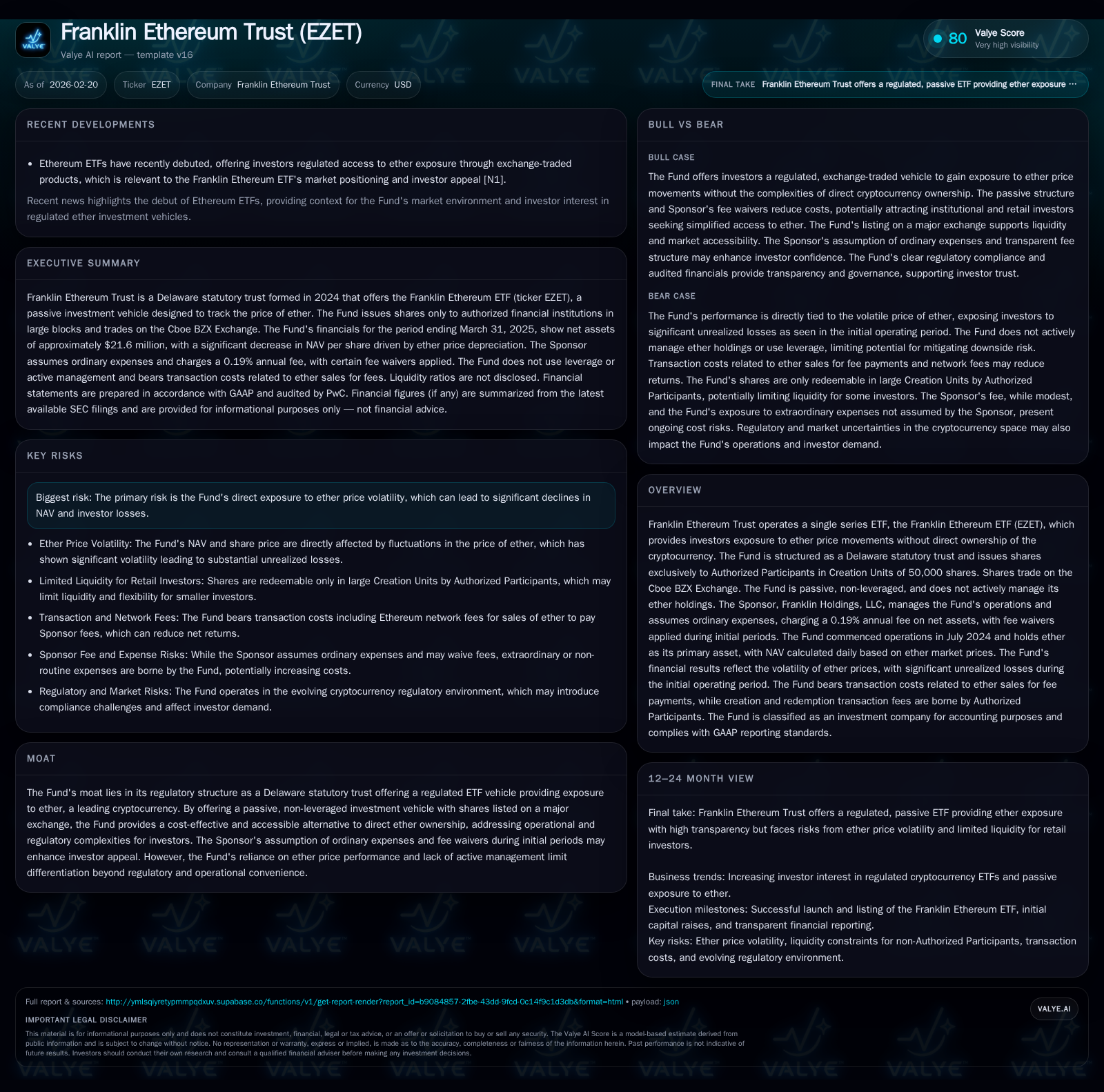
Franklin Ethereum Trust commenced operations in mid-2024, launching a novel regulated ETF offering passive exposure to ether without direct ownership complexities. The Fund experienced a nearly 47% NAV decline through its first nine months, mirroring ether’s market depreciation from over $3,400 to under $1,900 per token. Operating as a Delaware statutory trust with shares issued only to Authorized Participants in Creation Units of 50,000 shares, the Trust provided a regulatory-compliant vehicle easing investor access to ether price movements. Its passive management approach meant performance was fully tethered to ether's volatility, with a -44.4% ROE and negative cash flows reflecting large unrealized losses and market headwinds. Capital allocation included sizable share repurchases by the Sponsor, while future performance drivers hinge predominantly on ether price recovery and broader regulatory shifts affecting crypto ETFs.
Launching a Regulated Ether ETF Amid Cryptocurrency Volatility
Franklin Ethereum Trust (EZET) began trading on July 23, 2024, introducing a novel entry into crypto-linked investment products as a Delaware statutory trust structured ETF that offers investors passive exposure solely to ether price movements without requiring actual cryptocurrency ownership [S1][F1]. This structure provides an important regulatory wrapper: the Trust is not registered under the Investment Company Act of 1940 nor regulated as a commodity pool operator. Instead, it delivers access via exchange-listed shares traded on the Cboe BZX Exchange under ticker EZET [S1].
Shares are issued exclusively in blocks called Creation Units comprising 50,000 shares each, transacted only by Authorized Participants—financial institutions eligible to create or redeem shares in exchange for cash [S1][S6]. This design avoids complicated direct custody or peer-to-peer risks associated with holding physical ether or managing wallets securely.
By removing such operational hurdles and establishing a transparent expense fee arrangement—0.19% annually with significant early fee waivers—the Fund aims to offer a cost-effective alternative investment vehicle linking directly to the underlying asset's market price [S1][S14]. The moat lies fundamentally in regulatory convenience combined with accessible market trading of fractional undivided beneficial interests in a leading cryptocurrency asset class.
Review of Inaugural Period Performance: NAV Dynamics and Ether Price Impact
EZET’s financial results closely mirrored the trajectory of ether prices during its launch phase through March 31, 2025 [S10][F1]. The Fund’s net asset value per share declined sharply from an initial $26.21 at commencement to $13.94 by period-end—a nearly 47% decrease tracking the corresponding drop in ether from approximately $3,448 to $1,835 per ETH [S10][F1].
Unrealized losses were the main driver behind this decline: cumulative net realized and unrealized losses totaled about $17.23 million for the period [S10][F1]. This included roughly $995K of realized loss alongside $16.2 million unrealized depreciation tied directly to ether’s market drop [S10]. Such volatility is expected given the Fund’s strictly passive mandate without leverage or hedging strategies [S10].
These dynamics resulted in a net loss of approximately $17.24 million after expenses including the sponsor fee [F1], reinforcing that EZET's performance is essentially one-to-one with underlying cryptocurrency valuation fluctuations.
Understanding the Fund's Passive Investment Framework and Regulatory Setup
The Trust operates with deliberate structural simplicity: It holds only one portfolio—a single series ETF investing passively in ether tokens held via Coinbase Custody—and does not engage in active portfolio management or employ leverage or derivatives [S1][S6]. Authorized Participants transact directly with Creation Units composed of ether equivalent values; retail investors trade shares on the public exchange like any security.
The daily NAV per share calculation reflects fair value pricing based on CME CF Ether-Dollar Reference Rates unless overridden by sponsor discretion during fair value events [S24][S28]. The Sponsor manages operations and assumes ordinary expenses but levies an annual management fee capped at 0.19% of net assets—with early-stage fee waivers granted until January 31, 2025—to encourage investor uptake [S14].
This model strives for operational transparency while protecting shareholder interests through indemnification clauses covering most liabilities barring gross negligence or misconduct from Sponsor or Trustee entities [S22].
Financial Highlights and Key Metrics from Launch Through Early 2025
A concise review of key financial metrics extracted from SEC filings portrays EZET’s early financial health relative to market conditions:
Historical performance (annual)
| FY |
|---|
| 2025 |
Note: Omitted columns lack sufficient annual XBRL coverage in the provided tags (need ≥2 annual points): Rev, Net, CFO, OpInc, Capex, Div, Buybacks, FCF, ROE%. Source: SEC companyfacts cache [F1].
Note: Revenue and capital expenditure data are not available within disclosed SEC tags. [F1]
The negative operating cash flow correlates primarily with ongoing purchases of underlying ether holdings offset partially by capital inflows from share issuances during creation events.
Capital Allocation: Seed Capital, Creation Units, Redemptions and Repurchases
During its launch phase, EZET secured initial seed capital of $100K via sales of Initial Seed Shares representing 4,000 shares purchased by Franklin Resources Inc., an affiliate sponsor entity [S1][S6]. Shortly thereafter this seed block was redeemed in favor of two larger Creation Units totaling 100,000 shares backed by direct purchase of approximately 760 ETH valued at roughly $2.62 million at issuance prices near $3,446/ETH [S6][S11].
Between July 23, 2024 and March 31, 2025, additional issuance raised shares equivalent to approximately 13,300 ETH deposited into Fund custody while redemptions occurred totaling nearly 2,280 ETH withdrawn—a clear indication of dynamic capital flows consistent with investor demand fluctuations [S10].
Further capital allocation involved Sponsor-sponsored buybacks amounting cumulatively to about $6.33 million within this inaugural reporting period signaling active management of capital structure even outside active portfolio adjustments [F1][S16]. Dividends have not been declared nor paid as per available disclosures.
Risks and Limitations: Direct Ether Price Exposure and Operational Constraints
EZET’s exclusive focus creates inherent concentration risk through dependence on one volatile cryptocurrency asset class—ether—exposing shareholders directly to abrupt NAV swings triggered by crypto market dynamics rather than diversified revenue streams or hedging strategies typical of traditional funds [S3][S4].
Its strictly passive investment framework means no tactical responses exist to mitigate downside risk during severe price drops; fluctuations translate immediately into fund-level valuation impacts without discretionary intervention [S10].
Authorized Participants serve as critical liquidity intermediaries but present counterparty considerations since they alone may create or redeem large share blocks—in times of stress their reduced participation could amplify supply-demand imbalances affecting share price relative to NAV.
Operationally, while cost efficiencies arise from Sponsor assuming routine expenses and applying temporary fee waivers aiding investor return prospects early on, absence of active management limits avenues for alpha generation or drawdown protection compared with actively-managed alternatives.
Future Outlook: Metrics to Monitor and Potential Growth Drivers
Explicit forecasts remain unavailable in regulatory filings; however analysis suggests investors should monitor several factors closely:
- Primary dependence on ether price trends remains paramount; sustained recovery or stabilization above recent lows would be pivotal for NAV appreciation.
- Trading volumes and liquidity of EZET shares on Cboe BZX serve as indicators of market acceptance and secondary market efficacy.
- Regulatory landscape evolution relating to crypto ETFs structured as Delaware statutory trusts will influence operational flexibility and potential for launching additional series targeting other digital assets.
- Possible expiration or modification of Sponsor fee waivers could modestly impact investor costs affecting total returns.
- Behavior patterns among Authorized Participants around Creation Unit activities may signal shifts in institutional demand or liquidity provisioning capacity.
Given these sensitivities it is reasonable that Fund growth prospects remain tightly coupled to broad cryptocurrency ecosystem developments rather than internal tactical levers.
Disclaimer: This report synthesizes information disclosed in SEC filings up to February 2026 along with sector analysis conventions relevant to exchange-traded crypto funds. It does not provide investment recommendations or predict future fund performance.
Disclaimer: This is research-only, informational analysis and not investment advice. It may include AI-generated interpretation and general industry context. Always verify important details using primary sources.

Comments