
Tractor Supply Co’s Steady Expansion and Shifting Margins in 2025
Tractor Supply’s momentum in store growth and revenue met margin headwinds amid rising costs and competitive pressures in fiscal 2025.
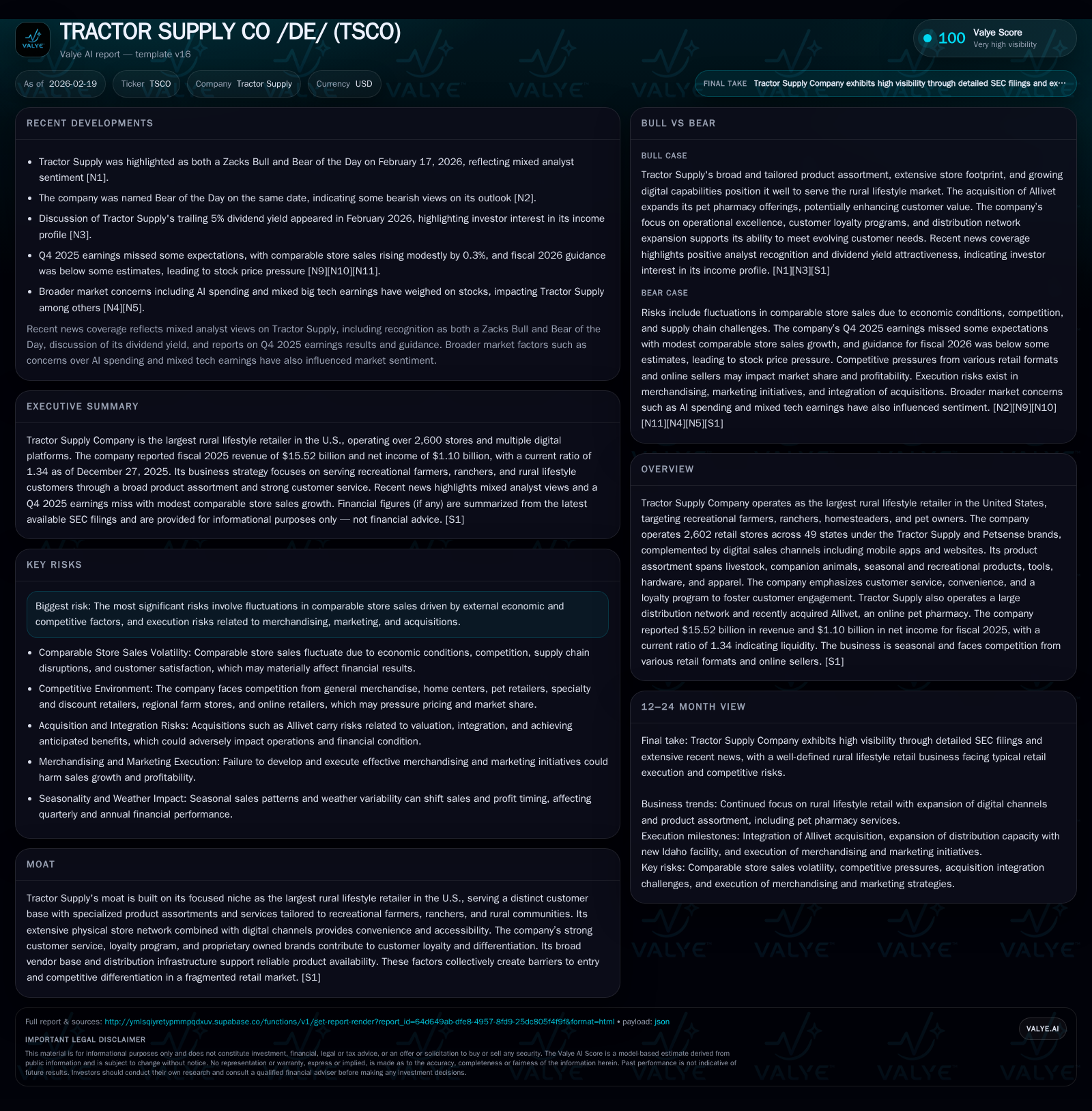
Tractor Supply Company maintained its position as the largest rural lifestyle retailer in the U.S. with continuous expansion of its store network and a 4.3% YoY revenue increase to $15.5 billion in FY2025. Despite top-line growth, operating income plateaued at approximately $1.47 billion, reflecting cost pressures including logistics and labor that compressed margins. The company’s omni-channel strategy, bolstered by its Neighbor’s Club loyalty program and digital capabilities, supports customer engagement and convenience. Capital allocation emphasized stable dividends and disciplined buybacks alongside investments in distribution infrastructure, such as a new Idaho facility opening late 2026. Market challenges include merchandise competition, integration risks from acquisitions like Allivet, and evolving consumer shopping behaviors. Management’s FY26 guidance came below expectations, warranting close attention to comparable store sales trends as indicators of growth sustainability.
Steady Revenue Gains Anchored by Expanding Store Network
Tractor Supply Company reinforced its leadership in U.S. rural lifestyle retail through steady expansion of physical presence and product breadth during fiscal year 2025. With a total of 2,602 retail outlets at year-end—comprising 2,395 Tractor Supply stores and 207 Petsense locations—its selling square footage rose approximately 4% year-over-year ([S4], [S12]). This network expansion fueled revenue growth from $14.88 billion in fiscal 2024 to $15.52 billion in fiscal 2025, marking a solid 4.3% increase ([F1]). The company strategically targets recreational farmers, ranchers, homesteaders, pet owners, and rural consumers whose lifestyle demands specialized supplies unavailable at broader big-box retailers ([S4], [S9]).
The product portfolio remains diversified with five major categories: Livestock, Equine & Agriculture (27% of net sales), Companion Animal (24%), Seasonal & Recreation (24%), Truck, Tool & Hardware (15%), and Clothing, Gift & Décor (10%)—maintaining stable category composition YoY ([S9]). The firm continuously refines assortment locally to meet geographic preferences while expanding consumable-usable-edible (C.U.E.) goods such as feed, pet food, propane, and seasonal products ([S10]). Enhanced customer access is supported by digital storefronts offering over 300,000 SKUs beyond store inventory levels ([S4], [S13]).
Despite broad penetration into small towns surrounding metropolitan hubs and rural communities offering substantial greenfield opportunities for new store openings ([S12]), the moderate revenue growth rate signals incremental saturation effects needing careful management.
Margins Under Pressure Despite Sales Growth: Operating Income Dynamics
Operating income remained largely unchanged at approximately $1.47 billion for FY25 compared with FY24 ([F1]), despite the top-line increase. This flat operating income generates margin pressure signals driven by intensifying logistic expenses—including transportation network servicing both physical stores and direct-to-consumer channels—and rising labor costs amidst tight employment markets ([S1], [S16]). The company emphasizes relentless merchandising execution and competitive pricing but faces challenges balancing promotional investments against margin hierarchy ([S8], [S15]).
The compression suggests difficulty translating revenue increases into proportional profit gains within a competitive environment where overall price elasticity is cautious due to discretionary spending sensitivities among rural consumers ([S16], analysis). New store ramp-up phases typically deliver lower initial margins due to pre-opening costs and localized market testing ([S20]), further diluting corporate-level profitability temporarily.
E-commerce and Distribution: Digital Channel Growth and Facility Investments
Tractor Supply integrates omni-channel sales channels through various digital touchpoints including websites for TractorSupply.com, Petsense.com, Allivet.com (pet pharmacy acquired Dec 2024), plus mobile apps providing an extended assortment not found in stores ([S4], [S18]). Buy-online-pickup-in-store (BOPIS), curbside pickup expansions, ship-to-store options, combined with direct shipment capabilities fuel cross-channel traffic synergistically.
Operationally, approximately 81% of store merchandise flows through its distribution network comprising nine strategically located centers totaling roughly 7.8 million square feet across key regions ([S6]). A significant investment is underway for a new facility in Nampa, Idaho adding around 865k sq ft expected operational Q4 FY26 designed to optimize last-mile delivery effectiveness within the Northwest market segment.
Logistics employs advanced warehouse management systems aligned with labor management tools aiming at improved inventory turn rates and fulfillment accuracy; proactive carrier negotiations mitigate transport costs amid inflationary pressures ([S6], analysis). Final Mile delivery solutions bolster reliability critical for direct sales to farms or businesses identified as the “Out Here” B2B segment critical for traction beyond core consumer retail.
Capital Allocation Focus: Managing Cash Flow, Dividends, and Buybacks
Tractor Supply generated robust operating cash flow of approximately $1.64 billion in FY25 representing a healthy YoY increase of about 15%, supported by disciplined working capital management ([F1]). Capital expenditures rose nearly 14% year-over-year to ~$895 million driven by new store builds, remodeling projects including Side Lot garden center expansions, technology upgrades enhancing supply chain agility as well as digital platform enhancements ([F1], [S12], [S26]).
After capex, free cash flow stands near $740 million—a substantial figure underpinning capital return policies while funding long-term investments ([F1]). Dividend payments increased modestly by about 3% to $488 million whereas share repurchase activity declined sharply from $561 million a year ago to approximately $361 million reflecting calibrated capital deployment priorities amid valuation uncertainties ([F1], [S7]).
Return on equity for FY25 is estimated near an impressive 42.5%, demonstrating efficient shareholder capital utilization even though net income experienced slight decline (-0.5%) compared to prior year due primarily to stable profits despite revenue growth ([F1] analysis).
Competitive Challenges and Risks Impacting Sales and Profitability
The retail landscape Tractor Supply operates within is populated by formidable competitors encompassing large general merchandise chains like Walmart and Home Depot, pet specialists such as Petco alongside independents including regional farm supply stores and farm cooperatives ([S8], [S20]). E-commerce pure-play competitors intensify the battle for the digitally-savvy consumer segment.
Risks also stem from integration hurdles following strategic acquisitions such as Allivet providing online pet pharmacy services acquired for $135 million albeit accompanied by operational assimilation complexities potentially inflating costs or disrupting focus ([S8]). Merchandise price volatility coupled with inflationary input cost fluctuations particularly on feed grains or trucking fuel add layers of uncertainty impacting gross margins directly ([S16], analysis).
Merchandising execution missteps or marketing programs falling short versus consumer preference shifts might necessitate markdowns or inventory write-downs affecting profitability materially if poorly managed ([S19], analysis). Weather variability impacts seasonal product demand timing complicating inventory management precision further contributing to financial performance swings across quarters but somewhat mitigated by reporting on half-year aggregates ([S15]).
Strategic Outlook: Guidance for Fiscal Year 2026 and Market Expectations
The company issued fiscal year 2026 guidance projecting results below prior consensus forecasts which triggered adverse investor reactions leading to a roughly 6% decline in share price following Q4 earnings release late January 2026 ([N14], [N2]). Management specifically highlighted moderated comparable store sales with only a nominal gain of +0.3% recorded in Q4 FY25 signaling deceleration at established locations requiring intensified attention.
Key indicators proposed for monitoring during FY26 include comp store sales trends that typically reflect underlying customer base health independent of broader store count additions allowing early visibility into organic demand trajectory ([N2], analysis). No detailed forward-looking financial metrics were offered beyond qualitative commentary indicating prudence given prevailing economic uncertainties.
Key Metrics Compact Table: Historical Financial Trends (FY2022-FY2025)
Historical performance (annual)
| FY | Rev ($bn) | Net ($mm) | CFO ($mm) | OpInc ($mm) | Rev YoY | Net YoY |
|---|---|---|---|---|---|---|
| 2025 | 15.5 | 1096 | 1635 | 1467 | +4.3% | -0.5% |
| 2024 | 14.9 | 1101 | 1421 | 1468 | +2.2% | -0.5% |
| 2023 | 14.6 | 1107 | 1334 | 1479 | +2.5% | +1.7% |
| 2022 | 14.2 | 1089 | 1357 | 1435 |
Note: Omitted columns lack sufficient annual XBRL coverage in the provided tags (need ≥2 annual points): Capex. Source: SEC companyfacts cache [F1].
Capital returns and efficiency (annual)
| FY | Div ($mm) | Buybacks ($mm) | FCF ($mm) |
|---|---|---|---|
| 2025 | 488 | 361 | 740 |
| 2024 | 472 | 561 | 637 |
| 2023 | 450 | 594 | 580 |
| 2022 | 410 | 700 | 584 |
Source: SEC companyfacts cache [F1]. Note: Buybacks data unevenly decreased over last two years indicating shift towards conservative capital returns; ROE excluded due to lack of precise denominator data though estimated ~42%.
DISCLAIMER: This report is intended solely for informational purposes based on publicly available filings and news sources as of February 19, 2026; it does not constitute investment advice or a recommendation to buy or sell any securities.
Disclaimer: This is research-only, informational analysis and not investment advice. It may include AI-generated interpretation and general industry context. Always verify important details using primary sources.

Comments