
Sundance Strategies' Liquidity Struggles and Regulatory Hurdles Limit Life Settlement Growth
Sundance Strategies operates a niche advisory business in the life settlements market while confronting severe financial constraints and competitive pressures.
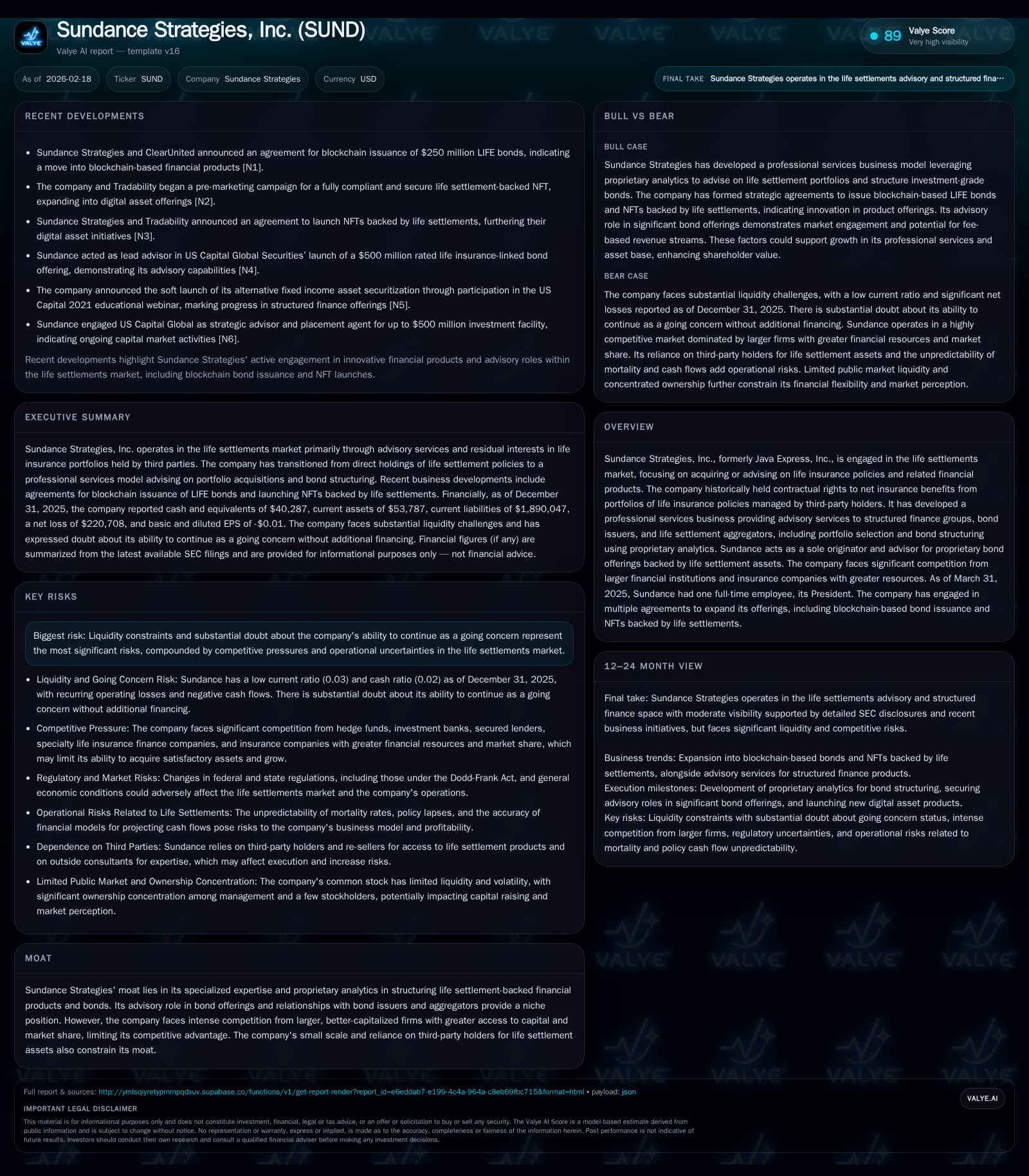
Sundance Strategies, Inc. has evolved from life insurance policy holdings to a predominantly advisory role in structuring life settlement-backed bonds. Despite its proprietary analytics and niche expertise, the company remains a minor player facing formidable competitors with superior resources. Its historical financial performance reflects persistent operating losses, negative cash flows, and a deteriorating balance sheet with a weak liquidity position. Going forward, growth prospects hinge on securing substantial financing and expanding its advisory footprint amid regulatory uncertainties and illiquidity in the underlying secondary market. Capital allocation has been conservative with no dividends or buybacks recently, underscoring liquidity preservation amid mounting risks to its going concern status.
Company Background and Evolution
Sundance Strategies, Inc., originally Java Express, Inc., shifted its business from retail coffee shops to focusing on the life settlements market after 2013 following a merger with ANEW LIFE, INC. This marked a strategic pivot to acquiring rights to net insurance benefits (NIBs) from portfolios of life insurance policies rather than holding policies directly. More recently, Sundance has transitioned primarily into an advisory role providing professional services around structured finance products backed by these life settlements. The company acts as the sole originator and advisor for proprietary bond offerings tied to pools of life settlement assets, relying on proprietary analytics for portfolio assembly and pricing.
Historical Financial Performance
Over the last several years the company has generated consistent revenues around $200K annually without meaningful growth [F1]. Operating income loss ranged from approximately -$690K in FY2022 to about -$604K in FY2025 (year ending March 31), showing slight improvement but persistent negative profitability [F1]. Net losses remain significant exceeding $1.6 million most recently and impairing shareholder equity which was -$6.3 million at year-end FY2025 [F1].
Operating cash flow has been negative each year recorded — with a decline by over one-third in FY2025 compared to FY2024 — indicating ongoing expenditure exceeding receipts from operations [F1]. This chronic cash burn highlights reliance on external financing rather than operational self-sufficiency.
Historical performance (annual)
| FY | Net ($mm) | CFO ($) | OpInc ($) | Net YoY |
|---|---|---|---|---|
| 2025 | -2 | -916212 | -604167 | +12.6% |
| 2024 | -2 | -666643 | -531406 | +34.7% |
| 2023 | -3 | -459713 | -682283 | -1.7% |
| 2022 | -3 | -813213 | -690709 |
Note: Omitted columns lack sufficient annual XBRL coverage in the provided tags (need ≥2 annual points): Rev, Capex, Div, Buybacks, FCF. Source: SEC companyfacts cache [F1].
Capital returns and efficiency (annual)
| FY | ROE% |
|---|---|
| 2025 | 25.4 |
| 2024 | 30.9 |
| 2023 | 46.6 |
| 2022 | 55.0 |
Source: SEC companyfacts cache [F1].
Note: Revenue only available intermittently; capital expenditures and dividend data not disclosed.
Business Model and Industry Context
Today Sundance does not own life insurance policies directly but advises bond issuers and investment groups involved in the securitization of NIBs derived from life settlement portfolios held by third parties [S23][S21]. Its value proposition resides in proprietary quantitative tools that help structure bonds backing these assets, including portfolio selection algorithms and cash management strategies designed to meet rating agency requirements.
The secondary market for life settlements remains relatively illiquid, fragmented, and dominated by larger players including hedge funds and major insurers possessing cheaper capital access [S19][S15]. These incumbents limit Sundance's ability to compete effectively or acquire sizable asset pools due to its small scale—highlighted by having only one full-time employee as of March 2025 [S15].
This industry faces heightened regulatory scrutiny following the Dodd-Frank Act which introduced consumer protection provisions potentially impacting transactions involving life settlements [S6][S11]. Compliance costs and legal risks from policy contestation claims represent significant hurdles with ongoing lawsuits involving major insurers cited as examples [S13][S14].
Key Risks
The company identifies liquidity constraints as its most pressing challenge, with substantial doubt expressed about continuing as a going concern absent additional capital raises [S3][S16]. Compounding this are risks including:
- Uncertainty in actuarial assumptions driving cash flow projections given insured individuals may outlive expectations.
- Litigation risks tied to insurable interest issues or fraud allegations affecting policy enforceability.
- Regulatory complexity with evolving state-by-state laws governing policy sales potentially imposing registration or compliance burdens [S8][S10].
- Poor liquidity in the secondary market limiting ability to source attractively priced NIBs or policies [S22][S20].
- Dependence on third-party service providers for key operational functions like medical record updates amidst privacy regulations such as HIPAA [S12][S24].
- Risk of default under convertible debt agreements that may accelerate repayments or restrict future financing access [S4][S5].
Capital Allocation and Returns
The company has not generated positive returns historically; no consistent return on equity figures can be calculated given persistent net losses coupled with deeply negative equity balances reaching over $6 million deficit at FY2025 close [F1]. Cash flows have been supported solely through financing activities rather than operational profits.
Dividend payments have not been declared or paid since prior periods; share repurchases last occurred around FY2017 during limited buyback programs totaling $750K annually then but none have taken place recently reflecting constrained liquidity positions [F1][S15][F1].
Future Growth Prospects
Organic growth opportunities depend heavily on Sundance’s ability to expand its advisory client base among structured finance groups issuing bonds collateralized by life settlements or similar assets . Success here would rely on leveraging proprietary analytics for selective portfolio assembly that meets investor credit criteria.
However, growth is capped by several factors:
- Critical need for additional financing to scale operations competitively versus large financial institutions.
- Limited internal resources and personnel preventing aggressive market development.
- Regulatory uncertainty that may impose costly compliance requirements limiting market segments accessible.
- Illiquid underlying asset markets restricting available pools for structuring new deals.
Absent raising new capital through equity or debt offerings—which carries dilution risk—the company may be forced to scale back planned activities substantially or face insolvency [S16][S27].
What To Watch Going Forward (Analysis)
- Progress toward closing new financing rounds on favorable terms signaling improved liquidity.
- Success in originating advisory mandates linked to bond issuances backed by life settlements demonstrating relevance of their analytical platform.
- Regulatory developments clarifying treatment of life settlement products as securities impacting operational scope.
- Market liquidity trends for secondary policy portfolios influencing deal pipeline quantity and pricing dynamics.
- Changes in operating expenses signaling cost control efforts versus investment for growth.
Summary Commentary
While Sundance Strategies possesses domain expertise reflected in its specialized analytics platform servicing structured finance initiatives within the life settlements market, it remains a highly constrained micro-cap entity struggling under financial distress. Its transition away from direct asset ownership toward professional advisory represents a reasonable strategic response but yields minimal revenue amid fierce competition from well-capitalized players.
With revenues essentially flat over the past decade juxtaposed against growing net losses eroding equity further into deficit territory, coupled with near-zero current ratio indicating an acute liquidity crunch, Sundance’s viability hinges largely on securing external capital inflows. Regulatory complexities tied to evolving federal oversight under Dodd-Frank consumer protections heighten compliance burdens while litigation threat looms around policy contestability issues inherent within this niche sector.
Prudent investors should monitor funding developments and contractual wins closely given these constitute critical catalysts determining whether Sundance can continue as a going concern or languish at the periphery of the specialized yet volatile secondary life settlements arena.
Disclaimer: This analysis is based solely on available public filings as of early 2026 and does not constitute investment advice.
Disclaimer: This is research-only, informational analysis and not investment advice. It may include AI-generated interpretation and general industry context. Always verify important details using primary sources.

Comments